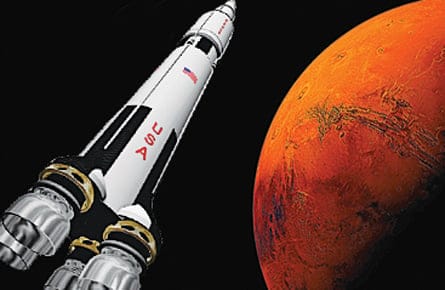
The mission to Mars, brought to you by. . .
For scientists and space buffs alike, sending astronauts to Mars is a long-standing goal. But a major impediment, notes scientist Rhawn Joseph in the Journal of Cosmology, is the $150-billion price tag of the mission—money he suggests could be raised through advertising.
Just as General Motors paid US$1 billion to sponsor the U.S. Olympic team at the 2008 Summer Games, corporations could bid to sponsor the mission, which “could easily raise $10 billion,” writes Joseph of the Brain Research Laboratory. During the 2010 Super Bowl, 30-second ads sold for about US$2.8 million apiece, numbers that would surely be exceeded during a Mars landing. And merchandising is a potential cash cow: annual revenue from Star Wars-related products, he notes, is about US$1.5 billion. “The human mission to Mars can be marketed and sold as the ultimate sports and reality TV extravaganza,” he writes. This, of course, banks on the fact that a high possibility of danger—even death—wouldn’t scare away potential advertisers.

Kate Lunau is a health and science writer at Maclean’s Magazine, who previously reported for the Montreal Gazette. She’s the recipient of several journalism awards, including the 2014 Yves Fortier Earth Science Journalism Award, and has been nominated for two National Magazine Awards. Like Elon Musk, she hopes to retire on Mars.
Related Posts

Who is Changpeng Zhao, Canada’s crypto king?

How these Québec-based businesses invested in energy efficiency

The Power List

A Canadian company is changing the way we buy mattresses
Get the Best of Maclean’s straight to your inbox.
Sign up for news, commentary and analysis. Join 60,000+ Canadian readers.