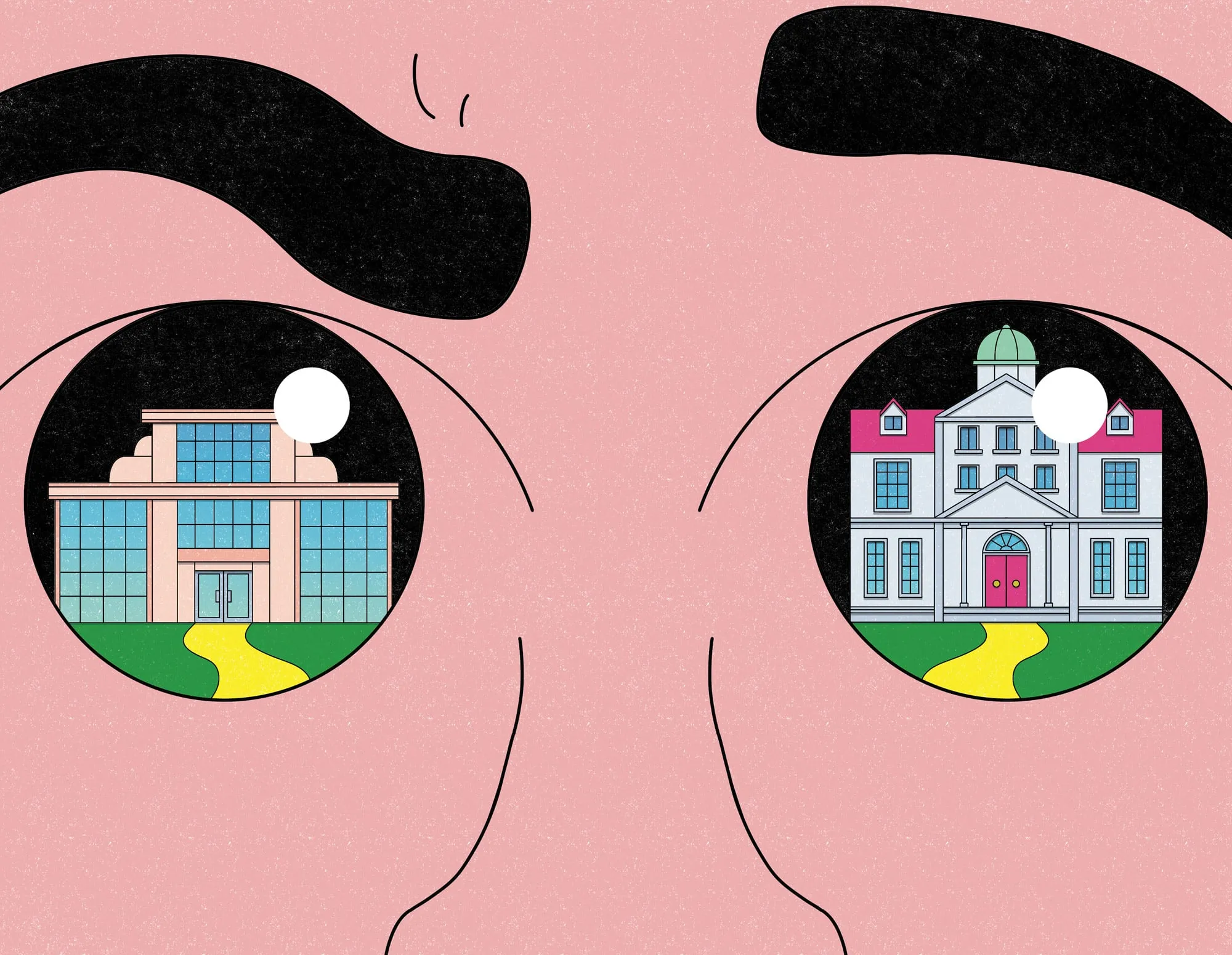
What’s the Difference Between College and University?
Abbey Rivers attended Brock University right after high school, and graduated on the honours list with a degree in media and communications studies and a minor in digital culture. Still, when she started searching for jobs, she realized she didn’t have the real-world experience employers were looking for. Feeling completely unprepared for the workforce, Rivers enrolled in a one-year post-graduate certificate program in public relations at Niagara College. She was hoping to learn practical, job-specific skills that would help her land a position.
Her plan worked. During the program, she got hands-on experience working on public relations campaigns and completed an internship at a PR agency. Two weeks after graduating, at 23 years old, Rivers had a job offer in hand from a Toronto PR firm. She says she uses the skills she learned at college every day in her job.
Job readiness at college
Many students wonder what they’ll do after they graduate from a university, but a college program leaves little room for interpretation. Diplomas and certificates are offered in practical fields like health care, automotive technology, manufacturing, financial management and construction trades, and often train students for very specific roles. Early childhood educator, airplane mechanic, floral designer and paralegal are just a few examples of the thousands of careers that going to college can prepare a student for.
Through labs, workshops, internships and work placements, students gain hands-on experience to help them land jobs quickly after graduation. Colleges keep their eye on what types of abilities are needed in the workforce, and adapt their programming to pump out grads with much-needed skills. The federal government’s plan to build nationwide housing and infrastructure, for example, will need a skilled workforce, and colleges are aiming to meet that demand.
Related Posts
Six Programs That Are Building A Stronger Canada

I Was a University Dropout. This is How I Found a Career I Love.
Rivers says her college program taught her more than how to do her job—it also taught her how to find work. Guest speakers came in weekly to teach them how to write a resume, look for a job, network on LinkedIn and ace an interview. The focus on job readiness works: out of those who graduated in 2018, almost 65 per cent of graduates with a college diploma reported employment income within five years of graduating, compared to only 56.4 per cent of those with an undergraduate degree.
University experience
While some university programs, like engineering or nutritional science, are more narrowly career-focused, most four-year university degrees don’t train students for a specific job or career path. Areas of study like philosophy, political science, mathematics or life sciences open up a variety of avenues: students may choose to pursue post-graduate studies in their field, apply to law or medical school or enter the workforce. One in five students, like Rivers, follow up a university degree with a college certificate or diploma to gain those job-ready skills after their more academically focused education.
But for many students just out of high school, a job is not the primary focus. Students who get good grades are often looking for an academically challenging environment where they can dive deeply into topics they’re interested in. Many high school grads are also looking for a student-life experience that includes living away from home in residence or other student housing. This scenario is much more common for university students than college students, who are more likely to live near their school and commute. At a university there is also an emphasis on skills that are broadly useful across different fields, like critical thinking, research and communication. Even if a degree is not job-specific, it can still help graduates get a job. Many positions are only available to candidates who have a university degree, including most leadership roles, international opportunities and jobs that require critical thinking. According to Universities Canada, the number of jobs requiring a university degree has more than doubled in the past 10 years.
Blurred lines
For all the differences between college and university, their offerings have begun to see significant overlap in recent years. Many colleges are starting to offer four-year degree programs for specialized professional studies, like Okanagan College’s bachelor of business administration or Fanshawe College’s bachelor of science in nursing. In some cases these programs run in conjunction with a university; in others they offer an applied degree that focuses on practical rather than academic skills. At the same time, many universities are offering more hands-on practical experiences, like co-op programs, which often advertise a higher rate of job offers upon graduation.
The expansion of options at colleges is good news for many Canadians: with 685 college campuses across the country, the vast majority of students are able to find a program within their own community, providing the opportunity for those in smaller centres to get an education without the cost of accommodation. College tuition is also generally more affordable. While there are some highly specialized college programs that rival university tuitions, on average, college graduates are saddled with significantly less debt than their university counterparts ($14,900 in 2020 for college grads compared to $23,000 for university grads). That said, while university tuition is more expensive up front, bachelor’s degree graduates earn 30 per cent more than those with a college-level certificate or diploma: a differential that grows over time as people advance in their careers.
For Rivers, combining a university degree with a post-graduate college program was the perfect way to transition from academic life to the workforce. She was able to build on her theoretical foundation with career-specific training and use the extra credential to get a job.

Rebecca Cuneo Keenan is a freelance writer living in Toronto. She covers health, finance, education, pop culture and more.
Related Posts
Learning to Weld Gave Me the Stability Bartending Never Could

I Went Back to College at 37 and Found the Work I Was Meant to Do
Everything to Know About Applying and Getting Into College