Menace on the Streets
On a warm night last August, a 12-year-old boy named Shawn Dunkley took a family friend’s electric scooter out for a spin near his home in London, Ontario. It was a powerful machine, ordered from the Chinese online retailer Alibaba. Dunkley was barrelling—helmetless, despite his mother’s pleas—along the paths of his family’s suburban neighbourhood, only a two-minute walk from his house. He glanced at the scooter’s speed display: 69 km/h. Suddenly, everything stopped.
Two passersby found him five minutes later, lying unresponsive a few metres from the pathway. His eyes were open, his expression vacant, his hair streaked with blood. A dead raccoon lay nearby. The best anyone can figure is that it darted in front of the scooter. The passersby called 911 and, within minutes, Dunkley was being rushed to London’s Children’s Hospital. He’d suffered a traumatic brain injury, a skull fracture and spinal bleeding.
He was transferred to pediatric critical care in a medically induced coma. A tube helped him breathe, and two catheters snaked out of his fractured skull to monitor his cranial pressure and drain his pooling cerebrospinal fluid. His doctors weren’t sure if he’d live or, if he did, whether he’d walk or talk again. At her son’s bedside, Crystal Dunkley anxiously awaited the 72-hour mark: doctors had told her that if Shawn lived for three days, his long-term odds would shoot up. She hadn’t understood how dangerous e-scooters could be, or how fast they could go. “I thought they were toys,” she says.
Twelve days after Dunkley’s accident, doctors started bringing him out of his coma. First, he gave a thumbs-up. Then, a toe wiggle, which was a tremendous relief—no spinal injury. Then he nodded and shook his head. Finally, his breathing tube came out.
Dunkley’s injury was no anomaly. At Toronto’s St. Michael’s Hospital, e-scooter–related admissions jumped 600 per cent from 2020 to 2024. Pediatric trauma centres have been particularly besieged: SickKids hospital, also in Toronto, treated 46 e-scooter injuries in 2024, up from only one in 2020. At the Montreal Children’s Hospital Trauma Centre, the number of cases multiplied tenfold in only a year, between 2023 and 2024. When I asked one ER physician what could be done to make them safer, he quipped: “Turn them into bikes?”
Related Posts

The Battle for the Soul of the University

My Secret Addiction
Related: In Defence of E-Bikes
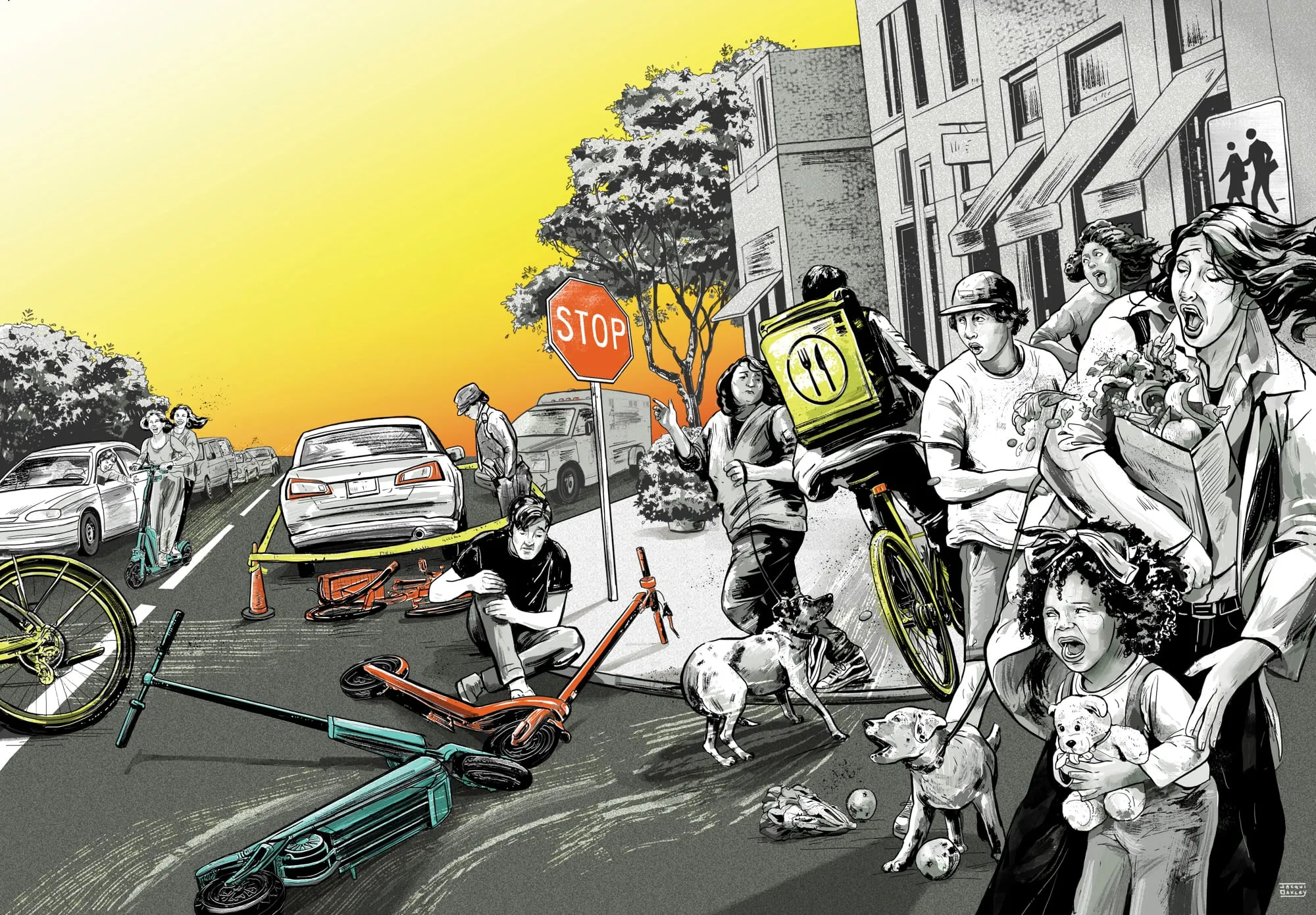
E-scooters and their burlier brethren, e-bikes, have zoomed onto Canadian streets faster than the law can keep up. Today, a mishmash of conflicting regulations governs their use in provinces and cities nationwide. No government ever decided that Canadian streets should become a test track for unregulated machines capable of going as fast as cars, and now these devices have obliterated long-established rules and norms of the road. Pedestrians see unpredictable interlopers zipping along sidewalks. Cyclists see invaders in their hard-won lanes. Drivers see chaos. And doctors see a plague of facial fractures, broken wrists and concussions.
Everyone, it seems, hates them—except those who love them. For many commuters, e-bikes and e-scooters have become the fastest, easiest way to cut through our increasingly congested cities. On paper, they provide the kind of transportation fix that city governments say they want: cheap, quiet and clean. That’s why Vancouver, Richmond, Calgary, Edmonton, Saskatoon, Regina, Hamilton, London and Halifax have, in the past few years, partnered with private companies like Bird Canada, Lime and Neuron Mobility to launch municipally authorized scooter-rental programs. In some cities, e-scooters have become the vehicles of choice for teens and twentysomethings to zoom through downtowns and nightlife districts—they’re cheaper than cabs and rideshares, quicker than walking and a lot more fun than taking the bus. And for delivery workers and couriers in low-wage, time-pressured jobs, powerful e-bikes are a necessity.
Public streets have always been contested, as drivers and cyclists and pedestrians jockey for their allotment of our crowded, finite road space. But until e-machines arrived, we could usually take a few basics for granted. Speed limits were non-negotiable. Sidewalks were for people, bike lanes for bikes and roads for motor vehicles. Everything had its place.
The micromobility revolution, as its proponents call it, has destabilized all that, and tensions have ramped up. There is a specific, anger-provoking anxiety that comes from being startled by something, or someone, that comes unpredictably and illogically out of nowhere, especially if they almost knock you off your feet. I cycle year-round in Montreal. The streets here don’t feel lawless, but my guard is up. Last fall, I watched three teenagers—two doubled up on an e-scooter, one on an e-bike—blow through a changing light. The e-bike was a heartbeat away from smashing into a truck, while the e-scooter riders lurched to a stop on the other side of it. They shrieked with laughter. That same week, a few blocks over, a man on an e-scooter turned the wrong way onto a one-way street at full speed and knocked my husband off his bike. The scooter guy was furious, astonishingly, with him. In Edmonton, dog-walkers have complained of silent, scofflaw e-scooter riders scaring their pooches from behind. In Mississauga, Mayor Carolyn Parrish called the devices “chaotic” and “ugly,” and the city’s e-scooter pilot program a “crazy experiment” and “an ongoing battle.”
A me-first orientation has dominated our city streets since long before the first e-scooter ever jumped a Canadian curb. But when micromobility machines arrived—fast, silent and everywhere all at once—they blurred the boundary between sidewalk and street, collapsing all the old hierarchies. E-scooters and e-bikes didn’t create the dysfunction on our roads, but they’ve revved it into high gear.
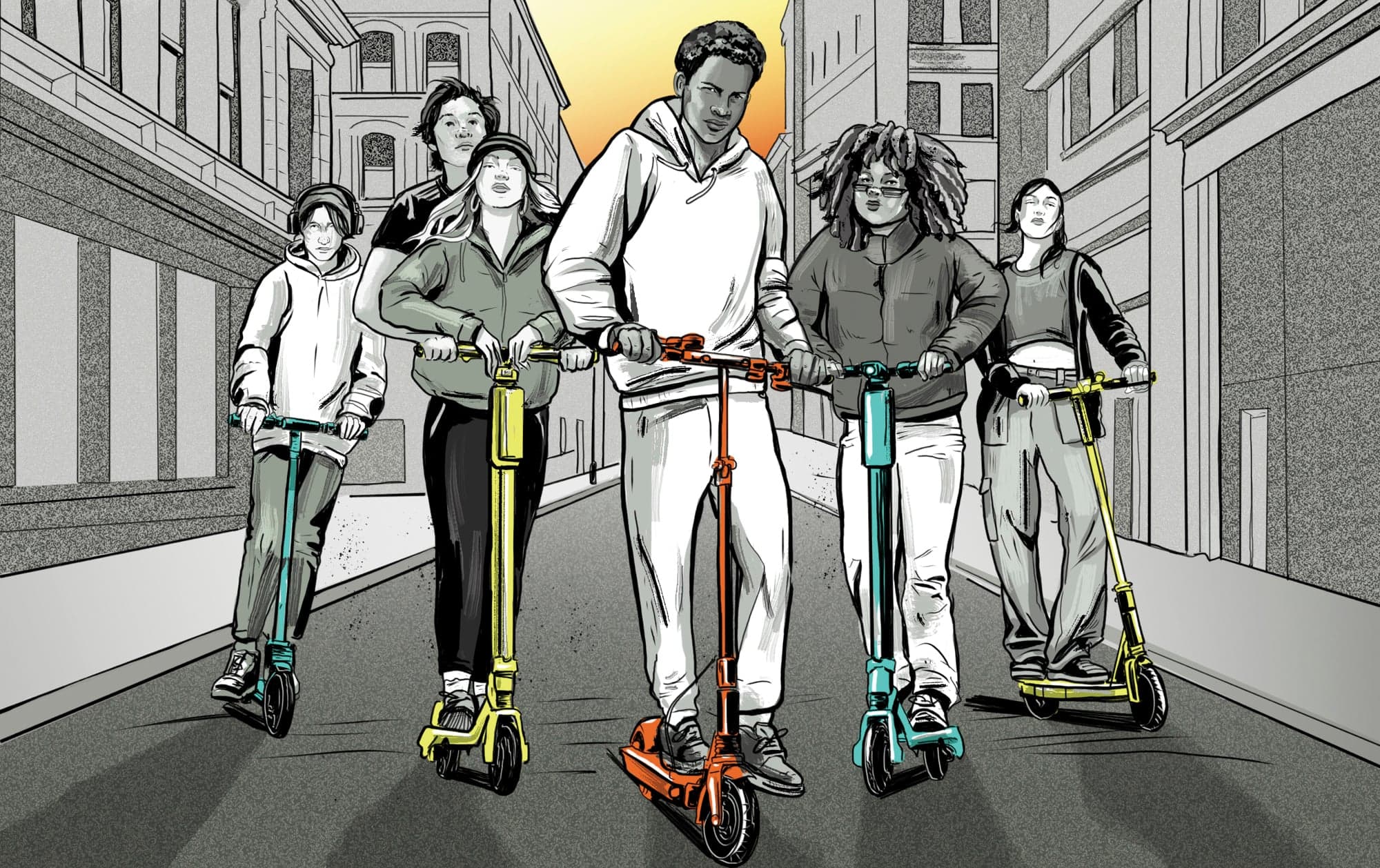
In the fall of 2018, San Francisco micromobility company Lime rolled out the first shared e-scooter program in Canada: a tiny fleet operating on a short network of campus paths at the University of Waterloo. In the pilot’s first two months, more than 6,000 users took 18,000 trips.Officials wanted to expand the program citywide. but they couldn’t: under Ontario’s Highway Traffic Act, e-scooters were prohibited on public roads.
The following year, Lime left for friendlier provinces, including Quebec, where the government amended road rules to allow a pilot project. The city of Montreal, eager to tackle congestion and expand clean transportation options, issued permits to two companies, Lime and Bird Canada (the latter backed by Toronto Raptors founder John Bitove), to set up a scooter-rental program. By the end of the summer, 680 shared e-scooters were in use across the island.
E-scooters had already been zipping around American and European cities for several years, leading to complaints about reckless use and scooters littering sidewalks, blocking traffic and clogging parking spaces. So the city laid down ground rules. Among them: riders had to be at least 18, they had to wear helmets, and scooters were capped at 20 km/h and barred from sidewalks. Riders also had to park in designated zones, not tossed on the side of the road. “We feel very lucky to have been able to control the problems before they arrived,” said one city official at the time.
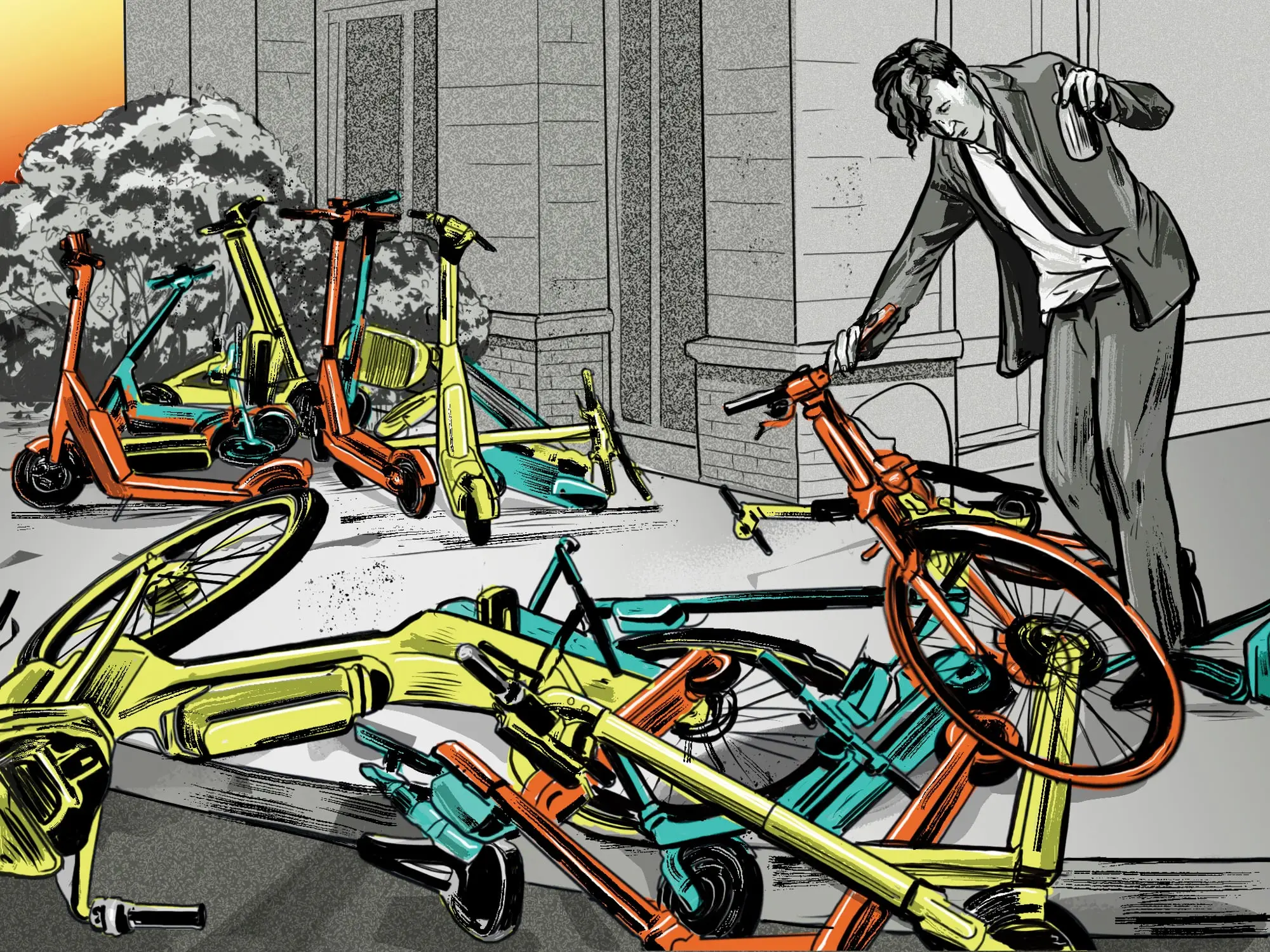
The problems were not controlled. Riders parked in designated zones only 20 per cent of the time. Abandoned scooters were left by sidewalks, intersections and metro stations. At least one ended up in the Lachine Canal. Police issued 333 tickets to e-scooter users for violations in just a few months. The project was scrapped the following year, due to mass noncompliance with the rules.
Across the country, e-scooters got a warmer reception. Calgary had wanted to launch a bike-share system as far back as 2011, but it didn’t have the budget to install stations. Bird’s dockless system, with no upfront costs, seemed a winning solution. In July of 2019, 1,500 shared e-scooters—500 from Bird and 1,000 more from Lime—hit the streets. Calgarians went mad for them. Lime, which already operated in 125 cities,recorded its most successful launch weekend ever. Within weeks, Calgarians made more than 100,000 trips, taking to the new devices in true Western style, with an I’ll-scoot-where-I-damn-well-please attitude.
Sprawling and car-dependent, Calgary might not seem like an obvious city to traverse on a tiny electric scooter. But the city is mostly flat, with so-so public transit and an extensive network of off-street pathways. E-scooters filled real gaps in the transportation infrastructure. More cities soon followed: Edmonton and Kelowna, B.C., in 2019; Ottawa in 2020; Windsor, Ontario, and a handful of communities across Alberta and B.C.in 2021. All of them faced the same issues Montreal did, but hoped the benefits would be worth it.
Most of the scooters filling Canadian streets were built in China, thanks to billions of dollars’ worth of Chinese subsidies and enormous domestic demand. In 2020 alone, Chinese factories produced more than 3.6 million e-scooters: some 85 per cent of the global output. But when they arrive at Canadian ports, they fall into a regulatory no-man’s land.
Motor vehicles in Canada must comply with the Canadian Motor Vehicle Safety Standards, which cover braking requirements, crash testing and more. Human-powered vehicles, like traditional bicycles and push scooters, are exempt. Micromobility devices don’t land neatly in either category, even though they’re motorized vehicles that can, in some cases, reach 80 km/h. Federal regulations, written before these machines existed, don’t address them at all. Instead, provinces are left to decide how—or if—to regulate their use. For example, Quebec, Ontario and B.C. have launched pilot programs for e-scooters that establish speed limits, wattage restrictions and minimum user ages. Saskatchewan, Nova Scotia and P.E.I. skipped pilots and permanently legalized them. In Manitoba and New Brunswick, there is no specific regulation, making e-scooters de facto illegal on public roads. In Newfoundland and Labrador, they are classed alongside mopeds.
Safety regulations are also a hodgepodge. Helmets are required in most places, but not in Alberta. In most cities, the legal age to ride an e-scooter is 16—except in Calgary, where the limit is 18, or Montreal and Halifax, where it’s 14. Some cities prohibit shared e-scooters but permit private ones, due to safety concerns. Elsewhere, it’s the opposite, also due to safety concerns. And while only one major municipality bans e-scooters, it’s a big one: Toronto. When Ontario launched its pilot in 2021, the country’s biggest city opted out, citing hazards that included busy sidewalks, battery fires and streetcar tracks that could catch a scooter’s tiny wheels like fish hooks. The ban has only been partially successful, of course. Anyone who spends any time on Toronto’s streets has seen plenty of scooter riders zipping through town.
Related: How to Fix Canada’s Traffic Problem
In Toronto, the real micromobility flashpoint has been the thick-set, moped-style e-bikes that have taken over streets and, especially, bike lanes. Like e-scooters, these are also stuck in a regulatory free-for-all. For many years, Transport Canada regulated “power-assisted bicycles,” requiring them to have operable pedals, a motor under 500 watts and a maximum speed of 32 km/h. Anything more powerful was classed as a motor vehicle, requiring a licence and insurance.
In 2021, the feds withdrew many of these regulations. Today, almost anything with two wheels and a motor can be imported into the country as an e-bike, provided its top speed is no higher than 32 km/hr—though many much faster vehicles are sold in Canada as e-bikes as well, in spite of the speed limit. Some provinces have taken action against them. In July of 2024, Quebec’s auto insurance board effectively banned motorcycle-style electric bikes that don’t meet federal safety standards. In British Columbia, a 2021 Court of Appeal decision clarified that machines that aren’t easy to pedal are illegal for road use.
Ontario has no such rules, though it does mandate that an e-bike motor’s power output not exceed 500 watts, and speeds not exceed 32 km/h. In practice, this rule is hardly enforced. And so, over the past handful of years, devices that look and operate more like small motorcycles than bicycles have overwhelmed the city’s bike lanes.
To get a better handle on the ins and outs of the e-bike marketplace, I visited Cherry E-bikes, a store in north Toronto. Owner Derek Michael opened the shop five years ago, first importing e-bikes from China and selling them under his own brand. The competition was fierce, so he pivoted from sales to repairs and now services all kinds of micromobility devices (including e-scooters, despite the city’s ban). The shop’s repair technician showed me an e-scooter he’d just finished fixing up, with a bright-orange chassis and a bedazzled steering column. “It goes from zero to 100 in four seconds,” he said.
Most of the e-bikes in Michael’s shop meet Ontario’s 500-watt limit for e-scooter and e-bike motors. But some are more powerful. The technician told me that misrepresentation is common in the business. He’s seen devices with 10,000-watt and even 15,000-watt motors that can accelerate faster and reach higher speeds, despite stickers that say they’re 500 watts. “Most of this stuff is being imported from Chinese manufacturers,” says Michael, “and they’ll put whatever label they want on the product.” There is nothing to stop riders from ordering even more powerful e-bikes online, some advertised as “street legal” despite top speeds of more than 55 km/h.
In Toronto’s downtown, the streets are especially chaotic. For once, pedestrians, cyclists and drivers have a common antagonist: e-bike riders threading through gaps in traffic, hopping sidewalks and zooming down bike lanes.
Many e-bike culprits are food-delivery couriers working for companies like Uber Eats and Skip (formerly SkipTheDishes). They form a massive gig-economy workforce that was largely invisible until high-powered e-bikes made them impossible to ignore, racing through the city with insulated food boxes strapped to their vehicles. The surge has been big enough that Metrolinx, the agency that runs the Greater Toronto Area’s commuter-transit system, added extra trains on one line and doubled bike capacity to accommodate food-delivery workers hauling their bikes downtown from suburbs like Mississauga and Brampton.
I spoke to one food-delivery worker named Ahmad, a refugee from Syria who moved to Canada in 2016 to avoid mandatory military service during the country’s civil war.(At his request, I’m using only his first name.) He trained as an electrical engineer, but he’s struggled to find a job in that field. So today he cruises Toronto’s downtown streets as a food-delivery courier, piloting a relatively modest, fat-tired e-bike. He doesn’t mind the work, and he loves being outdoors. “You see the city, you’re in the fresh air,” he says. He does about 25 orders a day for Skip and Uber Eats, making about $20 an hour.
Ahmad used to ride a standard pedal-powered bike, but he switched to electric about five years ago, when the pandemic rewrote the economics of the job. Lockdowns were driving a surge in demand for in-home food delivery and, at the same time, the field became literally more crowded as workers laid off during the first wave of COVID sought out quick income. Trips grew longer, too. According to Gig Workers United, a Toronto-based union founded in 2021 for delivery workers, couriers earned between $6 and $10 per order at the start of 2020. Today, that’s down to $2 to $4 per order, due to changes in pay structure introduced by companies like Uber several years ago. The result has been more couriers, competing for less money, covering longer distances. “It’s tough to do full-time on a bike,” says Ahmad, who works eight-hour shifts six or seven days a week.
Ahmad says he tries to ride courteously and carefully. His pedal-assist bike is not even close to the most egregiously oversized on the streets; it mostly complies with provincial rules, except for its motor, which at 750 watts exceeds the 500-watt legal limit. But it gives him a little extra oomph when accelerating with heavy orders. He always wears a helmet and he tries to avoid the sidewalk, though he admits he sometimes stops there when no one is around.
There are other couriers out there who are more flagrant about rule-breaking. Many are international students who are new to the country, unfamiliar with local traffic laws and under intense pressure to cut corners wherever possible. The companies that employ them set expectations for delivery times that make reckless behaviour—speeding, jumping the queue at a red light, running lights and stop signs entirely—almost inevitable. Couriers who work too slowly run the risk of low user ratings and warnings from their employers. The pressure to keep moving never stops, and the tension on the streets keeps rising.
Last May, a widely shared video showed a man push a shopping cart, seemingly intentionally, into the path of an e-bike courier riding in a Toronto bike lane, sending him crashing to the ground.Two months later, a 68-year-old pedestrian was left with a broken arm, split lip and multiple bruises after an e-bike courier ran a red light and struck her at a crosswalk.
The furor has reached city hall, where councillors have tried to respond to constituent concerns. In 2023, Councillor Dianne Saxe introduced a motion proposing that delivery drivers display identifiers or licences while on the job, so they could be more easily tracked and reported to law enforcement. That failed, after a city staff report recommended against it for a variety of reasons, including lack of jurisdiction and cost. Last December, Councillor Jon Burnside proposed that police should confiscate e-bikes and e-scooters from people using them on sidewalks.
But the politics here are complex. Dave Shellnutt, a cycling advocate and lawyer who calls himself “the biking lawyer,” argued to council that since the companies that employ these workers incentivize reckless behaviour, the onus lies with them to ensure safety. (He also made the point that, even though e-bikes are a novel presence on city streets, cars and trucks are still by far the more dangerous presence.) Shellnutt pointed out that a police crackdown would fall on mostly young, mostly low-paid, mostly racialized workers.
Related: Montreal’s New Rail Line is The Future
Gig Workers United makes a similar point. The group is advocating that couriers be reclassified as employees, rather than independent contractors, and be paid an hourly wage to reduce the financial incentive to make as many deliveries as possible in the shortest time possible. New York City mayor (and cyclist) Zohran Mamdani has also pledged to reduce incentives for food-delivery workers to ride recklessly, rather than sic police on them.
It’s not only a matter of equity, but efficiency: cities just don’t have the policing resources to micromanage rule-flouting e-bike and e-scooter riders. The Saskatoon Police Service, which says it is “complaint-driven,” doesn’t track infractions. Neither does the Vancouver Police Department. In Toronto, law-enforcement officials told city council in 2020 that they simply had no resources to enforce an e-scooter ban. The result is that few riders fear the police, even in Toronto, where anyone riding one is flagrantly disobeying the law.
Some of these scofflaws are just frustrated commuters. Geoff Ho started riding an e-scooter in 2023 to get from his home in north Toronto to his downtown office. For him, e-scooting isn’t an act of rebellion. “If you’ve ever taken the subway in Toronto, you know how unreliable it is,” says Ho. “The scooter gives me predictability.” On transit, his commute might take half an hour, or three times that. On his scooter, he’s home in 45 minutes, every day.
For long stretches of his route, there are no bike lanes at all. He rides, no faster than the speed limit, in the strip of curbside asphalt freed up by rush-hour parking restrictions. Drivers honk and blow past him. “Am I breaking the law? Yes, I am,” says Ho. “But if a lot of people are breaking a rule, something’s wrong with the rule.”
Ho knows he’s exposed, and he’s seen close calls. He wears a helmet, rides defensively and yields when he doesn’t have to. He also knows he’s been lucky.
One night in June of 2024, 25-year-old Austin Walker spent the evening with friends at a bar in downtown Saskatoon, watching the Edmonton Oilers trounce the Florida Panthers in Game 6 of the Stanley Cup final. Around 2:45 a.m, he rented a Neuron e-scooter, part of a fleet launched for a micromobility pilot project the year before. He set off toward his home in the city’s north end. A few kilometres away, a 38-year-old man named Wade Scott Chaboyer was leaving a work party, where he’d been drinking for hours. He took a cab home, then got into his own car to head to a different party.
About 20 minutes later, Walker and Chaboyer were both going north on Warman Road—a six-lane, highway-like arterial that slices through the city. Just after 3 a.m., Chaboyer struck Walker. He knew he’d hit something but, in shock, he drove all the way back home. Footage from a security camera at Chaboyer’s garage shows that, after returning, he spent 16 minutes trying to pry something loose from his bumper before going inside. On Warman Road, police found Walker’s body, with his right shoe missing. Officers followed vehicle tracks to the alley behind Chaboyer’s home, where they located his damaged car, with Walker’s orange rental scooter stuck in the bumper, his shoe wedged into it. Chaboyer eventually pleaded guilty to impaired driving causing death.
Walker’s father, Chet, blames Chaboyer for the collision—but he also believes the city and Neuron bear responsibility. He and his wife, Tera Walker, filed a civil suit last summer naming all three as defendants. The claim alleges that Neuron failed to establish or enforce a “no-go” zone, using GPS technology to disable scooters on highways or high-speed streets (other companies have done this, including Bird, which has created no-go zones and slow zones in cities where it operates). Warman Road, a major thoroughfare with a 60 km/h speed limit, would presumably have been included in such a zone. The Walkers’ suit also argues the company failed to limit or prohibit scooter use during “high-risk” hours (i.e. late at night), or to adequately warn users about the risks of riding on high-speed roads.
Toxicology results indicated that Walker had alcohol in his system at the time of the crash. And while Neuron bans users from riding while intoxicated—it’s also illegal—the company had no in-app sobriety checks or features at that time. (It has since introduced a cognition test in its app, though it is not always active—it’s typically used on weekend evenings and during festivals or other events.) As Chet Walker points out, the scooters are often lined up outside bars. “Why stack them up in front of the bar,” he asks, “if you don’t want anybody riding them after they’ve been drinking?” A spokesperson for Neuron told me the company “rebalances” the distribution of its scooters throughout the day, but declined to share details about when, where or how that occurs. It’s not always clear whether scooters outside bars are placed there deliberately, or simply left behind by users. In its statement of defence, Neuron Mobility denied that its actions caused or contributed to Austin Walker’s death.
Walker was killed by blunt force trauma to the head, which, as it turns out, is a danger uniquely common among e-scooter users. According to a 2024 report by the International Transport Forum, an OECD transport policy think tank, e-scooter riders face up to twice the rate of severe head injuries, and 50 to 100 per cent more facial and dental injuries, than cyclists.
It’s basic physics. Picture an e-scooter rider: a teenager, and male (Canadian data show the sharpest jump in injuries has been among boys aged 10 to 17). He’s not wearing a helmet and zipping along at about 22 km/h, below most speed limits but fast enough to feel fun. What he doesn’t feel is how little is keeping him and his scooter from toppling over. On a bike, big, fast-spinning wheels generate gyroscopic forces that resist sudden changes in direction. An e-scooter’s tiny wheels, just 25 centimetres across, are too small to mount much resistance. When his front wheel meets something whose shock it can’t absorb—a curb, a rock, any bit of unseen road debris much bigger than an inch tall—the frame pitches forward, and the rear wheel lifts off the ground. The rider, standing upright, is launched airborne at the same speed he was travelling. When his head strikes the pavement, his brain slams into the frontal bone, then rebounds. Rotational forces shear the axons in his brain cells, tiny vessels rupture and a pressure wave ripples through his cerebrospinal fluid. His body skids across the pavement. The scooter spins away into the grass. If he’s lucky, consciousness returns as a fog—nausea, confusion, a bright pulse of pain behind the eyes. If he’s not, bleeding continues inside the skull, swelling against the bone.
Erin Bristow is an emergency medicine doctor in Edmonton. These are the kinds of injuries that she began seeing several years ago: fractures, organ damage, traumatic brain injuries. Last year, she and several colleagues publisheda study in the Canadian Journal of Surgery, attempting to quantify their impressions.They reviewed all 760 cases of adult e-scooter injuries that presented to Edmonton-area emergency departments between 2019 and 2021. Three in five patients suffered multiple injuries. Just two per cent of riders wore helmets. And ER visits escalated along with the proliferation of scooters: from 53 in the summer of 2019 (though the data only accounted for part of the season) to 292 in 2020, to 318 in 2021. The researchers later conducted a roadside count of e-scooter riders and found that five per cent included passengers, sometimes children, standing in front of the person piloting the scooter. That especially worried them, since the passenger in front has a greater chance of injury. Brian Rowe, an emergency physician and co-author of the study, says, “We call them airbags.”
“I think people probably see scooters and think ‘Oh, what a fun thing to do,’ without realizing the risks,” says Bristow. She admits that she, too, was once so naive. In 2019, she took a trip to Santa Monica, California, to visit her husband, also a doctor, during his fellowship training. She rented a scooter there to zip around the city. Her husband’s American colleagues, already familiar with the devices, were horrified when they found out she’d been e-scooting. “Are you insane?” one asked.
Stewart Lyons is the CEO and co-founder of Bird Canada. He argues that even if soaring injury numbers look scary, they’re missing a crucial denominator: the rising number of riders.In Canada and the U.S., trips on municipal e-scooter systems nearly doubled from 38.5 million in 2018 to 69 million in 2023, according to the National Association of City Transportation Officials, a not-for-profit made up of experts from municipal transportation agencies across North America. “I’d rather there be no injuries,” says Lyons. “But there’s also been a large increase in users, so the rate of injury is actually going down.”
Truthfully, it’s hard to verify that kind of claim. One European study found a 30 per cent drop in injury rates between 2021 and 2024. But due to the regulatory haze and lack of licensure, no one can really say how many micromobility devices are in use across Canada, and certainly not how many millions of kilometres they travel per year.
In Canada, the response to micromobility safety challenges has been as haphazard as the rollout. But operators and cities are still trying to find the right mix of regulation and technological adaptation. Neuron Mobility has deployed AI-powered front-mounted cameras to detect and disable scooters riding on sidewalks, as well as a parking assistant that guides riders to legal drop zones and an emergency button to alert contacts in case of a crash. Lime has focused on behaviour, hosting helmet giveaways and providing discounts for riders who upload a photo of themselves wearing one. Bird Canada rolled out a new generation of e-scooters in Calgary last fall, with bigger wheels, shock absorbers and sensors to detect double-riding. The municipal government has also tried to bake safety and accountability into its vendor agreements, requiring companies to demonstrate parking compliance (i.e. not leaving scooters strewn across sidewalks). Vancouver skipped dockless scooters and has instead introduced stations across the city where riders can park, so that abandoned scooters don’t block sidewalks or doors. And in cities nationwide, geofencing is increasingly being used to automatically slow or entirely deactivate scooters in certain areas—possibly preventing tragedies like Austin Walker’s death.
Related: Why Canada Needs More Robots
Cities and micromobility operators in Canada can also look to the rest of the world for ways to reduce injury. In Shenzhen, China, e-bike crashes fell 30 per cent within six months of a new licensing program in 2020. In Oslo, a 2021 curfew banning rental scooter use between 11 p.m. and 5 a.m. cut injuries by more than half in a month.The same year, Helsinki introduced a weekend scooter curfew and a speed cap. That produced a 64 per cent drop in injuries.
But some cities are contemplating more drastic action. Last September, six weeks after Shawn Dunkley’s accident, a 47-year-old man was killed when the e-scooter he was riding in a different London neighbourhood collided with a paratransit van.In the aftermath, Deputy Mayor Shawn Lewis proposed letting the city’s e-scooter pilot lapse, effectively banning the machines.“Frankly, I’m done,” he told council last fall. “It’s time, from my perspective, for the province to step up and regulate.” Opponents argued a ban would punish law-abiding riders who had come to rely on the machines. By a vote of eight to seven, council delayed a final decision until at least this May.
Dunkley is back home in London. He’s been skateboarding and rollerblading, but always wears a full motorcycle helmet. I was surprised to hear he was itching to get back on the very same scooter he crashed. “I didn’t feel any pain,” he says. His mother told me the accident damaged the part of his brain that governs impulse control. “Most teenage boys don’t have much of that to begin with,” she says.
And yet Crystal isn’t sure a ban on e-machines is necessary, if the laws that already exist can be enforced and the devices better regulated at the border. Shawn, for his part, does have one takeaway after his summer in intensive care: “Wear your dang helmet.”
This story appears in the April 2026 issue of Maclean’s. You can subscribe to the magazine here or send a gift subscription here.
Related Posts

The Doom Spenders

Big Tech v. Me


The Rich List
Get the Best of Maclean’s straight to your inbox.
Sign up for news, commentary and analysis. Join 60,000+ Canadian readers.