Gift? Or bribery and fraud? A legal opinion on the Wright-Duffy affair
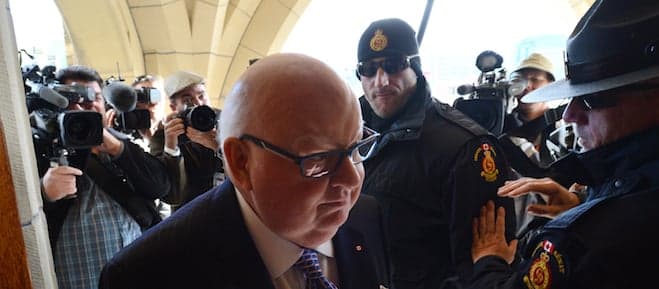
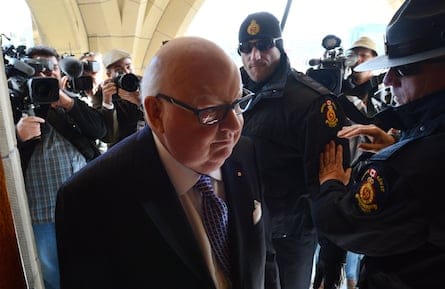
What started out as a $90,000 gift to repay taxpayers has gone from political scandal to criminal allegations. RCMP documents released yesterday allege that Nigel Wright and Mike Duffy committed bribery and fraud and are being investigated for breach of trust. None of these allegations have been proven in court.
So how does a financial gift meant to reimburse Canadians for a senator’s inappropriate expenses become potential bribery and fraud? We asked Penny Collenette, adjunct law professor at the University of Ottawa, for some legal clarification on this complicated situation.
Question: In the case of Nigel Wright writing Senator Duffy a cheque, how does this constitute bribery?
Answer: Wright says to Duffy, allegedly, I will pay you the money out of my own pocket if you agree to the talking points the PMO is going to help you with. And then Duffy says in return, I need to have the Senate committee report whitewashed.
We don’t know all the details, but [for a bribery charge, it can’t] just be negotiation. That will have to be proven in court, of course.
Related Posts

A glaring omission from Trudeau’s letters to his ministers: hunger

My love for the giant that is Ukraine
Q: And how do the fraud allegations come in?
A: Fraud. Misrepresentation. The easiest word I can use is “lie.” In this case, was the public lied to? Were there actually bribery negotiations at the beginning? That to me would be Step One. Then was Step Two the fraud? The cover-up? The lie? The problem you have with the Senate is they only have oversight of themselves.
Q: We can see how the $90,000 would benefit Senator Duffy. What would Nigel Wright get in return?
A: To make the problem go way. Why did he get involved? Because they needed the problem to go away.
Q: So if I pay someone to help with a debt, that’s against the law?
A: It is if you’re a public official. This is where it gets really complicated. For example, MPs cannot accept any gift over $500. They can’t accept any more than that because they could be bought.
If all this goes away, everyone will say this was nothing but political negotiation. But it’s not that when [if the allegations are true] you’re trying to tamper with the [Deloitte] report, when one public-office holder is paying another public-office holder out of his own pocket to make something go away.
Q: What if it were just $90,000 as a favour?
A: If you look at Section 16 of the Parliament of Canada Act, you’ll see very clearly that two public-office holders cannot be exchanging these kind of favours.
In this case, we are dealing with provisions that have not been used a lot. What you’ve got here: you’ve got criminal law, public law, political public law, administrative law, potential judicial reviews.
What we haven’t focused on in Canada enough is public law. Our House of Commons is in and out of trouble. The Senate has been this big mysterious black hole.
Correction: In our earlier conversation with Pennie Collenette, it was mistakenly stated that public officials cannot accept gifts over $200. The Conflict of Interest Code for Members of the House of Commons states MPs can accept gifts valued at $500 or less without disclosing them, with “sponsored travel” as an exception.

Aaron Hutchins is an award-attending journalist who writes about business, politics and public policy.
Related Posts

Why sanctions over the Ukraine invasion won’t stop Putin

The only acceptable response to Vladimir Putin

The Age of Wildfires

The Coutts blockade and controlling the narrative
Get the Best of Maclean’s straight to your inbox.
Sign up for news, commentary and analysis. Join 60,000+ Canadian readers.