Security fears loom over World Cup
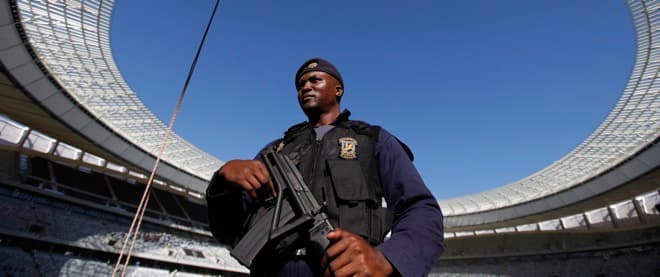 South Africa has been preparing for this summer’s World Cup for six years. The country has been a hive of activity, building sleek new transport services, pouring billions into showpiece stadiums and working feverishly to use Africa’s first World Cup to build a brand for South Africa as a modern country looking to the future.
But that’s not what people are talking about. They’re talking about crime. And South Africa can hardly blame them. Murder, carjacking, muggings and rape are a sad reality of South African life. While the situation is improving—South Africa’s murder rate has dropped a considerable 44 per cent since 1995—the rate of violent crime is extreme: that improved murder rate, at 37.3 per 100,000 people in 2009, still sits at nearly five times the world average, and is dwarfed by South Africa’s estimated rate of incidence of rape (a 2009 study reported that one in four men surveyed admitted to committing the offence).
The government has worked hard to calm fears ahead of the World Cup, which begins on June 11. They’ve pumped cash—1.3 billion rand (US$171 million)—into policing and security.  With some 46,000 officers detailed to World Cup security, the police are intent on flexing their muscles as the tournament approaches. Regular—and very public—drills and exercises seem designed to show they’re ready and willing to use their newly acquired cars, helicopters, surveillance aircraft and water cannons.
Despite the stats, some experts say crime fears are exaggerated. Dr. Johan Burger, senior researcher for the crime and justice programme at the Institute for Security Studies in Pretoria, wrote in an editorial to the U.K.’s Telegraph that murder and rape in South Africa, while appallingly frequent, rarely affect outsiders. Those crimes are a problem, but not one visitors need fear too much.
FIFA president Sepp Blatter, in signature impolitic style, has argued that prejudice, not crime, is the real problem. “Every year 11 million tourists go to South Africa and nobody says they should not go there,” he said. "[Security concerns are] an anti-Africa prejudice. There is still in the so-called ’old world’ a feeling that Why the hell should Africa organise a World Cup?…There’s no respect.”
Related Posts
“It wasn’t long before we were flooded with cholera patients”
Nothing prepared me for what I saw in Ukraine
South Africa is keen to get their respect, arguing that their record as a host nation, having successfully held the world cups of both rugby and cricket, should outweigh crime worries. "South Africa has hosted 146 international events without a single major incident," said Dr. Danny Jordaan, CEO of the 2010 World Cup Organising Committee, at the 2009 Confederations Cup, also held in South Africa. "Of course people must be mindful of criminal elements, but no more so than anywhere else in the world."
For all South Africa’s hosting success, security fears were stoked anew at January’s African Cup of Nations in Angola when three of Togo’s team delegation were killed and eight wounded in an ambush by rebels that left the team bus riddled with machine-gun bullets. Different country, different situation, say South African officials, but the tragedy has further unsettled already shaky confidence in security for the coming tournament.
Alas, despite police vigor and repeated assurances that safety will prevail, initial ticket sales were low, leaving some to speculate that security fears mixed with high costs of travel and accommodation were deterring fans. Just a day ahead of the Cup’s opening, however, FIFA reports that 135,000 tickets are remaining, putting ticket sales at 97 per cent.
As kick-off approaches, signs are emerging that though the fans may have materialized, so have the fears police were so desperate to guard against. Two days before the opening match, armed robbers entered the hotel rooms of a group of Portuguese and Spanish reporters, pressing a gun to one’s head as they stole cash and electronics. And on the eve of Africa’s first World Cup, two separate incidents saw a group of Chinese reporters held up at gunpoint, and three Greek players, had cash stolen from their hotel rooms.
Related Posts
Why sanctions over the Ukraine invasion won’t stop Putin
Why Russia should fear the coming insurgency in Ukraine
My devastating, inspiring trip to provide flood relief in Pakistan
‘Anybody want to drive this ambulance to Ukraine?’
Get the Best of Maclean’s straight to your inbox.
Sign up for news, commentary and analysis. Join 60,000+ Canadian readers.