Why Canada’s New Border Policy Could Screw Over Refugees
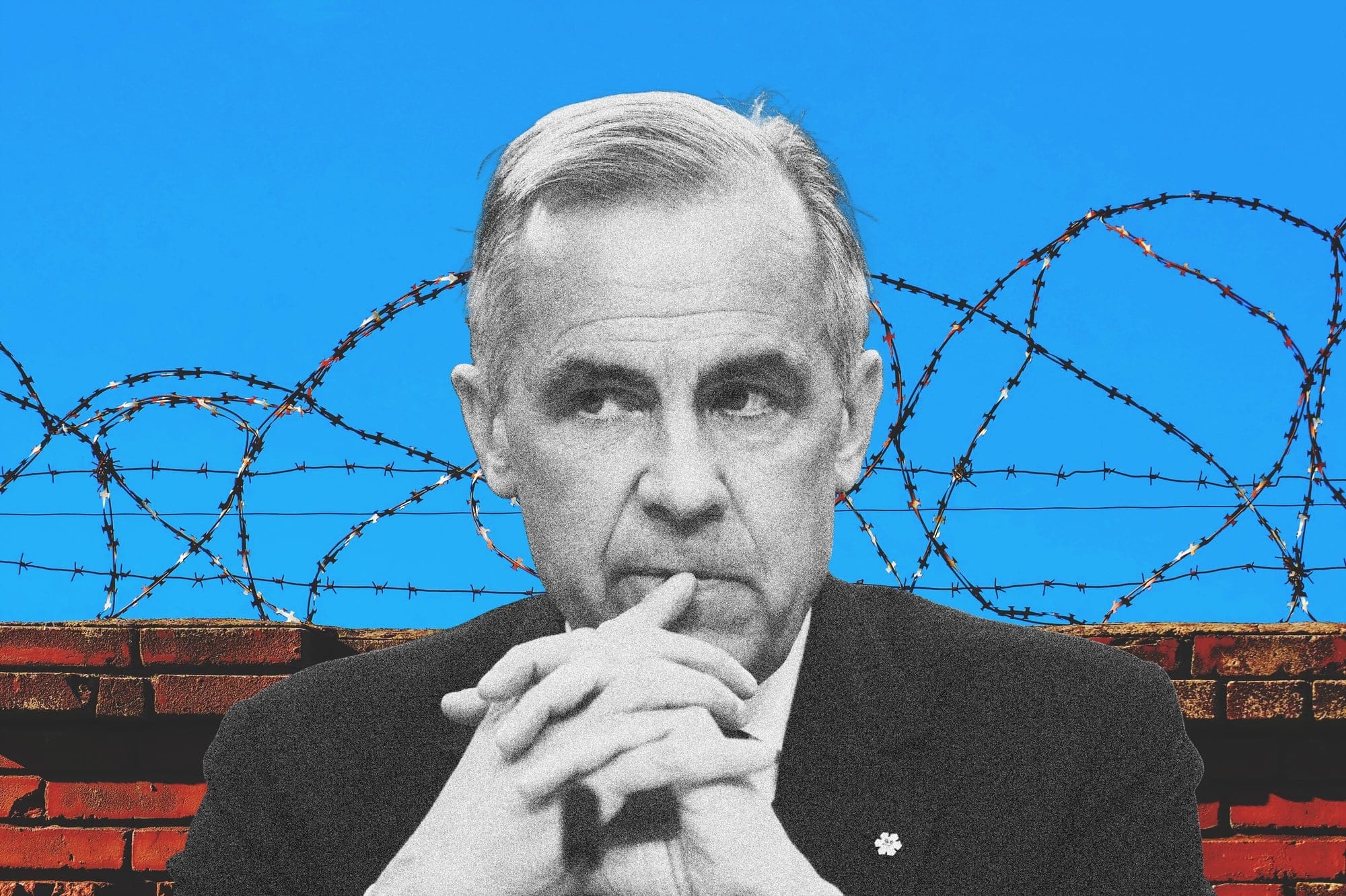
In June, Mark Carney tabled the Strong Borders Act to combat organized crime, fentanyl trafficking and illegal firearms at the border. As with many border-related issues these days, it largely stems from the Trump administration. “There were a number of elements in the bill that have been irritants for the U.S., so we are addressing some of those issues,” said public safety minister Gary Anandasangaree.
While Bill C-2 cleared its first reading in the House of Commons, many aren’t sold on the legislation. Immigration experts say it dramatically rolls back long-standing protections for refugees and migrants, and civil rights advocates say it gives Ottawa sweeping new surveillance powers that infringe on Canadians’ Charter rights.
Julia Sande, a lawyer and human rights campaigner at Amnesty International Canada, believes that critics are right to be concerned. Here, she breaks down what exactly is being proposed in the Liberals’ sweeping new omnibus legislation.
What exactly is Carney proposing via the Strong Borders Act?
The bill purports to strengthen Canada’s border in order to target some serious issues, like fentanyl, firearms and organized crime. Between 2022 and 2024, about 59 pounds of fentanyl were seized at the United States’ northern border (compare that to 61,900 pounds at its southwest border). There are definitely parts of the bill that directly relate to that. But Bill C-2 is an omnibus bill—a bill that seeks to amend several laws at once—and there’s a lot of other provisions in the bill that are unrelated to public safety.
Related Posts
My Adventures in Greenland
Carney Is the Crisis Manager Canada Needs
What kind of provisions are we talking about?
For example, Bill C-2 introduces a one-year bar for refugee claims: if someone makes a refugee claim more than a year after first entering Canada, they will no longer have their case heard by the Immigration and Refugee Board. Instead, applicants would get a Pre-Removal Risk Assessment, or PRRA.
Is that a fair alternative?
It’s not the same as having your refugee claim heard. You aren’t guaranteed an oral hearing, and there’s no built-in right of appeal. If your PRRA is unsuccessful, the only thing you can do is apply to a federal court for judicial review. But there’s nothing stopping the Canadian Border Services Agency from carrying out your deportation while your case is being reviewed. It’s a lesser system with fewer protections. You’re diverted from the process that was specifically designed to hear refugee protection claims, into something that was meant to be a last resort.
Are there any other countries that have instituted similar policies?
The U.S. has a similar one-year deadline for filing asylum claims and, so far, it has disproportionately affected women fleeing gender-based violence and LGBTQ+ refugees. A study from Physicians for Human Rights found that sexual violence can leave refugees so deeply traumatized and stigmatized that they struggle to recount their stories to government officers. As a result, women applying for refugee status missed deadlines at a rate 13 per cent higher than men. The same is true for LGBTQ+ applicants: some people have fled countries where their lives would be at risk if they came out. It takes time to feel comfortable or safe enough to tell your story. Others arrive unaware that being persecuted for their gender or sexual orientation may even qualify them for refugee status. By the time they learn, their first year might be up.
Does the bill affect immigrants who aren’t refugees? Economic migrants, permanent residents?
They’re also at risk. In the name of national security, the bill would let the government cancel or suspend certain immigration documents—like permanent resident visas or work and study permits—en masse without individualized assessments. The only justification they’d need is that it’s in “the public interest.” At Amnesty, we regularly talk to people whose families have given up everything to allow one person to come to Canada and set up a better life. They’re working hard, they’re studying, they’ve sold their home back in their home country to afford the move. They’ve followed all the rules. And now for some reason the government wants the power to just blanket rip the rug out from underneath people.
Are there any legal checks and balances on that kind of mass cancellation?
Not as they’ve proposed it. The only check is that they have to deem it to be “in the public interest.” That’s an incredibly broad, sweeping power.
What are the privacy implications of these expanded powers?
They’re expanding the ability for police and spy agencies to demand information without a warrant—based merely on “reasonable suspicion.” Canada Post, for example, could open your mail. Public service providers like doctors could be compelled to hand over private details. The bill would also enable information to be shared with foreign entities just with the consent of a minister. Some experts, including member of Parliament and NDP immigration critic Jenny Kwan, have raised concerns that American anti-abortion states could use the provision to request information from Canadian abortion clinics.
Why do you think the government is trying to reframe refugee laws in this national security bill?
I’ve been asking myself that question! I don’t have a clear answer—I’m struggling to understand what they think they’re going to achieve. At best, refugees are simply irrelevant to national security. At worst, this bill diverts refugee claims away from independent, specialized bodies and into systems that are far less equipped to assess them, like the federal courts. The claims won’t disappear; they’ll just move into spaces with fewer safeguards, while attention is pulled from genuine national security concerns like firearms.
What do you think is the driving force behind this bill?
I don’t think anyone asked for this. On the privacy side, nonpartisan organizations like the Canadian Civil Liberties Union have decried use of these powers, calling for total withdrawal of the bill. There’s no demand on the refugee front. Amnesty International has also called for the bill to be totally withdrawn.
In regards to the sections concerning fentanyl or crime, there’s this sense among the general public that they’re put in there to appease Trump and get better deals in tariff negotiations. But the bill wouldn’t do anything to the number or flow of refugees to the U.S.
Do you see parallels between what’s happening in the States and what Canada is asking for?
I’m reluctant to compare, because it’s easy to say, “It’s worse in the States,” and I don’t want to make a false equivalence. But we are seeing the mass cancellation of protective status in the U.S., and the idea that the Canadian government wants to equip itself with similar powers is alarming.
Does any of this raise Charter concerns?
Absolutely. For example, when it comes to refugees, the Supreme Court of Canada ruled in Singh v. Minister of Employment and Immigration in 1985 that refugees have the right to an oral hearing.
If this passes, what could Canadians see in a year or two?
If the bill passes, I think there’s a very real possibility that our government could be deporting people to face dangerous conditions and torture back home, all because their claim for refugee protection wasn’t fairly assessed. When it comes to privacy rights, law enforcement could have access to all sorts of private information—they could open your mail, could make requests from any service provider about you, and could share that information with foreign governments. And for some people who have fled foreign governments, that’s a terrifying idea.
That is a pretty grim picture.
They’ve titled it the Strong Borders Act. In one sentence, they’re talking about fentanyl and firearms—and in the next they’re talking about refugees. So even if they don’t say it explicitly, they’re painting refugees as a safety threat.
This interview has been edited for length and clarity.
Related Posts

Alberta Treaty Law Could Decide the Arctic

Canada’s Defence Firms Are Ready to Boom

How to Win the Space Race

Carney’s Biggest National Project is Mythmaking
Get the Best of Maclean’s straight to your inbox.
Sign up for news, commentary and analysis. Join 60,000+ Canadian readers.