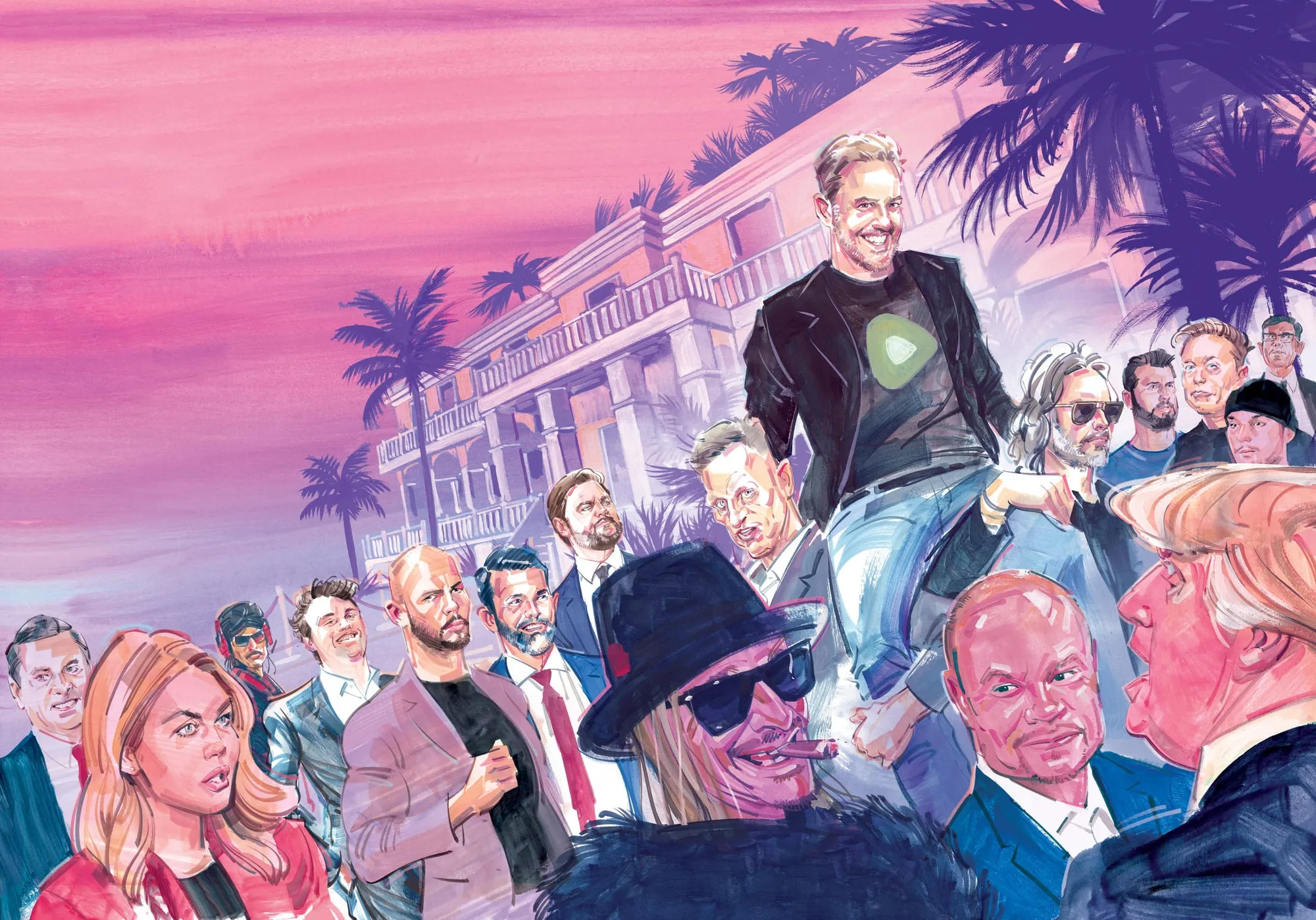
The Mayor of the Manosphere
On the morning of February 12, White House press secretary Karoline Leavitt presented to reporters a whirlwind update on President Trump’s fourth week in office: calls with Putin and Zelenskyy, new tariffs on aluminum and steel, an executive order to unleash DOGE on the federal workforce and, finally, a ban on the government procurement of paper straws. Then she opened the floor to the media. The first question at morning press briefings has traditionally gone to the Associated Press. But AP was in the administration’s bad books for refusing to adopt the term “Gulf of America.” So, instead, Leavitt gestured to the White House’s “New Media Seat”—a recent invention of hers that has typically been occupied by right-wing news outlets, like Breitbart and the Daily Wire, and independent journalists like Sage Steele, a former ESPN anchor turned anti-woke crusader.
On that day it was held by Chris Pavlovski, an entrepreneur from Brampton, Ontario, and the founder of Rumble, a video-hosting platform that has become a clearing house for MAGA-affiliated personalities, conspiracy theorists and culture-war influencers. Leavitt thanked Pavlovski for creating a space for such creators—including the president himself—to share their opinions without being censored by mainstream Big Tech platforms.
Canada’s Not For Sale
But Maclean’s is
SUBSCRIBE NOW
Slouching in a suit and tie, Pavlovski thanked Leavitt and the president for providing him a forum to defend free speech and complained of being censored by “foreign governments”—an accusation he has also levied against Canada in the past. Then he served up a soft lob: “Can you describe what the administration will do to protect U.S. interests and values worldwide?”
Leavitt described a recent executive order by Trump to end the “censorship” of Americans imposed by the Biden administration, and she said the president was leading by example. Of course, in the weeks that followed, Trump also deported protesters, ordered pages scrubbed from government websites, called for judges to be impeached after rulings that displeased him and suggested outlawing CNN and MSNBC. This might all sound like the opposite of protecting free speech. But, under Trump 2.0, the term has been redefined to apply to those who follow and uphold the president’s script.
And that’s why Pavlovski was there. Over the past five years, the 42-year-old Canadian has turned Rumble into a key piece of frontline infrastructure for MAGA’s culture wars, platforming many of the personalities who helped return Trump to power last year. Rumble was founded in 2013 as a video-hosting site, filled with clips of cute kids, funny pets and backyard stunts gone wrong, trying to compete with YouTube from a tiny office in downtown Toronto. For years, it pivoted over and over, looking for a market gap Big Tech hadn’t already filled. In 2020, MAGA types, booted from bigger platforms, decamped in droves to Rumble, which welcomed the influx.
Related Posts

Canada’s Defence Firms Are Ready to Boom
Carney’s Biggest National Project is Mythmaking
Today, Pavlovski is a little too old to be a startup wunderkind. The stubble he’s sported for the past 15 years is growing more salt than pepper. His haircut is the same short, conservative, strategically forgettable look he’s sported for years, if more expensive nowadays. He’s long and lean; when I spoke to him at a café in Toronto he appeared as a full stack of dark blue—indigo jeans, a navy sweater, a tech-bro vest. But he’s not really a tech bro. He’s neither socially awkward nor vibrating with bravado, despite an estimated net worth of $1.3 billion. He comes off as soft-spoken and nice—which is also how he describes Donald Trump, a man with whom he says he’s dined many times. He is not a MAGA firestarter himself. He doesn’t rant on livestreams or post inflammatory tweets. He’s circumspect about his beliefs. When I asked him to describe how his company turned into a pillar of America’s right-wing media ecosystem, he shrugged and said, “It just sort of happened.”
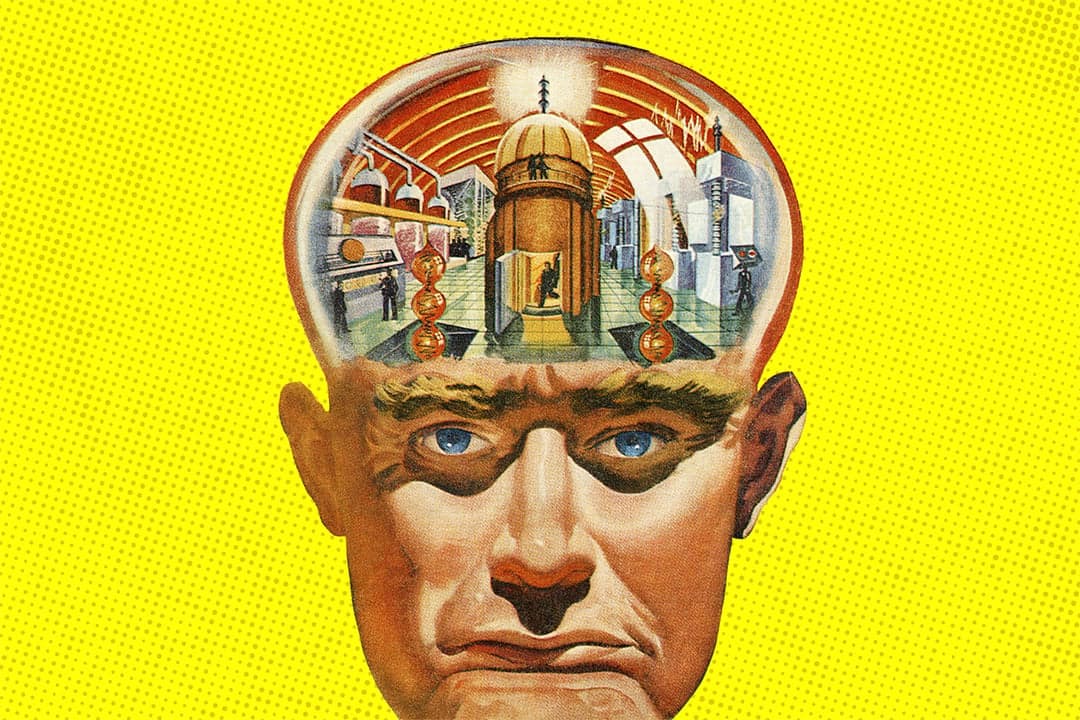
In Pavlovski’s telling, he’s just been along for the ride: a passenger on Rumble’s rise through the right-wing mediasphere. That might have been true in the beginning. But when MAGA came calling, he actively remodelled his company in the movement’s image. Rumble had been a company in search of a story, and the anti-establishment ranters and influencers of the MAGAverse had one to tell, fuelled by grievance and funded by speculative capital. Rumble gave them a microphone and helped engineer widespread acceptance of some of their most outlandish theories and beliefs. The question that Rumble and its founder face today is the same one that all successful populist movements eventually must: what role do they play when the margin has become the mainstream?
Pavlovski discovered computer programming at the age of 14, during the dial-up era of the late ’90s. He built games, a stock-trading site and, in 2001, a video-sharing site called
Jokeroo. It was part of a turn-of-the-millennium boom in pre-YouTube video platforms that included CollegeHumor, eBaum’s World and Metacafe. Jokeroo featured crude jokes, games and user-created clips that resonated with a young, American audience—a typical video might be entitled “Maniac Eats a Cactus” and depict exactly that. For an operation run from Pavlovski’s Brampton basement, it did well, earning $10,000 in its first few months. His parents, Macedonian immigrants, wanted him to go to university, and he studied business for a while at the University of Toronto, but as Jokeroo’s traffic surged, he focused on the company full-time. By the end of 2006, the site was getting five million unique visitors monthly.
Then came YouTube. Launched in 2005, it was gobbled up by Google a year later and quickly steamrolled all competitors. “I felt that was incredibly unfair,” says Pavlovski. If there’s one throughline to his career, it’s that grudge. He’s spent two decades in a one-way feud with YouTube, looking for an angle to challenge its dominance. In 2009, he hired his childhood friend Wojciech Hlibowicki as chief technology officer and an industry acquaintance, Claudio Ramolo, as a business development lead. They moved into a small office in downtown Toronto.
YouTube had already introduced a partner program to financially reward its biggest stars with a cut of ad revenue. Jokeroo tried to stake out its own territory by appealing to smaller creators. Staff hand-picked user-submitted videos with viral potential—a wobbly bulldog, a singing toddler, unlikely animal friends—and licensed them to sites like AOL and Yahoo. If one sold, the creator got a cut.
In August of 2013, a friend gifted Pavlovski a URL for his birthday: rumble.com. He said that Pavlovski was sure to build a billion-dollar company one day and would need a great name to do it. Rumble launched that October at the Dublin Web Summit. The new name was an upgrade, but under the hood it was the same offering: same leadership, same business model, same laser focus on staking out a market niche distinct from YouTube. The company moved into an office on the top floor of a shabby, four-storey yellow-brick building in downtown Toronto. There were nods to startup aesthetics—a ping-pong table, scribbled whiteboards—though the windowless conference room and ancient drop ceilings undermined the vibe.
The company’s early funding was mostly a family-and-friends affair. Rumble soon reached one million monthly views, licensing content to partners like CNN, Good Morning America, Xbox Live and many others. Contributor payouts topped US$4 million that year. Much of the site’s traffic came not from direct visits, but from licensed content that went viral after being shared on social media platforms, especially Facebook.
And there was nothing remotely political about any of it. In fact, at the time, Pavlovski positioned Rumble as an extremism-free zone. In 2017, advertisers including Pepsi, Walmart, Starbucks and GM fled YouTube after their ads appeared in videos featuring white-supremacist and anti-Semitic content. Pavlovski responded with an op-ed in Adweek, touting the way Rumble, at the time, screened videos for problematic content, creating a “brand-safe” environment for advertisers. By 2018, Rumble had experienced nearly 10-fold revenue growth over three years, landing it on Deloitte’s list of fastest-growing Canadian companies.
Then it all came to a grinding halt. That year, Facebook overhauled its algorithm to prioritize “meaningful social interactions”—posts from friends that sparked likes and comments, rather than posts from brands. The move gutted traffic to the publishers that licensed Rumble’s video content. One former account executive at Rumble estimates that the company’s unique monthly viewers dropped from 24 million to less than four million within weeks. Advertisers stopped calling, revenue plunged and Pavlovski was forced to lay off most of his employees, shrinking his workforce down to only 12 people. It was a nasty case of déjà vu: another tech giant, another algorithm shift, another business circling the drain.
Then, in the summer of 2020, Pavlovski got a call from Devin Nunes, a Republican congressman from California. “I was like, ‘Oh shit—did we do something illegal?’ ” recalls Pavlovski. But Nunes only had one question: if someone searched for him on Rumble, would his videos show up?
For years, the Trump-aligned congressman had been accusing social media platforms of suppressing his content—mostly clips from Fox News appearances, many of which included rants against Big Tech for censoring conservatives. Nunes was looking for an alternative. Pavlovski didn’t hesitate. “Definitely,” he said. Days later, The Devin Nunes Podcast premiered on Rumble. Viewers logged on for his opinions on California governor Gavin Newsom’s plan to dispatch state authorities to enforce COVID rules (Gestapo-like), Democrats (destroyers of America) and Trump (a foreign-policy savant). Within a month, Nunes had hundreds of thousands of followers, 10 times what he’d had on YouTube. Pavlovski could barely believe the numbers; as he saw it, other platforms had to be suppressing content like Nunes’s. There was no other explanation.
Then came Dan Bongino. A former NYPD officer and Secret Service agent, Bongino already had 600,000 YouTube followers for The Dan Bongino Show, spinning culture-war dust-ups—gun rights, mask mandates—into fuel for his base. Despite his popularity, Bongino claimed YouTube was cutting off his ad revenue. “We need somewhere to go where conservative views won’t be discriminated against,” he told the Washington Examiner in September of 2020. Soon after, he announced he’d taken an equity stake in Rumble, for an undisclosed amount.
Others began hopping aboard: conservative commentator Dinesh D’Souza, pro-Trump vlogger duo Diamond and Silk, MAGA darling Charlie Kirk and far-right outlet One America News Network all joined in the fall of 2020, posting about COVID conspiracies, the globalist agenda and how funny it was when Donald Trump called Democratic senator Adam Schiff a watermelon head. “It wasn’t a strategy of any sort,” says Pavlovski of Rumble’s swelling roster of conservative creators. “It grew and it grew and it grew.”
So did viewership. After Joe Biden won the 2020 presidential election and YouTube began removing content claiming the election was stolen, Rumble’s user base exploded with outraged MAGA types. In January of 2021, after Trump incited followers to storm the U.S. Capitol, YouTube and Twitter banned him, driving even more conservative users to the fringes, creating an alt-media ecosystem for the disaffected. Social media platform Parler surged to the top of Apple’s App Store, messaging service Telegram gained 25 million new users in three days and Rumble’s monthly site visits hit 135 million.
The rise of parallel information networks on the right didn’t just give banned creators new homes; it created an environment in which disinformation could flourish unchallenged. What played out on Rumble and similar platforms didn’t stay online, either. Election denialism quickly became a mainstay of Republican Party thought. Anti-vaccine rhetoric shaped public perception. the Great Replacement Theory—the idea that Americans were being supplanted by mass immigration—was treated as an urgent matter on campaign trails and cable news shows. When Pavlovski received that call from Devin Nunes, he didn’t intend to become part of any movement. But before long, MAGA money was bankrolling Rumble’s ascension to success beyond what he could have hoped for. So Pavlovski leaned in.
By March of 2021, Pavlovski was schmoozing over lobster buffets at Mar-a-Lago and, by May, he was getting to know the family. Then he began offering technical advice to Trump Media, a newly formed company planning to build a Twitter clone, eventually to be called Truth Social, from which the former president couldn’t be banned. Trump Media’s board included Donald Trump Jr. and Devin Nunes, who later resigned as a congressman to become its CEO. In June, Trump himself joined Rumble. (He now has 2.5 million followers.)
Pavlovski had long struggled to secure venture capital. But after MAGA’s ballot-box defeat, a seething group of creators and their supporters were eager to fund the prospect of an alt-right YouTube. That spring, Trump-connected venture capitalist Darren Blanton approached Peter Thiel—the conservative tech kingmaker who had co-founded PayPal with Elon Musk—and Narya Capital, a VC firm led by JD Vance. They invested a combined US$25 million in Rumble, valuing it at US$500 million. “I cried,” Pavlovski told me. “I worked so hard for that moment, and it finally came.”
The money was intended to scale up the platform—as well as lay the groundwork for Rumble to build its own data storage infrastructure. The idea was that Rumble would become a cloud-storage provider for conservative media companies like Truth Social, making them immune to potential censorship from mainstream Big Tech companies that would otherwise provide that service.
In late 2021, Rumble announced it would go public. But rather than launching a traditional IPO, it went public with a special purpose acquisitions company, or SPAC. At the time, SPACs had become a trendy shortcut to the stock market for startups intending to scale up fast, including WeWork, Nextdoor and 23andMe. Essentially, investors set up a publicly traded shell company that exists solely to raise the capital needed to acquire the company that they want to take public. The strategy allows the original company to skip much of the regulatory probing that would otherwise be involved.
The shell company Rumble merged with was called CF Acquisition Corp. VI, which was backed by Howard Lutnick—a Wall Street power broker with deep ties to conservative politics. Rumble’s merger brought in US$400 million, and the company debuted on the Nasdaq in September of 2022. Rumble used the cash to cut big-money deals with a new slate of anti-woke personalities. It’s unclear whether Pavlovski personally architected these deals—he declined to comment on them—but the pivot was a deliberate bet for the company on culture-war clout.
Rumble soon welcomed Russell Brand, the British comedian and actor who was in the process of reinventing himself as a born-again anti-vax influencer and conspiracy peddler. Another joiner was David Freiheit, a former litigator from Montreal turned right-wing pundit, known for promoting Canada’s convoy movement. Pulitzer-winning journalist Glenn Greenwald, a long-time critic of cable news orthodoxy, launched his own nightly news show on the platform. And Donald Trump Jr. signed on for an exclusive show called Triggered With Don Jr.
All of the new voices shared a posture of anti-establishment provocation. Many were also key figures in what has been termed the manosphere, the unofficial network of online influencers pushing alpha-male masculinity and anti-feminist—or simply anti-woman—beliefs. Perhaps the most notorious is Andrew Tate, whose channel is called Tate Speech; he claims his deal with Rumble was worth US$9 million. (Rumble itself doesn’t disclose individual payouts.) He had been banned from most platforms in 2022 after saying women bear responsibility for being sexually assaulted and now faces rape and human-trafficking charges in multiple countries.
Some of Tate’s disciples joined, too. They included Sneako, a gamer known for anti-Semitic and misogynistic rants who was banned from YouTube, and Adin Ross, a streamer evicted from Twitch for homophobic content. Carl Benjamin, known as Sargon of Akkad, built his career harassing women online, speculating about the rape-worthiness of female politicians and blaming feminism for mass shootings. He joined in the fall of 2022. So did Myron Gaines and Walter Weekes, the duo behind the Fresh and Fit podcast, who routinely invite women on their show and humiliate them in front of millions of listeners. But the jewel in Rumble’s crown was Steven Crowder, who signed an exclusive deal with the company in early 2023. Among his frequent topics: consent is ruining sex, single women are broken and career women will die alone.
The audience for these creators is almost exclusively young men, who might find in their masculine camaraderie and woman-blaming a balm for any number of generational crises: post-COVID isolation, economic precarity, collapsing institutional trust. But Tate, Crowder and others aren’t just provocateur edgelords. They’ve leveraged the confusion and anger of the manosphere, neatly aligning it with the anti-progressive rhetoric of the MAGA movement. That convergence has spilled into the real world, shaping Republican talking points about traditional family values, fuelling school-board showdowns targeting transgender youth and stoking hysteria about how feminism has supposedly broken masculinity.
Evan Balgord is executive director of the Canadian Anti-Hate Network, which monitors far-right activity online. He says the ease and speed with which this kind of content has influenced mainstream politics is due, in part, to the intimacy between creators and audiences generated by video and livestreaming. It fosters a shared language and in-group familiarity at mass scale. This is how a conspiracy like QAnon—the baseless theory that a Satanic cabal controls global institutions— can begin as anonymous, cryptic posts on the web forum 4chan before spreading to social media and, eventually, mainstream politics. (A 2020 NPR/Ipsos poll found that 17 per cent of respondents believed in QAnon’s core tenet about Satanic control of government. Forty per cent believed that a “deep state” was attempting to undermine the president.)
In a borderless online world, those dynamics aren’t unique to the U.S. Rumble has also elevated many right-wing Canadian voices: conservative news outlet Rebel News has nearly 450,000 followers, and Juno News has nearly 17,000. During this year’s election, Pierre Poilievre granted Juno News’s Candice Malcolm an exclusive interview.
When I asked Pavlovski what role his company might have played in shaping politics during the Biden years, he said he had no idea—and returned again to the issue of free speech. “There’s tons of content that I personally disagree with on Rumble,” he said. “But that’s exactly what defending free speech looks like. You can’t pick and choose.” He did add that he feels personally wounded when he gets attacked on social media: “Getting called a Nazi hurts.”
Pavlovski is quick to explain that Rumble users’ feeds are chronological, based on who they follow, rather than filled with recommended content with any kind of ideological skew. This is true. But the default view upon loading the site is the homepage, always filled with suggested videos featuring inflammatory headlines about DEI, trans kids, immigrants—a smorgasbord of moral panic. The site also features a Trending tab and an Editor Picks page, almost exclusively populated by hard-right content.
Out of curiosity, one day this spring I typed “feminism” into Rumble’s search function. The top results, in order, included a video about how universities brainwash women, a Tucker Carlson clip on feminism “destroying Ireland” and a four-and-a-half-hour Fresh and Fit episode entitled “Failure of the Left, Feminism, Israeli Influence on 9/11, Epstein, COVID Lies & MORE.” The rest followed suit: “Feminism Is the Root of Transgenderism,” “Patriarchy or Phaketriarchy?” and “Feminism Is a Jewish War on Woman and the Family Unit.”
At that point I closed the tabs and seriously considered sleeping through the next decade.
by early 2023, Rumble’s full-time team had grown to 70 employees, two-thirds of whom worked remotely from the U.S. That March, the company moved its headquarters from Toronto to Longboat Key, Florida, a quiet barrier island home mostly to retirees, not startups. Pavlovski chose Florida for its low-tax, pro-business, politically conservative environment—and because his snowbird parents winter there. Governor Ron DeSantis, who has 265,000 Rumble followers, even delivered a speech when the company opened the office.
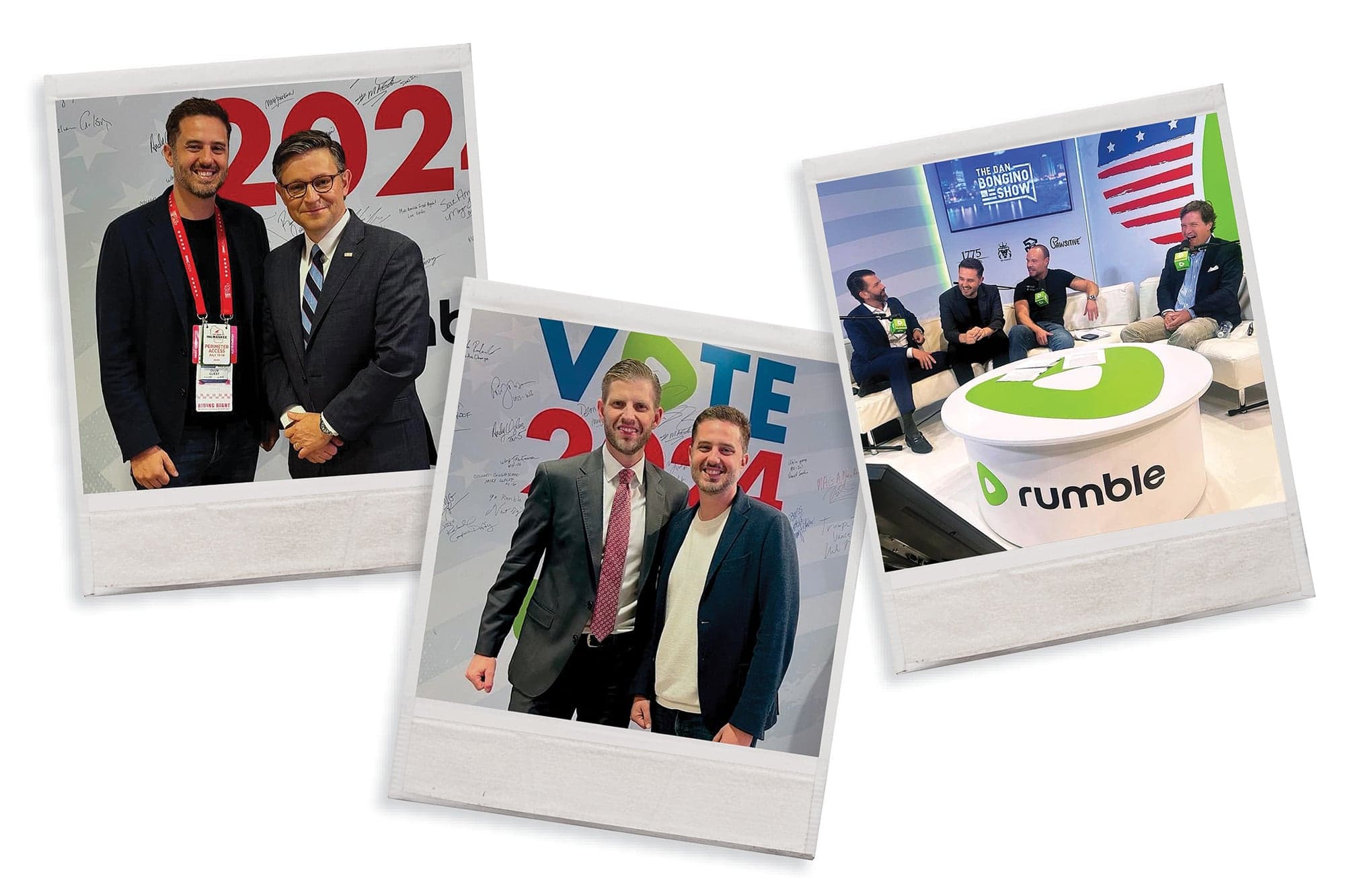
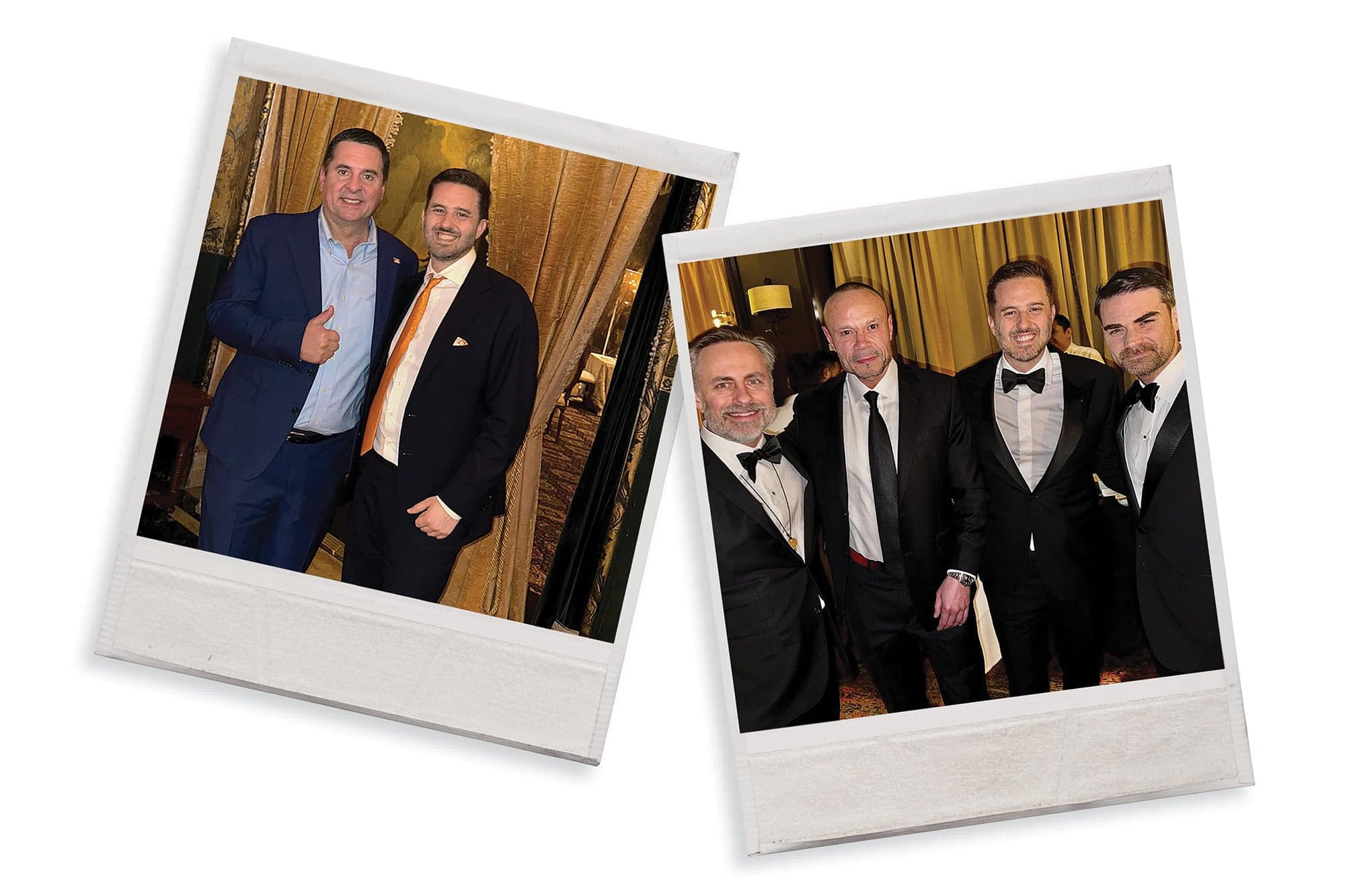
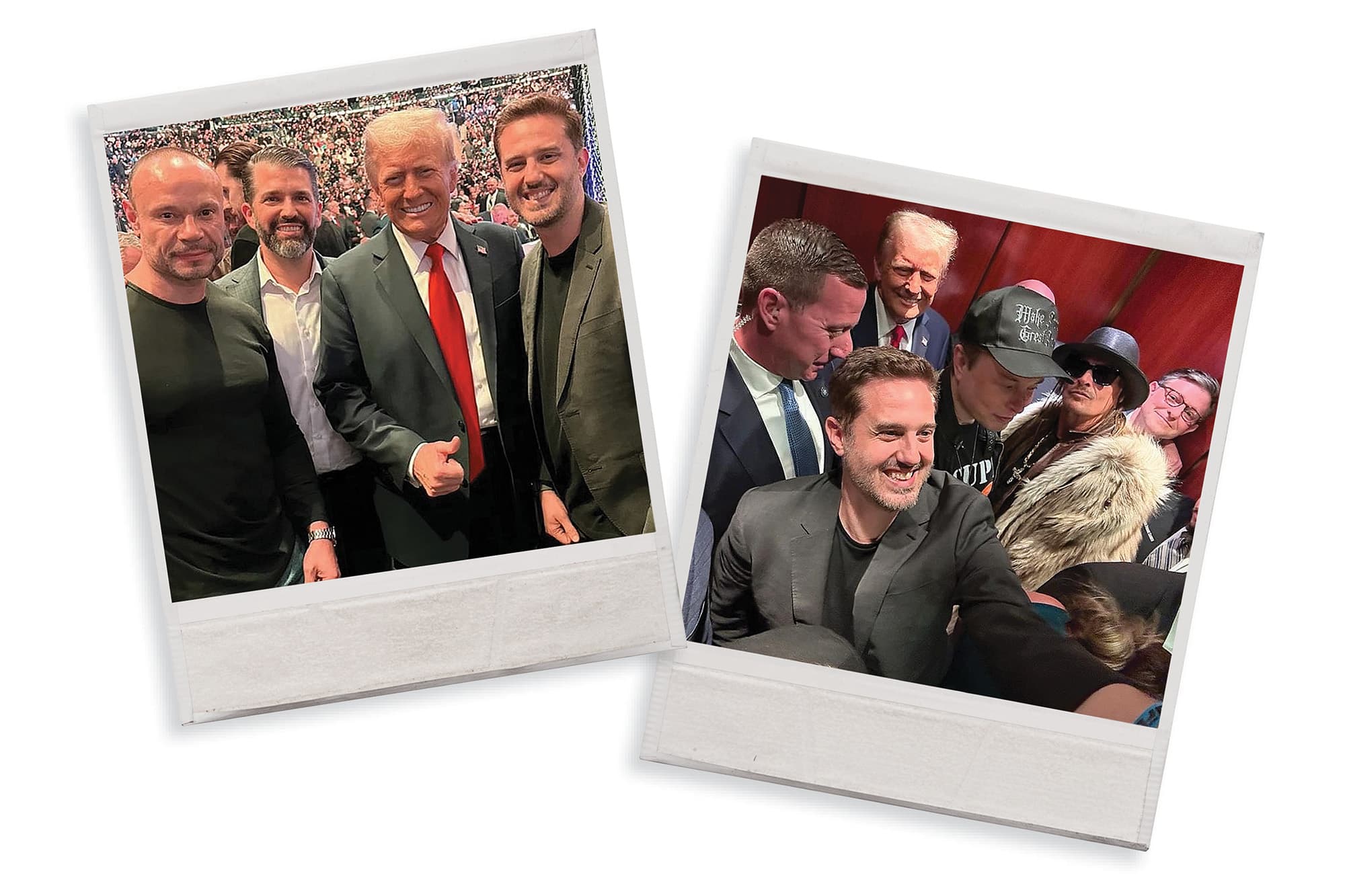
Pavlovski now splits his time between Canada and the U.S., but you wouldn’t know it by looking at his Instagram, steeped in MAGA-adjacent Americana. In one post, he’s ringside with Trump himself at an Ultimate Fighting Championship show in Las Vegas. In another he’s eating pizza in Sarasota with Barstool Sports founder and MAGA mascot Dave Portnoy. Then he’s back ringside with Trumps Ivanka and Donald in Miami, then at a Rumble-sponsored Bitcoin dinner with Russell Brand, Tucker Carlson and Donald Trump Jr. He appears to be tightly bound to Trump’s orbit, but on that Pavlovski deflects again: “I don’t have much of a place there,” he says. “My place is working on Rumble.”
There is another reason, besides a favourable political climate, that Pavlovski established an American office for Rumble. The U.S. does not have hate-speech laws as Canada does. In 2021, the Trudeau government proposed the Online Harms Act, a bill that aimed to hold platforms accountable for hateful or exploitative content. Pavlovski took the bill as an affront to free speech.
In May of 2024, Rumble held an event in Toronto called Rumble Live, in protest of the Online Harms Act. It featured Rebel News and some of Rumble’s own marquee names, including Glenn Greenwald, David Freiheit and Donald Trump Jr. The event was booked at Downsview Park, owned by Crown corporation Canada Lands, which added $37,000 in last-minute security and incidental costs over concerns that the event would attract an undesirable crowd. Rumble and Rebel News paid under protest but later sued Canada Lands, alleging the Crown agency used public infrastructure to suppress political speech. They’re seeking reimbursement plus $250,000 in punitive damages. The case is still unsettled.
Pavlovski seems to have a conflicted relationship with his home country. When Trump announced tariffs on Canadian goods, Pavlovski’s elbows were firmly glued to his ribcage: “Trump will outplay them all and already has,” he wrote on X. In another post, he responded to a CBC story he perceived as a hit piece on his company: “This is why Rumble moved its headquarters to the U.S.A. It’s not a friendly environment in Canada for freedom of expression.”
And freedom of expression, or at least his version of it, is Pavlovski’s north star. He believes platforms should be immune to outside pressure, and he’s declared his intention for his company to be “uncancellable.” That goal, as well as the need to generate more revenue, is why Rumble has been pouring money into its own cloud-storage product since 2021. Rumble Cloud finally launched in March of 2024 with three clients: Rumble itself, Truth Social and Locals, a Substack-type platform Pavlovski acquired in 2021. A few more, including the Miami Dolphins, joined that summer. But by June, advertising revenue was down 10 per cent from the year before as users were spending less time on the platform. More than half the SPAC windfall was gone.
Things began looking up as the U.S. election drew near—nothing boosts Rumble’s numbers like political division. Trump made full use of the alternative media pipeline that Rumble helped build. Manosphere streamer Adin Ross gave him a Cybertruck wrapped in photos of Trump with his fist raised in triumph after being shot in the ear, and Trump granted Ross an 80-minute interview. He spoke for hours with podcast bros including Theo Von, anti-woke comedian Andrew Schulz, the Canadian prank-duo-turned-MAGA-influencers Nelk Boys and many more. He skipped 60 Minutes in favour of friendlier mics, on Rumble and other platforms, whose collective followings reached into the hundreds of millions.
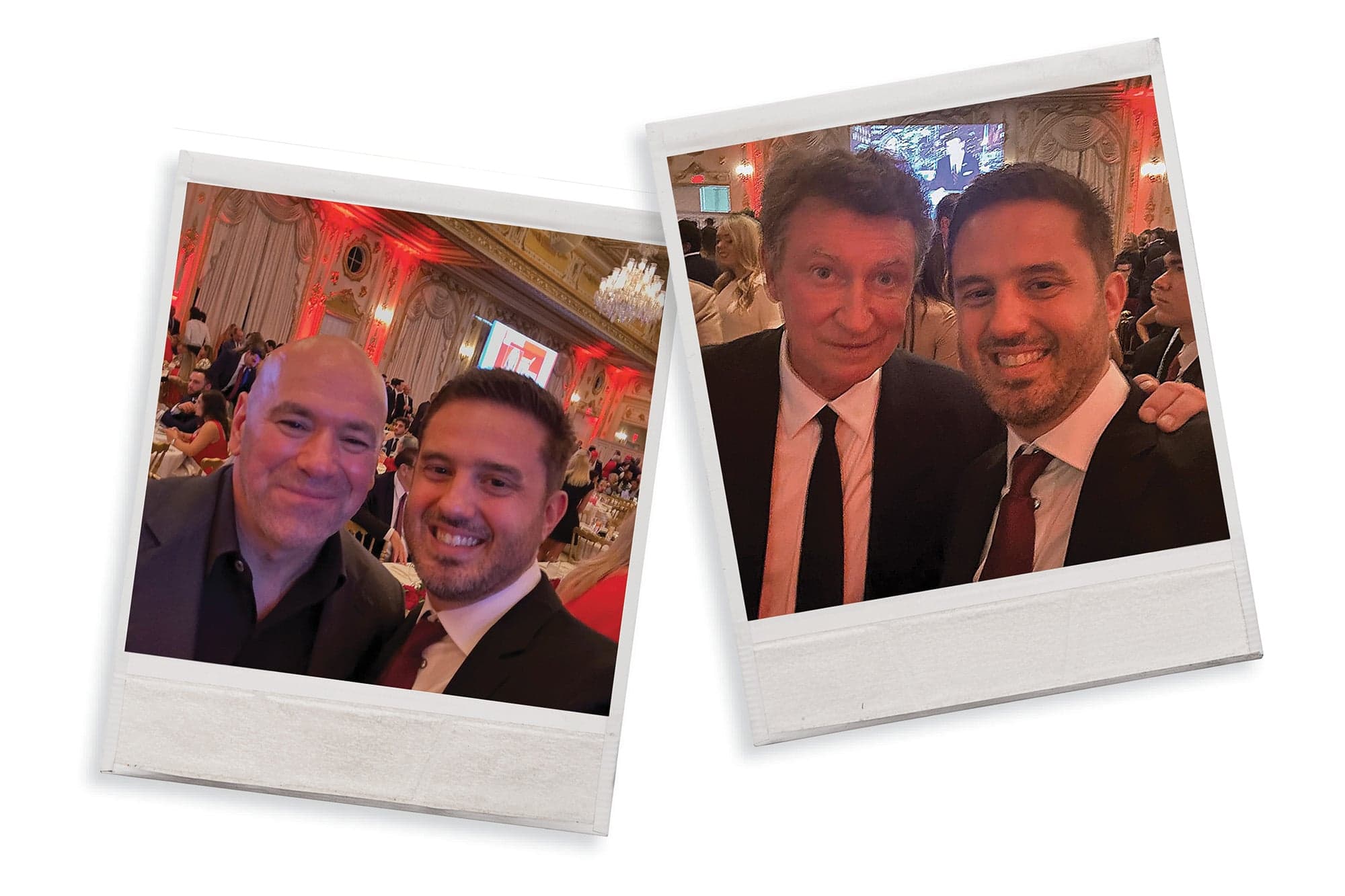
All were part of the MAGA media ecosystem Rumble had spent years building. And as Trump turned out for the manosphere, the manosphere turned out for Trump: 63 per cent of young white men voted for him, thanks in part to his mastery of this new media landscape the Democrats haven’t begun to crack. This isn’t an entirely new phenomenon. While progressives have tended to stick with fact-checked legacy news, conservative movements have long invested more heavily in alternative information channels—church networks, talk radio, early cable news. Rumble and platforms like it are simply the next generation, elevating extreme influencers and framing them as rebels. On election night, Rumble ranked third among streaming platforms in Apple’s App Store. Pavlovski spent the evening in a Mar-a-Lago ballroom. He later posted Instagram shots from the evening, depicting himself rubbing shoulders with Wayne Gretzky, Donald Trump Jr., Tucker Carlson and Ultimate Fighting Championship CEO Dana White. “Free speech won,” read one caption.
Yet the man himself acknowledges no responsibility for the political impact of his platform. He doesn’t know whether or not Rumble, and the personalities it platformed and audiences it built, helped shape American politics. If Pavlovski resembles anyone within the MAGA movement, it is not ideologues like Bongino or Nunes. He’s closer, in some ways, to Trump himself—a man who has shifted political allegiance multiple times over the years, from Republican to Democrat and back again, who has often been accused of having no fixed principles beyond the pursuit of personal aggrandizement. Both men rode waves of anger and resentment into positions of great power and influence. Both are opportunists who built and benefitted from the moment. The difference is that Trump owns it. Pavlovski shrugs it off.
When Trump returned to office, he brought many key Rumble allies with him to positions of power. JD Vance became vice-president. Devin Nunes was appointed chair of the president’s Intelligence Advisory Board. Dan Bongino and former Rumble general counsel Michael Ellis were named deputy directors of the FBI and CIA, respectively. Rumble board member David Sacks stepped down to become the White House AI and crypto czar. And Howard Lutnick was appointed secretary of commerce. Rumble is not state media, but it’s certainly state-adjacent.
Logically, having allies in positions of power should have cemented Rumble’s place in the new internet order. The company’s market niche was all about being anti-woke, red-pilled and rage-optimized. When Trump and other MAGA types were banned from YouTube and Twitter and other platforms, Rumble gave them a home. But in the past few years, the mainstream media has come to look a lot more like Rumble. This time, it’s not a Big Tech algorithm shift that’s eroding Rumble’s competitive edge; it’s the transformation of American politics that Pavlovski himself helped to engineer.
That process accelerated after Trump’s return to office, when he issued a flurry of executive orders to dismantle federal DEI programs and roll back protections for trans Americans. His first moves set the tone for a government hostile to identity politics in any form and willing to weaponize its power to target anyone who opposed it: universities, law firms, students, judges and journalists. To stay out of the administration’s crosshairs, tech and media companies changed direction. Meta scrapped fact-checking on Facebook and Instagram, citing “free expression.” YouTube, which had already reinstated Trump’s channel in 2023, loosened its moderation rules, removing references to gender identity and expression from its list of protected groups. And under Elon Musk, X increasingly runs on algorithmically juiced bigotry, slur-laced culture-war memes and AI-generated partisan spam.
This is the world Rumble built, but it’s also robbed the company of its niche—and Pavlovski knows it. “The proposition is changing,” he says. “Rumble is going to have to be more about being the best place creators can make revenue.” Back to its roots, in other words. That’s not going so well, however. Smaller creators are frustrated, overshadowed by the platform’s headline names—though only a few major players have joined recently, including Dr. Disrespect, a former Twitch star banned from YouTube for sending sexually explicit messages to a minor (he later admitted his error in sending messages which “leaned too much in the direction of being inappropriate,” but denied that anything illegal transpired), and Tim Pool, a former Vice News journalist turned anti-establishment commentator. Side projects like Rumble Wallet, a cryptocurrency integration tool pitched as a better way for creators to monetize their content—exactly how is not clear—have added to the confusion.
Pavlovski insists that the platform is diversifying beyond politics. In fact, he says, if you ask someone under 25, they won’t even recognize it as a political brand. He points to non-political social media personalities like Kai Cenat, IShowSpeed and SteveWillDoIt, who also have massive followings on YouTube, Twitch and TikTok. But SteveWillDoIt hasn’t posted on Rumble in a year, and Cenat and IShowSpeed, though they have channels, have never posted at all. In April, Australian rapper Iggy Azalea announced she was joining the platform. On paper, the polarizing and controversial artist seemed like a natural fit. But long-time Rumble users weren’t sold. “Straight trash,” posted one user. “I don’t think investors will like what they see,” warned another.
Advertisers aren’t keen on the platform’s lineup either. Rumble-bred ideas may be winning the culture war, but the potency it offers remains too toxic for big brands. Burger King, HelloFresh and British fast-fashion retailer ASOS all pulled out in 2023, after multiple womens’ allegations of sexual assault against Russell Brand became public knowledge. (Brand has denied the allegations and is still awaiting trial in the U.K.) Dunkin’ Donuts and Diageo allegedly weren’t even interested unless Rumble agreed to cut loose Steven Crowder. Once pitched as a brand-safe alternative to YouTube, Rumble’s near-absolutist devotion to unmoderated free speech is tanking its main revenue stream. The ads users do see appear like something out of a late-night infomercial fever dream: weight-loss hustles; exposés on Big Pharma, Big Dental and Big Pillow; Christian wireless providers; and 1775 Coffee, which tastes “fresh, not like the tears of an overpaid diversity consultant.”
The company reported net losses throughout 2024. Then came a windfall: a US$775-million investment from Tether, the crypto giant behind the world’s most-traded stablecoin, which is a kind of cryptocurrency whose value is pegged to a standard currency, usually the U.S. dollar. (In 2024, the UN labelled Tether the preferred choice of criminals and money launderers.) Of that total, US$525 million was earmarked for a stock buyback of 70 million shares. The offer was framed as an open call to all shareholders. As Pavlovski explained to me, if few shareholders opted to sell, it would be a vote of confidence in the company. What he left out was that a group of only seven senior employees and board members, including himself, had already pre-committed to sell nearly the entire order of shares. In the end, just 61,000 shares were sold by outside investors, so most of the windfall—US$524.5 million—went straight to Rumble’s senior leadership.
What Tether gained is unclear. The better part of a billion dollars is a steep price for a company that has remained consistently unprofitable. In 2025, Rumble Cloud has only signed two new clients: Grummz, a video-game developer, and the Tampa Bay Buccaneers. It also recently opened an office in Macedonia, where Pavlovski’s parents are originally from, and is courting that country’s government. But its ultra-libertarian commitment to free speech is likely to limit its global growth. It’s already been banned in Brazil for defying a court order to block a prominent right-wing blogger; in France for refusing to remove Russian state media content; and, ironically, in Russia as well for hosting anti-government content.
Still, Pavlovski has chipped away at his long-time foe, YouTube. The online media landscape has never been so fragmented. And there is little doubt that Pavlovski will find some new avenue forward. His genius, if that’s the word, is in knowing how to ride a wave, even one not of his choosing. I asked him if he considered himself a political person. No, he says. How would he describe his politics? “That’s a good question. I’ve never really thought about it.”
This story appears in the August 2025 issue of Maclean’s. You can buy the issue here, subscribe to the magazine here or send a gift subscription here.
Related Posts

My Adventures in Greenland

How to Win the Space Race

Alberta Treaty Law Could Decide the Arctic
Carney Is the Crisis Manager Canada Needs
Get the Best of Maclean’s straight to your inbox.
Sign up for news, commentary and analysis. Join 60,000+ Canadian readers.