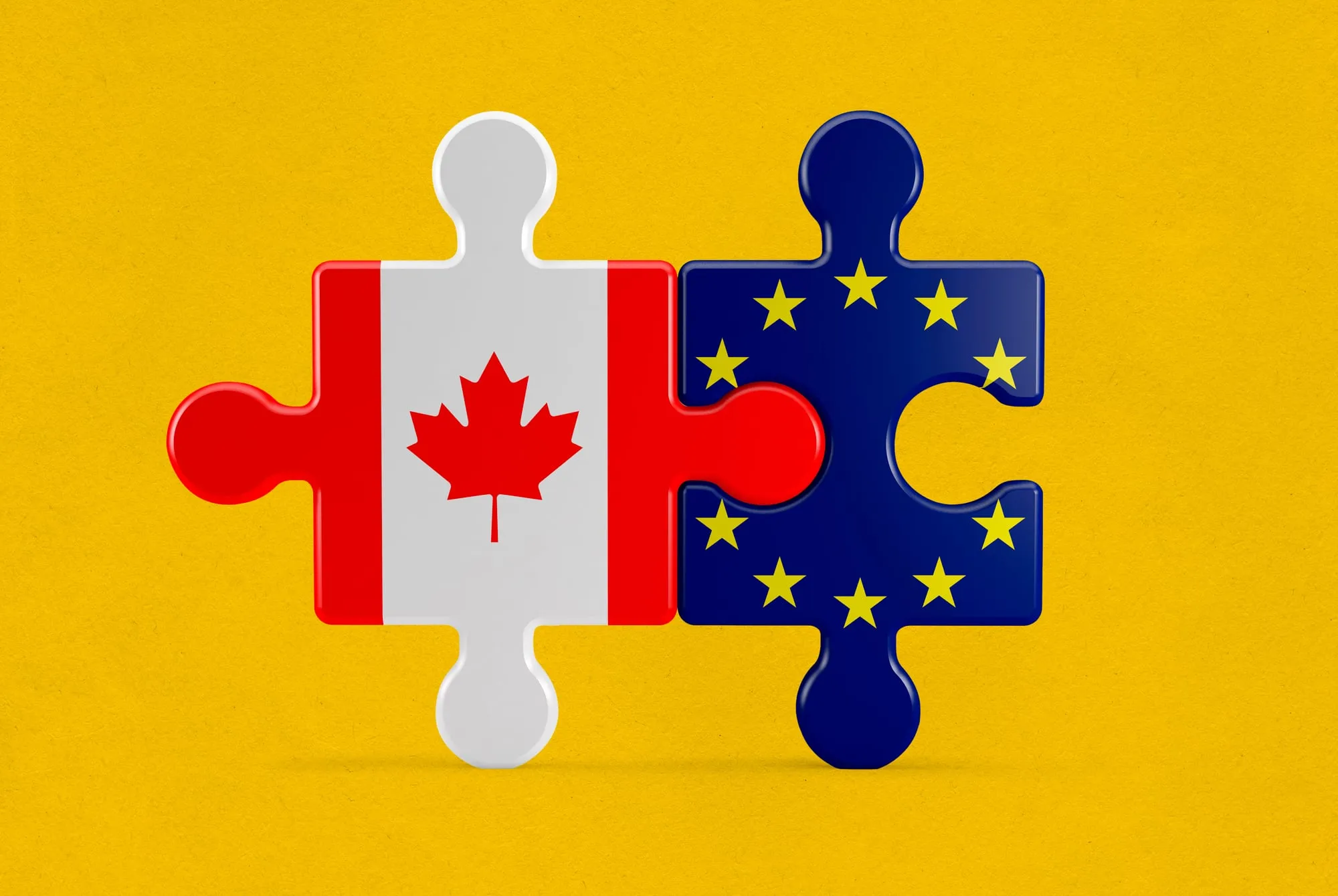
Why Canada Should Join the EU
Canada is in a tricky place. We’re a prosperous country in an increasingly precarious world, tied tightly to a superpower that’s grown more volatile. We’re reliant on commodities in a century that prizes ideas, and we’re trying to navigate multipolar geopolitics—all without a clear map. Our trade depends on open borders we don’t control. Our innovation feeds industries we don’t own. Our foreign policy has lofty values, but our economic leverage rarely matches our voice. We are, in short, stuck in the middle: of alliances, of markets, of history. And that middle is narrowing. It’s time we had a strategy to match the moment—one that includes forging a deeper economic alliance with Europe by joining the EU.
Full disclosure: I have skin in the game. I’m Canadian. My partner is European. We met in the air, somewhere over the North Atlantic. Our children are half-and-half, and our lives are stretched across both continents. I live in Berlin, where I benefit from access to German and EU research funding and appreciate the simple things, like functional public transit and an affordable cultural scene. My partner practised at Toronto’s Princess Margaret Hospital, one of North America’s best cancer centres, and still marvels at how the city pulls off a cohesion between languages, nationalities, religions and skin tone that seem elusive in his own country. We are both small-scale beneficiaries of a larger idea: that open borders, shared rules, trust and a little mutual respect can go a long way.
Canada and the EU belong together. We share something rare: a worldview built on co-operation, not coercion. Things like multilateralism and a rules-based system; the protection of human rights and democracy; and the importance of climate action and sustainability. Also, the cheese.
Even setting aside those obvious draws, there’s a strong economic case for joining the EU, starting with market size. Canada’s landmass is huge—physically and strategically—but its economy is not. Our GDP is about the same as the Chinese province of Guangdong’s. We have the population of Delhi. And yet, by some accident of fate, we’re part of the G7. My best guess is that Pierre Trudeau showed up at the G6, said, “Bonjour,” and Gerald Ford pulled up a seat for him at the table, mistaking him for the French president.
Size matters because bigger markets have more leverage, so they get better deals. They set the rules and call the shots. The promise of scale, combined with regulatory consistency, attracts investment. And with investment comes jobs. The EU, with its motley crew of 27 countries and 450 million people, has done a surprisingly good job of figuring this out. It accounts for a sixth of global GDP.
Related Posts

Carney’s Biggest National Project is Mythmaking
Carney Is the Crisis Manager Canada Needs
We got a sample of what EU membership might look like with the Comprehensive Economic and Trade Agreement, which provisionally came into force in 2017. It eliminated tariffs on most goods between Canada and the EU and improved market access for some services. But it’s still just a trade deal: it doesn’t give us EU voting rights, influence over regulation or access to structural funds that strengthen economic development and reduce disparities.
Sure, we could just export more lobster. But with an EU membership, we could also set the conservation standards that govern trap sizes or seasonal restrictions. When our fishers face a moratorium, we could dip into EU funds to help tide them over. We’d be able to do more than just sell more canola oil—we’d also get a say in how EU GMO rules or food-labelling policies are designed, and could use EU support for farmers who want to transition to more sustainable farming practices.
Selling more stuff abroad helps, but it’s not the same as building an economy. The bigger challenge is what we make, where we make it and how much value we both create and keep. By most metrics Canada is a staples economy: energy products, gold, wheat and lumber lead our export table. It’s not for lack of ingenuity. Frederick Banting invented insulin. Geoffrey Hinton pioneered machine learning. Pieter Cullis developed the lipid nanoparticles behind mRNA vaccines. But none of these were commercialized in Canada. We create opportunities, pass the ball and then someone south of the border scores the goal.
What we lack isn’t talent. It’s traction. That comes from having two things: a big market to sell to, and a deep capital pool to draw from. We have neither. The EU has both. With almost half a billion consumers operating under a shared set of rules, the EU is one of the few places in the world where a startup can scale continent-wide without having to morph at each border crossing. And it has the capital markets to back that scale, with pension funds, public development banks and venture financing options available in two dozen EU countries.
Turning our heads and hearts to Europe doesn’t mean turning our back on the United States. The U.S. is our longest neighbour, our largest trading partner, our default market. It’s always there, but not always all there. That’s the problem: roughly 75 per cent of Canada’s exports head south. Entire supply chains rely on an open border and the belief that the rules of the game will be sensible and transparent. They rest on the assumption that omitting “North” from “Buy American” was just sloppy copy editing. It works. Until it doesn’t. And then we’re sorry we didn’t see it coming.
Canada has always been good at compromise. Geographically, politically, economically, we live in the hyphen between other people’s empires. But compromise is not the same as strategy. If the world is sorting itself into continental, commercial and geopolitical blocs, we need to stop pretending we either float between them or rise above them.
Why would the EU want us, you self-effacingly ask? Well, we’re remarkably stable, extremely well-educated, ridiculously rich in natural resources and have no designs on Greenland. We don’t start wars. We don’t destabilize currencies. We can fuel the energy transition without threatening anybody’s sovereignty. And we have one of the most quietly admired national brands in the world. If you don’t believe me, just ask an American traveller in Europe about the maple leaf stitched onto their backpack.
But this isn’t just about good vibes and diplomatic hygiene. Canada could help the EU do things it already wants to do: secure critical minerals without relying on autocracies, expand its geopolitical footprint without overextending militarily, and deepen transatlantic ties without being wholly dependent on Washington. We’re aligned on rights, climate and institutions. We speak both French and English (with varying degrees of smugness). And with a seat at NATO, the G7 and half the world’s trade tables, we’d show up ready to play. Add to that rule of law, a robust financial architecture and millions of hyphenated Canadians with roots across the EU, and the case writes itself.
That doesn’t mean joining would be easy. There’s the tetchy matter of Article 49 of the EU constitution, which says that only “European States” can join their club. Last I checked, Canada was still part of North America. But continental classifications can be arbitrary, and the Mercator projection—that valiant attempt to reduce a 3D planet Earth to the 2D map hanging in all those elementary schools—is misleading. It’s closer to ship from Halifax to Lisbon than to truck from Halifax to Los Angeles. The world is bigger than we think and smaller than we imagine.
Joining the EU isn’t like swiping right. It would be a years-long, highly technical courtship that would require adopting the EU’s entire body of law—35 chapters’ worth—covering everything from food labelling and financial regulation to tomato traceability and caps on mobile roaming charges. All 27 member states must say yes, not once but repeatedly. And even if geography proves flexible, economic integration would still come with trade-offs: aligning environmental standards (say, pesticide and GMO use), adapting to EU competition rules (which might frown on our cozy oligopolies in banking and telecom), and revisiting how we subsidize agriculture or green tech. We might even have to consider adopting the euro. It would mean rethinking procurement rules, consumer protections and industrial policy—not just for optics, but to meet the expectations of a much larger system.
Even if it proves impossible, though, we should want to join. Not because we feel jilted, or because we need a new identity, but because we need a new plan. One that reflects who we are, where we are, and what kind of economy we want to be when we grow up.
Rajshri Jayaraman is an associate professor of economics at ESMT Berlin and an associate professor of economics (status only) at the University of Toronto.
Related Posts

How to Win the Space Race
Canada’s Defence Firms Are Ready to Boom

Alberta Treaty Law Could Decide the Arctic
My Adventures in Greenland
Get the Best of Maclean’s straight to your inbox.
Sign up for news, commentary and analysis. Join 60,000+ Canadian readers.