Canada’s Aging Infrastructure Is a Ticking Time-Bomb
In December, a major pipe in Calgary suddenly and catastrophically burst. The rupture occurred along a feeder main, a critical artery that funnels water from treatment plants into the city’s broader distribution system. Roughly 60 per cent of Calgary’s treated-water supply flowed through that single main. When the pipe failed, millions of litres of water surged into nearby streets, flooding a major roadway with an icy torrent. Thirteen people had to be rescued, trapped in their cars as the freezing water rushed past.
The incident was thankfully not fatal, but its impacts were far-reaching. It affected tens of thousands of residents. Alberta Health Services issued a boil-water advisory for 3,100 homes in nearby communities, and the entire city was asked to restrict water use—some by limiting showers to three minutes. It took weeks for the feeder main to be fully reconnected and for water to be declared drinkable again. The total cost of repairs is expected to reach millions of dollars.
This was not an isolated incident; it was the second catastrophic failure of the same feeder main system in two years. After a similar rupture in 2024, which occurred in a different section of the pipe, the city of Calgary installed acoustic fibre-optic monitoring along the feeder main. One million fine wires were wrapped around the concrete pipe in order to detect snapping sounds that occur when a structure deforms under stress—an early warning sign of potential failure.
But in the two months leading up to the 2025 collapse, there were no warning signs. The pipe failed anyway, splitting open along a clean line, almost like a zipper separating. The affected section was installed in 1975, and an independent expert report concluded that age-related deterioration posed a known risk that had gone unaddressed. In fact, the feeder main had been flagged as vulnerable as far back as 2004, after yet another failure briefly left 100,000 Calgarians without water.
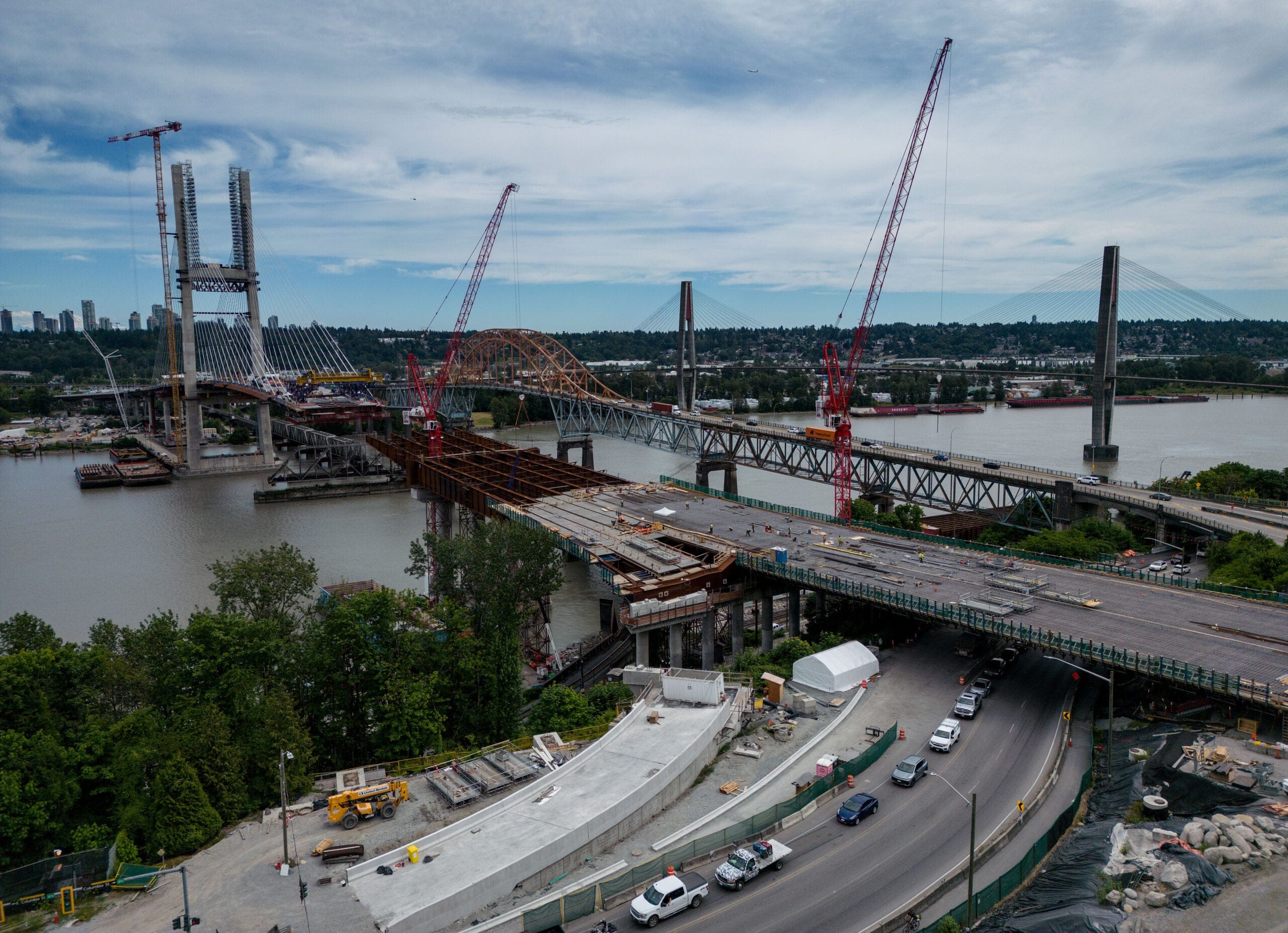
Incidents like these are likely to keep happening without intervention. The majority of Canada’s civil infrastructure is more than 50 years old, and a lot of it is starting to show its age. Across the country, there are more than 47,000 publicly owned roadway bridges, approximately 40 per cent of which are rated as being in fair, poor or even very poor condition. And as our population grows and traffic intensifies, the stresses on these structures will increase, accelerating their deterioration.
A big part of the problem is that much of Canada’s infrastructure is built with concrete. Concrete is ubiquitous because it’s relatively cheap, versatile and good for engineering applications when reinforced. But over time, it degrades and cracks due to environmental factors such as freeze-thaw cycles and chemical exposure. Climate change is intensifying temperature swings, increasing the frequency and severity of those freeze-thaw cycles and speeding up degradation. When concrete reaches its load-carrying capacity, it can fail suddenly, with very little deformation prior to collapse.
Related: Montreal’s New Rail Line Is the Future
That feature of concrete exposes the limits of our current monitoring techniques. Tools like Calgary’s acoustic system are installed with the expectation that they will help inform decisions about whether to continue operations or retrofit or demolish a structure. Recent failures show these forms of monitoring are insufficient.
Many of Canada’s structures—bridges, overpasses, dams—were designed to have a shelf life of about 50 years. They did what they were built to do, but there haven’t been timely replacements or large-scale renewals in the meantime. How did we get here? In many ways, it comes down to governments consistently prioritizing other demands in their budgets. Deferred inspections of Calgary’s water mains had costly repercussions, but this is far from one city’s problem: across the country, more than 25 per cent of water mains are in need of repair. In Montreal, a major water main burst in 2024, flooding surrounding streets, cutting power to thousands and triggering a boil-water advisory for 150,000 homes. City officials had identified signs of deterioration in earlier inspections, but repairs were deferred.
The consequences of these oversights can be deadly. The 2018 collapse of a bridge in Genoa, Italy, killed 43 people, despite careful monitoring of the structure. Canada has experienced its own tragedies, including the 2006 overpass collapse in Laval, Quebec, which killed five people. Without better ways to detect deterioration before disaster occurs, these kinds of incidents risk becoming more frequent.
Instead of relying on conventional monitoring methods that keep Canadians in a reactive mindset, we need a proactive approach that uses computer modelling to predict failures before they happen.
In practical terms, this involves building a digital model of a structure, such as a pipe or a bridge, that reflects how it behaves in the real world. We can integrate variables like temperature changes, load increments, frequency of use, material degradation and existing cracks. The models can then simulate how stress accumulates over time and predict when a crack is likely to form or reach a point where it threatens structural integrity, based on what we know about how concrete behaves.
One of the major advantages of the modelling approach is that it evaluates the system as a whole. It can help answer a critical question: where is the weakest link right now? If the model predicts that a failure is likely in five years, that information gives us options. Instead of waiting for a catastrophic break that forces closures and emergency repairs, targeted, proactive retrofits can be carried out earlier, at a lower cost and with far less disruption.
Predictive modelling doesn’t just tell us when to intervene, though; it can also tell us a lot about how to intervene. It allows engineers to simulate how a retrofit will change a structure’s behaviour and to evaluate whether that meaningfully reduces risk. When failures like the Calgary pipe break do occur, predictive models can be used to analyze the variables that led to the incident and help reduce the likelihood of the next one.
These models can also be strengthened by better data collection. For example, drones equipped with cameras could assist visual inspections by increasing their frequency and coverage. Rather than relying on occasional, labour-intensive inspections—where engineers are forced to use ladders or harnesses to access the infrastructure—drones could regularly collect images from hard-to-reach areas without shutting down roads or dismantling structures and feed information directly into the model.
Perhaps most importantly, this approach is relatively inexpensive. Computer modelling allows us to run virtual experiments on existing infrastructure with minimal operating costs. Plus, we can test scenarios over and over again.
This kind of predictive modelling is already widely used in other fields. In the auto industry, computer simulations have dramatically reduced the need for full-scale crash tests, cutting costs while improving safety. (This technology is also deployed in the aviation and shipbuilding industries.) In medicine, surgeons use computer models to simulate heart procedures before operating, testing how changes might affect blood flow or pressure. Applying this tech to aging infrastructure is not about inventing something new; it’s about using powerful tools we already trust to make better decisions.
This approach is not without its limitations. No one model can capture every variable with 100 per cent accuracy, so its predictions can’t perfectly reflect real-world events. In the auto industry, for example, simulations are verified through real crash tests. In the case of aging infrastructure, we can’t deliberately push a bridge to collapse just to see if the model is correct. There will always be some ambiguity about how closely a simulated failure reflects an actual failure. We can only rely on a computer model when we see that it can simulate a physical event—there is a calibration process that relies on observed behaviour. If we can integrate computer models into the structural-health monitoring systems, we can verify that the computer predictions are accurate, and update the model to improve its reliability. We can learn from every failure to prevent the next one.
Investing in predictive computer modelling can be a difficult sell at the municipal level. Hiring specialized experts to model a structure that may not fail for 10 or 20 years might feel abstract when budgets are tight. Yet, over the long term, preventative measures are almost always cheaper than emergency repair.
One way to make adoption more feasible is through collaboration. A concrete pipe in Calgary is not fundamentally different from one in Montreal. Sharing data and expertise could spread costs across jurisdictions, allowing everyone to benefit from the same predictive tools and making proactive planning even more affordable.
It may not be realistic to expect immediate replacement of Canada’s aging infrastructure, but it is realistic to make better use of affordable predictive computer modelling technology we already possess. Doing so would allow governments to move from reacting to failures like Calgary’s water main break to anticipating them, saving millions of dollars and, potentially, lives.
Emre Erkmen is an assistant professor of building, civil and environmental engineering at the Concordia University.
Related Posts
Canada Can Be a Refuge for America’s Grad Students

International Student Caps Are Decimating Canadian Colleges

How to Stop the Gen Z Slowdown

Can Canada Survive Trump’s Attack on Science?
Get the Best of Maclean’s straight to your inbox.
Sign up for news, commentary and analysis. Join 60,000+ Canadian readers.