How Arizona tried to make it illegal to say mean things online
Lately, it seems you can’t swing a LOLcat by its tail without hitting some public official flaunting their ignorance of the Internet. We’ve seen everything from Vic Toews trying to haul Anonymous before the Canadian Parliament to New York Police Commissioner Raymond Kelly claiming that “the Internet is the new Afghanistan.”
Not wanting to miss out on the party, legislators in Arizona recently tried to make it illegal to say mean things online. Two weeks ago,the state senate unanimously passed Arizona House Bill 2549, which reads:
“It is unlawful for any person, with intent to terrify, intimidate, threaten, harass, annoy or offend, to use any electronic or digital device and use any obscene, lewd or profane language or suggest any lewd or lascivious act, or threaten to inflict physical harm to the person or property of any person.”
Regardless of the fact that we shouldn’t be legislating civility, or that the right to be as asinine and hyperbolic as possible is one of the basic tenets of the Internet, the law had "First Amendment violation" written all over it. The language was overly broad, and no definition of terms like “annoy” or “offend” was given, meaning the bill could have criminalized being a jerk in the comments section of a website.
And of course, just like Mr. Toews’ in his defense of the invasive Bill C-30, Arizona lawmakers argued that such sweeping laws were needed to protect children––in this case, from the menace of cyber-bullying. Never mind that efforts to fight bullying with strict legislation--whether it targets the schoolyard or cyberspace––never seem to work.
Related Posts
The Terrifying Rise of Ransomware Gangs

Canada Needs More Robots
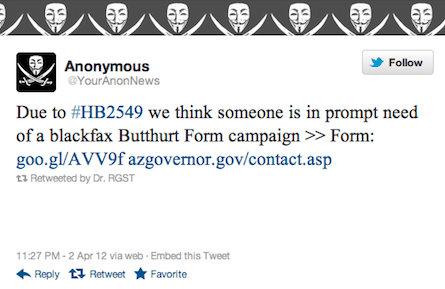
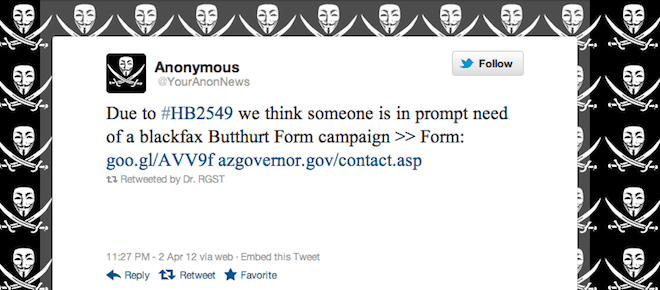
Fortunately, when you poke the Internet, the Internet pokes back. Free speech advocates immediately bashed the bill, and Anonymous began faxing “butthurt report forms” to Arizona Governor Jan Brewer. In case you’re unfamiliar, such forms are circulated in Anonymous locales as a means of mocking those who get offended by things they see online.
In the face of such opposition, it seems as if Bill 2549 has, in Internet parlance, been 404’d. After an attempt to amend the law, it was returned to the house. However, the bill remains on life support and could be resuscitated.
While this may be a case of all’s well that ends well, it’s also rather scary. It’s been six years since former U.S. senator Ted Stevens infamously reminded us that the Internet is “a series of tubes,” and yet lawmakers continue to display an embarrassingly low level of media and technological literacy.
The way we choose to legislate the Internet today will have profound effects on the world of tomorrow. It may be unreasonable to expect every legislator to be a sysadmin who can speak Leet, but they should at least understand the implications of the laws they’re passing--although that’s pretty hard to do if they don’t even read them.
Related Posts

Why Gen Z Is Addicted to Location Sharing

Teach Kids Digital Nutrition

Schools vs. Screens

A Canadian in Space
Get the Best of Maclean’s straight to your inbox.
Sign up for news, commentary and analysis. Join 60,000+ Canadian readers.