Why Gen Z Is Addicted to Location Sharing
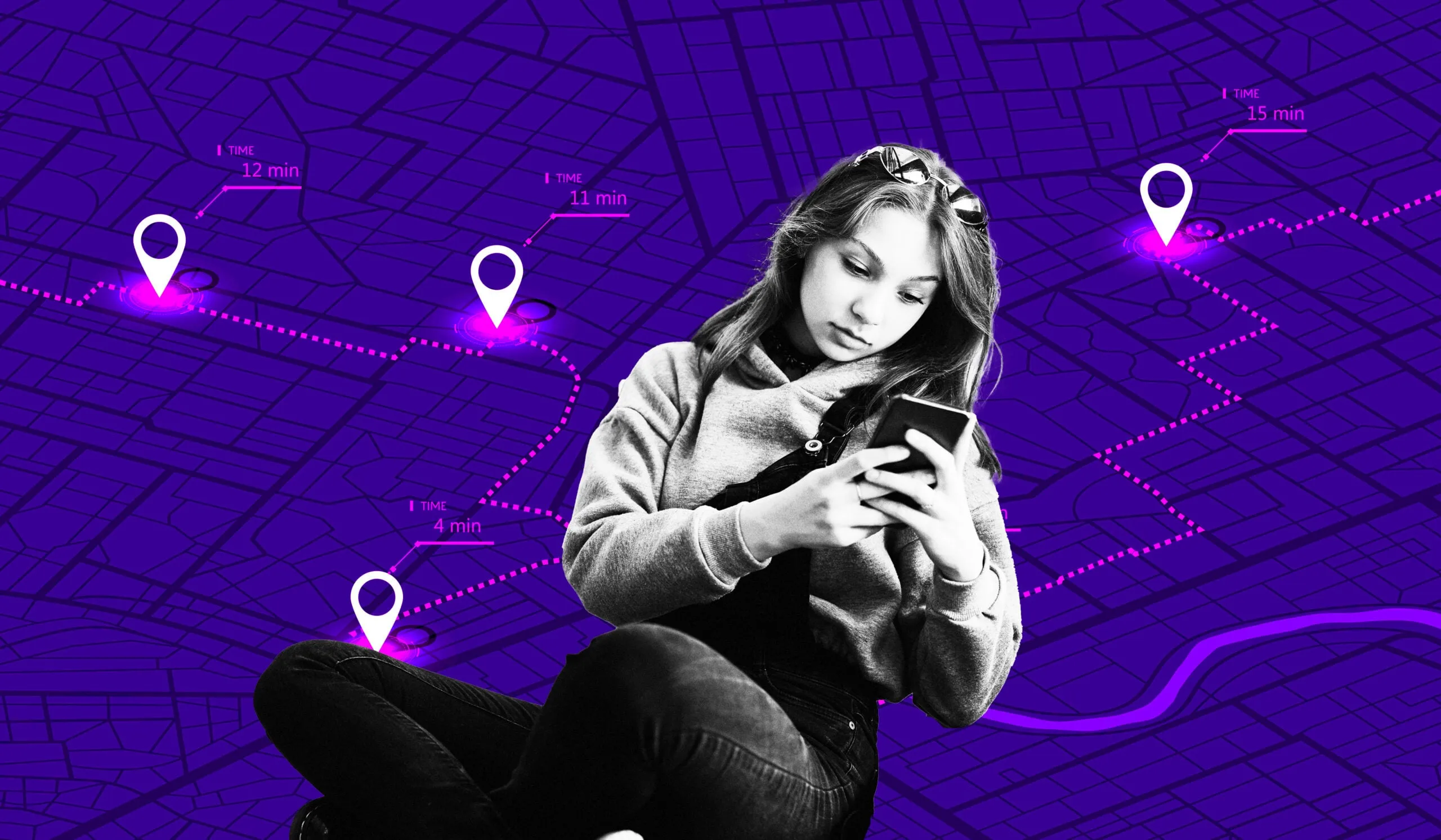
One recent afternoon, I was grabbing a matcha near my apartment when my phone buzzed with a text from a friend. “Is that a new café you’re at?” I laughed, the way you might when something is both funny and a little unnerving. I didn’t have to wonder how she knew where I was. Like 14 other people in my contacts, she can track my exact location at all times—just as I can track hers, along with those of my friends, roommates and old acquaintances.
I’m 22 years old and, among my peers, it’s become not only routine to keep tabs on our friends’ locations, but expected. Apple’s Find My Phone app, Snapchat’s Snap Map and Instagram’s location features allow us to share where we are at any moment, with whomever we choose. In the process, they’ve changed how we understand trust and privacy, normalizing surveillance-like behaviour that feels straight out of 1984—only Big Brother isn’t the government, but our friends. In a survey conducted this September by digital security company All About Cookies, 75 per cent of Gen Z respondents said they enabled location sharing on their phones.
Related: The Diabolical World of Phone Scams
Surveillance has become our default mode. You know you’re in a deep, committed relationship when someone pops the big question: share your location? My boyfriend and I share ours on Snapchat, and I’m not even really sure why. It could be because TikTok convinced us it’s what serious couples do—#relationshiprules posts frequently list location sharing as non-negotiable.
This habit didn’t come out of nowhere. On Foursquare, an app popular in the mid-2010s, users could tag themselves at specific locations. And people have casually tagged locations on Instagram for years—a bar, a restaurant or a beach halfway around the world. This is meant to brag about status, or to connect through shared places. Eventually, it became normal, even comforting, to be findable. Sharing our locations in real time, 24/7, just feels like the next step.
The first time location sharing entered my life was in 2017, when Snapchat launched its Snap Map, and users turned on their locations to allow dozens or hundreds of their connections to pinpoint where they were. If I went on Snap Maps right now, I would see hundreds of avatars spread over a global map. I’m lucky that my parents taught me about digital safety from a young age—I never shared my location publicly. But plenty of my peers did; as of 2022, 250 million users were using Snap Map each month.
Recent tools are more precise. Apple’s Find My Phone shows a user’s location down to the address. The user doesn’t need to have their app open—only their phone turned on. On Instagram’s recent location-sharing feature, meanwhile, users can show where they are through the app’s messaging tab.
Many of my friends treat location-tracking as entertainment. We openly stalk our friends’ dots on maps and joke about watching their “sims” move around. One person in my friend group is chronically late and, more than once, a group of us have been sitting in a bar waiting for her—only to check our maps, see she’s still at home and give her a call to tell her to get going. It only hit me later how invasive it was to do that without even thinking. Gone are the days when you could type “on the way” while still in bed, or flake with a vague excuse. Once, a friend texted me while I was out with my parents: “Are you at Starbucks? Sorry I was checking your location.” Another friend once texted, “Why are you at the mall?” (Look, sometimes I don’t want to admit that this is my fifth trip to Aritzia this week.)
What is most remarkable to me is that this surveillance doesn’t bother most of my friends. Many of us do it without considering why. I asked one of my friends who chronically checks locations why she does it, and she gave a few answers: tracking the progress of a bus her friend is on, or seeing if people she doesn’t like are at the same bar. The main reason: “I love knowing where my friends are!”
As easy as it is to start location sharing, it’s much harder to stop. Turning your location off is like leaving a group chat, or, for the Gen Xers out there, unfriending someone on Facebook. If you stop sharing, you’re making a statement. Did you have a falling out? Are you mad? For someone like me, who hates confrontation, it’s easier to leave it on than to explain that I just don’t need everyone knowing where I am all the time.
There are also social politics and hierarchies built into these maps. When I was in high school, my friends and I made a pact not to post on Snapchat and Instagram when we hung out unless everyone was there. We didn’t want anyone to feel left out. Today, it doesn’t matter if you’re actively posting; you’re always being passively followed. I’ve scrolled on the map as a reflex and seen a group of friends travelling on the bus, then going to see a movie together—without me. That’s fine. I don’t have to be everywhere all the time. But I also don’t need a big neon light flashing, “You’re not here!”
There are good reasons to share your location. I’m hyper-aware of the dangers of living in a university town. I’ve seen stories about kidnapping and sexual assault turned into TikToks, and I’ve marched in protests against sexual violence. It feels safer when people know where you are. On the other hand, is it really a good idea to broadcast your exact location with a GPS-enabled map?
There is another kind of danger as well: not just being tracked, but forgetting what it’s like not to be. I don’t really know what it’s like not to be watched. My generation has gone from living with our parents—who knew where we were all the time, because it was their job—to living as young adults who are always findable. (Imagine if Ferris Bueller had a location-tracking iPhone. His day off never would have happened.)
I wish I could experience the mystery of meeting someone without knowing where they were five minutes before. I’d like to send a “Where are you?” text and genuinely not know the answer. I would even like to be blissfully unaware of what my friends are doing without me. Instead, I’m constantly aware of the invites I never got. One of the only times I’ve been truly off-grid was during a tech-free summer camp. Otherwise, my phone, and those of my friends, have become nearly literal extensions of ourselves.
This phenomenon might not feel like exposure, since we’re so used to performing and showing off our lives online. We broadcast where we’re eating, who we’re with and what we believe. I’ve had a public Instagram account since I was 12 years old. But there’s a difference between being seen and being watched. When you’re posting, you’re showing people what you want. When you’re being tracked, everyone knows you went to the Blue Jays game, stopped for a coffee and went thrifting on the way home.
Location sharing is invasion disguised as intimacy. I don’t think Gen Z set out to give up our privacy. It happened gradually, until it became an expectation, and now nothing feels private—not even the places we retreat to when we want to be alone.
Fifteen people still have my location as I write this. Maybe this story will be my wake-up call to unshare. But if I do, I’ll get questions. “Everything okay?” “Did I do something?” And then I’ll have to explain: nothing’s wrong, I’m fine and I’ll see you later.
Related Posts
Teach Kids Digital Nutrition
The Terrifying Rise of Ransomware Gangs

Canada Needs More Robots

Schools vs. Screens
Get the Best of Maclean’s straight to your inbox.
Sign up for news, commentary and analysis. Join 60,000+ Canadian readers.