
The Blue Jays Lost. So Did I.
Like many Canadians, I experienced this year’s World Series as a series of tense, emotional highs and lows. Every hit or run sparked a thrill or a jolt of dread. Each game was more anxiety-provoking than the last. But unlike most Canadians, I had more than a fan’s stake in the outcome. I’m a professor of statistics, and I had accidentally stuck my neck out farther than I intended. My interest in the winning team was not only personal, but professional.
It all started innocently enough. As a statistician and frequent media commentator, I had a brief TV interview after the Jays made it to the World Series. I knew what they would ask me: what are the odds the Jays would win? To answer the question, I developed a simple statistical model. I extrapolated from the Jays’ and Dodgers’ regular-season performances, in which the Jays had the slightest advantage (a win-loss record of 94-68, versus the Dodgers’ 93-69). I also looked at home field advantage, which worked in the Jays’ favour, as they would have one more home game than the Dodgers. I didn’t delve into more complicated variables, like individual player performances or injury status. My statistical model ended up giving the Blue Jays a slight edge, with a 52.46 per cent chance of success. I explained my findings, and was ready to move on.
Only later did I realize that everyone else considered the Dodgers to be the heavy favourites. Most forecasters and gambling sites gave them a 70 per cent chance or higher of winning, with the Jays stuck in the mid-20s. People said we had little hope, especially considering the Dodgers’ superstar, Shohei Ohtani. Some even predicted a Dodgers sweep, with the Americans winning the first four games and going home early. By giving the Jays a slight edge, I had unintentionally gone far, far out on a limb, and I started to worry that my forecast had been way off.
Related: Goodbye to Gretzky
My precarious position was driven home to me just before the series began, while I was being interviewed by a Calgary radio host. When I told her my forecast, she gushed, “That’s incredible! Jeffrey Rosenthal, from the University of Toronto, with a Ph.D. in math from Harvard, you calculate that the Toronto Blue Jays have a slight edge of winning the World Series?”
“That’s correct,” I replied, with far more confidence than I felt.
So I was more nervous than most when the series began. Would the Dodgers sweep after all? Would the Jays be crushed? Would people somehow blame me, and would my credibility as a statistician and forecaster be ruined forever? Of course, a 52.46 per cent chance is basically a draw, but no one noticed that. An edge for the Jays was an edge for the Jays, period. My friends all seemed to interpret my statement as a declaration that the Jays would win.
Fortunately, they had an excellent first game, including a nine-run sixth inning. Ultimately, they emerged with a strong 11 to 4 victory. Phew. “My prediction doesn’t seem so crazy now, does it?” I posted online. With that convincing opener, my updated model now gave the Jays a solid 66.1 per cent chance of victory.
My euphoria didn’t last. In the second game, Dodgers pitcher Yoshinobu Yamamoto stymied the Toronto bats, holding them to just one run. The Dodgers won 5 to 1. Then, the third game went to an astonishing 18 innings before the Dodgers won again, 5 to 4. The Jays were then down to just a 31.3 per cent chance of victory, according to my model. The Jays—and my statistical forecasting—were both hanging by a thread.
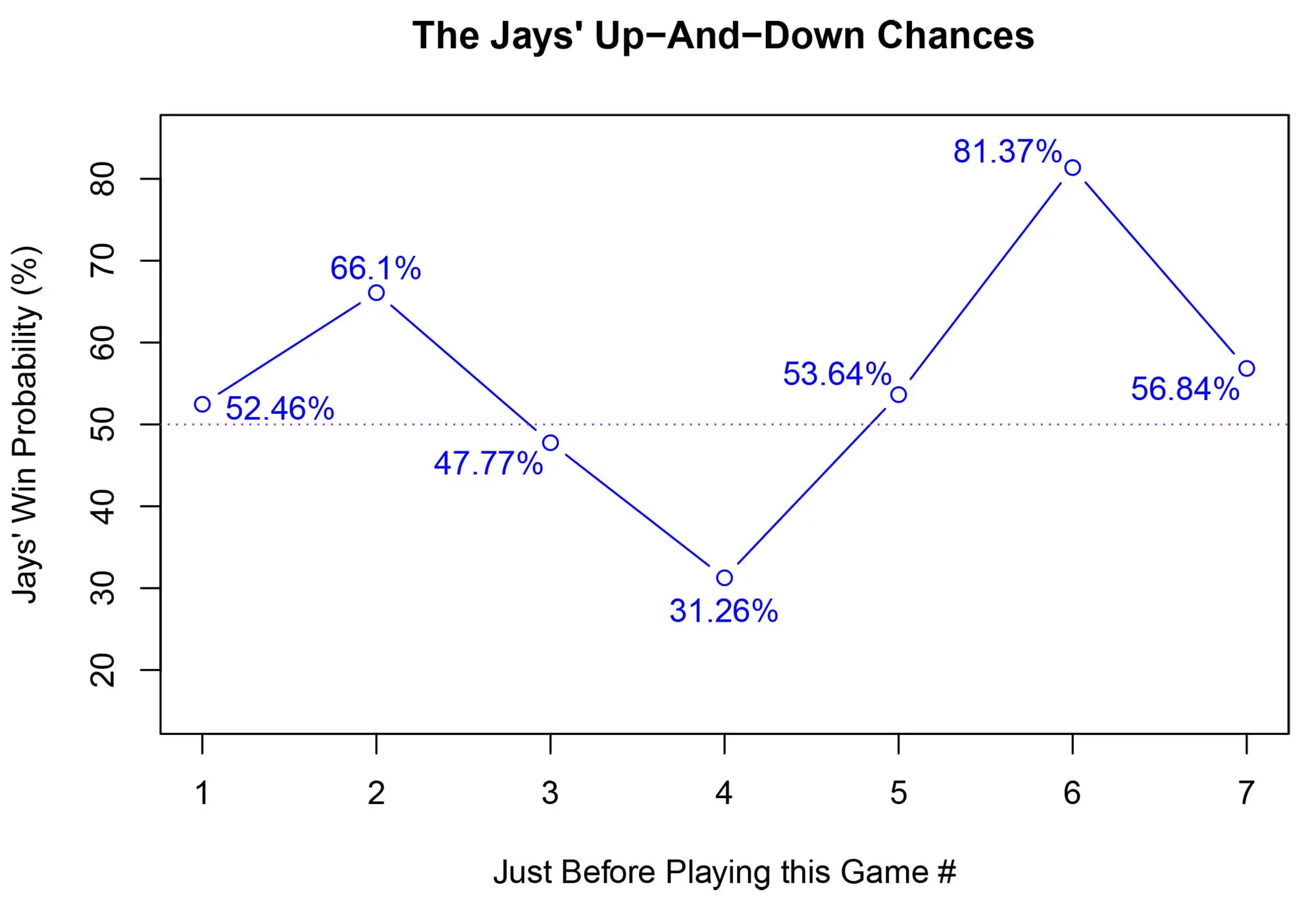
And yet, as I explained to anyone who’d listen, 31.3 per cent doesn’t mean it’s time to give up. And indeed, in the fourth game, the Jays fought back to a 6 to 2 win, evening up the series and restoring their edge. I now forecast a 53.6 per cent win probability. Would they prevail after all?
The fifth game was key; whichever team won would have a strong advantage going into the final weekend. Tensions were high. But I needn’t have worried. The first two Jays batters each hit a home run, and Trey Yesavage got 12 strikeouts, leading his team to a convincing 6 to 1 victory. My statistical model gave us an 81.4 per cent chance of winning the series. For the first time, I felt truly hopeful.
Once again, my hope was short-lived. In game six, Yamamoto again kept the Jays to just one run for a 3-1 win, which evened up the series and forced a seventh game in Toronto. By then, my model gave the Jays a 56.84 per cent chance of winning—still favoured, but not by much. And then that final game was so close. There were so many opportunities for the Jays to put it away. But the Dodgers eked out a narrow 5-4 victory in the eleventh inning, and the Jays’ near-triumph collapsed into tragic defeat.
So, after all that, the Jays didn’t quite make it. No World Series champions this year. As a fan, I’m very disappointed, but as a statistician, do I feel ashamed? Not really. I hadn’t really picked the wrong winner, since a 52.54 per cent chance of winning is virtually 50-50. Rather, while so many others thought the Dodgers had it in the bag, my statistical model predicted that the Series would be very close. Which it most definitely was. The Jays didn’t quite pull it off, but they could have. And that’s what a 50-50 prediction is, after all.
Jeffrey S. Rosenthal is a professor of statistics at the University of Toronto, and the author of the book Struck by Lightning: The Curious World of Probabilities
Related Posts

The True Cost of Competing in the Olympics

The World Cup Will Relegate Canada to the Sidelines

Goodbye to Gretzky
Get the Best of Maclean’s straight to your inbox.
Sign up for news, commentary and analysis. Join 60,000+ Canadian readers.