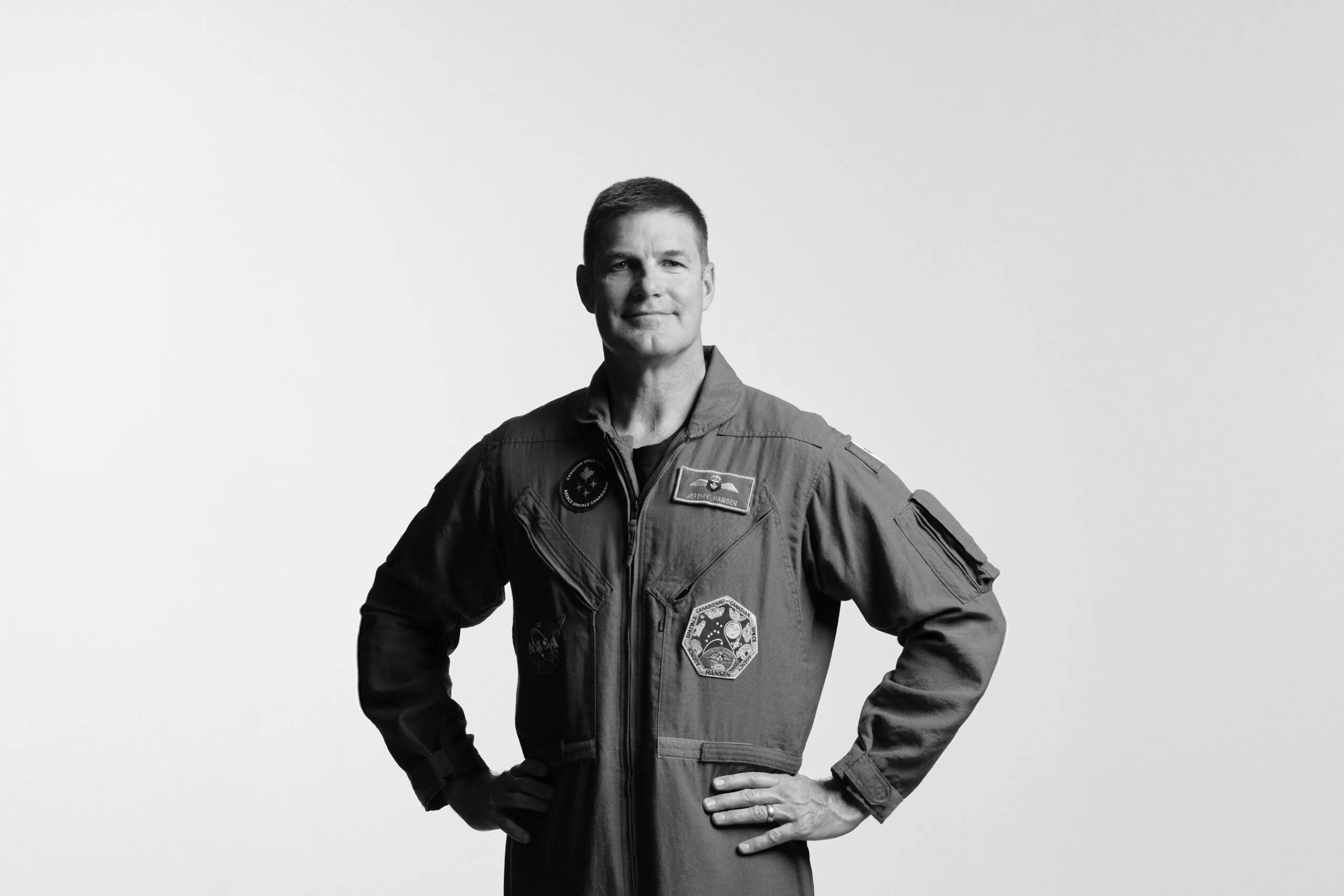
Jeremy Hansen’s Job Is Moon
In Jeremy Hansen’s opinion, some of humanity’s stickiest problems are best solved from 380,000 kilometres away. As soon as T-minus two months from now, Hansen, a former air force pilot from London, Ontario, will squeeze his six-foot-two frame into NASA’s Orion capsule and head for the moon, becoming the first non-American astronaut in history to travel beyond low-Earth orbit. During the mission, dubbed Artemis II, the four-person crew will perform a figure-eight lunar flyby, along with rigorous tests to track the effects of space on the human body. That data will be quite handy quite soon. Hansen’s roughly 10-day excursion is just the second phase in NASA’s multi-step plan to build a habitable base on the moon—and yes, Elon, eventually get humans to Mars.
Still, no one’s going anywhere without Canada’s help. In addition to our growing collection of launchpads and cargo-rocket companies, the Canadian Space Agency is hard at work on Canadarm3, mulling over a lunar nuclear reactor and lending a hand with Gateway, a next-gen space station that’ll orbit the moon—not to mention a kicky rover. But, given the chance, would Hansen leave Earth behind? Only temporarily.
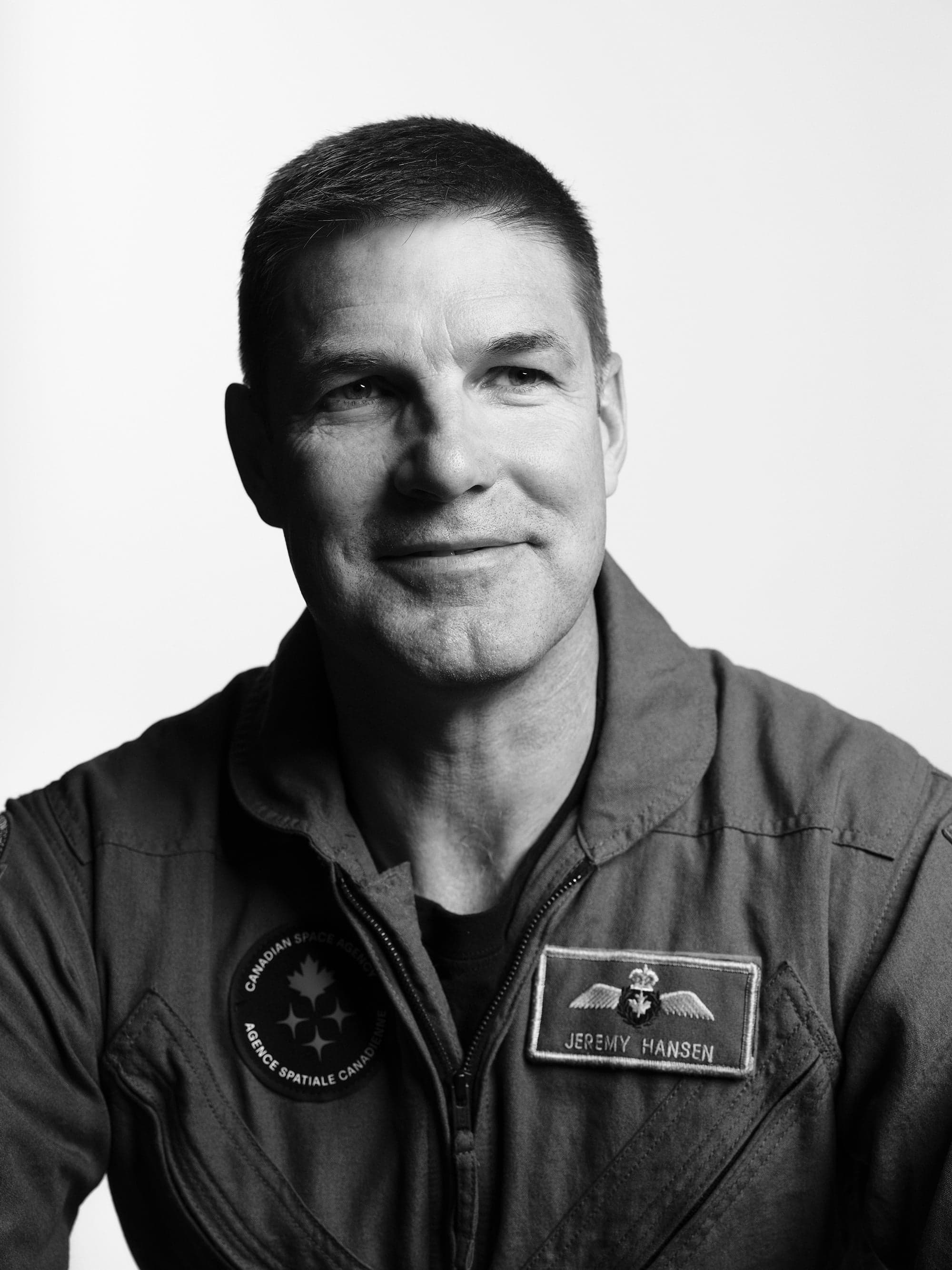
You’ve been an astronaut in name since 2009, but you’ve never actually been to space. How does it feel now that, after some delays for heat-shield repairs, you’re finally about to blast off?
The feeling is: busy. Am I super-excited yet? Not really. I’m just focused on mission accomplishment. This is the first time we’ve put people on this rocket, so we’re constantly trying to figure out what we could have missed. It’ll feel like I’m going to space when the engines cut out and we’re there.
Take me through some of your training exercises. You’ve been spending most of your time at the Lockheed Martin facility in Denver, correct?
Related Posts
Timothy Snyder Has Seen Tyrants Like Trump Before
The Man Who Wants to Mine the Ocean
Yep. In Houston, we have “emulators,” which are more akin to playing Microsoft Flight Simulator at home. Denver is where we have an iron bird, the closest thing on the ground to the real rocket. They’ve built an integrated test laboratory with exact twins of the computer boxes—even the wires are the same length. Just before I travelled back to Canada, we did a two-day “sim.” We rehearsed all the way from launch through the trans-lunar injection burn, which is when we accelerate to 39 times the speed of sound to fly out to the moon—roughly a day after launch. The trainers threw a number of issues at us; the vehicle was in a significantly degraded state, and a lot of our system redundancy was gone. We had to decide whether to head onward or come home early.
These sims are led by what you’ve called “evil teachers,” who purposely try to kill your crew. Have they succeeded?
I regret using “evil”; they’re just doing their job. They haven’t killed us yet, but I suspect they will a few times before we fly.
The Artemis II team’s main mission, in addition to the figure-eight flyby, is to test the physical impacts of space on the body, like human guinea pigs. Aside from the obvious lack of oxygen, how bad is space for us, really?
From a medical point of view, the biggest threat is radiation. The Earth’s magnetic field is a huge gift: it protects us from the sun’s radiation and the intergalactic kind as well. We’ll get a pretty significant dose onboard. The Apollo astronauts fared reasonably well afterward, but we don’t have a lot of data on that; we’ll be collecting our own. NASA’s taken cell samples from us to test before, during and after microgravity. We also see a loss of bone mass in sedentary astronauts—not a big deal for our 10-day mission, but it is for people aboard the International Space Station.
Don’t you also have to lick little pieces of paper every day to collect saliva? Why are you doing that?
That’s for an immune-system experiment NASA is running.
What if you bring a cold to space?
We really try not to. We’re in a two-week quarantine before we go up.
So what’s inside your personal carry-on?
We’re each allotted a pound of mass. A year and a half ago, I gifted my wife and three kids moon pendants with our family birthstones on them. They wore them for quite a while and, this past summer, I collected them back. I’ve sent those away to be packed in the vehicle. I’ve also got some flags.
Be honest: how’s the food looking?
I’m not a picky eater, so I might not be the best judge, but I think it’s pretty good. We’ve been feeding astronauts on the space station for 25 years straight, so a lot of effort’s gone into making things palatable. Food is a big part of morale. The Canadian side is bringing syrup and maple cookies because, well, it just has to be that way. And I’ve picked a curry dish that has quite a bit of flavour to it. We have a warmer that we can use once our food’s been rehydrated—an Easy-Bake Oven sort of thing.
The Orion module, where you’ll be bunking, is about the size of two camper vans.
Two is generous.
You’ll be sharing those extremely tight quarters with three Americans. It’s an interesting time for a tandem mission. Has our diplomatic drama permeated your pod at all?
We’re pretty walled off from it. Our international space team has a lot of water under the bridge, a lot of trust. We’ve taken care of one another for decades, so it’s quite hard to unseat that. The political tensions are very real, but we know, long term, the best thing is collaboration—not in a way that’s oblivious to what’s going on, but as a way to say, “Let’s remember what we’ve got here.”
We may not have the luxury of a U.S.-sized budget, but Canadians could definitely stand to brag more about our country’s space contributions. We’re now working on version 3.0 of the Canadarm. We helped out with the Webb telescope and, soon, Gateway, a brand-new space station that’ll orbit the moon. What ingredients make us so skilled in this department?
One big thing is that we’re willing to take risks. Take the Canadarm: if the shuttle bay had opened up and that arm had malfunctioned, it would have been a really public failure. Going from sunlight to shadow? Minus 250 degrees to plus 250 degrees? That’s a significant engineering challenge. Nobody had ever built space robotics before, and here comes Canada!
Takin’ risks!
For decades, the challenges we’ve faced as a country have inspired those grand leaps. We were the third country in the world to build a satellite, specifically to understand how to use space to communicate. Why? We have a huge land mass. Canada has challenges providing health care—not just in remote areas, but even in cities. The Canadian Space Agency has made some specific investments in care delivery for Indigenous communities. Health is actually poised to be one of our next big opportunities in space. When you return to the moon with the intent to stay—and eventually do the same with Mars—it changes the problem set. If someone on the space station is sick, we bring them home that day and get them to a hospital. Now we have to ask: how do we care for people when they don’t have the option of just leaving whenever they want?
The commercial side of extraterrestrial exploration—not just passenger flights, but cargo rockets—is going to be the next big space industry. Can Canada be a leader in that too?
Yes. The logical first step is getting to the point where we’re launching rockets out of Canada. We have to get those ports established from a regulatory standpoint and manage public safety, just like they do in the U.S. And people are now developing private launch sites in Nova Scotia and Newfoundland. It’s not always important to be competitive, but to have your own niche. Compared to other places, Canada’s geography has its advantages, with respect to how far away each country is from the equator, for example. Our high latitude makes us suited to sending satellites into polar orbits—ideal for climate monitoring.
When Katy Perry was on Blue Origin’s flight last spring, she serenaded the crew with a rendition of “What a Wonderful World.” Do you have a playlist ready?
Yeah. Each of us gets a pair of noise-cancelling headsets—the spacecraft is loud—and a tablet with procedures and schedules. When we get a little break, we’re allowed to play music on it. I haven’t finalized my playlist, but I’ve been grabbing some favourite songs. Moon-themed ones as well.
Got any Bowie on there? “I Don’t Want to Miss a Thing?” The Armageddon soundtrack could lower the vibes, I guess.
Good movie, though!
You’ve met a lot of kids in your travels. What do they ask you about the most?
Aliens. They also ask about the food—and the toilet. That’s pretty common too. It’s neat when small children, like Grade 6 and younger, ask why we should go to space. They’re already thinking about why we explore when we have so much to tackle down here.
How many have raised the fact that you look like Buzz Lightyear? It’s striking.
I don’t think I’ve gotten that from kids. Definitely from reporters.
“Astronaut” is high on the list of jobs kids want to grow up to do. You actually became one. How was your desire different?
Hard to be certain, but my mom will tell you it showed up when I was five years old. We had encyclopedias at home. The volumes were shipped to us, one a month, in order. “A” obviously arrived first. I dissected that one and found airplanes, which I loved. Then I spent a lot of time on “Armstrong, Neil.” I turned my treehouse into a spaceship. Our family visited the Kennedy Space Center, and we took a cute photo of me with one of those cardboard cut-outs—a spacesuit with my head through it. Joining Air Cadets was also monumental in my growth; I was so shy before that. I basically told my parents I wanted to be an astronaut, and nobody told me I couldn’t.
You’re also an experienced aquanaut and cave-naut, a designation I just found out existed. You’ve spent six days underground in Sardinia on a Canadian Space Agency excursion and a week underwater off the coast of Key Largo with NASA. Is there any place in the universe you’re too scared to venture to?
All of that scared me at some point. The cave is by far the most dangerous thing I’ve ever done. One minute you’re moving through an open space, surrounded on all sides by rock, and the next, you realize you’re on the precipice of a cliff. You can only see what you illuminate with your headlamp. If we were seriously injured, we could’ve had to survive for a week or longer just to get out of the cave to a hospital. There are definitely things I won’t do. I’m very practical with risk. I’m not interested in thrill-seeking within an inch of my life. There has to be an objective.
NASA is transparent about the fact that the Artemis project’s ultimate goal is getting humans to Mars. Never mind Elon—do you think we will?
I don’t question whether we’ll get there; how quickly we do depends on how much money we want to invest in technologies that benefit us. There are some now where, if they work, they’ll change how fast it comes together. SpaceX’s Starship is a pretty extraordinary example of that, though we have to see how that all works out. If we connect new plasma engines to nuclear power in a scalable way, it could take the journey to Mars from eight months to 40 days, in theory.
Would you want to live there?
I’d be happy to do a tour of duty, but I’d want to come back. Earth is awesome. Mars? Not so awesome.
Have you gleaned any new insights into why we keep shooting for the moon, aside from beating China to lunar leadership?
I don’t think we ultimately do it for the flag-planting; the driver is more altruistic than that. Humans explore. We’re always going to. The beautiful thing is that it also happens to drive innovation. Eight billion of us couldn’t live on Earth if we didn’t have these grand objectives, which push us to create technology for problems we don’t yet have. Apollo was a great example of that. We take for granted its huge influence on so many things, whether that’s computing or microwaves. We sometimes assume that they’d have just come along anyway.
I understand you’ve already rehearsed saying goodbye to your family.
We’ve done that a couple of times now; launch day is highly scripted. I’m super-optimistic that we will survive this mission. But the reality is you could lose a crew in space, and it would not be that hard to do—not necessarily because of any negligence, but because of the extreme nature of what we’re doing. We may just get unlucky. This discussion is part of preparing the team—and preparing society, too. As we’ve seen in the past, the knee-jerk reaction with complicated missions has been: “We should stop doing this.” That would be horrible, the only way to not honour that crew’s sacrifice. The most important thing is that we stack the next rocket and let the next four astronauts go.
Related Posts

Beverley McLachlin is Watching the World’s Legal Drama

Ana Bailão vs. the Housing Crisis
Why Wes Hall is betting on Black entrepreneurs

Is Canada’s Military Ready for Trump?
Get the Best of Maclean’s straight to your inbox.
Sign up for news, commentary and analysis. Join 60,000+ Canadian readers.