The Water Movement: Inside the fight for Hong Kong
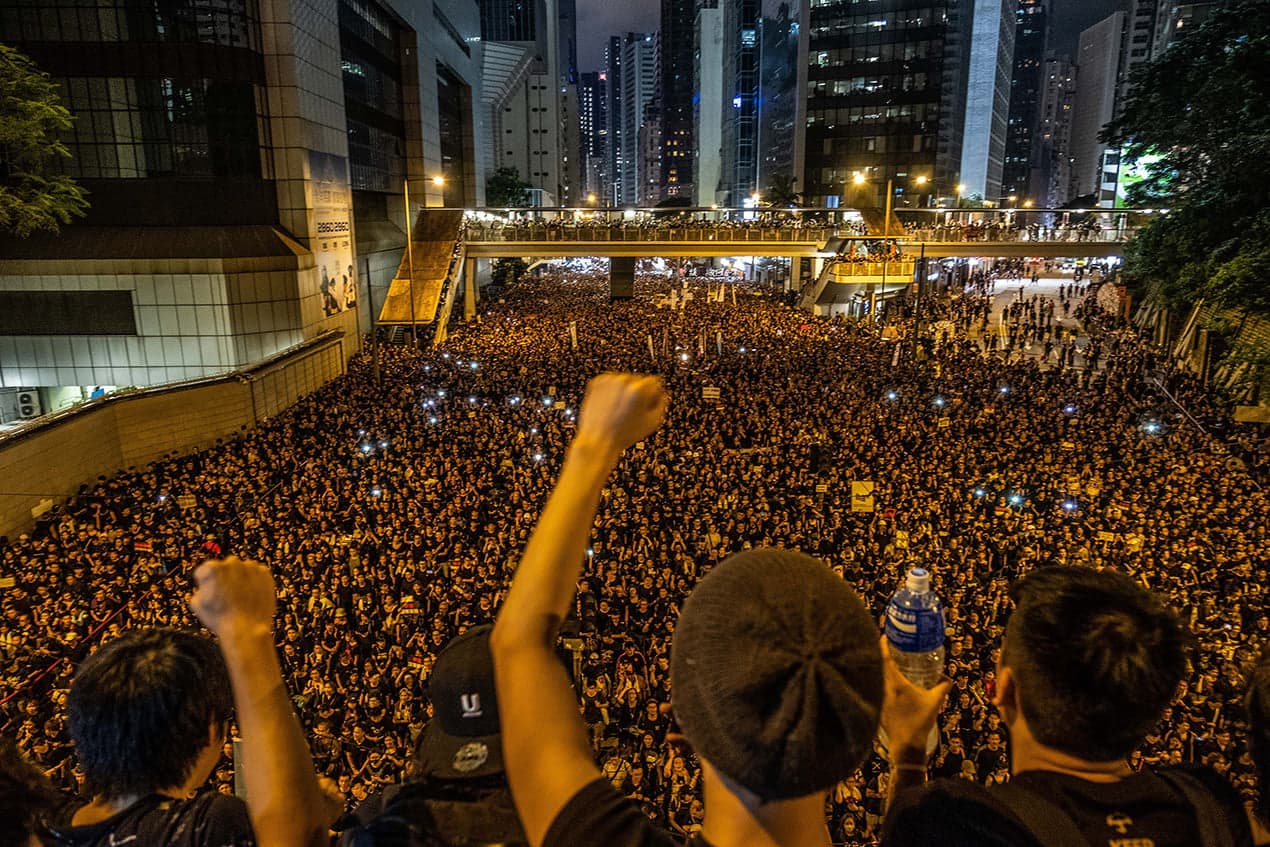
Lam Yik Fei/The New York Times/Redux
Two million people have flooded the city’s streets to protest China’s rising influence. Shannon Gormley on one day of the protest and the lives that it touched.
July 2, 2019
Inside the fight for Hong Kong
Shannon Gormley
To see the most spectacular thing modern man has ever built, deposit 2.70 Hong Kong Dollars into one of the little vending machines at the end of the Tsim She Tsui pier on a clear evening, and take a ticket. You’ll find the Star Ferry, small and wooden, bobbing in the dark water: step inside, and sit beside a window on the upper deck. You’ll want to make sure it’s the upper deck.
They’re lovely. But many things are lovely. You are here for something more.
Hail a boxy red taxi, get off at the funicular station, and take the old tram up the mountain. The city shrinks into a blur of lights reflected in its own glass. Now step off the tram, onto the escalator, and out to the platform. There you are hit with it.
Now lean over the railing, look down, and squint. Somewhere below are four of the city’s seven million people: a lawyer, a legislator, a reporter, and an activist. Separately, they are at work. A daughter of Hong Kong was killed in a foreign place, and now they must prevent the Hong Kong’s pro-Beijing government from exploiting her murder as a pretext to do what it has wanted to do for some time: Pass a law allowing Hong Kong authorities to hand people accused of one thing or another over to Beijing, which has been known to commit murders of its own. Each in their own way, these people resist the law; however, they are not alone.
The ferry will putter across the harbour to Hong Kong island’s Central district, and as it glides along, its windows will frame the skyscrapers before you. The effect is a series of botanical sketches hung along the waterfront. The Bank of China: a bamboo shoot, leaves folded in over themselves, tapering upwards. Two IFC: a single trunk stripped clean of branches. Jardine House, its round tree hollows peering out at the water; Central Plaza, its top-floor bulb housing a church in the sky.
The Peak—of Hong Kong, of everything. Beyond the lookout on the mountaintop, hundreds of towers stretch into the air like a sprawling grove of crystal trees. From the ferry, it was a few individual ones that amazed; from up high, it is their number. The city has more skyscrapers than any other. Hong Kong doesn’t have the tallest building on Earth, but that’s not the point. Any one can take a plot of land and plant a tall building on it. Hong Kong grew itself a forest.
Hong Kong’s ’umbrella movement’ is reborn
You’ll never see these four individuals from this height. But had you been here on the night of June 16th, 2019, and had you stared hard enough at the streets below lining the island, you might have seen the ground between the mirrored trees of this glassy forest seeming to shift, forwards and backwards, rising and falling, flooding with roaring black waves.
Lawyer Philip J. Dykes, SC stands for a portrait in his office overlooking the Legislative Council building in Admiralty, Hong Kong on July 2, 2019.Photograph by Suzanne Lee/PANOS
Before the march: Early Afternoon, June 16th
Philip J. Dykes, S.C., is bent over his enormous mahogany desk, a near-third of which is inhabited by a mother-of-pearl-clad globe, doing paperwork, as he does most Sunday afternoons. Dykes will not be marching today. His knee is bad. He sympathizes with the cause, of course: Absurd, that after a man strangled his Hong Kong girlfriend to death in Taiwan and then returned home to Hong Kong in 2018, the government insisted on drafting a law allowing the surrender of suspects to other jurisdictions without an extradition treaty, most notably mainland China.
From 14 floors above, this very window granted a clear view of that nasty business on Wednesday evening. Right in front of the Legislative Complex, in the lower-left corner of Dykes’s window, a group of boys protesting the extradition law tangled with police beside a tree. The police gave chase. The boys ran. One boy ran slower than his friends. He tripped and fell. Dykes watched the police beat the boy as he lay in the side of the road. Dreadful business. Bullets flew past the glazing—rubber bullets, mercifully—but in any event Dykes was too high up to be harmed. Now, as then, the sensible thing is for Dykes to complete his paperwork. In this manner he will do his part.
There were the joys of family life: With her translucent skin and smile, his lovely daughter Rebecca. Then there was work, which had become rather more interesting than he had been given to expect. Britain had agreed to hand over control of Hong Kong to Beijing, effective 1997. While Dykes was abroad in England teaching a law course, in the summer of 1989 Beijing killed thousands of its own students in answer to their request for democracy in Tiananmen Square.
“I’ve got good news and bad news for you,” he told Dykes.
“You’ve been promoted to assistant Solicitor General.”
“The bad news is, you’ve got to get back here and help draft a bill of rights for Hong Kong.”
On this afternoon Dykes glances back out the window. The street in front of the legislative complex is empty but for the lines of police officers. This is meant to be the protester’s end point, after they have marched the 3.5 kilometres from Victoria Park— the park where they commemorate Tiananmen every year—agitating against that confounded bill. In theory, the law justified by a murder could instead serve to legitimize Beijing’s more overt political abductions. Without any such legal cover in 2015, Beijing was accused of snatching Hong Kong bookstore employees and detaining them on the mainland, possibly because authorities objected to some political scribblings their shop sold. Perhaps Hong Kongers will be mollified by the chief executive’s assurance this week that she will delay proceeding with the bill. Still, the police wait for the protesters—Dykes can see that, but he has a less clear view of what, precisely, they are waiting to do.
The Lawyer
When the British expatriate was an English major at Oxford, he had not thought he would become a lawyer; when he became a lawyer, he had not thought he would come to Hong Kong to work for its colonial government; when he came to Hong Kong in 1985, he had not thought he would stay long. But a tutor told him that barristers require a happily limited amount of schooling, then a newspaper jobs advertisement made Hong Kong sound interesting, then Hong Kong became home, and that is how life happened to Dykes.
“Give me the good news.”
Dykes returned. If Hong Kong was to be relinquished to China in less than a decade, Great Britain would at least protect the last true vestige of its empire from those of its soon-to-be rulers. Dykes managed an international team of a dozen lawyers and judges in drafting the bill, and he was pleased with the team’s efforts. Like it or not—and Beijing most assuredly did not—the bill was made technically a domestic matter for Hong Kong and therefore none of China’s concern, through a bit of clever legal manoeuvring, if Dykes did say so himself, that placed it beyond Beijing’s reproach.
The mainland has rather a poor track record when it comes to matters of justice, with its tendency to detain, jail and torture people with little regard for matters of due process. It is only natural for there to be concerns, and the government has itself to blame for the fact that one million people marched past this very building last Sunday in their perturbance. Still, the barrister will sit here, in the company of his jade Chinese statuettes and law texts, where he can observe the goings-on below. When he swivels his leather wingback chair around, and grips it to support his large frame, he’s able to survey the vast Hong Kong legislative grounds across the street.
“All right.”
The then-Soliciter General called Dykes.
Legislator Fernando Cheung stands for a portrait in front of a vandalized Legislative Council building in Admiralty, Hong Kong on July 2, 2019Photograph by Suzanne Lee/PANOS
The Legislator
Fernando worries about what the police have done and might do still. After the government pretended it was giving itself permission to surrender Hong Kongers to the dictatorship in Beijing because of a mother’s grief, many people marched. After 72 of them were brutalized by police on Wednesday, and even after that other unspeakable horror last night, Hong Kong’s chief executive has stalled the bill but not withdrawn it. No one feels safer. The pro-Beijing establishment has looped a rope around the city’s neck, and will only promise not to pull the noose tight just yet.
He stayed away from Hong Kong long enough to have three children. Only when one of his daughters, severely disabled, needed more care than Fernando and his wife could give her alone, did they all move back to Hong Kong, 15 years after Tiananmen. Things seemed all right. Hong Kong’s rule of law, its justice system, its civil liberties were intact. There were a couple of crises in the decade that followed, but their occurrence seemed nearly to confirm that the city wasn’t in mortal danger, for the city won: When the government tried to pass a national security bill in 2003 with an ominously broad definition of sedition, 500,000 people flooded Hong Kong and drowned the bill in the streets. Fernando saw the Hong Kong people as a tidal wave blocking the sun: In the roads, in the restaurants, on the buses, everyone dressed in black.
The Honourable Fernando Cheung, who usually stalks the halls of the legislative complex in his electric blue running shoes, occasionally yelling at the guards who turn away visitors lacking proper identification—This is the people’s house! This is a person! Let her in! Today, he is standing on a roadside a few blocks from Victoria Park beside a group of people in wheelchairs. They can’t march, exactly, and they can’t start with the others, but soon they will lead.
Today, too, all is black. It’s for different reasons. Last week when the police fired on its own people, it sent Hong Kong into mourning. Fernando wonders if police will do the same today, and whether the rubber bullets will always be rubber. People keep calling this bill an existential crisis, but that implies a future danger. People’s lives are at stake right now.
Fernando was at Berkeley in 1989, a college student himself, when the regime murdered all those students. He and the other Hong Kong expats crowded around the television set of a friend’s dorm, watching kids their own age get shot in Tiananmen Square. They used every fax machine they could get their hands on to fire information out all over China: friends, family, journalists, random peoples’ numbers they found in desk drawers, it didn’t matter. They knew mainlanders weren’t getting news themselves. Along with the protesters died Fernando’s hope that Hong Kong would inspire China to democratize.
The Stand News reporter Lam Yin Pong stands for a portrait on a bridge next to the Legislative Council building in Admiralty, Hong Kong on July 3, 2019.Photograph by Suzanne Lee/PANOS
The Reporter
The view should be pretty good from where Lam is, but there isn’t much to see. The reporter climbed all the way up some scaffolding to get a shot of the crowd. It’s a sparse one today. The protesters were supposed to meet here in Victoria Park, so where is everyone? “Be water, my friend.” That’s the Bruce Lee quote that has all of Hong Kong talking, as if the martial arts artist is giving his city battle tactics from beyond the grave. “Water can flow, or it can crash.”
Water. This is barely a trickle, here. They can’t even fill all the soccer pitches.
Not that Lam Yim Pong has always been a model protest attendee. When other Hong Kong people came out to kill 2003’s National Security Bill during Lam’s last year of high school, he was otherwise engaged with video games and girls. Politics was for adults; if Lam had a political belief system, it was that people should believe in their politicians.
That changed in university, where he stumbled into journalism with the vague idea it wouldn’t stick him behind a desk all day. A friend lectured him on the single lesson he remembers from college: It’s a reporter’s right to be skeptical of the government and his responsibility to tell the truth about it. Lam just hoped that wouldn’t be on the exam. Classes bored him. He wanted to get out there. He talked his way into an internship at TVB News, one of the most prestigious television broadcasters in Hong Kong. Sure, he might have been a glorified errand boy, hanging around the lobbies of politicians’ apartment buildings shouting questions at the backs of their heads as they strode to and from the elevators, but better to be on the lowest branch on a tall tree than the apex of a stump. He had TVB on his resume and he could make his name on that.
The internship over, he found work at a business newspaper. One day during 2008’s global meltdown, it occurred to Lam that his story, which had nothing to do with the financial crisis, suggested Hong Kong might need to depend on Beijing to survive the financial crisis; then it occurred to him that most of his colleagues’ stories suggested the same. They said it, so he said it, so they said it, and so on.
But while Lam was at the paper, people were more preoccupied with the bias of his former employer, the once-respected television station. Lam was working away at his desk one day in 2009 when he looked up and saw it on the television monitor above him: a shot of a man holding a banner mocking the very station broadcasting his image. The banner accused the television station, which had dramatically downgraded coverage of Hong Kong’s annual Tiananmen vigil, of peddling sloppy news. One of the most influential media outlets in Hong Kong was now widely believed to be under the stranglehold of Beijing.
Lam climbs down the tower, and finishes setting up to cover a non-event. It was in this same park all those years ago that the man held the banner. Banner Man had accomplished nothing more than starting a slogan. It’s hard to see how a crowd this small could do much more.
Activist and politician Nathan Law stands in the streets in Wan Chai in Hong Kong on July 1, 2019.Photograph by Suzanne Lee/PANOS
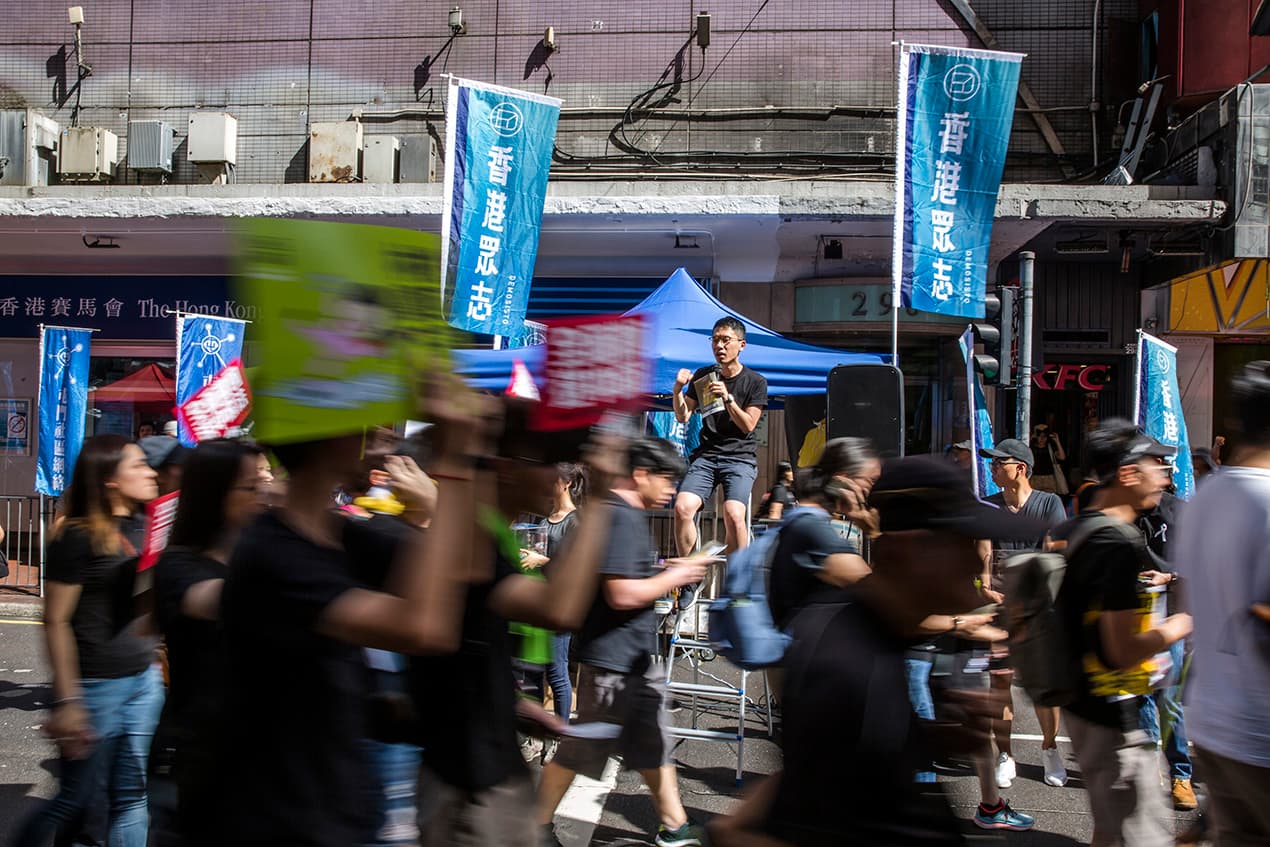
Protesters hold up an anti-extradition law sign in Hong Kong on June 16, 2019.CYan Zhao/AFP/Getty Images
Along the march: Mid-Afternoon, June 16th
It begins. Fernando hears them before he sees them: A white van that parts the black sea of people is obscuring the stream of protesters in its wake. “NO EXTRADITION TO CHINA,” roar its loudspeakers. The crowd roars back. The van drives through the intersection in front of Fernando and the people in wheelchairs. Then the van stops. The marchers stop, too. A gap is created between the van and the crowd, and it is into this space that Fernando and the wheelchairs will funnel.
In the decade after the handover, he forgot about Beijing often enough that he could work with pro-establishment politicians. One day in the Legislative Council, a business tycoon approached Fernando and told him he respected his work with disabled people; Fernando never asked him why, but the tycoon said the cause was close to his heart, too. He suggested they take on Disney together, which was building a theme park in Hong Kong, and force it to hire a certain number of disabled people. They lost the fight, but it was nice in those days when they could be on the same side.
Still, it wasn’t until last month that he could have anticipated he would have to fight his pro-Beijing tycoon friend, much less imagined the terrible way in which he would have to do it. Truly, Fernando had never wanted this.
No, thank you. Fernando steps forward and turns left, and the wheelchairs turn with him, and they roll into the road, and the crowd roars louder, and off they go.
The Legislator
Maybe Fernando should have known it couldn’t last forever. But he wasn’t in the Legislative Council from 2008-2012, and by the time he returned, everything had changed. There seemed to be a parallel government in place: China’s Liaison Office was running the show, and the pro-establishment legislators were letting it do so.
"NO EXTRADITION TO CHINA.""
Fernando never thought he’d enter politics. He studied social work. But Hong Kong’s undemocratic democracy allocates about half of the Legislative Council’s seats to professional associations and interest groups, and the social workers needed a good representative in 2004, and he became that representative, and one of the first things he did was find ways to help disabled people like his daughter become closer to their communities.
Nor will he think of it now. As the van idles, Fernando looks straight ahead at the gap between the vehicle and the marchers, the space he has spent his public life forcing open for people who usually have to sit on the sidelines. In mainland China, things are improving for disabled people, but when a dictatorship grants basic rights, it offers them as a gift: “Thank you for granting me a few civil liberties,” you are meant to say; “Thank you for not imprisoning me without due process today.”
Hong Kong’s skyline of skyscrapers from The Peak on June 30, 2019Photograph by Suzanne Lee/PANOS
The Reporter
In 2013, Lam was ready to do more than run after politicians and shout at the back of their heads for the television station he had interned at. TVB wanted him back. It offered him a reporting position.
Lam knew why he’d take it. Sure, he’d heard the rumours about TVB’s news director receiving calls from China’s Liaison Office about how this story should be told this way, that story should be told that way. But it was a great career move. He was older now, his portfolio bigger. He could do the job well this time. When he explained it that way to his old university friends over dinner, no one protested. He was defending his decision to himself.
“You can’t talk to those scholars,” Lam’s colleague said, when Lam told him who he was thinking of. “The company won’t let you.”
“Those scholars are pro-democrats.”
Forget all that, his editors told him and his colleagues. Find stories about how the kids were hurting the city. Business was suffering, drivers were annoyed—that sort of thing.
Lam was reporting on more protests at the centre of an intersection the day he realized no one distinguished between his name and the name of the company that paid him. The logo of TVB was emblazoned on his microphone. Some protesters noticed it. A ring of them encircled Lam and his cameraman. Two rings. Another; then another. The size of the crowd was so vast, 500 people or so, Lam didn’t know how they all landed on the same beat, but in unison they began to shout.
Today, as police are forced to open up new roads to make room for the thousands of people circling the protest, Lam runs with the crowd, recording their shouts. This is a solemn procession, but it is not a slow or silent one.
In his reflective yellow press vest, Lam bobs along the street like a little dinghy in an ocean of black. It’s hard to know where to point his camera. One stream of people gushes in from that road, another stream from this one. Lam chases the truck, managing to keep up with the middle-aged legislator in the blue sneakers and the wheelchairs moving alongside him.
The job gave him the status he’d wanted and the responsibilities he’d earned. The only downside was Lam couldn’t breathe. Once, he told a colleague he was working on a story and needed a political scholar to comment.
But few things were as bad as during the Umbrella Movement, the sit-in protests of 2014. While Nathan was standing on stages and telling protesters to claim their city and their voting rights, Lam was trying to get footage of the arrests. Pretty soon he was teargassed alongside everybody else. It was supposed to be his day off, but when he was shopping he heard things were kicking off with police. He went in. For the first few seconds after the tear gas canister landed right beside him, he didn’t feel so bad. He did what a good reporter does: push deeper into trouble to get a better shot. Then the gas flooded his lungs and Lam was gasping for air—drowning again. After that night, the reality of the streets hit Lam in the face: As they were beaten and suffocated for 79 days, these students were building some kind of anarchic utopia under their umbrellas and tents. They established a recycling system, they stocked the bathrooms, they set up study rooms.
“F--k you CCTVB! F--k you CCTVB!” Again, and again, and again. Lam could only stare at his feet. The worst part was, he agreed with them.
“I don’t know why you’d take it,” a friend of his said. She worked there herself. “It will just make you angry.”
Lam didn’t like it. Hong Kongers, either: Since the day Banner Man had mocked the very TV station that was broadcasting him, the reputation of Lam’s employer, TVB, had taken hit after hit. “CCTVB,” people called it now, in honour of China Central Television, CCTV. The B-team for the Party’s station.
“Why?” Lam asked.
Protesters shout outside the Legislative Council building as they demonstrate against the now-suspended extradition bill on June 16, 2019 in Hong Kong.Carl Court/Getty Images
The Activist
By 2016, Nathan had helped found a party that stood for achieving Hong Kong self-determination, had stood for election himself, and had become the youngest legislator in the history of Hong Kong. When he became a legislator, he and five others personalized their oath for office in such a way as to promise their true allegiance to the people they represented and not, perhaps, to Beijing. Nathan thought he was good at the job. He knew how to listen to people and translate what he heard in policy.
Out of arrivals, he saw yet another crowd coming toward him. Some security officials mobilized to protect him, surrounding him in a circle. More circles of assailants surrounded the officials. Nathan was punched, kicked, scratched. He wasn’t ready to throw a punch back just yet. He was looking for the man with the sly eyes. Where was he?
“It’s no use,” Nathan said. “You’re not going to intimidate me.”
The pro-democracy camp held an emergency meeting. One of the legislators Nathan most admired approached him.
Nathan didn’t think so highly of himself. History was a whirlpool and it had sucked him in.
Today, two years later, he stands on another stage, and asks protesters to fill the box with whatever they can afford. The money will go towards people the police have injured and arrested. We have to support them, Nathan tells the crowd. They’ve sacrificed more than we have.
Nathan can see the truck coming his way. Behind it, in front of it, all around it, are the young people and the older people who know they wouldn’t have to protect the young people now if only they had done more when they were young themselves. Nathan has ten seconds, maybe twenty, to speak to each protester as they pass by. He and a few others on stage have written spiels that take them about that long. He starts to spit his out as fast as he can, over and over. He has experience giving stump speeches.
There. In front of him. The man looked satisfied. Nathan didn’t hate him. He just had something to say. Their eyes locked, so close to each others’ that Nathan didn’t even have to shout over the fists pummelling him.
“You must come back,” Fernando said. “You’re the brightest among the young.”
“I voted for you!” some of his supporters call back. He knows it’s not his fault, but he fears they wasted their votes on him.
But he felt responsible to more than Hong Kongers. In early 2017 he flew to Taiwan to help its pro-democracy legislators. He’ll never know how his flight information was discovered. He spotted the man right away though, the one with the sly eyes leading a group of more than a dozen people at the Hong Kong airport in shouts. “Traitor!” the crowd called out. “Get out of Hong Kong and don’t come back!” When Nathan landed in Taipei, a second crowd was there to greet him. This group followed him around for days, hurling rocks and eggs. He wasn’t hit there, either. That happened when he arrived back in Hong Kong.
A month after being expelled from the legislature, for standing on a stage and telling people to take back their square, Nathan was sentenced to prison. He’d be there for two months.
Then Nathan ran—slipped down some stairs his assailants poured liquid on—and kept running. He got away from the crowd that day, but Nathan couldn’t escape the establishment. Later that year he, along with other pro-democrats who had sworn their own creative interpretations of the oath of office, was stripped of his legislative duties; Dykes defended but could not save him. The oath was Beijing’s excuse to kick him out of the Legislative Council, ensuring that the pro-democrats lost their majority of geographical constituencies.
Protesters demonstrate against the now-suspended extradition bill on June 16, 2019 in Hong Kong.Carl Court/Getty Images
The peak of the march: Evening, June 16th
They cram the covered walkways, they jump the road barriers, they hang over the bridges, they stand on the planters, they fill the ferries, the subways, the streets. The people of Hong Kong are everywhere. In the shadow of apartment blocks and shopping malls and skyscrapers, they have come together to tower over their own city, the tallest in the world, and say that it will not be taken down without a fight.
Fernando thought his friend said he agreed. But if he did privately, it didn’t stop the man from trying to sabotage a committee meeting the pro-democrats were holding about the extradition bill. In May, Fernando’s friend led the pro-Beijing camp in an obstinate attempt to hold its own meeting in the same room at the same time. So how could Fernando stop what happened next? As pro-democrats circled the man, trying to physically prevent him from entering the meeting room, pro-Beijing politicians circled them. In the centre of the crushing storm, Fernando saw his friend. But what kind of friend hands someone the rope to hang you with?
“Over my dead body.”
Fernando pushes on through the streets of Hong Kong, the people’s representative disappearing into the people as they walk toward the legislature. These are people. This house belongs to them. For now, anyway.
The Legislator
“Chaos,” some would later call the scene; those legislators who feared that members of their electorate would be surrendered to a system that tortures and executes people may have believed a more accurate term to be “an act of self-defence.” And so Fernando thought only one thing as his once-ally tried to enter the meeting room:
“My friend,” Fernando would say when he ran into his old disabilities ally in the Legislative Council hallways after the extradition bill was introduced. “This isn’t good for Hong Kong.”
The circles pushed harder. By the end, one legislator went to the hospital on a stretcher, and another had his arm put in a sling.
Protesters sit outside the Central Government Offices in Tamar on June 16, 2019.Winson Wong/South China Morning Post/Getty Images
The Reporter
By now, Lam had found a job with an independent outlet. After TVB’s own employees accused it of minimizing police brutality, Lam signed an internal petition against it. Many of his friends resigned, and Lam was eventually pushed out. Meanwhile, the noose tightened around all media: An editor-in-chief of a major newspaper was stabbed by two assailants on a motorbike with a knife; a British journalist was denied a work visa, and then even entry as a tourist, after moderating a talk featuring an independence activist; opinion pieces have been pulled, access to Macau denied, and journalists report that they’re censoring themselves before someone else can.
But who could defend the man last night. He had just a raincoat to protect him. He was standing on top of a piece of scaffolding that surrounded a shopping mall one block from the Legislative Complex, and his only weapon was a banner. No extradition to China.
He can only film. Thousands, today, line up at the spot by the road where the man died. This, as much as the legislature, is the destination of the crowd that has swelled to two million. When they approach the roadside, some pull out their lighters and burn incense. Lam keeps recording. He couldn’t save the man yesterday; maybe he can’t save his city. Still he records, on and on, so that the world might have a clearer view of the people who die in their own streets, but will not do so quietly.
Lam has reached the end of the road. Last night he stood near this very spot in the hours before it happened, that thing the whole city is talking about, and now he has to report on why Hong Kongers have cleared out flower shops and walked for miles to mark it. Everyone is grieving, but Lam is here to record others’ grief at the terrible death, not his own feelings about it.
When Lam heard the man refused to climb down from the building, the reporter made his way over and set up shop across the street. He filmed the protester for hours, wondering what the guy thought he was doing. He’s just standing there, Lam thought. What’s he accomplishing with this? Lam packed his things and went home. By the time he walked through his door, the man in the raincoat had smashed into the pavement. When Lam cried that night, it was in anger at the government for bringing its own people to the brink, and for his own inability to bring his city back from it.
On the day a million people marched, one week ago, Lam was finished censoring himself. Three, maybe four protesters were standing near the legislature. Lam wore a press badge on his left sleeve, but that night it seemed more of a target than a shield. You don’t have special privileges here, he heard the police shout at him as he filmed. Then they told him to open his backpack. When all they found were water bottles, they demanded to know whether he planned to use the water as a weapon. It was such a stupid question, Lam didn’t bother to answer. Ultimately deciding that the drinking water was not going to be deployed for subversive purposes, an officer reversed course. Put the water back in your bag, he demanded—faster! He was getting a kick out of this. Lam kept filming, broadcasting live. You defend your line, I’ll defend mine, he thought.
The Lawyer
When Dykes’ own mobile rang those 18 months ago, he was occupied with important matters at a British embassy located far from Hong Kong. The caller knew where Dykes was, and why he was there. The purpose of the call could only have been most urgent. Dykes picked up the phone.
The tricky thing was, Dykes was rather engaged at present. He was in Lebanon, and had other responsibilities to fulfill, those of a more personal nature. He had come to Beirut to collect the body of his daughter. Rebecca had been killed.
Hours, it lasted. She died but she fought.
Over the following year and a half, Dykes would stand for election, defeat the incumbent by a hundred votes, and devote a sizeable portion of his tenure to explaining to the public in the clearest possible terms why, in his professional analysis as a barrister and chair of the bar association, the murder of a daughter of Hong Kong did not necessitate a law that would threaten rather than protect the rights of all. Under Dykes’s watch, the bar would become another ring of defence surrounding the Hong Kong people: condemning police brutality, insisting on the rule of law, and certainly not dissuading 3000 lawyers from marching the streets in their own protest against the bill, all clad in their suits.
Dykes cannot see this, but on the opposite side of the block where he stands, thousands more approach another roadside where another body was found, that of the felled protester. They pour their bouquets of flowers out onto the street, then slip away, leaving the ditches of Hong Kong spilling over with roses.
The young people have planted their signs in front of the Legislative Council. On some, an image of a raised fist; on others, pictures of beaten protesters; and on one, a long-stemmed white rose sprouts from a splatter of blood. As night falls, the protesters will raise their mobile phones, beaming stems of light into the air.
Not bullets. An Uber driver; a piece of rope; a ditch.
And that is why, on this scorching afternoon along the highway that runs beneath his office window, several protesters, then several dozen, recognize the lone figure of Dykes, approach him, and thank him one by one for what he has done for Hong Kong.
“We know this is a difficult time for you,” said the caller, another barrister. “But will you do it?” He was asking Dykes to run for chair of the Hong Kong Bar Association. A group of like-minded legal colleagues could find no one else they trusted to defeat the incumbent, a man who was not as vocal an advocate of constitutional principles as the bar would need in the year ahead. Dykes was widely respected, had succeeded in the job before, and was regarded as partisan to the law, not a political party. Dykes would, however, have but twenty-four hours to decide whether to run.
There was much paperwork to be done that week, many tasks to be completed. Dykes released a statement saying he trusted the courts would protect the legal rights of his daughter’s murderer. He ensured the safe passage of her body. And he gave the caller his answer. He was running. Back home, you see, it was quite an important time for the law.
Share on FacebookShare on Twitter
Hong Kong’s skyline of skyscrapers from The Peak on June 30, 2019Photograph by Suzanne Lee/PANOS