The Anti-Slop Music Resistance
I play in a cover band called the Duotangs, so named because we keep our sheet music—for songs by the Hip, Doors, Strokes, Beatles and beyond—in the same flimsy, three-pronged folders used by grade-schoolers. Every spring, we pull up Toronto’s summer-concert calendar and pick a few to attend together. “Band field trips,” we call them. This year, we zeroed in on Jack White’s July show, partly because we play a tune by the Raconteurs. Arguably, the real draw was his opening act: Angine de Poitrine.
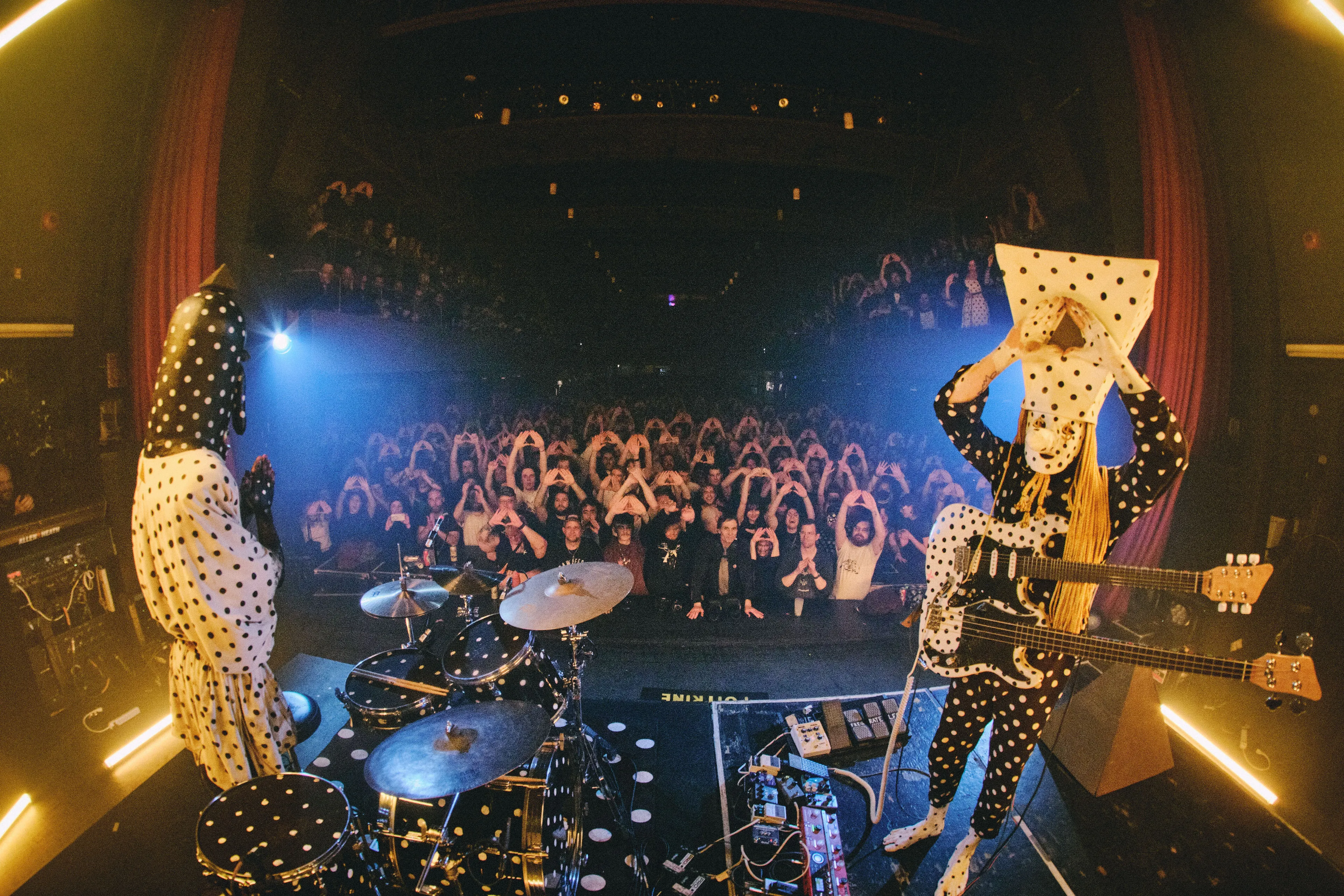
On the off chance that they have yet to infiltrate your feeds, Angine de Poitrine is the biggest (and most bizarre) band of the year. The group’s two members—anonymous, thirtysomething earthlings from Saguenay, Quebec, who perform under the aliases Khn and Klek—claim to be 333-year-old time-travelling aliens. They play micro-tonal math rock supposedly inspired by a quartet of musical monkeys from Borneo. They speak in guttural drones and perform in polka-dotted pyjamas and giant papier-mâché masks with long, phallic noses. Most baffling of all? These intergalactic weirdos are suddenly, stratospherically popular.
Related: Studios will steal artists’ faces and voices
As recently as January, Angine were averaging 50,000 streams a week, less than some bands I’ve played in. But by April, the duo’s songs were pulling in more than 10 million weekly listens from fans on every continent. Vinyl copies of their debut album, 2024’s Vol. I, were fetching thousands of dollars online. And no matter how many shows they added to their blockbuster 50-city world tour, tickets kept selling out. My Jack White seat cost me $135, but to see Angine de Poitrine headline Toronto’s Mod Club later that same night, I would’ve had to fork over more than $1,000 on the resale market. In the Duotangs’ group chat, our bassist asked what all of us were wondering: “Has a band ever blown up so fast?”
Random as it may seem, Angine de Poitrine’s overnight success was actually two decades in the making. Khn and Klek have been playing music together since they were 13. (Online sleuths have predictably attempted to identify their true identities by comparing Angine to similar-sounding Quebecois rock duos, but I’m content to let the mystery be.) In 2019, having booked two shows in the same week, they put together their current schtick—outfits, polka dots and all—as a way to entice the same fans to show up to a second concert.
But it was years later, smack in the middle of a collective cultural meltdown about AI’s impact on art, that Angine really blew up. This past February, the Seattle radio station KEXP released footage of them playing France’s Trans Musicales festival. It’s less Tiny Desk Concert, more extraterrestrial cult ritual: Klek looks like a burnt hot dog, smacking drums with the ferocity of a jackhammer and the precision of an atomic clock. Khn, meanwhile, wears a giant inverted pyramid on his head and literal dollar signs over his eyes. He lays down slinky riffs on a custom double-necked guitar—electric on top, bass below—stomping loop pedals with his bare feet and turning effects knobs with his toes. It was something no ears had heard before, something no eyes had seen.
Related Posts
How Jeanine Brito’s pretty-creepy paintings made her an art-world darling
The Building: A cozy, communal gallery for Fredericton’s art lovers
The performance, which included some highly robotic chanting, charmed millions of humans. Clips quickly crept into YouTube, Instagram and TikTok feeds. The band, it seemed, was the fractured internet’s common denominator—the one thing that could convince just about anyone to stop scrolling. Music-theory nerds debated whether their songs were microtonal or quarter-tonal. Bewildered vloggers released reaction videos by the dozen. (YouTuber Rick Beato made one called “Please STOP Sending Me This.”) Dave Grohl, of Foo Fighters and Nirvana fame, proclaimed that Angine “absolutely blew my fucking mind.” So many people were googling them that even the search engine decided to get in on the fun. As of this writing, if you search the band’s name, polka dots will cover your screen.
As much as AI-powered algorithms are responsible for Angine de Poitrine’s virality, the band’s success is also a repudiation of slop art—the kind that now threatens the livelihoods of legions of composers, performers and audio engineers. Today, machine-learning models can pump out polished, Top 40–style pop songs in seconds. AI-generated bands like the Velvet Sundown are multiplying, and Spotify recently introduced stronger protections to prevent bad actors from flooding playlists with computer-generated dreck explicitly engineered for passive listening.
Yes, traditional stars like Taylor Swift and Sabrina Carpenter still top the charts. But the buzziest acts of the past few years have all been auditory oddballs who took risks and broke rules. The American singer-songwriter Dijon made it big by layering uncomfortably raw vocals over glitchy beats. Chappell Roan wowed the world with campy costumes and over-the-top operatics. And the experimental rockers Geese, the hottest New York band since the Strokes, are, depending on whom you ask, either the saviours of rock ’n’ roll or so screechy-sounding that they’re downright unlistenable. The fact that AI can produce middle-of-the-road pop has evidently opened up a new lane for artists who want to create what computers can’t. Concurrently, we listeners have been saturated with so much sterile easy-listening pablum that what we really want now is bold, norm-busting art made by total freaks. And no act scratches that itch quite like Khn and Klek.
Their music—an uncategorizable mélange of metal, funk, psychedelia and sometimes polka—has earned comparisons to Frank Zappa and King Gizzard & the Lizard Wizard, an Australian band that’s also experimented with microtones. To my ears, they sound like the Ritalin-powered progeny of Primus and An Endless Sporadic, a prog-rock band formed by two guys who met playing Guitar Hero. Still, comparisons fall short. That’s partly thanks to Khn’s unorthodox guitar, which has twice as many frets as a standard instrument, allowing him to play lopsided licks that transcend the 12-note scale typical of Western music. The extra tones imbue their songs with a certain antsiness; Khn builds and releases tension by toying with listeners, dancing around the notes our brains expect to hear. This results in tracks like “Fabienk,” which sounds a bit like a dial-up modem trying to connect to the internet. It’s taut and discordant—fitting, given the name Angine de Poitrine loosely translates to “chest pain” in French. As one Duotang put it in our group chat, “I can only listen to them for like 15 mins before I start going insane.”
Not long ago, a vibe like that would have scared audiences away. Now, it’s what’s drawing them in. Whereas computer-generated music tends to be inoffensive, humourless and derivative, Khn and Klek have created something fresh, foreign and mischievous. And, according to them, it’s all a big joke. “There’s no language; there’s no political meaning. It’s just two freaking things doing music,” Klek told the Toronto Star. They don’t claim to be principled champions of manmade art—on the contrary, they purport to be from another planet. But that hasn’t stopped fans from treating them like humanity’s last best hope. “Death to AI!” one concertgoer screamed at a recent show.
By the time this story is published, Angine de Poitrine’s 15 minutes might be up. They may translate their newfound fame into an enduring career, playing shows for music nerds like me for years to come. But I’m under no illusion that the masses are going to rapidly embrace math rock, or that we’ll be adding any Angine songs to our Duotangs set anytime soon. The big takeaway from the band’s success is something more timeless: that, in the AI era, the role of great art remains unchanged. It’s meant to excite, surprise and challenge us. To explore the human condition. To take us right up to the edge of the training data, then plunge us into the unknown.
What did you think of this story? Send a comment for publication to letters@macleans.ca, and supply your name and address. Comments should be fewer than 200 words, and may be edited for length and clarity.
Related Posts

The Building: A Calgary parkade redesigned with the future in mind
Inside the new Toronto home of The Second City
The Building: Labrador’s striking new cultural centre
Rising opera star Charlotte Siegel is a destined diva
Get the Best of Maclean’s straight to your inbox.
Sign up for news, commentary and analysis. Join 60,000+ Canadian readers.