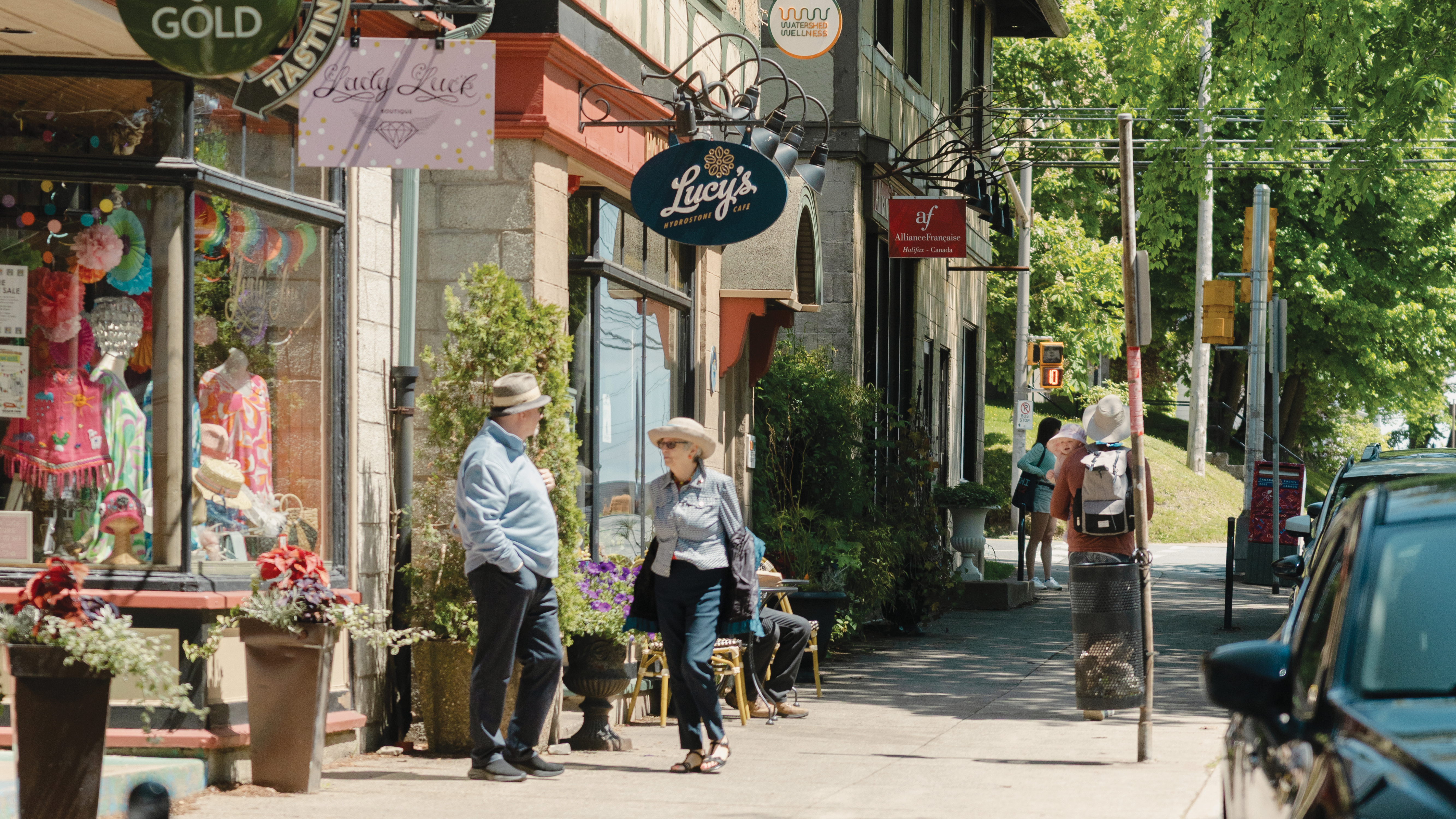
The Hydrostone, Halifax: The Historic Makeover
On a December morning in 1917, two ships collided in Halifax Harbour. One was packed with TNT and other explosives bound for Europe. The collision ignited the cargo, and the blast that followed was the largest human-caused explosion before the atomic bombings of Japan. More than 1,600 buildings were burst into matchsticks, and 2,000 people were blown up, buried or engulfed in flames.
My five-year-old son loves this story. And why not? If you’re five, 1917 is almost prehistoric. And explosions are awesome—especially if you can look out your bedroom window and point toward ground zero. It’s also a neat origin story for his own home: the obliterated neighbourhood was rapidly rebuilt as a master-planned suburb of rowhouses, constructed from fireproof concrete blocks called hydrostone.
I moved to the Hydrostone in 2016. It wasn’t cool, but it was pleasant. The streets were lined with towering elms and framed to the east by Fort Needham Memorial Park, which has a commanding view of the city’s harbour. It was quiet, sleepy and semi-suburban. But the city was on the cusp of a dramatic change. The year prior, Halifax’s long-standing outmigration reversed, as more people moved in from other parts of Canada than moved out. International immigration doubled as well. Between 2015 and 2025, Halifax’s population ballooned by 26 per cent. The Hydrostone, and the Bloomfield area immediately south of it, grew by a combined 40 per cent. Bloomfield especially has come to function as a vibrant, younger adjunct of the historic Hydrostone, its formerly empty lots and industrial sites filling with new construction.
As thousands more people—mostly apartment dwellers, mostly younger—fill the streets, the area has become a focal point for some of Halifax’s best food, drink and cultural offerings. In 2017, Italian newcomer Federico Pasquinelli ended the neighbourhood’s coffee drought with Espresso 46, operating out of a street-facing window in a converted warehouse. There’s also Bar Kismet and, on the Hydrostone’s main drag, the Ostrich Club—both offering inventive small plates and cocktails that seem parachuted in from a larger city.
New standouts keep coming. They include the Narrows, a pub in a beautifully restored Victorian house, and Suda Table, a small café opened in 2022 by Korean newcomers, serving delicate, savoury pastries and dumplings. What makes the area cool, though, is not simply its food and drink scene. Nor is it the stacks of vinyl at Obsolete Records, or the well-stocked shelves at Agricola Street Books, or the view of the sunset from the top of Fort Needham. The swelling population has come with challenges around affordability, congestion, gentrification and strained infrastructure. But it has resulted in a civic maturation Haligonians could not have anticipated only 10 years ago: far busier streets, a more diverse population and a liveliness and urbanity rarely found in cities of this size in Canada.
The neighbourhood’s rapid transformation has also, thankfully, not erased its identity. Especially on foggy mornings, the skyline of new towers that’s sprouted seemingly overnight disappears in the haze, and out in the narrows, foghorns still sound, just as they would have 100 years ago.
Related Posts

Heated Rivalry Is Anti-Dystopia Art

How to Win the Westminster Dog Show

The Golden Age of Smut
How the Olympics Remade Montreal
Get the Best of Maclean’s straight to your inbox.
Sign up for news, commentary and analysis. Join 60,000+ Canadian readers.