I Let an AI Avatar Teach My University Course
In the nearly 25 years since I finished my doctorate in theology, the amount of knowledge available for humans to absorb has absolutely exploded—especially since ChatGPT came on the scene. I teach courses on contemporary culture and ethics at Acadia Divinity College in Wolfville, Nova Scotia; I’m also president and dean of theology for Acadia University. I’m used to fielding big questions. But now, they’re bigger than ever. In the past, when religious scholars were asked what makes humans uniquely human, they might’ve said “rationality.” Artificial intelligence has blown that theory out of the water. I’m keen on the idea of AI as a co-creator of human creativity, whether in writing, research or other pursuits. But if we’re all using omniscient chatbots as filters for how we see the world, I’ve been wondering, what does that mean for religious education—and religion as a whole?
Related: They Lost Their Kids to Fortnite
I started playing with ChatGPT on my own time right after its rollout, asking it questions like, “Do you believe in God?” (Its answer: “I can’t, because I don’t have independent consciousness—or a body.”) Then, about a year and half ago, John Campbell, Acadia’s director of development and technology, stopped by my office. We were casually chatting about AI, and I said something like, “I wish ChatGPT could make my course syllabus for me!” John said, “Let’s see if it can.”
We made up a title, “The Ethics of AI”—which wasn’t a course at Acadia at the time—then typed in some learning outcomes, a key part of designing any post-secondary course in Canada. Once we’d entered them, we said, “ChatGPT, please generate a 12-week syllabus.” It did, instantaneously. It even included classes on practical topics, like when it’s okay to use AI for sermon-writing and how to prepare our students—all future pastors—for community ministry. Then, we said, “Generate the lectures.” It spit those out instantaneously too. John and I looked at each other, stunned. It was exceptionally impressive.
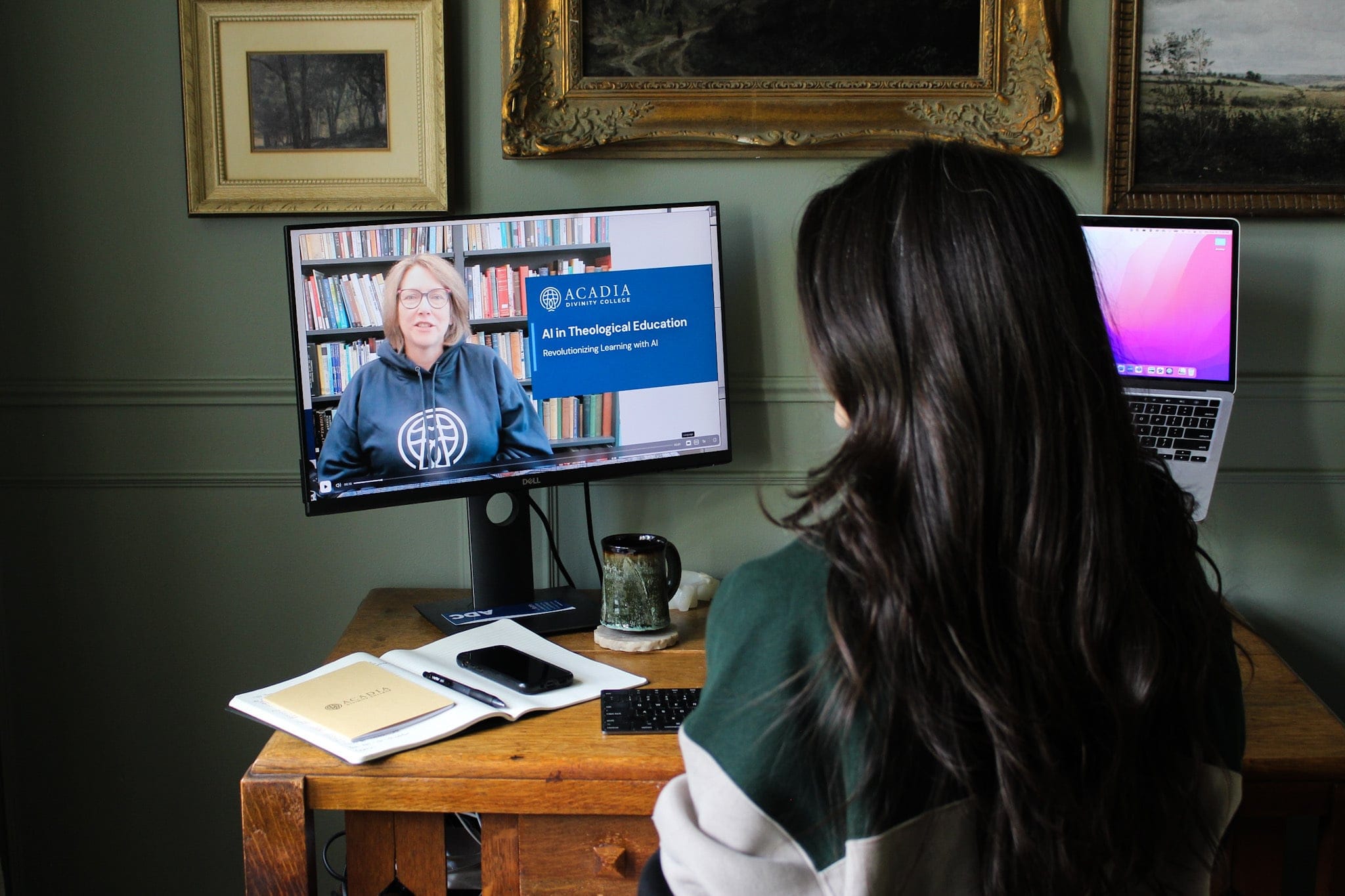
We could have stopped our experiment there, but we wanted to see the extent of AI’s educational potential, to really blow it out. We decided to run the country’s first fully AI-generated theology course, with approval from Acadia’s research ethics board. John and I recruited six students, whose tuition we covered in exchange for them agreeing to be part of our mini research project. Three-quarters of Acadia’s students are remote learners, so we regularly produce teaching videos for lectures, then schedule face-to-face tutorials for in-person conversations about course material. For our AI ethics course, however, we fed the lectures into an avatar-generating program. An AI would teach the entire syllabus and provide feedback to students.
Related: How Astrology Became The New Therapy
Because I’m Acadia Divinity’s president and resident ethics prof, we thought it made sense for me to be the avatar’s model. All I had to do was read a five-minute script to the software. I’ve done a fair amount of media over the years, so I was used to seeing myself on screen. The weirdest part wasn’t the busy shirt I decided to wear on filming day; it was that, when I watched the lecture videos back, it genuinely looked like me on the screen. Just a year before, if you watched an AI-created avatar talk, the mouth would’ve looked strange, and the voice would’ve been slightly off. Ours was much more sophisticated. We could even switch the language it was speaking, which blew me away. (In real life, I’m not fluent in German.)
Our ethics course ran over 12 weeks last winter, with John as its de facto supervisor. He made sure the course progressed, that there were no problems with the tech, and that the students received their marks. I, on the other hand, had no contact with them at all. Their final feedback about the experience was quite negative, which I found interesting. One student asked, “How do we know that the content the AI taught us wasn’t made up?” (In fairness, you could say that about any teacher—or just Google it.) One woman really hated it. She was incredibly wary of political or gender biases seeping in, a common worry about large language models and their makers.
Almost everyone found the avatar’s feedback a bit meaningless. It was generally affirming, but only because it came from a program designed to make them feel good. Another critique was more intangible and harder for the students to articulate: a lack of depth. They said they knew the quality of material they would get from the real me, for example, was deeper than what they were getting from the machine. I took that as a compliment. On the whole, the students’ appraisal seemed to boil down to, “Please, never replace professors entirely.”
Acadia has no plans to do that, but we have started integrating AI elsewhere in the school. In ADC FuturesGPT, an online platform we designed for our profs, we encourage our faculty to ask ChatGPT for creative solutions on how to teach certain material. One of our history professors has also gone the video-avatar route—her students have simulated conversations with major religious figures, like John Calvin and Martin Luther.
The school’s pastoral psychologist, Glen Barry, who worked for many years in Nova Scotia’s public health system, oversaw the creation of Arch, a bot used by our counselling students. They used to have to practise their skills by role-playing with their friends, but not all humans are great actors, so that approach had its limits. In one scenario, Barry had the Arch bot present as someone with obsessive compulsive disorder, whose family wasn’t understanding of their mental-health struggles for cultural reasons. The students were blown away by the nuances in the bot’s portrayal of that experience. A machine was helping them empathize.
One of the biggest questions we face now is how we can teach our future pastors to provide support in a world that increasingly devalues in-person interaction. Sociologists have identified a new phenomenon called self-spirituality, the practice of building your own customized spiritual life from a wide range of sources—not unlike the way we make playlists from songs suggested to us by Spotify. In the absence of a central, offline community, people are selecting pieces of Buddhism, Hinduism, Christianity and other faiths and designing a solitary spiritual practice of their own, sometimes with the assistance of tech tools.
There are scenarios in which the guidance and care ChatGPT can provide is extremely helpful. If I was an elderly woman in a nursing home, for example, and nobody was visiting me, I’d love its companionship. But many people have also turned to machines for company because it’s simply less difficult and complicated than interacting with other human beings. In Lucerne, Switzerland, there’s now an AI confessional box with a simulated Jesus inside; in Warsaw, Poland, an AI statue called SanTO, described by some as a “Catholic Alexa,” responds to visitors’ queries and concerns with biblical passages.
Neither of those machines is going to challenge or confront you, even if that’s what you need. Their advice isn’t generated from anything that truly cares about you. They can’t look after you when you’re sick. Even grieftech, a new technology that allows bereaved people to create avatars of their deceased loved ones, runs the risk of prolonging the grief it’s designed to help process. Pastoral counselling might be more helpful in a situation like that.
Still, these AI avatars have presented us with a new opportunity to expand international ministries. In North America, we talk a lot about the decline of the church, but in the Global South, Christian churches are growing by orders of magnitude year over year. At Acadia, we’ve thought about feeding more of our course material to AI—the same way we did with our ethics pilot. We could create a new avatar (that’s not me) and leverage its multi-linguistic capacity to design an online platform to educate new clergy around the world. Even in developing regions, people have phones, which is all they’d need to access it. We’ve also considered offering that program to new and recent immigrants to Canada, nearly half of whom are Christian. When John and I asked our students what they thought of using a low- or no-charge version of our avatar-led classroom pilot for that purpose, their responses were much more positive.
People of faith have always worried about humans’ propensity to replace God with things made with our own hands. In the Old Testament, it was idols made of wood. These days, it’s ChatGPT. But for all its challenges, AI is pushing postsecondary schools back toward what education ought to be: a way to build one’s critical capacity, ethics and self-understanding. Humans do have a tendency to anthropomorphize inanimate objects, like how our brains see faces in foods and cars and knots of wood. I think we see people in almost everything. We need to remember that ChatGPT is just a machine generating language, but there’s still a lot we can learn from it—even about the transcendent.
Related Posts

MBA Directory 2025

My Classroom Will Be AI-Free This Fall

Canada’s Best Universities in 2025 by Student/Faculty Ratio
AI Is Ruining My Education
Subscribe to Message Board, our weekly newsletter guide to planning your post-secondary journey
Whether you’re a student, parent or guidance counsellor, Message Board is a resource you won’t want to miss out on.