I Survived My First Year of Military School
I grew up in Val-Morin, Quebec, a small, woodsy village in the Laurentians. My parents, both teachers, would take my brother and I on road trips and vacations whenever they could and always encouraged us to be adventurous. So when they accepted teaching contracts at AFNorth International School in Brunssum, Netherlands, when I was 15 years old, it felt like an opportunity for all of us. One minute I was wandering the forests of my sleepy hometown, the next I was attending school with students from military families who had lived all over the world.
AFNorth serves families connected to NATO and international militaries, so the school brought together students from a huge range of countries and cultures. It was tiny (my graduating class only had around 60 students) but it felt global. Through the school’s sports system, I travelled across Europe to compete in soccer and basketball tournaments against other American Department of Defense schools, and my teammates came from places like Germany, Spain, Portugal and the United States.
Outside the classroom, the Canadian community in Brunssum had a huge impact on me. Every couple of weeks, military families, teachers and staff would get together for “TGIF” events—barbecues and social nights where everyone would hang out and catch up. It was at those gatherings that I first met Royal Military College of Canada, or RMC, graduates and members of the Canadian Armed Forces, or CAF. They all spoke about RMC with admiration. At first, RMC appealed to me because it seemed to combine a lot of things I already liked, like academics and being challenged physically and mentally. The smaller class sizes of 15 to 25 students were attractive, and I really liked that I could continue studying in English and French. My dad and I did a lot of research online to find out more about what RMC was like, and the more I learned, the more it seemed like a place that would constantly push me to improve.
I officially enrolled in February of 2025, and at that point, I was considered to be serving in the CAF. Our tuition and benefits are fully covered on the condition that we commit to serving two months in the CAF after graduation for every month of subsidized study we receive. For a four-year degree, that amounts to about five years of military service. We’re also paid to be here since we’re considered full-time employees of the CAF. After deductions for housing and meals, I take home about $700 every two weeks, which means I don’t have to juggle a part-time job on top of school and everything else.
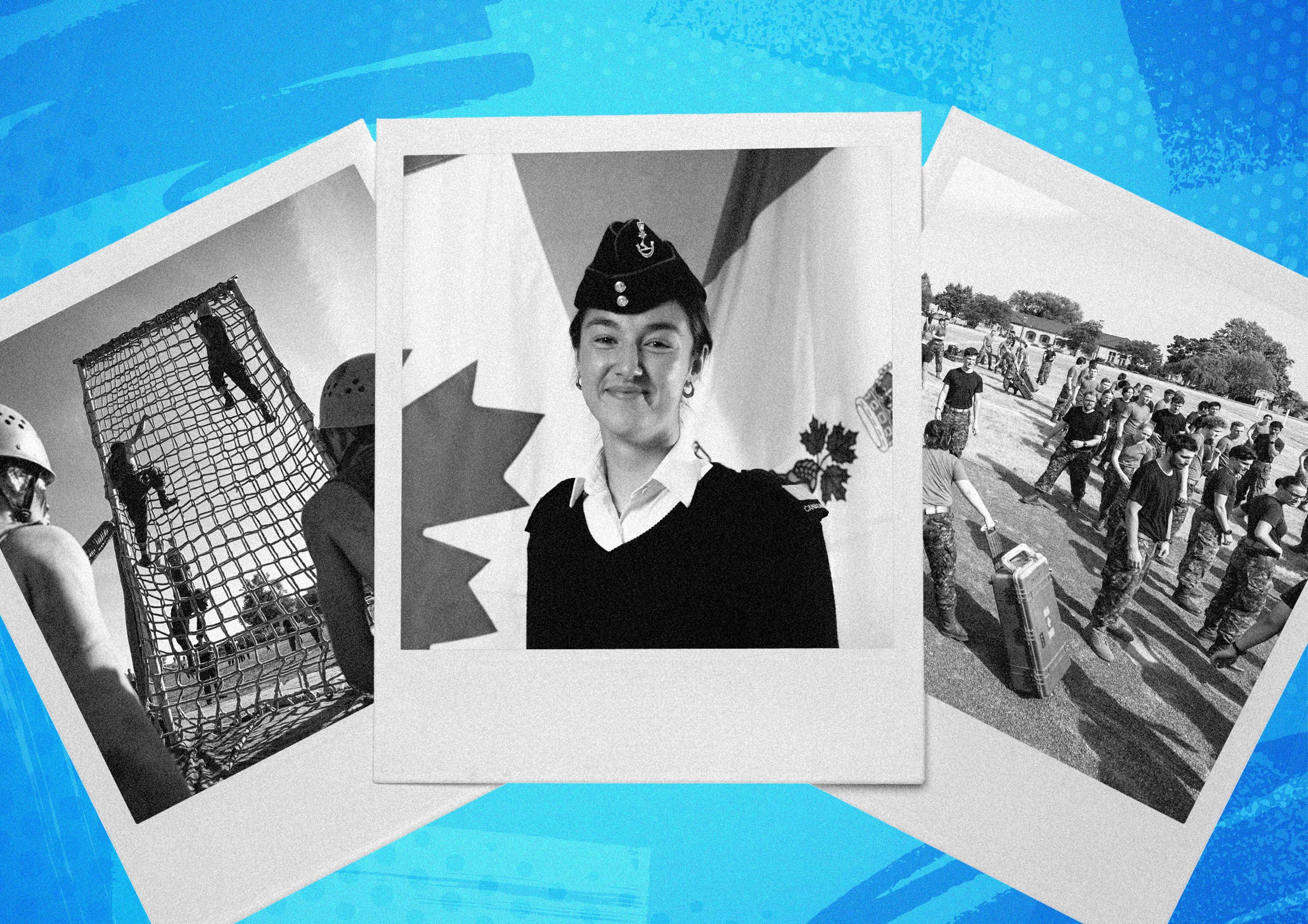
Before starting my studies in the fall term at the RMC campus in Kingston, I had to complete the first part of my Basic Military Officer Qualification training (BMOQ) at a recruit school in Saint-Jean-sur-Richelieu, Quebec. It was intense. My days were packed with morning runs, classroom instruction, weight training and drills where we practised moving together as a unit. We learned about what the military is, what it stands for and how it operates, but there was also a huge emphasis on discipline and attention to detail. Platoon commanders and sergeants regularly inspected our uniforms, rooms and kits to make sure everything met CAF standards.
Mid-August, after five weeks of training, I headed to Kingston a lot more prepared for what was to come, but I still couldn’t have imagined everything that was awaiting me. I stepped off the bus for orientation, officially called Orientation Integration Period for First Years, or OI1, and immediately felt overwhelmed. I hadn’t fully understood what OI1 was before arriving, so I thought I was just showing up for a regular university orientation. Instead, OI1 is a month-long onboarding routine where new cadets are confined to the RMC Peninsula at Point Frederick in Kingston, Ontario. After saying goodbye to my family, I marched through the Memorial Arch, symbolizing my official entry into the college. Over the next few weeks, we learned about the basics of life at RMC—its four pillars (academics, military, physical fitness and bilingualism), the campus layout and what would be expected of us over the next four years. We also got sorted into squadrons and flights. The Cadet Wing (essentially the whole student body of RMC) is divided into 13 sub-units called Cadet Squadrons. Cadet Squadrons are then divided into smaller groups of about 20 cadets, called flights. That’s your core group—you spend the most time with these people in first year. You sleep in the same dorm and you spend a lot of your down time together.
Related Posts
How to Plan a Gap Year
Lessons From My First Year of University
OI1 was tough, and I had my share of second thoughts and moments of self-doubt. It’s hard not to compare yourself to others when you’re living and training in such close quarters. I had played soccer and basketball for most of my life, so I came in feeling pretty confident about my fitness. But during our obstacle course training, I kept falling off the monkey bars because my upper-body strength just wasn’t where I needed it to be. I remember feeling so embarrassed every time I landed flat on my face in front of my flight. Thankfully, they just kept encouraging me to get back up and try again. One of the most important things I learned during OI1 was how to laugh at myself. Once I stopped dwelling on every mistake and started treating them as opportunities to learn, the experience became a lot more enjoyable. At the end of OI1, there’s the obstacle course. We climbed cargo nets, walls and ropes, carried logs, ammunition boxes and tires, pulled a truck, and paddled assault boats. My flight ended up placing second out of 13, which I’m still proud of. It became one of my favourite memories from first year.
Once the semester starts, life settles into a pretty rigid routine. I usually get up somewhere between 6 and 7 a.m. before heading to breakfast and classes. During the first semester, cadets take a broad mix of courses before choosing a major. There’s a range of four-year undergraduate programs that offer pathways into vocations like aeronautic and mechanical engineering, computer science, business administration, psychology and many others, so I had plenty of options. As an arts student, I spent my first year taking economics, psychology, English, mathematics and politics before eventually choosing political science as my major.
Balancing all of those commitments took some trial and error. At first, I struggled to figure out what to prioritize and how to manage my time effectively. Eventually, I realized that staying organized was essential. I have three calendars in my room and others on my computer and phone, and I’m a big fan of sticky notes. Being thorough about tracking assignments, meetings, duties and other obligations made it much easier to maintain some semblance of a work-life balance.
Outside the classroom, physical fitness is a major part of daily life. Every member of the Canadian Armed Forces has to pass the FORCE Evaluation (another acronym—Fitness for Operational Requirements of Canadian Armed Forces Employment), a standardized fitness test administered yearly across the military. It involves things like shuttle sprints, sandbag lifts, loaded carries and dragging heavy sandbags across the floor—basically a series of exercises designed to make sure we meet the physical demands of military service. Cadets train regularly throughout the year, including mandatory 10-kilometre morning runs every Tuesday and Thursday.
It can definitely be exhausting at times, especially during final exams when it feels like there’s always something that needs to be done and there just aren’t enough hours in the day. But there are supports that make things easier. I don’t have to worry about cooking, washing dishes or rushing off to a job after class. Since meals are provided and most of us live on campus, I’m able to spend my free time doing things that help me recharge, whether that’s exercising, reading, writing, calling my family or spending time with friends.
Outside of academics and training, the RMC also has a surprising number of clubs and extracurriculars. I joined the Expedition Club and had the opportunity to spend a week sea kayaking through the Florida Everglades, island hopping during the day and camping each night. I’m also a member of the mountaineering team, which has taken me ice climbing in Quebec—things I would have never thought to try before coming to RMC. There are also opportunities like windsurfing, debate, war games, photography, and even a sport parachuting club. People tend to imagine military school as extremely rigid and one-dimensional, but there’s actually a lot of room for people to pursue different interests.
I’m currently completing the second half of BMOQ (basic training), and it feels completely different from the first. The first couple of weeks are spent in garrison—at home base, basically—preparing for the field, but after that you’re outside a lot, putting everything you’ve learned into practice. We spend weeks in the field learning basic soldier skills, navigation, fieldcraft and leadership while working through different scenarios as a team. A big part of the training is learning how to lead and follow effectively under pressure, whether that’s giving orders or making decisions when you’re tired and wet and would honestly rather be asleep. We work through realistic training scenarios that can involve responding to simulated enemy activity, locating downed pilots or helping civilians in need. The final weeks are where we’ll be evaluated on those skills, so there isn’t much downtime. You’re pretty much always busy, and there’s a lot of physical activity involved. If I could give future cadets one piece of advice, it would be to train your legs beforehand. You’ll thank yourself later.
While BMOQ is helping me develop as a leader, it’s also reinforced what I want to do after graduation. For me, that means becoming a public affairs officer, or PAO. It’s a role that combines a lot of things I’ve always enjoyed: writing, communications, public speaking and current events. PAOs get deployed internationally, but don’t serve in combat roles. They advise leadership teams and tell the military’s story. They’re still trained for combat though, because, as the RMC leaders like to say, we’re soldiers before anything else. Once I graduate, I’ll have to complete a Civilian-Military Cooperation course to be ready for deployment, and then I’ll see a lot more of the world.
Truthfully, I still have no idea exactly where my future is heading. But after moving between countries, attending three different high schools in four years and adapting to life at RMC, uncertainty doesn’t feel as intimidating as it used to.
As told to Cameron Graham.
Related Posts

The Fight to End Hunger on Canadian University Campuses

The Crisis in Student Housing

The Confusion and Controversy of University Meal Plans