My Life-Changing Gap Year
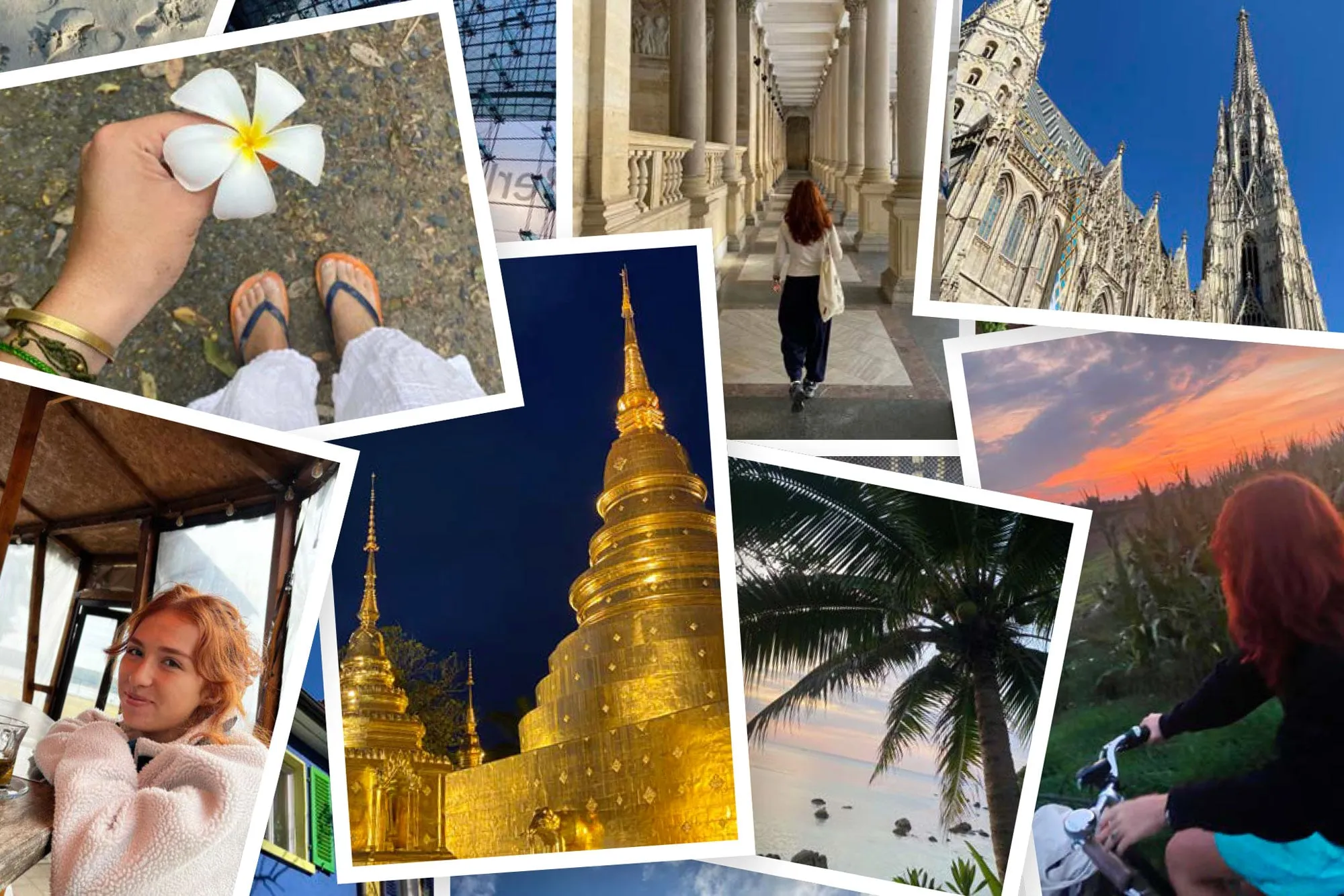
I was born into a family of hardcore adventure-seekers. My mother is a French Canadian who runs marathons for fun, and my father is a cycling-obsessed American. They met in Cameroon, where my father was working with the Peace Corps and my mother was teaching French alongside a group of nuns. Growing up in Montreal, our family trips took us hiking through the countryside of Vietnam, into the jungles of Panama and up the volcanoes of Indonesia. Closer to home, my summers often involved cycle tours across Quebec or, once, the long ride from Toronto to Montreal. These journeys exposed me to other ways of life and sparked a deeper curiosity in me to understand the world beyond home. In high school, I was choosing between eight majors, mostly social sciences such as linguistics, geography, urban planning, anthropology, sociology, political science, economics and French literature. I decided to take a gap year to explore even more and figure out what I felt genuinely drawn to study.
I’m not alone in wanting to pause for a big adventure. A 2022 Statistics Canada report found that 12.5 per cent of post-secondary students took a 12- to 15-month gap. The Canadian Gap Year Association reports that 75 per cent of its members who have taken a year off say the experience increased their academic motivation. Beyond the numbers, there’s a growing sense—among families and post-secondary institutions alike—that time spent navigating the world independently can be just as formative as time spent in the classroom.
My gap year plan started to take shape in my first year of CEGEP (the Quebec equivalent of Grade 12) when my mom proposed our whole family take a year-long bike trip. While spending the entire year with my family wasn’t exactly what I had in mind, it felt like the perfect opportunity: I could travel across the ocean with my parents and two younger brothers and spend some quality time biking with them. But I would also split off to explore the world—and myself—on my own.
We left Montreal in the summer of 2023, after I completed CEGEP, and set out with an ambitious plan. The route we imagined would begin in Lisbon, cross continental Europe to Turkey, continue through Southeast Asia and finish with a ride across North America—averaging about 80 kilometres a day. I planned to leave my family in the new year and head to Germany for an internship.
The first leg of the trip was a reality check. In Portugal, one of the hilliest countries in Europe, we’d set off at sunrise and climb up to 1,500 metres a day, each bike weighed down with roughly 50 pounds in our panniers and saddlebags. Until that point, I’d considered myself fit. I liked running, but I wasn’t in the extreme road-cycling shape you needed for a journey like this. We made some rookie mistakes, too. In Spain, we took a wrong turn that sent us across a narrow highway bridge, wedged between a steep cliff and passing trucks, holding onto our bikes for dear life. We barely pedalled, focused only on staying upright. When we finally made it through, I was so shaken I started sobbing. Flat tires, headwinds, bickering, flies in our faces and rough road conditions added to the strain. It didn’t take long for me to realize I needed to connect with people my own age earlier than planned.
Related Posts
The Fight to End Hunger on Canadian University Campuses
The Crisis in Student Housing
Leaving my family and travelling on my own meant I needed to pay my way, so I applied to volunteer at a youth hostel in Prague for a month, working in exchange for accommodation through a site called Worldpackers. When I arrived, I immediately questioned whether I’d made the right decision. My manager was stressed and unkind, and the hostel was understaffed. I worked three nights a week at the front desk—11 p.m. to 7 a.m.—on top of laundry and cooking. I also led guests on hikes and sightseeing tours during the day, then took them out to bars at night.
Before long, I was having the time of my life. My healthy routines completely unravelled, though. I stopped exercising, drank almost every day, barely slept and ate far less than I should have. I was exhausted and living in a daze—but I was having so much fun that it hardly seemed to matter. After the month-long gig, I left the partying behind, took a 23-hour bus trip to meet my family in Bulgaria and biked with them for about a month to Turkey. By the end of that stint, things were going really smoothly. We were in better shape and each person understood the responsibilities of biking together, so the family dynamics were much better than before. In Istanbul, I tearfully said goodbye again and flew on my own to Cambodia.
From there, I made my way through Thailand and Laos, finding hostel work through Worldpackers along the way, while also giving myself time to just be a tourist. In late January, I headed to Germany to begin a six-month language immersion program, which was a gift from my grandmother. I was excited for this next adventure, but also nervous.
In hindsight, I hadn’t organized this part of the trip nearly enough. The biggest setback was my visa. With the Schengen Zone visa I was travelling on, I couldn’t work. I had planned to get a Youth Mobility visa, which allows people who are 18 to 35 years old to live and work abroad for up to 12 months. There were complications because I’d already been in the area for a while, and I lined up at the immigration office at 6 or 7 a.m., once a week, hoping to speak to someone.
Before the trip, I had applied for an internship at the Quebec Delegation in Germany but, as the visa issues dragged on, my work options narrowed, which forced me to scramble. I landed a job as a dishwasher and kitchen helper at a traditional Bavarian restaurant.
It was a grey, cold winter. I started in-person German classes four hours a day, four days a week, and moved into a shared apartment where one of my roommates was a Québécois bike mechanic my parents had met while travelling through Germany. Over time, my German improved drastically and I built a life that revolved around school, work and friends. I also fell for Germany’s techno scene and ended up in a meaningful romantic relationship.
As great as things were going, university applications loomed in the back of my mind. Living in Germany brought things into focus, though.
Germany is home to one of the largest immigrant populations in the EU and, through my language program, I bonded closely with people who had arrived there under very different circumstances than I had. I met refugees from Ukraine, North Africa, Iran and other regions affected by wars, conflicts and instability. Many of them had experienced being painfully uprooted from their home countries and were struggling to rebuild their lives. Even in a country as progressive as Germany, I saw how deeply racism remained embedded in everyday life. It became clear to me that maybe another major I hadn’t seriously considered yet—international development—was what I wanted to pursue. In March, from my laptop in Freiburg, I applied to McGill. I received the acceptance in April.
I left Germany in June and rejoined my family in Washington, D.C., for the final leg of their ride back to Montreal. After nearly 14 months away, we arrived home in August of 2024. Later that month, I started at McGill. I’m now in my second year of a three-year program. Alongside international development, I’m doing a second major in economics.
Biking with my family taught me how to live in community with others while being responsible for myself. When something goes wrong on the road, it’s yours to fix. Early on, changing a flat tire took hours; by the end, it took minutes. The trip also taught me not to take comfort or certainty for granted. Some nights we expected a real bed and didn’t make it to our destination in time; other days it rained nonstop and we weren’t properly geared for it.
Travelling on my own was life-changing. My drastic change of plans in Germany forced me to adapt and figure things out on my own in a way I hadn’t before. It was exhausting at times and occasionally lonely, but it taught me how to handle things by myself while still knowing when to lean on my parents (by phone) when things got overwhelming.
My gap year also taught me a lot about who I am: I realized I’m far more of an extrovert than I thought I was. I still need my quiet time, but I thrive on human connection and that’s pushed me to seek out groups at McGill like the outdoors club and salsa dancing club.
I’m now considering another gap year after graduation, possibly through an international development internship in Africa or South America, before pursuing a master’s, potentially in Berlin. Along the way, I’d also like to run a marathon and try a triathlon. No matter where I go, I will hold on to something my parents have always emphasized: what matters isn’t the destination, but the journey.
This story appears in the 2026 edition of the Ultimate Guide to Canadian Universities. You can buy the issue for $19.99 here or on newsstands.
Subscribe to Message Board, our weekly newsletter guide to planning your post-secondary journey
Whether you’re a student, parent or guidance counsellor, Message Board is a resource you won’t want to miss out on.
Related Posts
I was a Campus Tour Guide. These are the Best Questions People Asked Me.
How to Plan a Gap Year
Lessons From My First Year of University