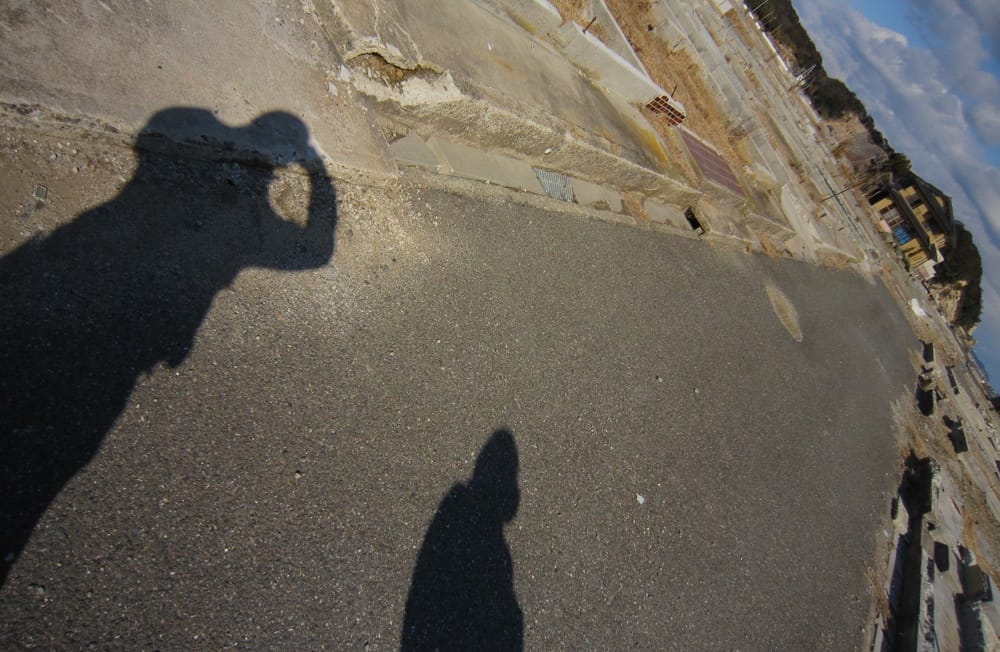
How do you clean a Japanese mountain?
I’ll never forget driving a mountain road in February 2012 through a Fukushima prefecture farming village so picturesque it could be the setting of a fairy tale or traditional Japanese ghost story, and coming upon a group of masked, white-clad men in Hazmat suits striding through the fields and surrounding our car. I was driving with photographer Noriko Hayashi, who also translated for me, and I asked her, half joking: why aren’t we wearing head-to-toe protective gear?
These workers go from settlement to settlement in the region surrounding the crippled Dai-Ichi nuclear plant, attempting to do something that’s rarely, if ever, been tried: clean up fallout.
If it weren’t so frightening, it would be funny. In conversation with a Fukushima farmer, he mentioned how much of the mountain behind his farmhouse authorities had told him they would commit to decontaminating: 20 metres. He wants the whole mountain cleaned. How do you clean a mountain, I asked him.
The way he understood it, those masked men in Hazmat suits would come and collect the fallen leaves.
This is one of the startling things about the nuclear disaster that is still unfolding in Tohoku: the collision between fairy tale villages like this one and science fiction.
Related Posts
‘Anybody want to drive this ambulance to Ukraine?’
“It wasn’t long before we were flooded with cholera patients”
Along the winding Japan National Route 399, which skirts the 20-km exclusion zone surrounding the Dai-Ichi plant, many of the villages are empty, evacuated by local decree. Only small security outposts, here and there, disrupt the human emptiness: the little huts, positioned at important junctions, are manned by farmers who can no longer put their fields to use due to the contamination.
Each time a car passes, they murmur the license plate number to each other and record who is coming and who is going. The concern is that robbers will plunder the empty villages.
On a little side excursion, to Namie, where some of the highest radiation levels have been recorded in Japan either within or without the no-go zone, one can stop the car in the middle of the street and leave the doors open to explore; you are hampering no traffic. The public clocks continue to turn over, the only sign of ongoing human routine.
Otherwise, in the middle of town, amid the barber polls that do not spin and the extinguished vending machines, the sound of rustling grass and the birds have taken over: birdsong has replaced the workaday public announcements that once regulated life in Namie. Road kill is left on the road: the crows, big as terriers, will deal with it.

Nicholas Köhler is a freelance journalist whose work has appeared in Maclean’s, the South China Morning Post and The Christian Science Monitor, among other places. He has reported from around the world, including New Orleans after Hurricane Katrina, northeast Japan after the 2011 Tohoku earthquake, and more recently from Myanmar as it lurched toward democracy. You can reach him at nick@nicholaskohler.com.
Related Posts
Why Russia should fear the coming insurgency in Ukraine
Nothing prepared me for what I saw in Ukraine
Why sanctions over the Ukraine invasion won’t stop Putin
My devastating, inspiring trip to provide flood relief in Pakistan
Get the Best of Maclean’s straight to your inbox.
Sign up for news, commentary and analysis. Join 60,000+ Canadian readers.