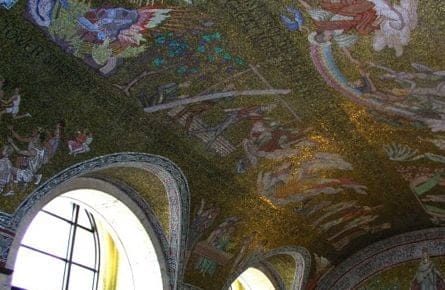
A late, glittery Christmas card: Byzantium in Ottawa
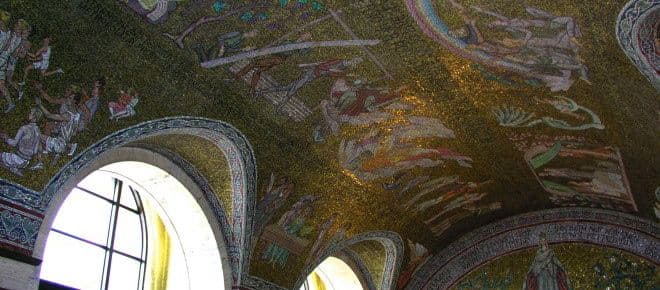
Every so often, it’s a good idea to change the way you look at things. I have a little trick for that: on my way into work at the National Press Building just off Parliament Hill, a few times a year, when I’m feeling stale, I’ll duck into the next-door Wellington Building and just tip my head back.
Above me then is an intricate, complex mosaic in the Byzantine manner, covering the entire vaulted ceiling of the vestibule, made of many thousands of brightly and subtly coloured pieces of glass. At first glance, the style prepares you for a theme drawn straight from the Bible or classical mythology.
But many of the figures are dressed in the fashion of the 1920s, when the mosaic was installed, like the formal grouping of four men in three-piece suits (one with a bow tie!) and five women in smart knee-length dresses. A cluster of runners clad in white shorts and singlets, sprinting toward a finish line, call to mind the athletes from Chariots of Fire, training for the 1924 Olympics.
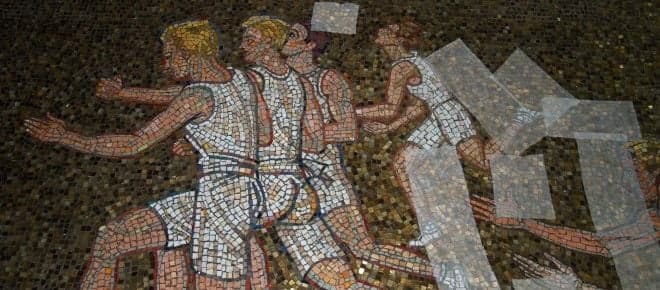
The combination of 1,500-year-old decorative technique and 85-year-old attire has to make you smile. Consult the wall plaque and you’ll discover the whole thing is meant somehow to allegorically represent the Metropolitan Life Insurance Company as a protector of health and well-being. The building was completed in 1927 as the company’s Canadian headquarters. The government bought the handsome Beaux-Arts landmark in 1973, and it is now undergoing extensive renovations.
Making sure the mosaic isn’t damaged during the work is the responsibility of the federal government’s Canadian Conservation Institute. James Bourdeau, the institute’s manager for fine arts, furniture and interiors, says WiFi-equipped monitors affixed to the mosaic’s surface and on the vault above transmit a signal if vibrations exceed safe thresholds. It’s happened “a few times,” Bourdeau says, resulting in work being temporarily stopped, and methods changed. Instead of jack-hammering, for example, workers have switched to sawing out slabs of flooring that must be removed.
Related Posts
Jonathan Vance pleads guilty, gets conditional discharge
The federal budget is a mixed bag
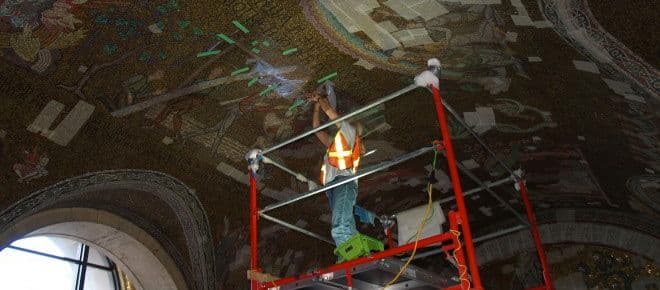
The mosaic is well worth the care. It was designed by Barry Faulkner, a celebrated American muralist, and executed by craftsmen of the specialized firm Ravenna Mosaic Co. (named after Ravenna, Italy, where some of the finest Byzantine mosaics are to be seen), which had offices in New York and St. Louis. Perhaps the firm’s most viewed mosaic is "Intelligence Awakening Mankind," in Manhattan’s famous Rockefeller Center, but Bourdeau prefers the Ottawa example. “It’s more fun,” he says.
For all its eccentric charm, the Wellington Building mosaic is more than a novelty. Ottawa’s quasi-official style is the Gothic Revival of Parliament Hill, with good examples of High Victorian, Beaux-Arts with neoclassical touches, and Art Deco scattered nearby. Overt Byzantine references, though, are as rare here as anywhere. Yet modern culture has been enlivened by recurring outbreaks of interest in Byzantium’s highly formal, conservative, exacting, and, to our eyes, exotic art and design, from those familiar great poems by Yeats, to a late Frank Lloyd Wright church, to Gustav Klimt’s crowd-pleasing gold-tinted paintings.
So it’s good to know that Ottawa’s prime example of that important subterranean stream in our heritage is being properly tended, and will be there intact, when the Wellington Building reopens in about three years, to again widen the eyes of any visitors fortunate enough to glance up, startling them into a way of looking at the world that’s at once old and fresh.
Related Posts
Pope Francis apologizes for residential school abuses

338Canada: A tale of two premiers

Inflation rate surpasses a three decade high
New federal budget will include up to $8 billion in defence spending
Get the Best of Maclean’s straight to your inbox.
Sign up for news, commentary and analysis. Join 60,000+ Canadian readers.