Firefighting Is My Family Business
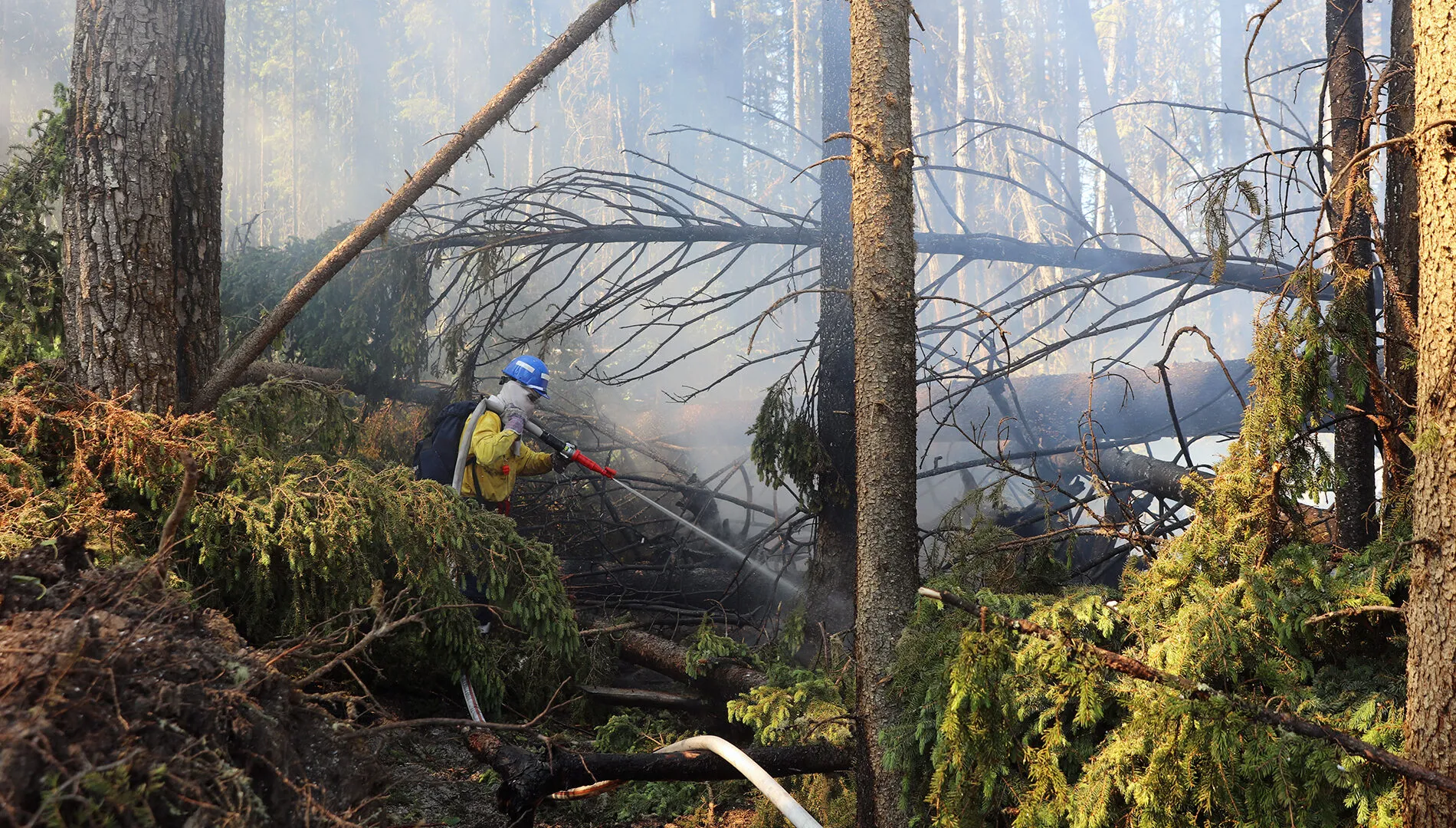
I’ve known my whole life that I wanted to be a firefighter. It’s in my blood; the men in my family have been in the service for four generations. When I was a baby, my dad started as a structural firefighter, responding to house and car fires in Slave Lake, Alberta, where I grew up. My first birthday was at the fire hall. There are pictures of me celebrating in the truck, my family members eating cake in the station meeting room. As I got older, I hung around the fire hall with my dad, sometimes tagging along to observe on emergency calls.
By 2011, I was eight and my family and I had moved to Edmonton. I remember playing outside in the backyard when it suddenly got very windy. Weirded out, I ran inside to find my mother speaking with someone on the phone about a wildfire—my hometown of Slave Lake was burning. Up on the fireground, there were 100 kilometre-per-hour winds, and pieces of roofing flying through the air. My dad immediately packed a bag to go help with the relief effort. He hadn’t even been dispatched. It was abrupt—enough to make me worry. Even though I had grown up with him dropping me off at the fire station at a moment’s notice to respond to calls, this felt different. Over two days, the fire spread, and a third of the town was destroyed. My sister and I cried for the house we grew up in. My friends evacuated to stay with us for several days before moving to shelters in the city. I learned with certainty that communities can disappear in an instant.
This knowledge didn’t dissuade me—if anything, it solidified my conviction that I was going to become a firefighter. By 14, I was going to weekend firefighting training sessions with my dad and his buddies. At 15, I joined the Edmonton Fire Cadet program, earning high-school credit by learning to fight fire in controlled simulations. At 16, I went on my first fire call: an RV trailer with aggressive flames shooting out of it. I had a mentor nearby, giving me instructions on fire suppression tactics and watching over me to keep me safe. In 2024, when I was 21, I completed a fire-school apprenticeship program and earned my formal accreditation.
My goal was to work a stable firefighting job in Slave Lake. But after graduation, there were no job openings. A full-time position as a structural firefighter today is coveted; it’s an opportunity that most young firefighters are anxiously seeking. My cohort tried to help each other out, talking about who’s hiring and interview methods, but there was still a competitive edge to those conversations. With no full-time openings, wildland firefighting was the obvious second option. It offered long, paid deployments with no expenses, and I could build my resumé in hopes of returning to the world of structure fires.
I started out as a swamper—the person who sits in the passenger seat and gets out to do the grunt work. I worked for a family-owned contract wildland firefighting company, being dispatched to camps to spray bright-red fire retardant where neighbourhoods met the forest line.
Related Posts
Diana Beresford-Kroeger Is a Green Machine
Inside the Fight for the Ring of Fire
We got called out to my first big wildfire in Fort McMurray in 2024. As we drove our semi-trucks for hours to get up to the site, a column of smoke overhead was moving toward the community. On the way, all you could see were car headlights, lined up to head south. The evacuation order was small—6,000 people or so—but after the megafire there in 2016, no one wanted to take any chances. A classic wildfire setup awaited us at camp: white government pick-up trucks everywhere, roughly 200 firefighters and heavy equipment operators in their yellow shirts, milling around. It looked chaotic, but everyone knew their place and purpose.
I often worked in the evacuation areas, spraying fire retardant by the tree line. It’s calmer than you’d think: ghost-like neighbourhoods where no civilians can get hurt. It’s nothing like fighting fire in the woods late at night—that makes the hair on the back of my neck stand up. There are night-vision helicopters swirling around, and if they drop water on you it hurts badly. The most crucial tool in firefighting is situational awareness, and at night, that’s dampened beyond comfort. I’m constantly looking up for possible tree fall. When the roots are burnt out from a forest, a trunk has nothing to anchor it down—a gust of wind can knock it over. My team and I are always looking out for each other, ready to pull someone back to protect them at the sound of a creak.
Since that first season, I’ve been dispatched to camps all over Northern Alberta. Boyle, Redwater, Swan Hills, Marten Beach, Red Earth, Fort Simpson, Whitecourt—each time patrolling, searching for hot spots, preparing sprinkler systems or putting out active fire. At a minimum, my crews will get sent for 14 days with two days off, unless the fire is extinguished. If it’s bad, the deployment can be extended to 21 days with three days off. We groan and complain on occasion, but ultimately, it’s what we signed up for.
Alberta has always been vulnerable to wildfire, but in recent years the scale has increased dramatically. “Zombie” fires regularly burn past the fire season and well into February, staying alive beneath the snow because of drought. Human-caused fires create their own damage, but over 90 per cent of the hectares burned in Alberta are caused by lightning strikes deep in the woods. The 2016 Fort McMurray wildfire was so voracious that it created its own weather system and exploded trees that were green and full of water. In 2023, just before I started fire school, more land burned than ever before in the province’s history: 2.2 million hectares in seven months, where the previous five-year average was 226,000 hectares. A third of the fires that summer were out of control. I remember the never-ending smoke. There were so many ignitions that it was hard to keep track. My dad and I discussed it at length. Knowing that the province was stretched for resources, we talked about heading north to go and help.
I don’t feel afraid of worsening wildfires, nor have I ever questioned going into the service because of its inherent danger. And while I know climate change is real, I don’t have climate anxiety. In my experience, it’s just not something firefighters really talk about. Wildfires are just part of our lives, and we accept them as they come. But it’s a common saying in our industry that when a wildland firefighter drives through the forest, they look at trees differently. They’re fuel. When I think of a stand of spruce trees that goes on for kilometres, a nice acreage that backs into a wooded area, or those classic Albertan valleys circled with forest, I know that a fire could rip through them if given the chance. When we build communities right inside the boreal forest, it’s what we’re going to get.
Now, at 23, I work full-time as a wildland urban interface firefighter (also called WUI, pronounced “woo-ee”) for the Lesser Slave Regional Fire Service. We’re trained to protect communities that run right along the edge of wildfire-prone forests. Our work blends the knowledge of wildland and structural firefighting, and it’s still a relatively rare specialization; our crew is one of eight operating in the province. I work alongside three guys who are 24, 27 and 49 years old.
On a day-to-day basis, we drive around neighbourhoods to identify homes most at risk of wildfire, and upload their details into a database, so if there’s a flare-up, we understand how to dispatch effectively. We also ship out to wildland zones to protect the neighbouring communities, relying on our knowledge of how to safely work in residential zones. We know where the structures can shelter us from the elements, the parking lots where we can seek safety and for how long we can protect homes without risking our own safety. Mayors and emergency managers look to WUI teams like mine to understand when and how to evacuate their towns. Our whole goal is to never again have out-of-control devastation like in Jasper, Fort McMurray or Slave Lake.
Fire dominates my whole life. My phone is always buzzing with notifications of wildfires and lightning storms. It’s hard when I’m not dispatched to nearby fires—I watch the map on my phone, angrily ruminating about the homes being lost. I just wish I could go help.
My contract as a WUI firefighter expires at the end of this summer, pending renewal from the province. I hope they approve it, because I want to keep working. I still have tons to learn in the field, especially as new forms of extreme weather throw never-before-seen challenges at even the most experienced veterans. Regardless, every day I wake up excited to keep on with the job of firefighting over the course of my lifetime.
—As told to Jacqueline Newsome
What did you think of this story? Send a comment for publication to letters@macleans.ca, and supply your name and address. Comments should be fewer than 200 words, and may be edited for length and clarity.
Related Posts
Tourism at the End of the World
How to Save B.C.’s Wild Salmon

The Eco-Therapist Will See You Now
The Case For Solar-Powered Sidewalks
Get the Best of Maclean’s straight to your inbox.
Sign up for news, commentary and analysis. Join 60,000+ Canadian readers.