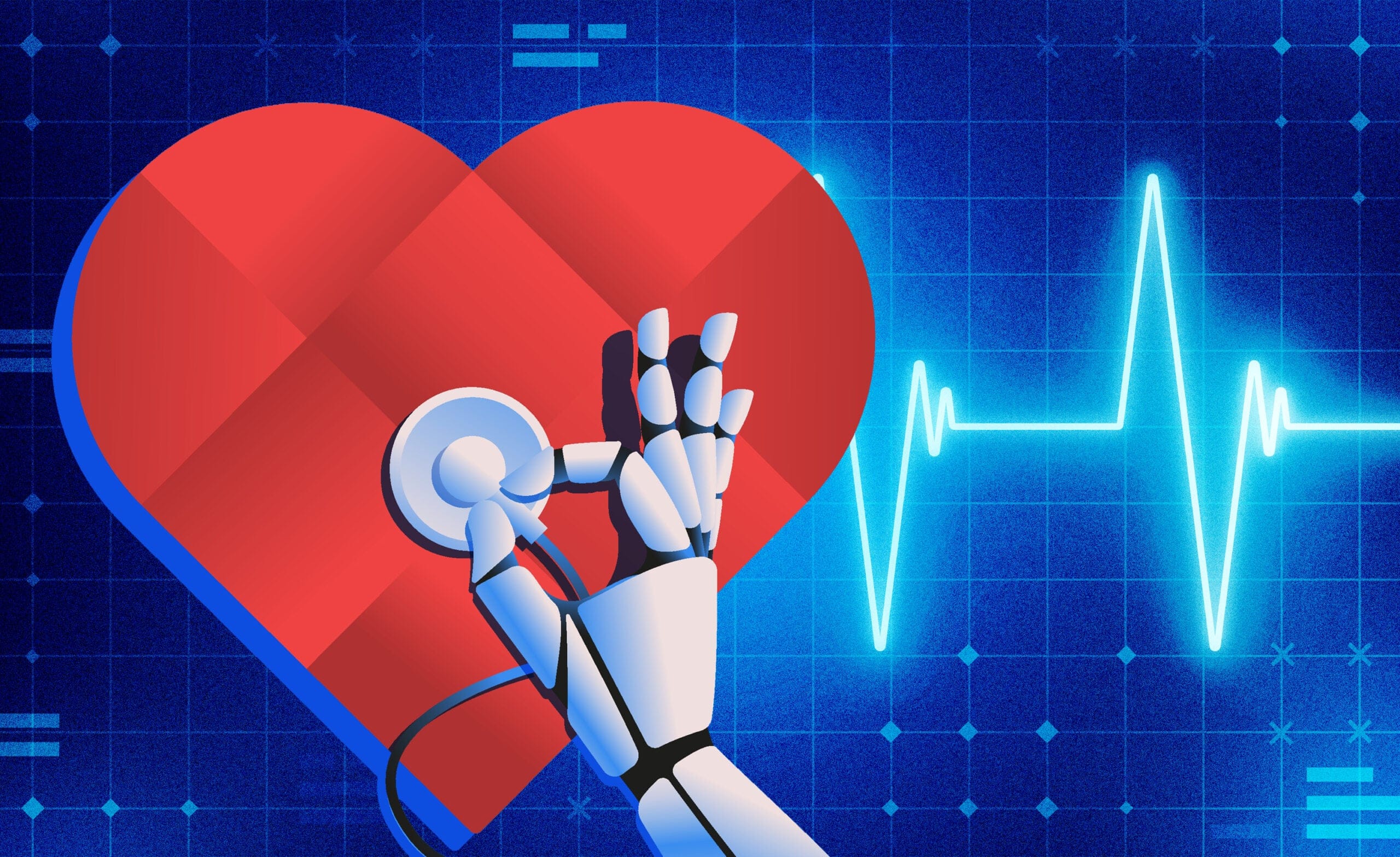
AI Could Save Canada’s Health-Care System
I spent more than a decade working in emergency rooms, and I carry those shifts with me still. I remember young families waiting 12 hours through the night, not because there weren’t enough beds, but because there weren’t enough nurses or doctors to move the long line of patients ahead of them. I remember elderly patients arriving frail and frightened, plagued with multiple chronic illnesses, needing hours of attention in a system already stretched to its limit. And I remember the people who simply gave up and left without ever being treated.
Medical school and residency had prepared me to face tragic outcomes brought on by disease and trauma. They hadn’t prepared me to witness those outcomes unfold because our health-care system had failed. On many shifts, I felt a deep sense of shame as patients pleaded for attention. Their frustration was justified, and I knew we were letting them down.
Related: The Smart Case for Private Health Care
This was not neglect on the part of health-care workers. By my 10th year in practice in 2014, we were routinely running at full tilt. The system was breaking down under a math problem we cannot escape: more older, sicker patients are showing up in the ER and fewer young, healthy Canadians are available to work as health-care providers. Nearly one in five Canadians is now a senior. Within a decade, it will be nearly one in four. That means millions more people needing complex care and not enough young Canadians to provide it. This is not a forecast. It’s a countdown.
The cracks are everywhere. Some 6.5 million Canadians lack a family doctor. Last year, emergency rooms across Ontario and Manitoba closed their doors because hospitals could not safely staff them. Patients in crisis are met not with care but with locked doors. The system is not bending anymore. It’s breaking.
New medical schools have opened in the past few years, but we cannot solve this demographic equation by training more physicians and nurses alone. Burnout is accelerating. More than half of Canadian physicians are considering reducing their hours. In just one year, Canada lost three per cent of its family doctors, a net reduction in a system already stretched thin.
I know that burnout intimately. By the time I was 40, after 11 years in the ER, I was crushed by exhaustion. The collapse of the system mirrored my own. Many days, there weren’t enough nurses to carry out my medical orders. I watched talented young doctors arrive full of hope, only to leave medicine a few years later, depleted by a job they loved but could no longer sustain. I loved my work, but I also knew I could not keep going this way. That is why I co-founded Maple, which has grown to be one of Canada’s largest virtual care providers, providing millions of online appointments each year. I could not single-handedly address our system’s deterioration from the bedside, but maybe, from outside the hospital, I could build tools that would make a difference.
Related: State of Emergency: Inside Canada’s ER Crisis
For me, technology has never been about replacing physicians. It’s about empowering us to do more. When it comes to AI, much of the public debate focuses on jobs lost. However, in health care, AI can maximize the resources we have, not eliminate them.
At Unity Health Toronto, researchers are using AI tools to predict the level of support a patient will need, helping to improve patient outcomes and physician workloads. Since the program’s deployment at St. Michael’s, unplanned mortality has fallen by over 20 per cent. In Quebec, AI is spotting sepsis risk in ICUs, enabling earlier interventions. At Maple, we use AI to automatically build patient records before appointments. That means doctors spend their minutes listening, explaining and connecting, not typing. In most of my ER visits, up to three-quarters of my time went into fact-finding and documentation. With AI intake tools, that work is done in advance, and the visit becomes more human, not less.
We’ve learned something else while building these tools: bedside manner matters, even for bots. Older chatbots ignored tone and irritated patients. Today’s intake AIs can read impatience or anxiety and adapt by clarifying, speeding up or slowing down. One patient told us, only half-joking, “I wish all doctors were as nice as your AI intake agent.” That line makes clinicians smile, but the point is serious: tools that reduce clinician burnout while improving the patient experience are not gimmicks. They’re real, and they’re meeting patients’ needs.
International evidence shows this works. A Swedish trial pairing AI with radiologists in breast cancer screening preserved detection rates while cutting workload in half. Routine, repetitive work can be automated without sacrificing safety. In Japan, hospitals are already using an AI system approved by regulators to detect strokes and aneurysms earlier, giving patients faster access to life-saving treatment. In England, an AI-powered “smart triage” system reduced wait times for appointments by 73 per cent, according to an NHS study.
Canada has the pieces to lead this transformation. The Vector Institute produces world-class AI research. The Pan-Canadian AI for Health Strategy has laid an ethical foundation. McKinsey estimates that scaling AI could reduce health spending by up to eight per cent annually without compromising outcomes. With Canada spending about $330 billion a year on health care, that’s roughly $26 billion in potential efficiencies annually, resources that could be redirected into upgrading critical infrastructure, reopening ERs and hiring more health practitioners.
What’s missing is scale and political will. Too many tools remain trapped in pilot projects and medical journals. The uncomfortable truth is that Canada invented modern AI but has largely failed to commercialize it here. We spend billions on foreign health technologies while domestic innovators struggle. With health care, we once again risk exporting the prosperity of Canadian science while importing solutions. And without national leadership from Ottawa, we will continue tinkering while ER closures and wait times worsen.
For Canada to truly realize the promise of AI, we need more than pilots. We need policy. That means making Canadian-built AI tools the first choice in our health system, creating clear pathways to scale solutions, and ensuring transparency and trust by using plain language with patients. It means building infrastructure that can evolve with new technology, embedding privacy and security safeguards from the start, and establishing a national framework so Canadians know AI is being deployed responsibly. It’s about digital sovereignty: making sure Canadian innovations are adopted here at home to strengthen our health system, reduce burnout and improve care.
This is not about cutting corners. It is about rescuing a system in crisis. If Canada leads, every Canadian can access care. If we lag, foreign AI tools will arrive anyway. They may help stave off rationing, but at a steep price: ceding control of our health-care system to foreign corporations and losing a once-in-a-generation chance to lead in health AI.
The good news is we don’t have to start from scratch. Canada already has innovative health-technology companies ready to scale solutions that reduce burnout and improve care. With the right support and a clear demand for homegrown innovation, the transformation can truly bear a Canadian flag. The question is whether we will seize the moment or watch it pass us by.
Brett Belchetz is the CEO and co-founder of Maple, one of Canada’s leading virtual health-care platforms. He is a practising physician in Toronto.
Related Posts

Canada’s Flu Seasons Are About to Get a Lot Worse

A Doctor’s Plea for Civil Discourse

The Secret Weapon in Canada’s Sewers

Canada Needs a National Vaccination Registry
Get the Best of Maclean’s straight to your inbox.
Sign up for news, commentary and analysis. Join 60,000+ Canadian readers.