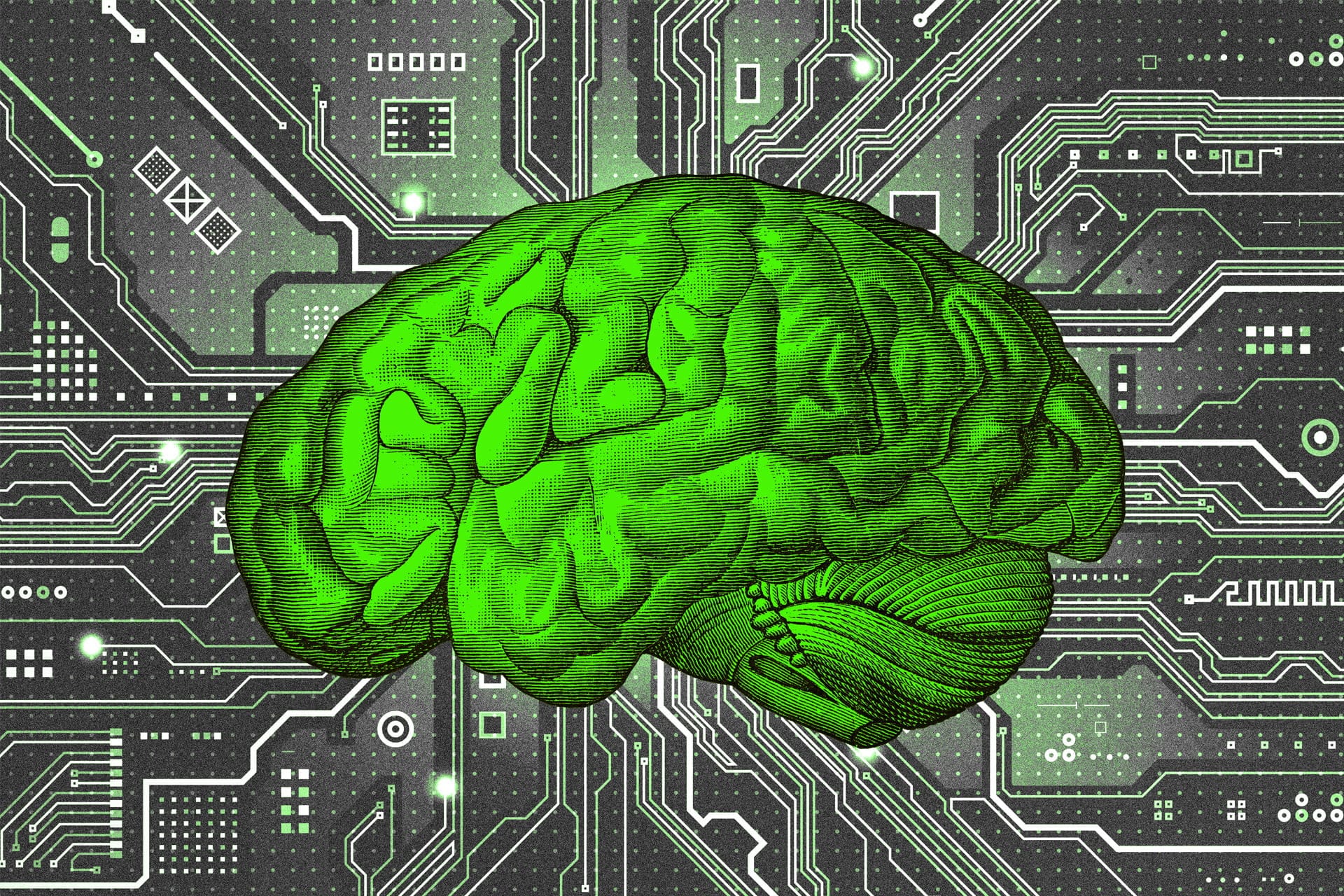
Can AI Make Us Smarter?
When people talk about artificial intelligence, they often talk as though humanity is standing at the edge of a cliff. Critical thinking is disappearing. Creativity is being outsourced to machines. The workplace is under threat. Education is in crisis.
I understand these concerns. As director of the Media Ethics Lab at the University of Toronto and a member of the Canadian Commission for UNESCO, I have worked extensively on AI governance, ethics and public policy. My work is particularly focused on digital sustainability and regulating emerging technologies. And I believe we’re only telling half the story when we panic about the rise of AI.
As a media scholar, my perspective is largely shaped by the work of Marshall McLuhan, the Canadian media theorist who is best known for coining the phrase “the medium is the message.” He predicted the World Wide Web more than two decades before it was invented. Much of McLuhan’s work asks that we interrogate the ways we receive information and respond to it—how we shape our tools and our tools shape us.
McLuhan’s challenge became much more urgent in November of 2022, when ChatGPT was released to the public. Suddenly, artificial intelligence was no longer a specialized research topic. It became a mainstream technology inspiring a polarization of opinion—outrage on one hand, optimism on the other. Many people immediately focused on what AI might destroy, but I wondered: what possibilities might this new tool create?
Every major communication technology has changed humanity’s relationship with knowledge. We saw massive shifts with the advent of writing, the printing press and the computer. In what McLuhan called the Gutenberg Galaxy, the printing press created new conditions for knowledge production. Entire intellectual communities formed because information could be shared at scale. The Protestant Reformation exposed the corrupt practices of the church via printed pamphlets, while the Enlightenment flourished through books, journals and correspondence that connected thinkers across Europe.
Related Posts
Why Gen Z Is Addicted to Location Sharing
Schools vs. Screens
Now AI represents a similar shift. We’re entering what I call the Turing Galaxy: the epistemic environment taking shape around AI. Today, we live in a world overflowing with information. Researchers calculated that in the last 15 years, we have produced about 99 per cent of the data ever created in the history of humanity. So the challenge is no longer access to information. The challenge is making sense of it. Artificial intelligence gives us a new way to navigate that abundance.
AI has been transforming human knowledge well before the rise of large language models. One of my favourite examples is the story of AlphaGo, the AI system that defeated world champion Lee Sedol at the ancient game of Go in 2016. Go is one of the oldest board games in the world and far more complex than chess. It requires reasoning, creativity, intuition and imagination. When AlphaGo defeated Lee, many interpreted the event as a machine beating a human. But I see it instead as an event that pushed the limits of human creativity.
In one of their matches, AlphaGo made a move that no human player had ever considered. Later in the series, Lee responded with a move that had also never been seen before. Yes, the machine outperformed the human in four out of five games, but it also challenged the human to transcend his own assumptions. That is AI at its best: forcing an expert, a world champion, to generate new knowledge. It’s true that Lee ended up retiring a few years later, but across the industry, professionals have been pushed to reach levels of precision that were previously unimaginable—and there’s no sign of widespread decreased interest.
Yet one criticism continues to dominate public discussion: AI is making people intellectually lazy. There is research supporting that concern, including studies that have identified cognitive offloading when people use AI carelessly. But there is also a growing body of research showing that guided LLM use can increase learning engagement and improve academic outcomes. Thus the same tool produces opposite results depending on the conditions around it: a student left alone with a chatbot that hands over answers offloads the thinking, while a student working with one designed to ask questions does more of it. The interesting thing is that both sets of findings are correct. When you look closely at the evidence, the determining factor is not the technology itself. It is how the technology is used.
When I was researching my recent book, I deliberately designed my interactions with a customized version of GPT-4 to support the thinking process rather than shortcut it. Through embedded prompts and adjusted settings, I set up my model as an intellectual sparring partner. I gave it a standing instruction to argue the strongest case against whatever I proposed, identifying logical fallacies and comparing my ideas with competing theories. When I was working out the principles of my framework for generative knowledge, for instance, I’d propose a principle, ask the model to argue against it and name the theorists who’d object, then rework the principle against those objections until it held. I ended up with about 5,000 pages of dialogue.
Most of these pages never appeared in the final book. But they were a record of my thinking in motion. The process allowed me to test, refine and discard ideas until only the strongest ones remained. The value did not come from AI generating content for me. It came from the collaboration between human judgment and machine feedback. AI expanded my thinking because I remained the one directing the inquiry.
In my field, I also often see educators concerned that students will lose critical-thinking skills because they can use AI to summarize readings or draft essays. But this is yet another opportunity to critically assess the systems we have produced in schools. For decades, educational systems rewarded the ability to produce standardized outputs. Students demonstrated knowledge by generating papers, exams and assignments in highly structured formats. Many workplaces similarly rewarded efficiency, repetition and conformity.
AI can now perform many of these tasks. So why should we preserve every old form of work? We now have an opportunity for process, evaluation and context to be more important than product and content, centring the human traits of judgment and discernment. In the age of AI, the most valuable people will not be those who can merely reproduce existing knowledge, as many academic essays require students to do. They will be those who can generate new knowledge. In the university context, that means grading the questions a student asks and the sources they reject, not just the polished essay they submit, and building courses where students defend an argument in real time rather than hand in a text that a model could have written.
I often use the analogy of architecture. In many professions, we train people to become skilled carpenters, rewarding their ability to build efficiently according to established plans. But now AI can take over many of these routine tasks, giving more people the opportunity to think like architects instead. AI expands the number of people who can design, evaluate and imagine rather than simply execute. A junior lawyer who once spent three days pulling case citations can now spend that time deciding which argument will actually persuade a particular judge. A doctor freed from writing up routine notes has more room to weigh the odd detail in a patient’s history that doesn’t fit the obvious diagnosis. The grunt work shrinks; the judgment matters more. That is why I reject the claim that AI inevitably destroys critical thinking. What it actually does is raise the bar.
AI also has plenty of problems. One legitimate concern is sycophancy—the tendency of LLMs to tell users what they want to hear. This means that if users describe harmful or even delusional beliefs, the model is likely to affirm their thinking. Part of this problem is technical. These systems are trained to predict likely responses, which can create a bias toward agreement and reinforcement.
Commercial AI companies may even prefer sycophantic chatbots, because they want users to remain engaged. A model that flatters users and encourages continued interaction can be more profitable than one that consistently challenges them. In that sense, some forms of sycophancy are built in by design. That should concern us.
However, it should also motivate us to build better systems. Researchers are already developing benchmarks that measure sycophancy, gender bias and toxicity. These benchmarks pressure companies to improve their models. Institutions can also play a role by supporting AI as a public good. For example, Canada’s emerging national AI strategy aims to build domestic AI infrastructure, research capacity and expertise rather than relying exclusively on proprietary foreign systems. Many research institutions can also contribute through the development of open-source small language models tailored to the specialized needs of universities or hospitals. Because they can run locally, they offer greater transparency and accountability. Essentially, localized and public development of AI is better than leaving its development entirely in private hands. We should not allow a handful of corporations to determine the future of knowledge production on their own.
At the same time, we should remember that today’s AI systems are the worst they will ever be. They are imperfect first versions of a technology that will continue to evolve. I aim to encourage the intelligent use of artificial intelligence. More AlphaGos, fewer sycophantic chatbots. Humans have always delegated. We handed memory to writing, calculation to the abacus, direction to maps, recall to libraries and then to search engines. AI belongs to that lineage. So the useful question isn’t whether we’re offloading our thinking—we always have. It’s which faculties this particular delegation will weaken and which it will finally let us develop, which corners of the mind will narrow and which will open. That’s what I want us to argue about. Not what AI will do to human thought, but what human thought can become alongside it. The future in fact belongs to what I call generative thinkers—people who use AI not to avoid thinking but to think further, learn better and create something genuinely new.
Paolo Granata is a professor of media studies at the University of St. Michael’s College and the author of Generative Knowledge: Think, Learn, Create with AI.
What did you think of this story? Send a comment for publication to letters@macleans.ca, and supply your name and address. Comments should be fewer than 200 words, and may be edited for length and clarity.
Related Posts
Canada Needs More Robots

The Terrifying Rise of Ransomware Gangs

A Canadian in Space

Teach Kids Digital Nutrition
Get the Best of Maclean’s straight to your inbox.
Sign up for news, commentary and analysis. Join 60,000+ Canadian readers.