
How to Pay for School: A Parent–Student Guide to the Money Conversation

With Summer here, final post-secondary acceptance letters have landed in mailboxes. For many Canadian families, the excitement of this life-defining milestone is quickly followed by a highly practical and looming question: How are we actually going to pay for it?
With average domestic undergraduate tuition hovering near $8,000 per year, and the all-in cost of a four-year degree: including housing, food and living expenses, ranging from $65,000 to $130,000, post-secondary education represents one of the largest financial investments a family will make.
Recent research from RBC reveals that more than half of Canadian students (57 per cent) rely on financial aid or loans to fund their education. Yet, entering the world of borrowing can feel overwhelming for young adults and their parents alike. For many students, this is the very first time they manage large-scale credit.
To help families navigate this transition with confidence, this Q&A guide breaks down the real costs of university, shifts the mindset around borrowing, and outlines how different financial tools can work together harmoniously.

When should families start having conversations about paying for university, and what should those early discussions focus on?
The short answer: as early as possible and certainly more than once. Financial clarity starts with open, transparent communication at home before classes even begin.
Talking about how to pay for school early can help students feel more confident when big decisions start becoming real. These initial conversations do not need to provide every single answer or a perfectly finalized spreadsheet right away. Instead, they are meant to help families build a clearer picture together and align expectations.
Money remains one of the least talked-about aspects of the post-secondary journey. Parents and students frequently assume they are on the same page regarding who is paying for what, only to discover a disconnect when first semester bills arrive. In fact, the biggest financial surprises in the first year rarely stem from tuition itself; they come from a gap in understanding the less obvious, day-to-day costs of independent living.
Families should use these early discussions to talk openly about financial expectations, family contributions and what portion of the costs the student will be responsible for covering.

Many families think of tuition as the primary expense, but what are some of the commonly overlooked costs students should plan for?
Tuition is only one piece of the post-secondary puzzle. For students living away from home, tuition is often just a fraction of the total cost, while rent, groceries, transit and everyday life make up the bulk of the expenses.
What’s more, a school year may not go exactly as planned. An unexpected rent increase, a reduction in part-time work hours during exam season, or a broken laptop can quickly disrupt an overly rigid budget.
Smart Tool Tip: To move from rough estimations to a concrete plan, families can utilize online tools like the RBC Student Budget Calculator to map out real-world income against expected expenses.
With so many different funding sources available, how do they all work together?
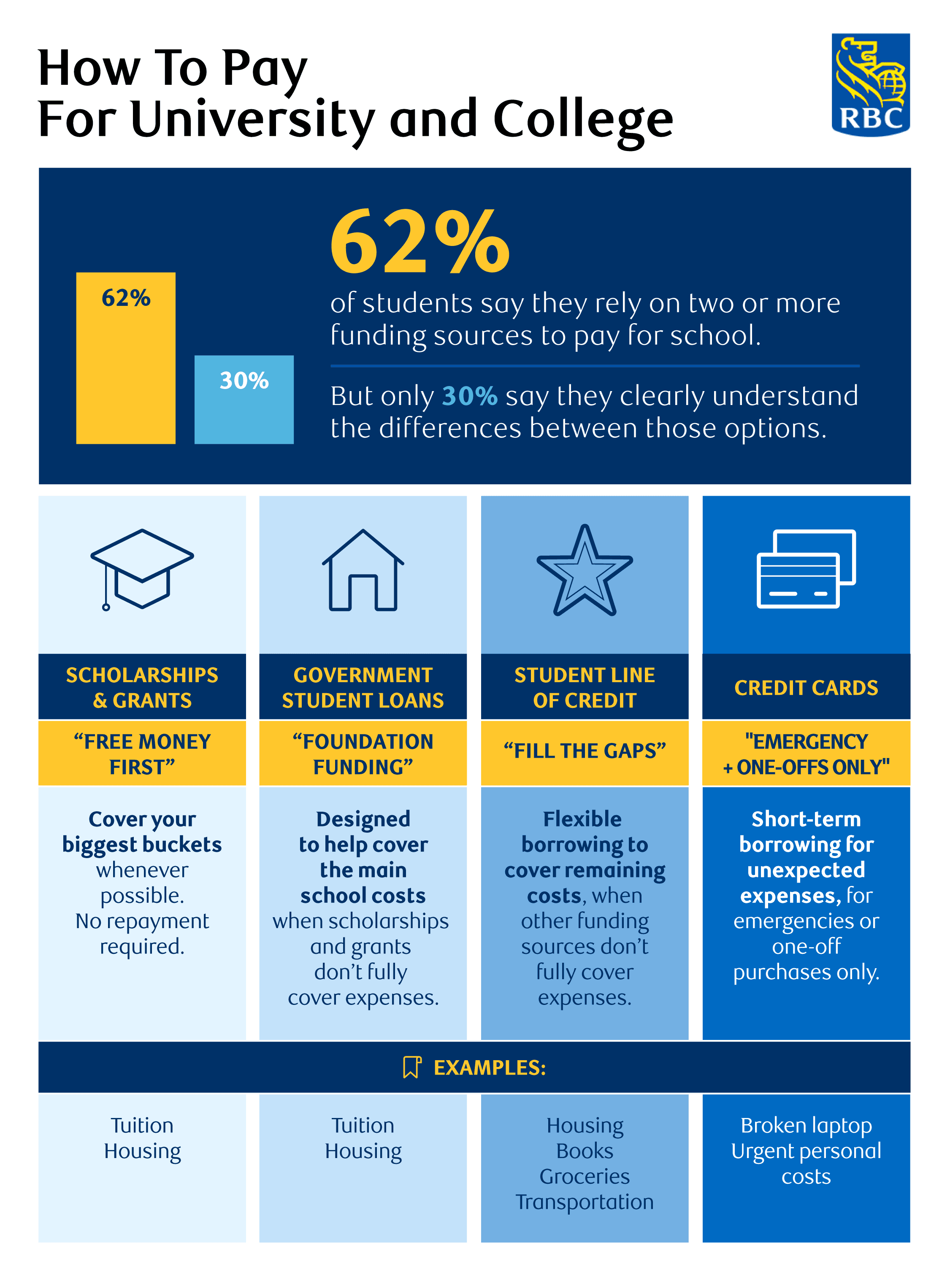
Paying for university has become increasingly complex. Today, fewer students rely on a single source of funding. According to the data, 62 per cent of students say they rely on two or more funding sources to pay for school.
A typical student financial plan might look like a mosaic: a government grant covering tuition, a part-time job paying for groceries, parental savings assisting with rent, a scholarship buying textbooks and a line of credit or credit card filling in occasional gaps.
However, stacking these funds without a strategy can cause confusion. Only 30 per cent of students state they clearly understand the structural differences between options like government student loans, lines of credit and credit cards.
There are a plethora of funding options available for students with different financial needs, understanding which types work for you can give you a personalized borrowing plan to fund your education. The challenge isn’t the act of borrowing itself; it is borrowing without a distinct role assigned to each dollar. By establishing what each fund is responsible for, families can prevent misallocation and avoid running out of cash mid-semester.

The concept of "debt" can be intimidating. How can parents help students think about borrowing in a healthy, manageable way?
Borrowing is a reality for many Canadian post-secondary students, but it is most manageable when viewed as one specific tool within a broader financial ecosystem, not the entire plan itself. Parents can guide their children through this transition by introducing four core mindset shifts regarding smart student borrowing:
1. Not all debt is equal: It is important to differentiate between what can be considered "productive" borrowing versus lifestyle debt. Borrowing to fund tuition, mandatory textbooks, or a laptop required for a program is an investment in long-term outcomes and future earning potential. In contrast, relying on high-interest credit cards to fund short-term lifestyle choices such as last-minute concert tickets, daily takeout, or spontaneous trips without a clear repayment strategy can quickly become difficult to manage.
2. Aim to protect flexibility, not to maximize credit: Financial confidence does not come from borrowing the maximum amount available, it comes from how efficiently that credit is managed. Building a strong credit history early is important as it helps individuals qualify for a first apartment lease, a car loan, or future financing–responsible usage is key. Students who avoid maxing out their available credit limits preserve a safety net for unexpected expenses. Unused credit is never wasted; it provides essential financial breathing room.
3. Budget for real life: Many students build financial plans based on a "perfect scenario" where they never order takeout, work maximum hours every single week and never buy a coffee on campus. But real life involves flexibility. Work shifts may get cut during exam weeks, or burnout might limit energy levels. Families should build a buffer into the plan, expecting at least one surprise expense per term, and revisit the numbers regularly to adjust for real-world spending habits.
4. Understand the consequences and repayment early: A common pitfall for students can be ignoring the mechanics of repayment until graduation arrives and grace periods end. Understanding how interest accrues across different borrowing tools can alleviate stress later on. For instance, understanding the basic functions of credit cards reveals that interest typically accumulates monthly if the balance isn’t paid in full. Meanwhile, student loans and specialized student lines of credit often feature different grace periods or interest structures. Knowing these nuances allows students to make highly informed choices, such as borrowing only what is strictly necessary for a semester rather than accepting a maximum limit automatically.
Key Takeaways for Families:
- Initiate the Talk Early: Begin financial discussions when deciding where to apply, to schools in town or planning to move out.
- Look Beyond Tuition: Factor in the heavy impact of everyday living costs like groceries, utilities, transit and emergency buffers.
- Assign Roles to Funds: Categorize incoming money so that grants cover tuition, savings cover rent and flexible options handle daily variables.
- Borrow with Intent: Focus credit usage on productive educational necessities rather than lifestyle spending and treat unused credit lines as a protective safety net.
- Consult the Experts: Families do not have to figure it all out in isolation. Speaking with financial aid offices or a financial advisor can help clarify borrowing options and establish a sustainable plan.
For further resources, interactive tools, and information on structuring a student financial plan, visit the RBC Student Borrowing Guide.
This article is intended as general information only and is not to be relied upon as constituting legal, financial or other professional advice. A professional advisor should be consulted regarding your specific situation. The information presented is believed to be factual and up-to-date but we do not guarantee its accuracy and it should not be regarded as a complete analysis of the subjects discussed. All expressions of opinion reflect the judgment of the authors as of the date of publication and are subject to change. No endorsement of any third parties or their advice, opinions, information, products or services is expressly given or implied by Royal Bank of Canada or any of its affiliates.
Related Posts

Boosting Canadians’ employability for the clean economy

The beauty industry’s innovative shift to inclusivity and sustainability

What went down at BMO’s BlueCarpet Premiere of Spotlight - Women in Asset Management