The Future of Higher Education Is Flexible
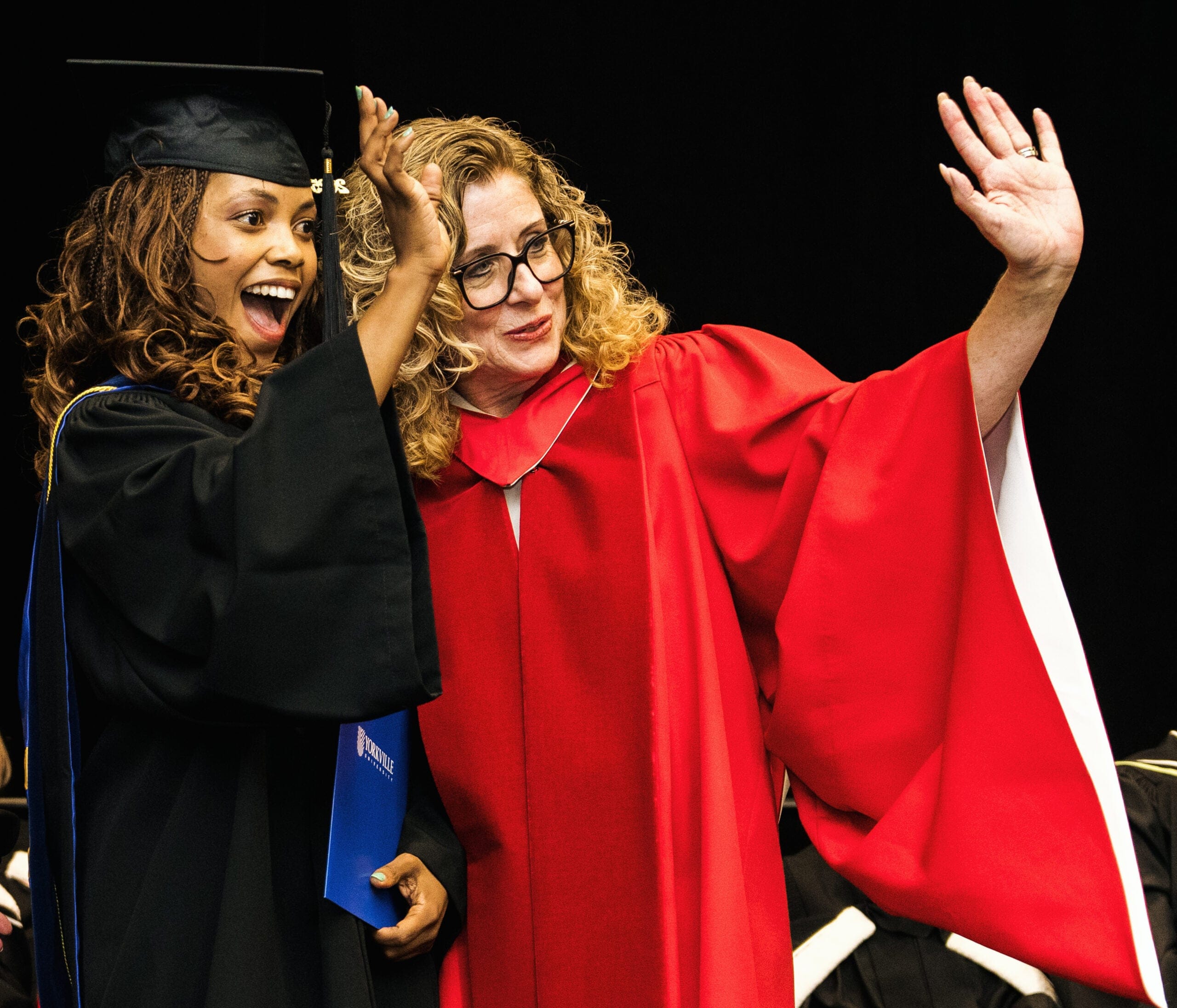
Each time Julia Christensen Hughes, president and vice-chancellor of Yorkville University, takes the stage at convocation, she beams while graduates walk across the platform to the cheers of family and friends. Some do so holding a newly born infant. Others thank spouses and children for their support, including family at home, through the digital livestream. To her, it’s a picture of what higher education looks like today: a way for people to keep learning—at any age, from anywhere—while building busy, full lives.
It’s a path Christensen Hughes knows well, having given birth to two sons during her MBA, and a daughter during her PhD, years ago. Higher education must adapt to the needs of modern learners, Christensen Hughes says—a challenge that Yorkville University, which offers flexible in-person and online undergraduate and graduate programs, is passionate about addressing.
Most universities were designed for specific types of learners: young Canadians fresh out of high school who can dedicate four or more years to earning a degree, as well as graduate students who spend a year or more away from home, family and careers to do so. Though the model works for some, it excludes many who must balance outside commitments alongside their learning.
Yorkville University offers a different experience. Their student demographic highlights the school’s commitment to meeting the needs of diverse learners: the average age of an undergraduate student is 26, and at the graduate level, it’s 35. The majority are women who choose to learn online, coming from every province and territory in Canada, including from some of the country’s most remote communities.
“The percentage of society that can afford to take four or five years or move away from home to earn a degree is shrinking,” says Christensen Hughes. “Yorkville makes it possible for people with full lives to achieve their professional and personal goals.”
A model that fits real lives
With a largely asynchronous learning platform, Yorkville students have the flexibility to learn at times that best suit them. Students can also expedite their learning journey by studying four semesters a year at the undergraduate level, or three per year at the graduate level. Its purpose- and career-driven degrees include bachelor’s programs in business, creative arts and design. The university also offers master’s degrees in education and counselling psychology, and a doctorate of counselling and psychotherapy. In addition, Yorkville is launching a new MBA offering in January 2026. These programs prepare people for professional careers that align with current societal and labour force needs, says Christensen Hughes.
Learning that keeps pace with change
Higher education in Canada is facing many challenges, including rising financial pressures from declining international enrolment, inflation and deferred maintenance of university facilities. These issues are leading to larger class sizes that do not easily support student engagement or assurance of learning, Christensen Hughes explains. Generative artificial intelligence is also challenging traditional forms of teaching and learning assessment.
Yorkville has addressed these challenges by investing in a robust online learning environment with an average class size of 20. “At that level, faculty members can get to know their students, and support their learning, like a mentor would,” says Christensen Hughes. Yorkville also ensures that students develop core, transferable skills called Signature Learning Outcomes. These competencies, including digital capabilities, adaptability, social responsibility and collaboration, are woven into each curriculum.
Canada is also facing a productivity crisis, and a key part of the challenge is the need to re-skill or upskill existing professionals. Being able to learn flexibly, Christensen Hughes says, enables working students to apply what they’re learning at Yorkville directly into real-world settings, benefiting both them and their employers.
“I believe learning is enhanced if you can apply it immediately. The conversations among students are more robust and interesting, and the feedback is more immediate,” she says. “With careers being quickly reshaped by artificial intelligence and other emerging technologies, students can’t afford to test the efficacy of what they’re learning four years down the road when it may no longer be relevant.”
As the landscape of higher education adapts to mounting pressure and shifting realities, Yorkville University continues to meet the evolving needs of learners and the professions they aspire to join. “We are different on purpose,” says Christensen Hughes. “We are reshaping how Canadians learn.”
To learn more about Yorkville University, click here.
Related Posts
What went down at BMO’s BlueCarpet Premiere of Spotlight - Women in Asset Management
The beauty industry’s innovative shift to inclusivity and sustainability

Boosting Canadians’ employability for the clean economy