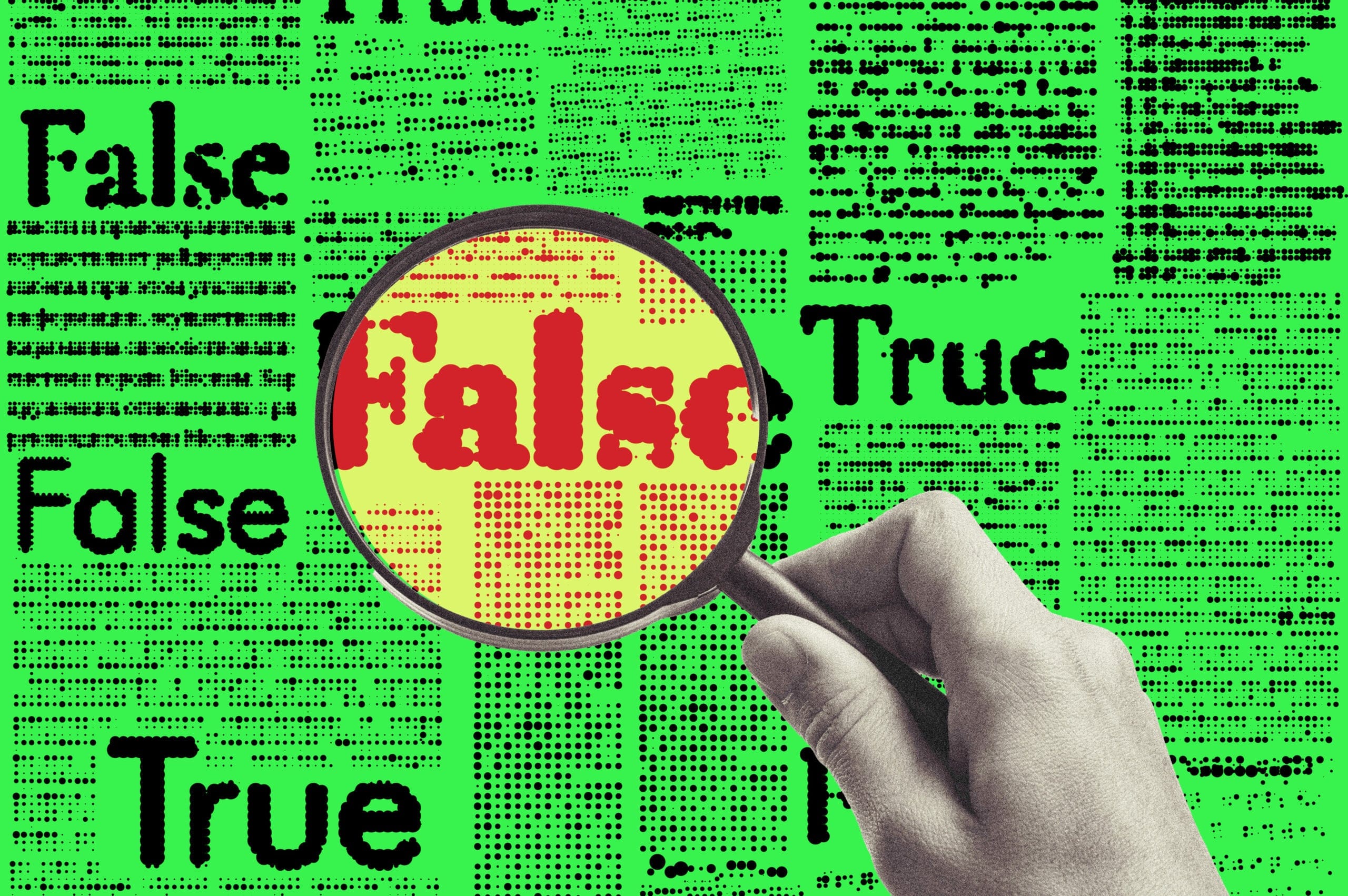
Can AI Save Us From Misinformation?
I started in journalism during a different era for the industry, a time when reporting meant lugging huge cameras and other heavy equipment through airports to war zones and other flashpoints around the world. I was the reporter viewers saw on screen, authoritatively telling stories for Global News, ABC, CNN and Al Jazeera, working from Cairo, Addis Ababa, Port-au-Prince, Gaza and elsewhere.
It’s the only job I ever wanted. I would land in a country in crisis, and people would rush to me with questions: Was this ceasefire just a trap? Is our government behind that bombing? Was the other side paying off the UN? Often, I was barely off the plane when people would approach me, hoping I had the information they needed—and that I could confirm the story they wanted to believe.
Over time, I began to see a pattern. In crises, people are starved of trustworthy information, so they fall into camps, each side claiming truth and blaming the other. During my reporting years, I saw it in the Middle East, where media, leaders and people clung to their own national narratives, deaf to the other side. In Afghanistan, the failure of both government and foreign interventions left people with no one to trust at all—and to despair. These crises rarely started with violence. They began with confusion and a lack of information. Trust frayed, institutions faltered and polarization hardened. Once that spiral begins, it’s painfully hard to reverse.
This is no longer someone else’s crisis; it’s Canada’s. For decades, journalists, academics and public institutions, imperfect as they were, acted as guardrails, verifying facts before they reached the public. Today, AI is upending how we access information, and chatbots like ChatGPT are quickly becoming a primary source of information, preferred by many over traditional news. In 2025’s annual CanTrust Index, which polls Canadians on how much they trust certain social institutions, 41 per cent of Gen Z Canadians said they see AI systems as reliable sources of information. That’s nearly the same as the 49 per cent who trust traditional media.
Related: The Diabolical World of Phone Scams
But they shouldn’t. AI is flooding us with unchecked, unfiltered content. Some of its information is sourced from discredited or obsolete sources. Some of it is from web forums like Reddit—social hubs, not fact-checked platforms. And some of it is even intentional misinformation. Canada’s Communications Security Establishment warns that state-sponsored actors, especially from Russia and China, are using AI to fill the information environment with falsehoods.
Things are not improving. A study by NewsGuard, a U.S. company that rates websites for accuracy, found that as recently as last year, AI chatbots would refuse to answer many prompts if their answers were uncertain. That refusal rate has since dropped to zero. AI now answers everything, whether it knows the answer or not. The study also found that the 10 leading AI chatbots repeated false claims 35 per cent of the time, nearly double the rate of the year before. Chatbots have also been known not just to repeat false claims, but to invent them. In 2023, the Guardian warned readers that ChatGPT was making up fake articles, purportedly from the paper’s archives. And this past January, Apple paused an AI feature that summarized news after it created fictional headlines for readers.
In December of 2024, former Global TV anchor Kevin Newman and I started messaging friends and former colleagues, floating an idea: what if we could create our own guardrails, combatting AI falsehoods with AI-generated fact-checking? In journalism, facts are essential, and those of us in the business have been dismayed to watch the media ecosystem, and our shared fact-based reality, be overtaken by social media and rumours. We traded questions, frustrations and warnings. Soon, our conversation spread—through private chats, group threads and LinkedIn messages—to other writers and editors, and beyond, to AI engineers and even acquaintances in military intelligence. For them, facts are a matter of life and death.
We called the new effort Get Fact, and about 150 people offered to help us build it. They included Wendy Freeman, former president of CTV News; Jody Thomas, Canada’s former National Security and Intelligence Advisor; and the deeply patriotic and legendary music producer Bob Ezrin. Dozens more came from the advertising industry and civic organizations like the Commissionaires.
The Get Fact team spent almost a year building an AI fact-checker we call Laura (named after Laura Secord, the Canadian heroine), to make fact-checking as easy and simple as spell-checking. The idea is that it would extract claims, identify the facts in that claim and check them in real time against trusted datasets—sources we know to be accurate—and return a concise, cited summary. We envisioned it as a web-browser extension that could be installed wherever you get information: at home, at work, on your phone. It would be voice-enabled, so you can say, “Hey Siri, ask…” For companies aiming to avoid the risks of misinformation, it could sit with every employee, checking reports, verifying emails and seeing what’s being said about the company, and if anyone needed to stop it. (A beta version is live right now on our website; a new and more advanced model will launch early next year.)
Related: How Astrology Became the New Therapy
Writing code and building algorithms was just the start. The real challenge was finding truthful facts in oceans of data, especially those buried in misinformation. Even skilled fact checkers often disagree on what’s misleading, missing or out of context. So we brought in seasoned editors and fact checkers, including Kathy English, a world leader in fact-based editorial integrity, to help us design a layered process that detects bias, applies judgment and handles nuance.
Then engineers built a team of AI agents, each with a task, each working in sequence toward a single goal: verify the claim, find the facts and share them. Over time, accuracy improved. Hand-offs between agents got sharper. The system got smarter.
This wasn’t just a technical problem. People are deeply skeptical of authority and of anyone claiming to decide what counts as truth. So, we made transparency core to our effort: users can check the data and the sources. This is especially critical, since AI bots get their information by scraping the internet, drawing heavily from American and global sources. That means Canadian realities risk being distorted, overlooked or erased. Our politics, public health, and Indigenous communities are especially vulnerable. For example, in May, the Trump Administration’s Make America Healthy Again report was riddled with AI-generated errors. The anti-science rhetoric on vaccines, chronic illness and more found within entered the AI pipeline. Though it doesn’t reflect Canadian science, this data seeped into the information space that chatbots use for our information.
This crisis cuts across every major issue we face, distorting our discussions about issues as disparate as climate, crime and the economy. And while the printing press and the industrial revolution played out over generations, the historic shift with AI is happening at lightning speed. So many of my conversations now end with, “That’s not what I heard,” or “Is that really true?” I hear claims like “Canada taxes the U.S. 250 per cent on all dairy” or “We would all be richer if we became the 51st state.” These conversations feel disturbingly like my old reporting days in crisis zones. Sometimes, when I asked someone a question, they’d pause, because they didn’t know what to trust. But sometimes they’d speak with total certainty, despite having no facts to back it up.
When I hear the doomsday predictions, that AI will become Skynet or trigger a robot uprising, I see the real threat as far more insidious, and already here. It’s in our feeds, in our group chats. It’s quietly shaping what we believe. And if we don’t confront it now, it will decide what’s real for all of us.
Wilf Dinnick is CEO and co-founder of Get Fact.
Related Posts

In Defence of Screentime

Why iPad Babies Have More Tantrums
Railway Tycoons Shaped Canada. Don’t Let AI Barons Do the Same.
Canada Needs Homegrown AI Infrastructure
Get the Best of Maclean’s straight to your inbox.
Sign up for news, commentary and analysis. Join 60,000+ Canadian readers.