Drone Highways Are Coming to Canada’s Skies
Back in 2016, I joined the University of Toronto’s student aerospace team with my friends Ayaan and Shayaan Haider. We’d build our own makeshift drones then make them square off in silly competitions, like seeing whose model could fly eggs a few kilometres without cracking them, or deliver cans of beer to frat houses without shaking them up. We noticed our fellow students were ordering items from Amazon Prime that they could easily get from local corner stores, so we created a delivery app, programming our drones to zip around buildings and other city structures to drop off orders.
Creating flight paths that drones can navigate autonomously isn’t as simple as plotting routes on Google Maps. When you look up, you may see clouds, telephone wires, maybe a few birds. But from a robotics standpoint, all kinds of invisible factors influence the accuracy of a drone’s route, like its altitude, electromagnetic and radio-frequency interference, GPS and telecom signals and, yes, weather. In 2018, the Haiders and I started capturing these datasets using sensor-equipped drones, bikes and other modes of transportation to map out cities like Vancouver, Toronto, Ottawa, Calgary and parts of Montreal.
That’s the origin story of AirMatrix. Today, it’s a master-control software that helps pilot autonomous drones safely, simultaneously and compliantly using all of the aforementioned data, updated in real time with an assist from AI. It’s now being used by the Canadian and Ukrainian militaries, as well as 30 American organizations, including the Federal Aviation Administration, or FAA. Soon, we’ll deploy in Riyadh.
Related: Send In the Delivery Robots
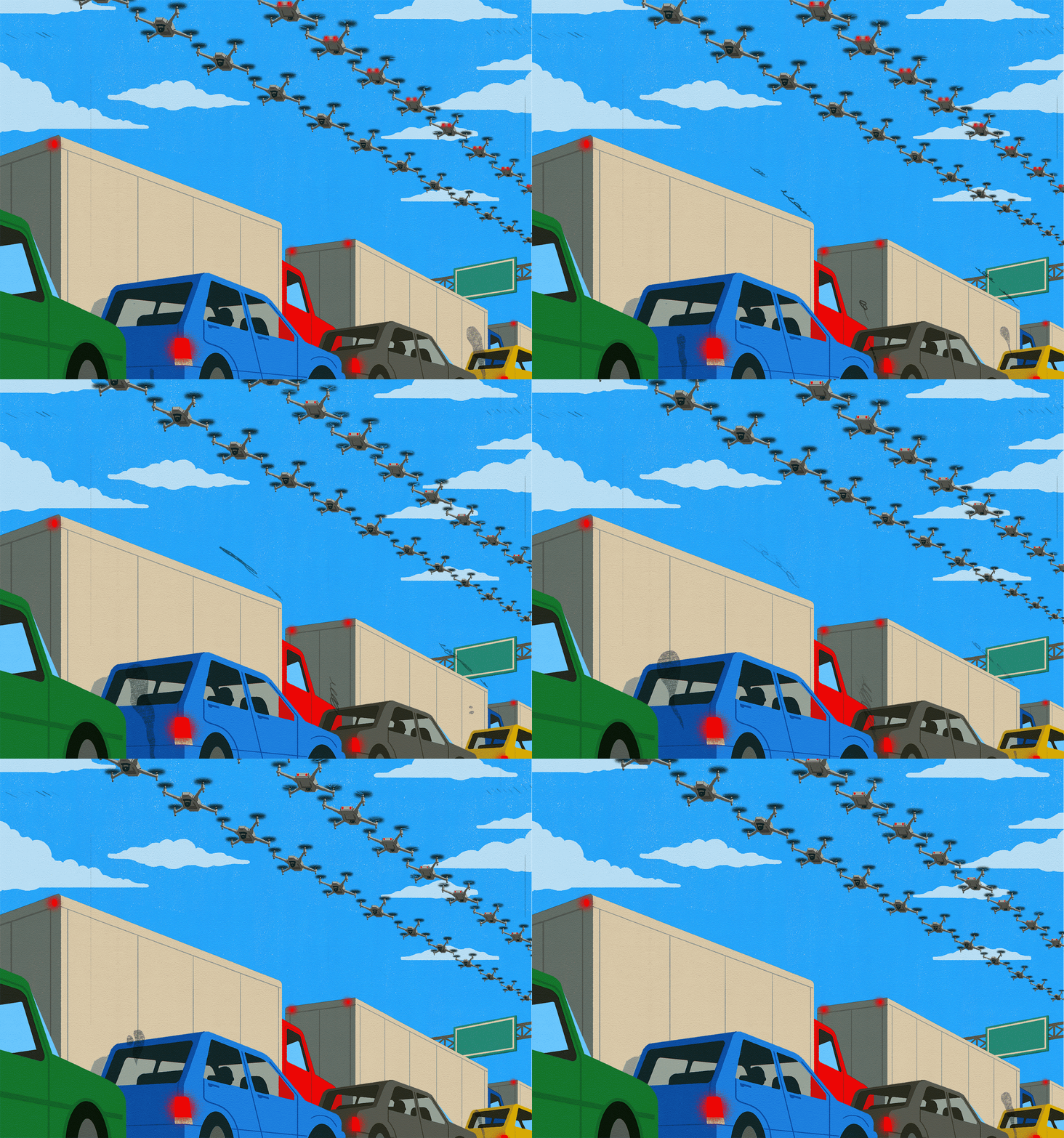
Skyways are quickly going to become essential infrastructure for drones, just as roads are for cars. Between 2019 and 2025, Transport Canada certified more than 107,000 drone pilots, and our domestic drone industry is set to grow five-fold in the next decade, from US$3.5 billion in 2024 to US$15.5 billion by 2035. While the Canadian military can fly its drones as high as it wants, commercial drones will mainly stay below 400 feet in the air—and we’ll need to rigorously map out that space to keep traffic moving and prevent accidents. Drone operators typically use GPS to chart their paths; there’s a six-metre margin of error, which could prove catastrophic once Canada’s skies further densify. AirMatrix, on the other hand, maps routes down to the millimetre.
Once their paths are plotted, drones could be used for almost any task, anywhere Canadians need them. They’ll be able to inspect civic structures, like government buildings and telephone wires (which is good news for pole-climbing techs). They’ll also have a role to play in health care, possibly in the form of medication deliveries. In fact, the world’s first delivery of lungs to a transplant patient via autonomous drone, flying from one Toronto hospital to another, took place on AirMatrix’s flight path.
Related: Time to Privatize Canada Post
One of the most important emerging uses within Canada is defence. We sometimes say AirMatrix provides “sovereignty-as-a-service,” a play on the phrase “software-as-a-service.” Historically, the British Empire achieved military dominance because of its naval supremacy; later, the Wright brothers’ tinkering helped the U.S. become an aerial superpower. You only need to read the news to understand that low-level airspace threats are now the predominant ones. According to combat medics, drones have caused roughly 60 to 70 per cent of soldier injuries and deaths in Ukraine, for example. Even if a country isn’t in an active war, drones can also be used by neighbouring nations for reconnaissance purposes.
Canada’s current biggest vulnerability on this front is the Arctic, which makes up 40 per cent of the country’s total land mass. As climate change melts our ice, previously locked trade routes will open up, facilitating passage by vessels from China, Russia and the U.S. Canada’s federal government uses satellite and radar to monitor activity in the region, but there are vast swaths of the Arctic that have no digital eyeballs on them at all. And some of our satellites only retrieve images at 12-day intervals. The same technology that maps drone pathways in cities is starting to be used to more regularly scan our northern skies. AirMatrix’s software, for example, can pull data from any sensor, radar or camera located in the territories to create a security mesh—a central nervous system looking out for threats to critical infrastructure or airspace violations, whether by a drone or something else. It could also report any unsavoury activity to the Royal Canadian Air Force, prompting an immediate response.
The need for non-compliant-drone detection doesn’t just exist above the Arctic Circle. Thousands of these incidents now occur across Canada every year. In 2022, a drone carrying a shopping bag full of guns breached the U.S.-Canada border before crashing into a tree near Port Lambton, Ontario. AirMatrix has also been used by prisons, which frequently deal with drones trying to smuggle contraband like weapons and cellphones over their walls. Authorities spotted more than 1,000 drone drop attempts at Canadian federal penitentiaries in the first half of this year alone. As drone technology becomes more accessible to the average person, these incidents will only increase. That’s why we need to track and counter them.
Scaling mapping and defence detection to a national level is going to take time. Many of the Canadian buildings we’d want to protect are in restricted airspace. In the U.S., the FAA has a program in place to grant security agencies access to sensitive areas for data collection purposes; Canada does not. Drone use is currently regulated at the federal level by Transport Canada, but issues like criminal enforcement—and best practices for commercial drone flights across urban, forested and tundra landscapes—bleed into provincial jurisdiction. (Cities also enact their own bylaws that govern drone use.) AirMatrix is part of a drone-specific traffic-management task force led by Transport Canada that’s looking at all of these concerns, including which agency is best suited to handle air-traffic control. Right now, the job falls to Nav Canada, which operates the country’s civil air-navigation system. That could change in the coming years.
Someday soon, drones will be just another vehicle we share space with. Some Canadian Terminator fans might think of Skynet and get spooked. Making them comfortable isn’t just about ensuring drones can fly around without causing aerial disasters; it’s also about creating technologies that can spot and remove any machines operating illegally in low-level airspace. I think of our software as the good version of the all-seeing Eye of Sauron from The Lord of the Rings, and also in terms of Maslow’s hierarchy of needs. First the security, then medication deliveries, then the fun stuff.
Bashir Khan is the co-founder and CEO of AirMatrix and a founding member of Canada’s National Security Innovation Council.
This story appears in the upcoming November 2025 issue of Maclean’s. To receive the issue, subscribe here.
Related Posts

Why iPad Babies Have More Tantrums

Can AI Save Us From Misinformation?

In Defence of Screentime

Canada Needs Homegrown AI Infrastructure
Get the Best of Maclean’s straight to your inbox.
Sign up for news, commentary and analysis. Join 60,000+ Canadian readers.