A Judge Recognized Aboriginal Title on Private Property. Panic Ensued.
On a Thursday afternoon in August of last year, Malcolm Brodie, the mayor of Richmond, B.C., got a call from one of the city’s lawyers. He had news: the province’s Supreme Court had reached a decision in Cowichan Tribes v. Canada, the longest trial in Canadian history.
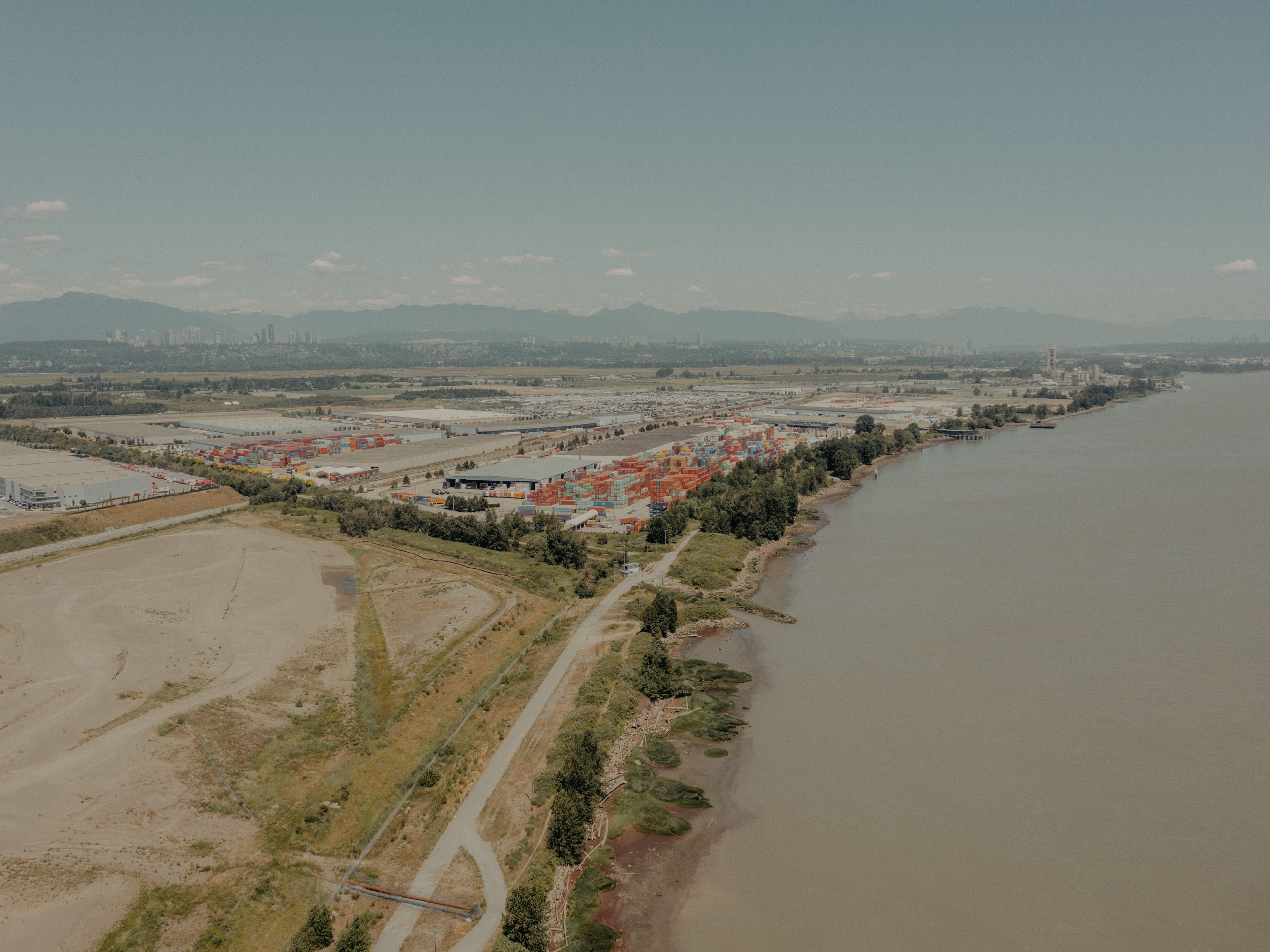
The verdict wasn’t what Brodie wanted to hear. The Cowichan, the province’s most populous First Nation, had spent years claiming title to a swath of land along the city’s southern edge, at the mouth of the Fraser River—once the site of a Cowichan village called Tl’uqtinus and today a slice of suburbia containing federally and municipally owned property, a marine container terminal, a golf course, blueberry farms, a former landfill and about 45 private homes. B.C. Supreme Court Justice Barbara Young determined that the Cowichan title was “prior and senior” to private property and recognized the Cowichan people’s Aboriginal title—a unique mixture of property rights and governing authority—to 300 hectares of the city. To Brodie, who has been the mayor of the Vancouver suburb for 25 years, the ruling felt like an attack. His response was one word: “Unacceptable.”
Brodie immediately called Richmond’s seven city councillors in from their summer vacations for an emergency meeting with lawyers. According to the ruling, the Cowichan’s property rights would not replace the ownership enjoyed by homeowners, known legally as fee simple rights. But they would sit alongside them, and the specifics of just how that can or should work were unknown. Brodie and Richmond’s councillors decided to notify people in the affected area. In October, roughly 150 property owners received a letter from the mayor.
When Justice Young delivered her ruling, after two years of deliberation, it marked only the third time a Canadian court had recognized a First Nation’s Aboriginal title, and the first time title had been established in an occupied, urban area, affecting private property. But despite the case’s profound implications and extraordinary length—513 days of courtroom proceedings spread over four years—Brodie’s missive was the first some of his constituents had heard of the trial. The letter included a map, on which the Cowichan land was demarcated by a dark line. “For those whose property is in the area outlined in black,” Brodie wrote, “the court has declared Aboriginal title to your property, which may compromise the status and validity of your ownership.” In this he was mistaken: the ruling had explicitly preserved the validity of homeowners’ property title.
Brodie’s letter caught fire on social media, then in the press. Speaking to the CBC, he said, “The ruling could apply, potentially, to every parcel of freehold property in the province and probably in most parts of Canada.” Property owners wanting to learn more had been invited to an information session at city hall, but panicked calls began flooding his office and it grew clear that far more people planned to attend the information session than the number he’d originally planned for. So Brodie changed venues and opened it to the public at large. On a rainy Tuesday evening, three days before Halloween, more than 700 people packed into Richmond’s Sheraton hotel ballroom.
Related Posts
My Misadventures in Gentle Parenting
The Battle for the Soul of the University
Brodie is 77 years old and comports himself with avuncular authority. But that night, the crowd was agitated on arrival, and the mayor’s unflappable demeanour was tested immediately. Despite his opening reminder to be civil, accusations and pandemonium soon engulfed the room.
“Why didn’t you warn us earlier!?”
“No one was informed about this process while it was going on!”
“Our property values are going to be devalued … will that be taken into account?”
Many comments sparked shouts and applause, and Brodie repeatedly told the audience to quiet down. Still, he couldn’t quell the frustration. People had come for answers—but Brodie seemed confused, too. When one person said, “If I don’t own my land anymore, why am I going to pay the city taxes?” Brodie looked at the city’s lawyer and asked, “Does he own his land anymore?”
Instead of easing anxieties, the meeting sparked a fresh news cycle, and the spectre of Aboriginal title erasing private property seized imaginations locally, nationally and internationally.
“Canada’s $1 Billion Question: Do Property Rights Still Exist in British Columbia?” asked a headline in the Wall Street Journal a few days before Christmas. One week later, The Atlantic magazine published a 3,000-word critique by senior editor and conservative gadfly David Frum, who warned that homeowners’ property rights throughout Canada could be “retroactively voided” if the precedent became law. The Cowichan tried to fight this narrative, explaining that they weren’t going to take anyone’s land or home—Justice Young’s ruling, preserving fee simple title, precluded that anyway. Such reassurances had all the impact of spitting on a bonfire.
The situation metastasized into a crisis for B.C.’s NDP government, which had been a vocal supporter of Indigenous rights since coming to power in 2017. Opposition Conservatives were quick to portray the Cowichan decision as a consequence of Premier David Eby’s supposedly radical land-back agenda. Protecting homeowners from further land claims became a major Conservative talking point, and the party began pulling ahead in the polls—buoyed by the federal Conservatives, especially Pierre Poilievre, who swore to protect Canadians’ property. Eby chose the politically expedient route, joining the chorus against the court’s decision and pledging to “go to the wall” to defend private property.
Almost immediately, the city and province decided to appeal—as did two other First Nations, who argue the claim area belongs to them. Even the Cowichan appealed, because Justice Young’s decision only applied to 40 per cent of the area they’d claimed. All of these appeals will now work their way through the B.C. Court of Appeal before almost certainly being brought before the Supreme Court of Canada. Any final decision is years away. But a raw national nerve has been exposed, and the court of public opinion is not waiting for any verdict.
The idea of reconciliation with Indigenous peoples has bound Canadians in passionate dispute for years—to define it is, in many ways, to define our country. Is reconciliation an acknowledgement? An apology? A payoff ? But the ruling in Cowichan Tribes v. Canada made it tangible, with real-world implications beyond the symbolic. And it attracted global attention because those implications are globally relevant. Many countries have Indigenous populations. A few, like New Zealand and Ecuador, have restored some degree of Aboriginal rights and title. But none have returned part of an inhabited city to the living descendants of the Indigenous people who once lived there.
The consequences will reverberate across Canada. In B.C., no treaties were signed with Indigenous groups at Confederation—the province simply took what it wanted. That leaves much of B.C. exposed to title claims. The Prairies and Ontario are less vulnerable, since numbered treaties explicitly extinguished Aboriginal title over most—though not all—land. But in Quebec there are very few signed treaties, and the peace and friendship treaties covering Atlantic Canada don’t discuss land surrender at all. The Cowichan precedent’s implications are especially profound in these regions.
Late last winter, I visited Mayor Brodie in his office. Voluble and brisk, he greeted me with a laminated cut-out of the Cowichan title map—the same rough satellite image he’d included in his October letter. A misshapen rectangle drawn in Jiffy marker outlined the area the Cowichan had won. We contemplated it for a moment. “It used to be,” he said, “that if you wanted to know who owned a property, you simply went to the land title office.” He traced the black rectangle. “Now you’ve got something the court has described as a senior and prior interest to that title,” he said. One piece of land, in other words, with two owners. He frowned. “How can those two co-exist?”
To be honest, when I first heard about the Cowichan decision, I was shocked too. I’ve lived on the West Coast for 30 years. Indigenous rights have been a major focus of my work as a journalist, and the title area is a half-hour drive from my house in Vancouver. But I’d never heard anything about the Cowichan’s connection to this part of the province. Most of their population of about 8,000 people live on the other side of the Salish Sea, spread across Vancouver Island and some tiny gulf islands. When Justice Young’s ruling dropped last August, my first thought was, What have the Cowichan got to do with Richmond?
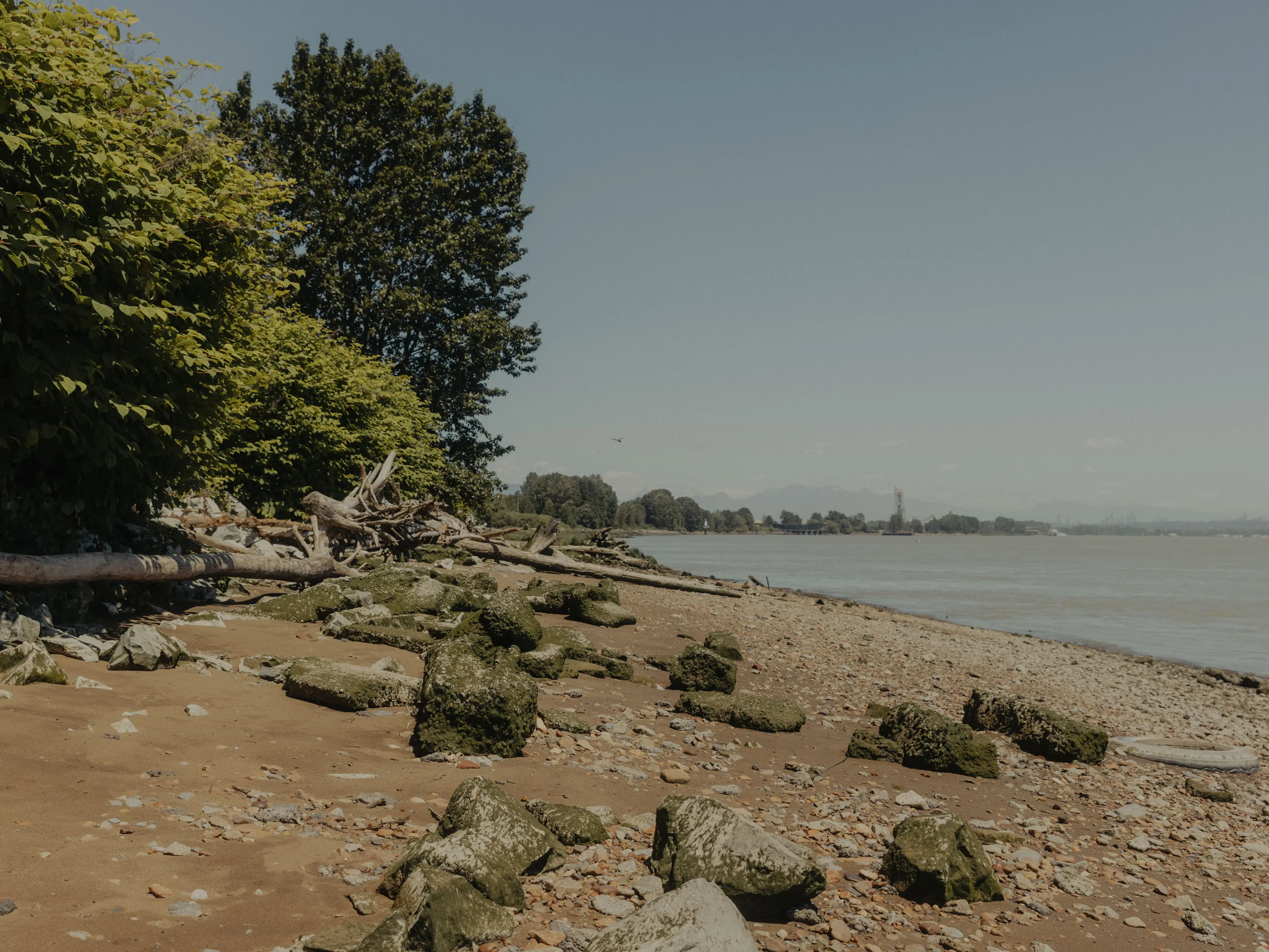
It turns out that the answer is the Fraser River—the majestic waterway that runs through 1,400 kilometres of the Rocky Mountains before reaching Richmond, where it spills into the Pacific. Before Europeans lived here, the Fraser was called the Cowichan, named for the 11 tribes throughout the Salish Sea region who were then the area’s dominant military force. Each spring, thousands of Cowichan people decamped from their villages to converge at the mouth of the Fraser, one of the mightiest salmon-bearing rivers on Earth. They packed huge cedar planks for the journey, using them to turn their canoes into catamarans. When they arrived, the planks became the walls and roofs of more than 100 longhouses—the pre-colonial equivalent of modular housing, containing space for thousands of people. From June through September, they caught and processed a winter’s worth of salmon, curing the red flesh in the sun or smoking it over firepits. This village was Tl’uqtinus.
Shana Thomas is the chief of the Lyackson First Nation, one of five bands that comprise the modern-day Cowichan. She’s a deft communicator who speaks quickly and laughs easily. She grew up moving between various small towns on Vancouver Island and, despite being Cowichan herself, she too heard little about Tl’uqtinus when she was young. That changed when she enrolled at the University of Victoria in the late ’90s, where she studied political science and completed a master’s degree in Indigenous governance. She started working as communications director for the Hul’qumi’num Treaty Group, a coalition of Cowichan bands who were negotiating land claims with the provincial government. That’s when she began hearing Elders talk about Tl’uqtinus.
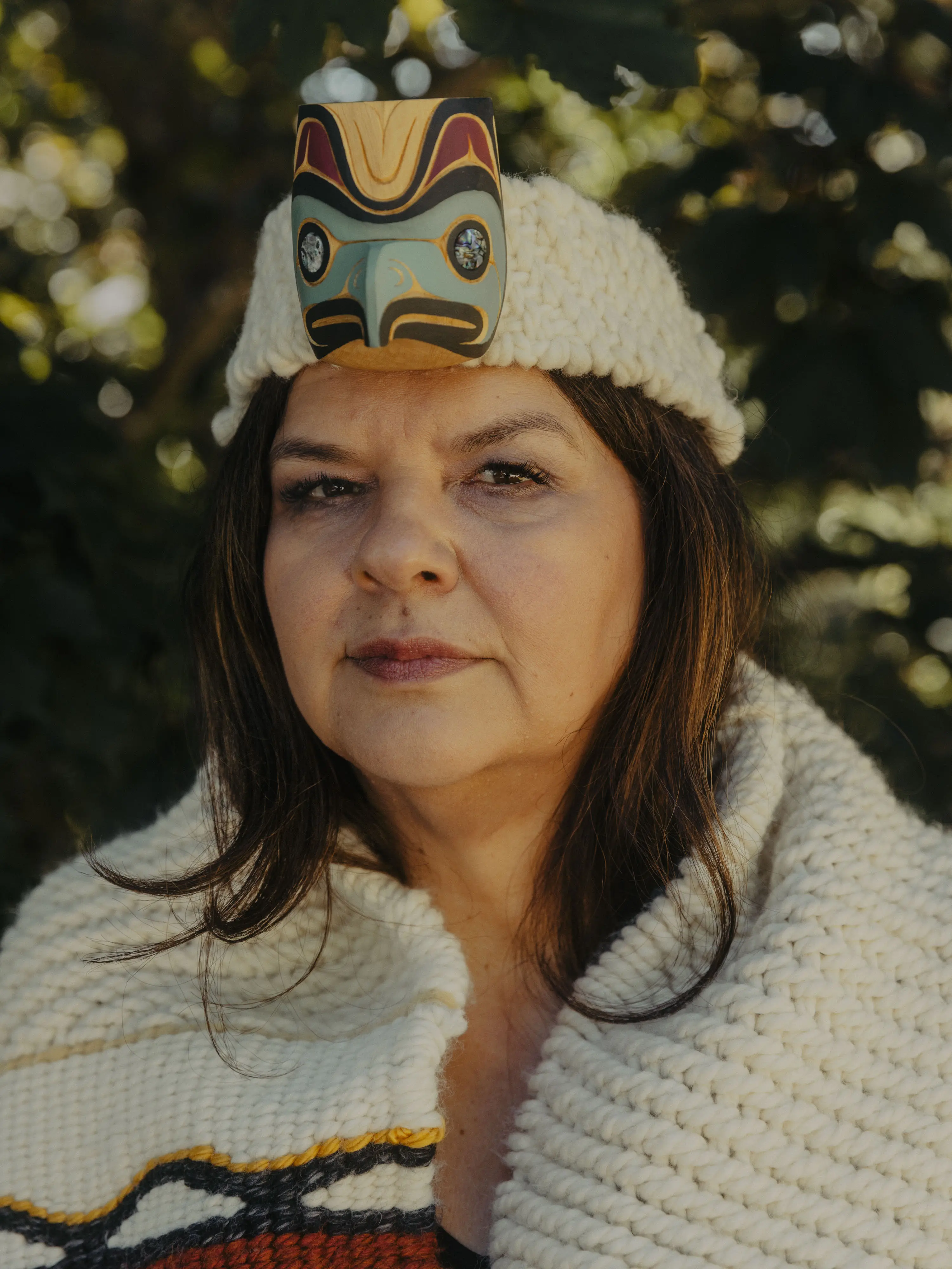
The Hul’qumi’num Treaty Group had been asking the B.C. government to recognize their claim to Tl’uqtinus since 1992, but the government refused to discuss it; officials didn’t believe the Cowichan had a historical connection to the area (or, at least, not one they could prove). So in 2014, the group finally filed their claim in court.
As with all modern land claims, the legal basis for their case was grounded in Section 35 of Canada’s Constitution Act, adopted in 1982. Section 35 consists of a single sentence, open to wide interpretation: “The existing Aboriginal and treaty rights of the Aboriginal peoples of Canada are hereby recognized and affirmed.” That phrase has opened the floodgates to a long series of Supreme Court decisions that have birthed now-familiar concepts like the “duty to consult,” which requires government to engage with Indigenous groups when considering actions that could affect treaty rights. “Aboriginal title” is another; it simply means that an Indigenous nation that exclusively occupied a piece of land before Confederation—and never signed it away with a treaty—retains some ownership.
Over the past half-decade, Section 35 has reinforced Indigenous claims and rights on scales large and small. The most sweeping application so far was the creation, in 1999, of the self-governing, two-million-square-kilometre territory of Nunavut. More modestly, it’s been used to guarantee the right of Métis people to hunt in Ontario’s Sault Ste. Marie region. About 100 land claims are being negotiated nationwide, but it’s only when talks fail—or, as in the Cowichan case, fail to begin—that they end up in court.
Proving Aboriginal title in court is a monumental undertaking. That’s why only two nations, Tŝilhqot’in and Nuchatlaht, both in B.C., had done it successfully before the Cowichan. A nation must establish, with extraordinary specificity, that they had sole occupation and control of the claim area at the time of Confederation. To make their case, the Cowichan chiefs assembled a small army of archaeologists, ethnobotanists, cartographers, anthropologists and historians. The team unearthed thousands of pages of public and government documents, ships’ logs, church records, journals and private correspondence, all dating back to first contact.
Here’s what they established: in 1853, B.C.’s first governor, James Douglas, promised the Cowichan their settlements would be set aside as permanent reserves in exchange for peace. In 1859, the job of surveying Tl’uqtinus fell to B.C.’s chief commissioner of lands and works, Richard Moody—the principal scoundrel of this entire saga, after whom the nearby city of Port Moody is named. Instead of surveying and setting aside the village, Moody bought a piece for himself, flipped it for profit and allowed other officials to do the same. The Fraser River gold rush was beginning, and Tl’uqtinus occupied prime real estate on a river that served as a highway to the Interior for tens of thousands of prospectors. Under Moody’s watch, Tl’uqtinus was sold for the enrichment of provincial bureaucrats.
The new authorities soon forbade the Cowichan from setting up their seasonal longhouses, then from accessing the water at all. According to Shana Thomas, the loss of salmon from the river led to starvation. And the Cowichans’ disparate communities were cut off from their gathering place, fracturing their shared identity.
The Cowichan petitioned the premier and, in 1913, the prime minister, Robert Borden, but to no avail. They petitioned the king of England in person twice, travelling to Britain in 1906 and 1911, but their efforts were fruitless. In 1909, they tried to take their claim to court, but the government denied them the special fiat that Indigenous people needed at the time to pursue court cases. Then, from 1927 to 1951, the federal government amended the Indian Act to make it illegal for Indigenous people to hire a lawyer—in part as a response to the Cowichan efforts. In the 1990s, they tried pursuing their claim through the then-new B.C. Treaty Commission, which was established to resolve the province’s many land claims out of court. But the commission refused to discuss Tl’uqtinus. Finally, in 2014, they filed their claim with the province’s Supreme Court, though the trial didn’t begin until 2019. It claimed nearly 750 hectares in total, out of which the court’s decision ultimately applied to 300. (The rest contains a similar mixture of farms, industrial land and private homes.)
John Elliott was one of four Cowichan chiefs named as plaintiffs. Sixty years old, with a full head of black hair, Elliott has been chief of the Stz’uminus First Nation, a community descended from the historic Cowichan Nation, since 2009. He speaks in the measured, unhurried cadences of someone who’s spent more of his life outdoors, hunting and fishing, than dealing with legal dramas and jurisdictional debates. He grew up on the land and waters around Vancouver Island, where his grandfather taught him to fish and told stories about their people’s ancestral territories. One of them was Tl’uqtinus; Elliott’s grandfather used to go there as a boy, when the area was entirely undeveloped.
Other Elders contributed to Elliott’s education, describing the kinds of food and medicinal plants they could gather at Tl’uqtinus. “I didn’t know how important it was at the time,” says Elliott. “But I never forgot it.”
During the trial, Elliott told the court about the bounty of the Fraser’s salmon run and the frustrations of asking the Department of Fisheries and Oceans for limited access to fish there. “We would be always battling DFO,” he told me, “and they would always say the same thing: ‘prove that you fished here.’”
Fishing rights were core to the Cowichan case. But that has now been fully eclipsed by the question of land—for most Canadians, real estate matters more than salmon. On that question, lawyers for B.C. and Richmond argued that too much time had passed for the Cowichan to get the justice they sought.
I asked Elliott a question that Malcolm Brodie and many others have asked me: if the Cowichan don’t plan to take anyone’s property, why did they include private property in their title claim? After all, much of present-day Tl’uqtinus is federal Crown land, and the spot where longhouses once stood is now an empty stretch of dike owned by the city. Why not stick to that and leave private property out of it? Elliott’s answer was simple: “We just drew the historical map of our ancestors.”
He reiterates that the Cowichan are not going to take away anyone’s home. But because of where that line is drawn, there is now a gobsmacking number of logistical questions to confront. Who should maintain roads and power lines? Who collects property tax? What about land use—what if someone wants to open a hotel, or build a highrise, or a factory? If there’s a fire, who puts it out? Justice Young didn’t try to resolve any of those issues. She declared that it’s the government’s job, not the court’s, to untangle the 300-hectare knot of shared ownership and overlapping jurisdiction resulting from her judgment. This was particularly urgent for the private owners of homes and businesses—innocent parties who’d unknowingly purchased stolen goods from the province. She gave B.C. 18 months to negotiate a final agreement.
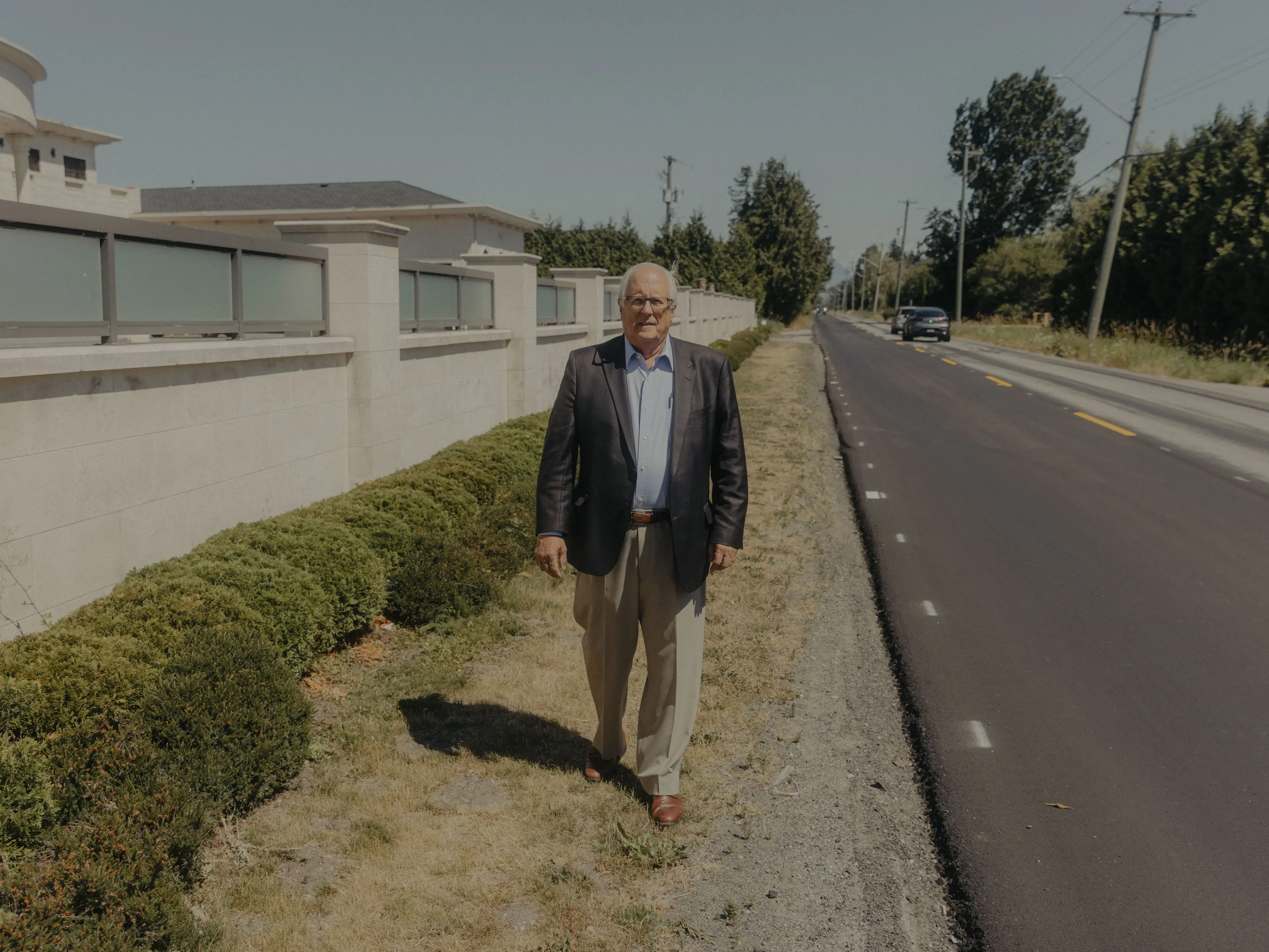
The several dozen private homes in the Cowichan title area line a strip of asphalt called No. 6 Road. It’s a narrow, shoulderless thoroughfare, bordered in places by swampy blueberry farms that surround many of the homes. It’s mostly mansions, with lots of faux-Roman columns and tall windows framing grand pianos. A few years ago, the city grew concerned that new houses were eating into agricultural land and passed a bylaw limiting their size to 4,300 square feet.
A beleaguered sense of shell shock united those who opened their doors when I knocked. One renter told me that a TV crew had frightened his wife just the day before; she’d answered the doorbell only to be confronted by rolling cameras, glaring lights and a microphone thrust in her face. The man, who asked not to be named, said his landlord lived in China and didn’t seem worried about Canadian politics. Across the street, a new behemoth was under construction. One day, I spotted a grey-bearded Sikh man hauling two-by-eights in the driveway. He didn’t want to be identified either, but he shared that he owned his property and was indeed very worried. He’d moved to Richmond in 1980 and worked in a sawmill for over 30 years. Two years earlier, he’d sold his previous home and bought this one on No. 6 Road for $3 million. He’d spent another $2 million on construction costs. But now, if he needed to borrow more, who would lend to him?
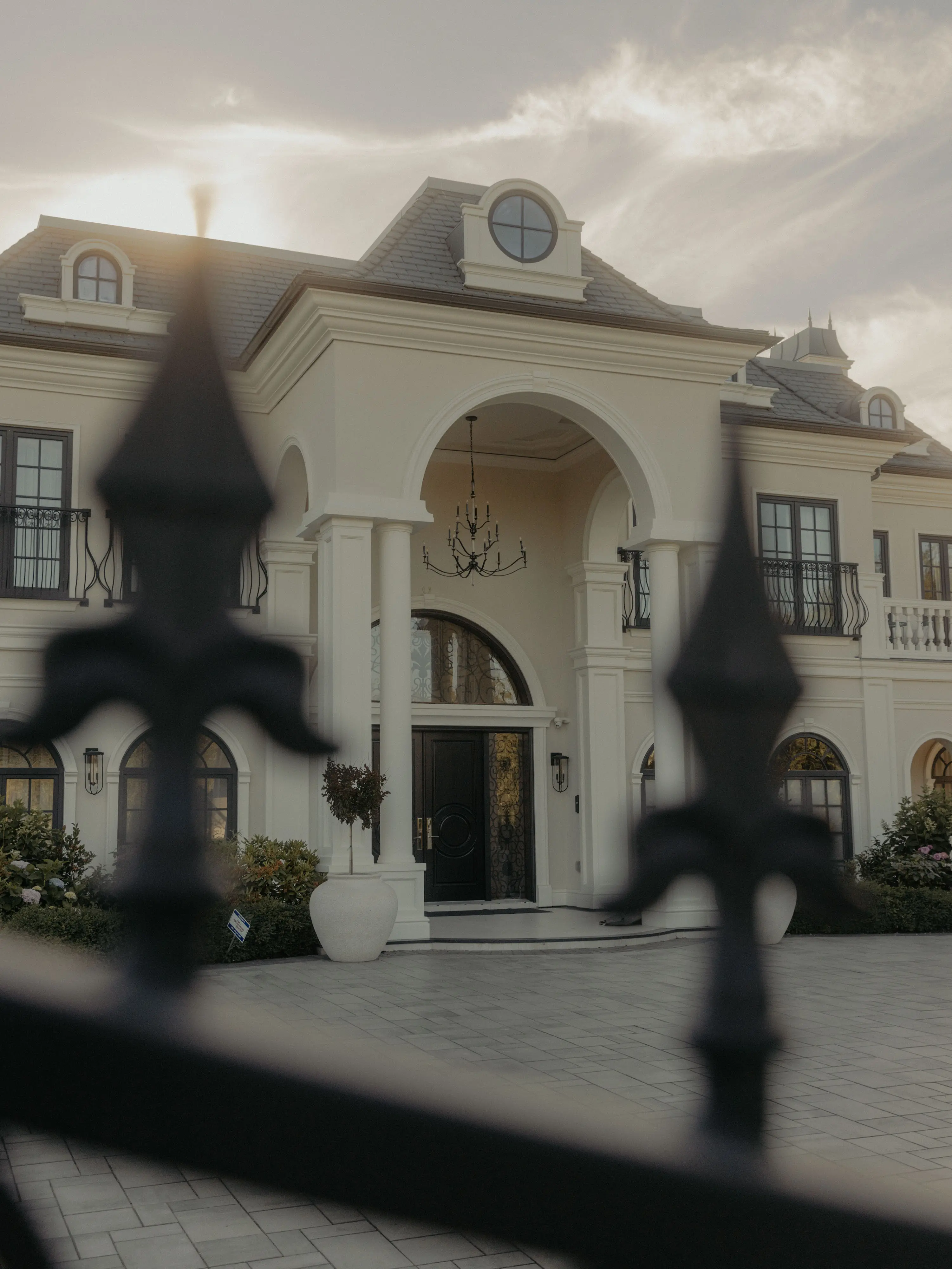
He wasn’t necessarily wrong. There is a cloud of uncertainty hanging over Tl’uqtinus, especially given the unknowns over how private and Aboriginal title will be reconciled. Some people fear that the Cowichan decision could somehow cost them their homes. Others are worried they won’t be able to sell them. Premier Eby has said the major banks assured him the Cowichan decision won’t impact their lending practices (my own inquiries to several banks yielded only noncommittal boilerplate), but a handful of local property and business owners have claimed the decision caused their financing to fall through. None have proven it, though, and neither Brodie nor anyone else I spoke to could name a specific example.
One party, however, has taken their complaint to court. Montrose Properties is an industrial real-estate company that owns 120 hectares in the title area, nearly half the total land. The company was planning to build a new warehouse when Justice Young’s decision came down. It had already spent $7.5 million to prepare the site and planned to borrow $35 million more for construction costs. Montrose says the lender and a prospective tenant pulled out of the deal after Justice Young’s decision, though it won’t identify either party. Last November, the company filed an application to reopen the Cowichan trial so it can be added as a defendant, but this June, Justice Young dismissed the application—she said that the company was well aware of the proceedings before the trial’s conclusion.
It’s true that property values have probably fallen. Jason Upton, a property assessor who works throughout B.C., estimates that the Cowichan decision will lower property values by around 30 per cent until a final settlement is reached and anxieties abate. He’s advising credit unions to be cautious about lending in the claim area. “There’s a lot of uncertainty here,” he says. “It’s what the average buying public deems it to be. They deem it to be a risk, so the lender deems it to be a risk.”
The Cowichan don’t deny this. In their view, it’s one more reason for the province to negotiate a deal setting out expectations and responsibilities—figuring out how shared jurisdiction over the title area will ultimately work. Until then, they say, complaints about plunging property values or financial uncertainty should be directed at the province.
Speaking to Upton, I realized that the dire warnings issued by Mayor Brodie, Premier Eby and other politicians last fall may have unwittingly exacerbated the problems they feared. I spoke to other experts who agreed. Robert Hamilton is a law professor at the University of Calgary who specializes in Indigenous rights and property and constitutional law. “There’s a degree to which this stuff is self-fulfilling,” he says. “If you’re a business, and you have these really senior leaders and politicians talking about the risk, what are you going to think?”
Only one person on No. 6 Road was willing to speak with me using their full name, on the record: Judy Kutny, who moved there with her husband 36 years ago. Today the two of them run a topsoil-processing company that operates out of the backyard of their house, which would be huge in most neighborhoods but, among this row of mansions, seems downright modest. Fit and tanned with short-cropped hair, Kutny greeted me with a knowing smile when I came knocking. She didn’t invite me in but was happy to chat on the doorstep.
Plummeting property values are not an immediate concern for the Kutnys. They’re mortgage-free and have no desire to sell soon. Even so, the Cowichan decision has spooked them. “We bought this house in good faith,” she said. “We have a fee simple title that says it’s ours. And now they’re trying to say it’s not.” She continued, “I don’t understand how you can come 200 years later and say, ‘This is mine.’ Where have you been for 200 years?”
Consciously or not, Kutny was echoing what many public figures have been repeating. Her fears reminded me of a conversation I had with Alexa Loo, a Richmond city councillor who plans to run for mayor when Malcolm Brodie steps down this fall. “It’s hard to make reparations for what happened to people 150 years ago,” Loo said. “None of them are still alive, so the hardship that they endured is theoretical.”
These kinds of statements reveal a sticking point in the debate over what reconciliation means—and how much Canada and Canadians should extend themselves on its behalf. On the one hand, Canadians today are not responsible for crimes committed generations ago. But it’s also true that the present grows out of the past. Both chiefs I spoke to described myriad current hardships related to the loss of Tl’uqtinus. One is the nation’s housing crisis; Tl’uqtinus is only one parcel of land that has been taken from the Cowichan over the years, and many today live on reserves that are far too small for their populations. Another connection is to food security. The Fraser River is still abundant with salmon, and Chief Thomas told me that her community, specifically, went without harvesting fish at all in the three years before the decision. Now their freezers are full. But beyond any one cause or effect, the theft of Tl’uqtinus was one of the biggest links in the long chain of cultural destruction that impoverished the nation and disintegrated their social and cultural bonds. The nation recently emerged from a wave of youth suicides, for example. Was that due to losing Tl’uqtinus? No. But the fact that summers at Tl’uqtinus were replaced by winters in Kuper Island—one Canada’s most notorious residential schools—for generations of their forebears, including many still alive today, is certainly a factor.
This history was reflected in Justice Young’s ruling. “The profound adverse consequences—the dispossession of the Cowichan people of their homeland—continue today,” she wrote. “This gives rise to a fresh cause of action each day it continues.”
But that argument has not fared well outside of the courtroom. An Angus Reid poll published at the end of October found that 60 per cent of British Columbians felt the Cowichan decision “harms the relationship between Indigenous groups and the rest of the province.” Another poll by the same firm in April found 53 per cent of the province agreed that the B.C. government’s support for reconciliation “goes too far.” That was up nine points from August.
It isn’t surprising that so many who support the principles of reconciliation recoil from its implementation. What could be more human than regretting an effort once its scale becomes clear? Nor is it surprising that those who never supported reconciliation see this ruling as a threat from which Canadians need to be protected—an attack on our property rights, the foundation of our economy and our conception of ourselves. Or more than that: a form of revenge.
So we find reasons to backtrack. The cost is too high. The time isn’t right. It happened too long ago.
I asked both Chief Thomas and Chief Elliott what their visions were for Tl’uqtinus’s future. Beyond being allowed to fish again, what did they want to happen with the land? Both described building a housing complex for Cowichan youth studying or working in the Vancouver area, or where Elders travelling for medical appointments could stay. They pointed to a lot of unused land where that could be built, like the landfill, which could be remediated. Beside that is the most precious area: the shoreline where their ancestors’ cedar-plank longhouses once stood. It’s currently occupied by a gravel road and a dike, overgrown with wild blackberry bushes.
I asked about the private property owners, especially the homeowners who feel they have a right to be part of the conversation. Had the Cowichan leadership spoken to them directly?
Chief Elliott paused for a long while before responding. “There’s going to be a day and time,” he said, “when we’ll sit with them, have the conversation of how we are going to work this out.” He sighed and then reiterated the point the Cowichan had made often: “We’re not kicking them off.”
When I put the question to Chief Thomas, over the phone, I could almost hear her eyes roll. “Obviously, the Cowichan have been really clear that they’re not targeting individual homes,” she said. “The judge said, ‘There is Aboriginal title here, but fee simple remains intact, and it’s up to the province to negotiate what that means.’ ”
Until the province does so, Thomas said, there’s not much more the Cowichan can do to assuage concerns. Thomas did, however, suggest a template for a positive outcome: “Take a look at the Haida ‘Rising Tide’ agreement.”
The Haida Nation has claimed title to Haida Gwaii—an enormous archipelago off B.C.’s West Coast—for decades. In 2024, after years of negotiations, the provincial and federal governments recognized Aboriginal title over Haida Gwaii and its surrounding waters. This includes hundreds of private homes and other properties. The terms of the arrangement were spelled out in a document called the “Rising Tide” agreement, created by the Haida Nation and the provincial government, which details how private property and Aboriginal title are to be reconciled. It’s a co-management plan and a living document, expected to evolve over time. In it, the Haida commit to honouring private property, which the nation can only acquire on a willing-seller, willing-buyer basis. In essence, non-Haida property owners can still buy or sell property as before and pass it down to their next of kin. If somebody dies without an inheritor, ownership passes to the Haida. And the province continues to collect taxes and maintain infrastructure as before.
The main difference between Haida Gwaii and Tl’uqtinus, besides their vastly different sizes, is that B.C. negotiated in the Haida case before the nation took it to court—which it certainly would have. The province knew the Haida had a strong legal hand. The nation had won many previous court battles over resource extraction in their territory, including a historic 2004 Supreme Court decision that established the duty to consult. By contrast, in the Cowichan case, the province appears to have been caught flat-footed.
The “Rising Tide” negotiations took years, encompassing public hearings that gave Haida and non-Indigenous residents the opportunity to learn about the plan and air their concerns. This was what the Cowichan had spent three decades asking the B.C. Treaty Commission to do. On Haida Gwaii, there were, and remain, objections and disagreements, but the case didn’t spark an international uproar or an anti-reconciliation backlash. Nor, two years later, has it had any impact on Haida Gwaii’s property values.
When I spoke to B.C.’s attorney general, Niki Sharma, she agreed the Cowichan deserved justice and said the province was using the “Rising Tide” agreement as a template for negotiations on Tl’uqtinus; negotiations that began this February, even as the province appealed. “I think there’s a path forward, through agreement, that gets us to that balance,” Sharma told me.
If that was the case, I asked, why was the province appealing the decision? “There needs to be clarity in the law,” she said. The province disagrees with Justice Young’s assertion that Aboriginal title is, by definition, “prior and senior” to fee simple title. Its appeal is not really about disputing the Cowichan’s claim to Tl’uqtinus. But it doesn’t want the principle that Aboriginal title trumps private property to be enshrined in law.
The province received a small legal lifeline last December. In a parallel case unfolding on the other side of the country, the Wolastoqey Nation has been fighting since 2021 for title over not a small parcel of land, but five million hectares of New Brunswick—essentially the entire western half of the province. This area is sparsely populated, but the claim did include private property: residential land, as well as a great deal of forest land owned by a handful of timber companies. But, last December, the New Brunswick Court of Appeal ruled that Aboriginal title could not be recognized where private titles existed. The Wolastoqey Nation may be entitled to financial compensation, the judge said, but not to the land itself.
Mayor Brodie, Premier Eby and others leapt on the decision as proof that Justice Young had erred, and that her decision could be overturned if, and likely when, the case reaches the Supreme Court of Canada. But there are enormous differences between the two claims: first, the Cowichan had a paper trail showing that the Crown reneged on a deal for a small, specific plot of reserve land. And, unlike the Cowichan, the Wolastoqey did not pledge to honour all private property. They promised to leave homeowners’ property titles intact, but explicitly sought to invalidate the titles of forestry companies. Instead of arguing that two forms of title can co-exist, as the Cowichan have, they tried to expropriate thousands of square kilometres of private property outright—precisely what some have accused the Cowichan of secretly intending.
In May, the Supreme Court of Canada denied the Wolastoqey application to appeal. That matter is settled. But as to the bigger question of whether Aboriginal title can co-exist with private property, the country’s highest court kept its powder dry. One way or another, this will be decided by the Cowichan case.
No two land claims are alike. Some are huge (Nunavut occupies one fifth of Canada’s land mass) and some are tiny (Tl’uqtinus could fit inside Vancouver’s Stanley Park). Most are rural, some are urban. Some overlap one another. But one thing they all require, if they are to be implemented successfully, is for Canadians to reimagine something of our country’s essential nature—for someone like Malcolm Brodie to look at a map of his city hanging in his office with an expanded idea of what property might mean, and to see the Cowichan Nation not as a costly intruder but as one more player with a stake in the community’s well-being. Whether we’re up for that is another question.
There is a convincing argument that Aboriginal rights and title make Canada stronger. Alberta recently provided a dramatic example of how that can work; in May, the province’s superior court ruled that a proposed referendum on provincial sovereignty was unconstitutional because of the impact separation would have on treaty rights. Premier Danielle Smith wiggled out of that by changing the wording of the referendum question, but it’s clear that the treaties covering most of the province present a major obstacle to secession.
Unresolved land claims, then, are essentially treaties-in-waiting. But it’s rare to hear any Canadian leader articulate a vision of their benefits to non-Indigenous Canadians. Indeed, Premier Eby, ostensibly an advocate for Indigenous rights for most of his career, has emphasized the opposite with respect to the Cowichan decision. The B.C. Conservatives’ new leader, Kerry-Lynne Findlay, has said that land claims are stoking fears “that nothing you own is truly safe. Your home. Your land. Your property. Your freedom.” Pierre Poilievre has announced a Conservative task force on property rights, in response to the Cowichan decision. Arguing over the matter during question period, the Conservative leader demanded that Mark Carney pursue a more aggressive legal defence of private property rights. The Prime Minister declined, but did say during the exchange that he “fundamentally disagrees” with the Cowichan decision.
He didn’t say which part, though. Few people do. Who has time to read an 800-page legal decision? Still, it’s obvious what people object to: the idea, as Justice Young put it, that “change to the status quo in the Cowichan Title Lands must occur.” Few things are more uncomfortable than changing the status quo. The courts may order it, but who says we have to listen? Why not change the law, or amend the Constitution? We’ve done it before, in the 1920s, when the government responded to land claims by making it illegal for Indigenous people to hire lawyers. But that only led to years of conflict. The likeliest alternative to the painstaking project of reconciliation is not a frictionless real estate bonanza, or a return to the status quo. It’s a return to the crises of Oka and Idle No More, and a tsunami of new legal battles.
Whatever comes next, that’s one lesson the Cowichan have already made clear. “We’ve waited 150 years,” Chief Elliott told me. He bears no ill will toward any resident of Richmond. He has no designs against them—but he feels no obligation to appease them, either. “We went through one of the biggest trials in Canada,” he said. “We have nothing but time.”
This story appears in the August 2026 issue of Maclean’s. You can subscribe to the magazine here or send a gift subscription here.
What did you think of this story? Send a comment for publication to letters@macleans.ca, and supply your name and address. Comments should be fewer than 200 words, and may be edited for length and clarity.
Related Posts
The Rich List
My Secret Addiction
Big Tech v. Me

The Doom Spenders
Get the Best of Maclean’s straight to your inbox.
Sign up for news, commentary and analysis. Join 60,000+ Canadian readers.