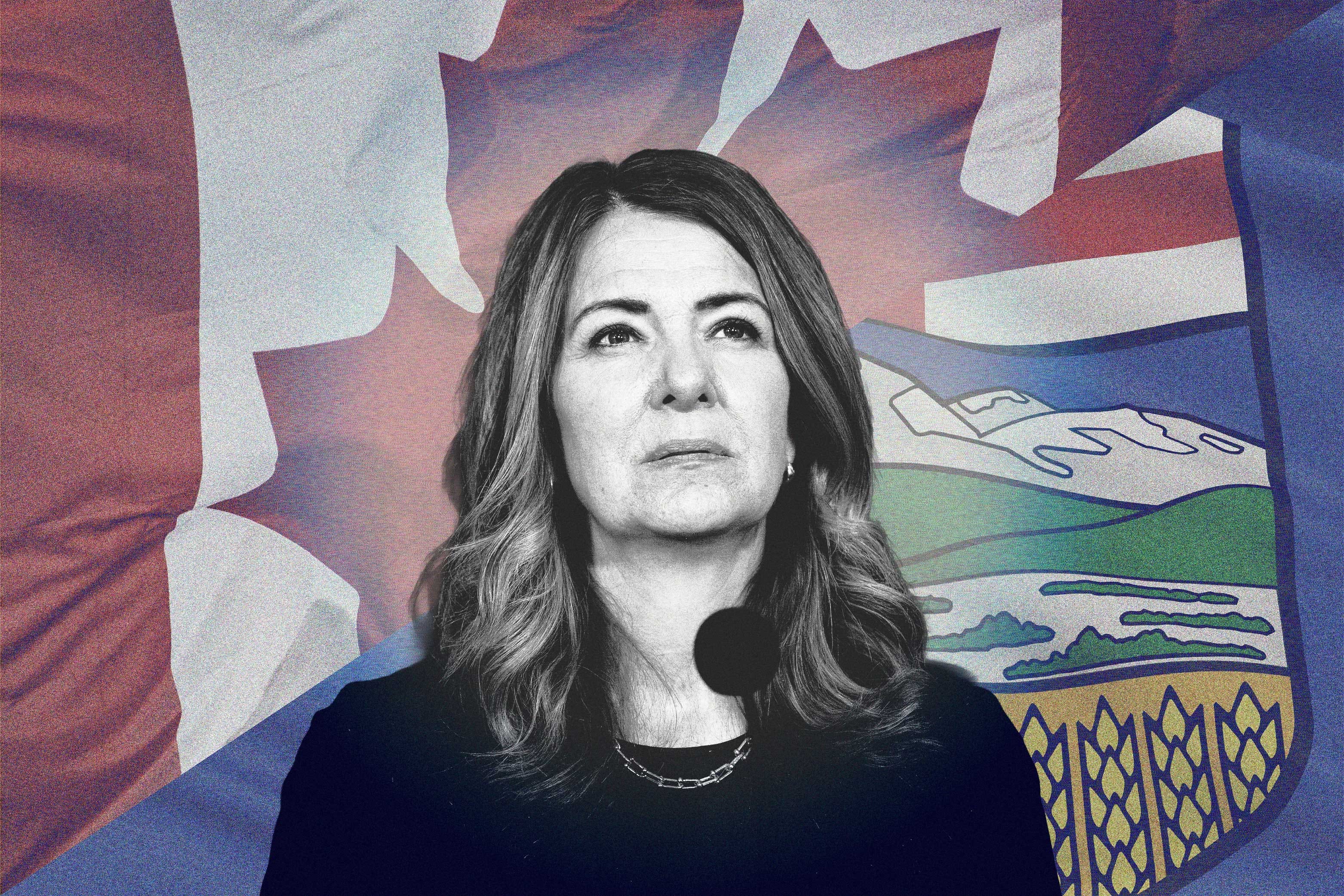
How Danielle Smith Dodged a Brexit Bullet
In May, Alberta Premier Danielle Smith announced a referendum on whether to separate from Canada. Or, more accurately, she announced a referendum, and that referendum will be about whether to eventually have another referendum, and that second referendum will be about independence.
Unsurprisingly, this convoluted two-step has been met with ridicule. It’s fitting that the announcement came just before the 10-year anniversary of the U.K.’s vote to leave the European Union; the tragicomedy playing out in Alberta increasingly conjures the ghostly visage of Brexit. But the very “referendum on a referendum” approach that has attracted so much derision may have fixed one of the greatest problems with how Brits weighed in on their nation’s future.
Alberta’s separatism row bears a striking resemblance to Brexit. Like Smith’s, David Cameron’s referendum was entirely an exercise in party management. The expectation was that the vote he called would likely fail, silencing the Euroskeptic agitators within the Conservative party for a generation.
Buoyed by having pulled off the same trick with a vote on Scottish independence two years earlier, Cameron announced the referendum for June of 2016 and proceeded to himself campaign for Remain. When the Leave side won with 52 per cent of the vote, Cameron promptly resigned, literally singing a jaunty tune as he walked away from both the podium at 10 Downing Street and from responsibility for fixing the mess he engineered.
The denouement of Cameron’s gambit suggests that his playbook is not a smart one for either the premier or the province to follow. Unlike Baron Cameron of Chipping Norton, Smith doesn’t have a consolation peerage waiting for her if this stratagem proves to be a blunder. A brave, wise or merely far-sighted leader would refuse to drag the province through months, perhaps years, of political turmoil simply because they cannot find any other way to quiet the most extreme elements among their party’s supporters. However, if Smith insists on attempting the same manoeuvre as David Cameron, she can at least learn not to make all the same mistakes. And to Smith’s credit, it looks like she may have done just that by building a second referendum into the plan.
Related Posts
Canada’s Defence Firms Are Ready to Boom

Alberta Treaty Law Could Decide the Arctic
Brexit has been a calamity. The U.K.’s GDP per capita is at least six per cent lower than if it had remained in the European Union. Britain hasn’t even been able to properly excise itself from EU law—the putative point of the entire exercise. At least 6,925 and perhaps as many as 150,000 EU laws remain on the U.K. statute books. Even when Parliament does make legislative changes, those amendments cannot depart too materially from EU law, lest they jeopardize the U.K.’s ability to trade with European countries that still impose EU standards. The country’s governance is now in such tatters that Britons are on their sixth prime minister in a decade, with a seventh arriving very shortly. No Canadian should look to post-Brexit Britain as a model of the sunlit uplands that await an independent Alberta.
Before it could be a substantive disaster, however, Brexit was first a failure of process—and the greatest procedural failure was the timing and role of the referendum. The 2016 ballot question asked the public whether they wished to leave the EU, but provided no details as to what that would mean. And while the referendum was technically non-binding, the political mandate resulting from a Leave victory would de facto compel the government to invoke Article 50 of the EU Treaty, triggering a two-year period in which the departing member state either negotiates a withdrawal agreement with Brussels or else leaves without a deal on its future relationship with the bloc. Only at the end of that process would the public find out what Brexit would actually look like. At that point however, they wouldn’t be consulted on whether they still wanted to go ahead with it. Brexit would simply proceed.
Imagine a presidential election, but conducted backwards. First comes the general election, in which voters pick which party’s candidate will be president. And only then does the winning party hold a primary, picking its nominee who automatically wins the presidency. In such a system, the winning party would have no incentive to pick a moderate candidate who will appeal to the country as a whole—why worry about electability when you’ve already won? This hypothetical system sounds outlandish, but it was, in essence, how Brexit was handled.
The Leave campaigners’ resulting behaviour was wholly predictable. At first, during the referendum campaign, they not only touted impossible benefits with no trade-offs—famously, the side of the Vote Leave battle bus falsely claimed that Brexit would free up £350 million per week to spend on the National Health Service—they also won over many wavering voters by reassuring them that it could be a “soft” Brexit that still maintained many features of EU membership.
But once a victory in the one and only referendum was safely in their pocket, they changed their tune. Hardline Brexiteers—chief among them Nigel Farage, who currently leads the ascendant Reform Party—repeatedly asserted that anything less than a complete severing of all ties with the EU would be a “betrayal” of the people’s expressed will. Only when it was too late to change their vote was the public told what would come of all the promises made to them.
Crucially, Farage and company delivered similar invective against the idea of holding a second “confirmatory” referendum after the electorate had a clearer picture of what Brexit would actually look like. The Brexiteers contended, not implausibly, that this would constitute an attempt by Westminster elites to keep asking the people for their opinion until they provided the desired answer. Put less charitably, however, what this revealed was that, as far as the Brexiteers were concerned, “respecting the will of the people” meant not obtaining their consent to the actual Brexit that would be imposed on them.
There’s evidence that these sleight-of-hand techniques would have been enough to change the end result. If those who only supported a soft Brexit—who, in other words, would have preferred Remain if the alternative was the hard Brexit that was ultimately on offer—were subtracted from the 52 per cent voting Leave, contemporaneous polling data indicates that you would no longer have a Leave majority. Indeed, many voted Leave not in the expectation that it would actually bring about their departure from the EU, but simply to send a message to Brussels so that British concerns would be taken more seriously. Suffice it to say that subsequent events got somewhat out of hand for these voters.
It’s against this backdrop that we must evaluate Danielle Smith’s decision to announce up front that there will be a second referendum if the first succeeds, with “the legal process required under the Canadian Constitution”—which, in practice, means a negotiation with the rest of Canada on the terms of the proposed separation—happening before the second vote takes place. Yes, it leads to a convoluted ballot question. Yes, it’s whiplash for the electorate to suddenly go from facing zero referenda to potentially facing two. However, it lays out the entire process from the outset, precluding any future suggestion that a second referendum is just a ploy by those unsatisfied with the results of the first.
The benefits of this approach do not all accrue on one side. The initial referendum won’t be the final word on whether to stay in Canada, which lowers the perceived stakes of voting to leave, especially as a form of protest. Consequently, the separatists increase their odds of obtaining a victory at that first stage, which would mean that the issue will dominate Albertan politics for years.
In exchange, however, the federalists get to fight the second referendum—the one that really matters—on much more favourable terrain. If things get that far, the public will have no illusions that a victory for the leave side would mean anything other than actually leaving. And if it’s after the negotiation process, the public will know in much more detail what independence would and would not look like.
There’s a persuasive case that the benefits accruing to the remain side are far more potent, and that’s all to the good. But there’s a more principled reason to prefer this approach: democracy is better served by a process that measures the public’s preferences at every critical juncture.
Perhaps this account gives too much credit to Smith. Perhaps this double-referendum strategy is entirely about sidestepping the sorts of legal challenges that have thus far bedevilled the separatists’ attempts to put sovereignty on the ballot. At times, Smith has indicated as much. But none of the legal authorities that stand in her way say anything about requiring multiple referenda. That feature is a choice, not a legal necessity.
Mark Carney, too, must not repeat the Brexit mistake. Troublingly, he recently signalled that—relying on his interpretation of the Clarity Act—Ottawa would refuse to engage in any negotiations until Alberta delivers a final, definitive vote to leave. This posture is unfortunate. At the risk of stating the obvious, the electorate’s final answer on independence can only be an informed decision—one where the voters are fully apprised of what separation would mean—if the proposed terms are negotiated before that binding vote is held. If the federal government will only begin negotiations after an irrevocable referendum, then we’re just back in the Brexit scenario with all of the attendant mischiefs that Mark Carney says he’s trying to avoid. There is another, preferable interpretation of the Clarity Act: one wherein a negotiation is triggered even by a non-binding vote, so long as it is clearly a vote expressing a desire to leave.
However slickly they are presented, the separatists’ promises defy credulity. A 40 per cent tax cut with no reduction in services is simply not in the offing, nor will independence undo what the last half-century of economic history has wrought for a single-income family’s ability to afford a home. The reality of independence would be a landlocked state dependent on oil exports, possibly much smaller in size than the present-day province, since it is doubtful that the Albertan government can pull Indigenous communities out of Canada against their will.
A fully telegraphed policy that there will be no separation without a final confirmatory referendum is the ultimate check on this bait-and-switch. Right now, separatists are busy trying to sell a unicorn; when they later show up with a sickly horse, Albertans are entitled to reject delivery.
Sean Husband is a prosecutor in B.C. The opinions expressed in this article are his own and do not represent the views of his employer.
What did you think of this story? Send a comment for publication to letters@macleans.ca, and supply your name and address. Comments should be fewer than 200 words, and may be edited for length and clarity.
Related Posts

Carney’s Biggest National Project is Mythmaking

How to Win the Space Race
Carney Is the Crisis Manager Canada Needs
My Adventures in Greenland
Get the Best of Maclean’s straight to your inbox.
Sign up for news, commentary and analysis. Join 60,000+ Canadian readers.