Canadians Want to Age At Home. Postal Workers Can Help.
As a geriatrician, I’ve seen the same story repeat itself countless times in the busy emergency departments and hospitals where I work in Toronto. An older patient who lives alone with a medical condition that needs regular attention is discovered by a visiting family member long after that condition has progressed into something worse. Most older adults live with one or more chronic illnesses, things like heart, lung and kidney disease, or diabetes, that need regular monitoring. Without someone to regularly check in on them, they might not even realize their condition is deteriorating—especially in weather events like this summer’s heat waves. In some cases, we’re able to intervene in time and reverse any damage done, but others don’t even make it to the hospital.
But despite the risks of living independently in old age, it’s what virtually all of my older patients say they want most. In Canada, multigenerational households and communities are rare. And as our population gets older on the whole, aging in place is becoming less of a preference and more of a necessity: most older Canadians can’t afford to live in a retirement residence, and it has been estimated that Canada will need to more than double its current complement of 199,000 long-term-care beds to 454,000 by 2035. We are nowhere close to meeting this goal, which helps to explain why more than 70,000 Canadians are currently on the waitlist for one of these beds. Even if we eventually meet our overall capacity goals, we urgently need solutions to make living alone safer and more fulfilling for older Canadians. As the director of health policy research for the National Institute on Aging at Toronto Metropolitan University, this is one of my main mandates.
Canada has always had services and community groups who check on older adults. There are non-profit organizations who offer friendly visits, telephone check-ins and meals-on-wheels deliveries that give older people face-to-face interaction, but these aren’t universally funded or available. Municipalities are increasingly deploying community paramedics—trained health-care workers who check in on vulnerable groups, like older people who are frequent callers of 911 services for non-urgent reasons. Publicly funded home care services don’t typically provide wellness checks, while private ones tend to be costly and out of reach for many individuals and their families. Others lean on neighbours to check in, but this too can be unreliable, and older adults never want to feel like a burden to others. Ultimately, many wellness checks end up being done by police or paramedics—at great expense to all of us as taxpayers, and often when it’s already too late. Few of these options are sustainable or scalable for the demographic realities we are facing.
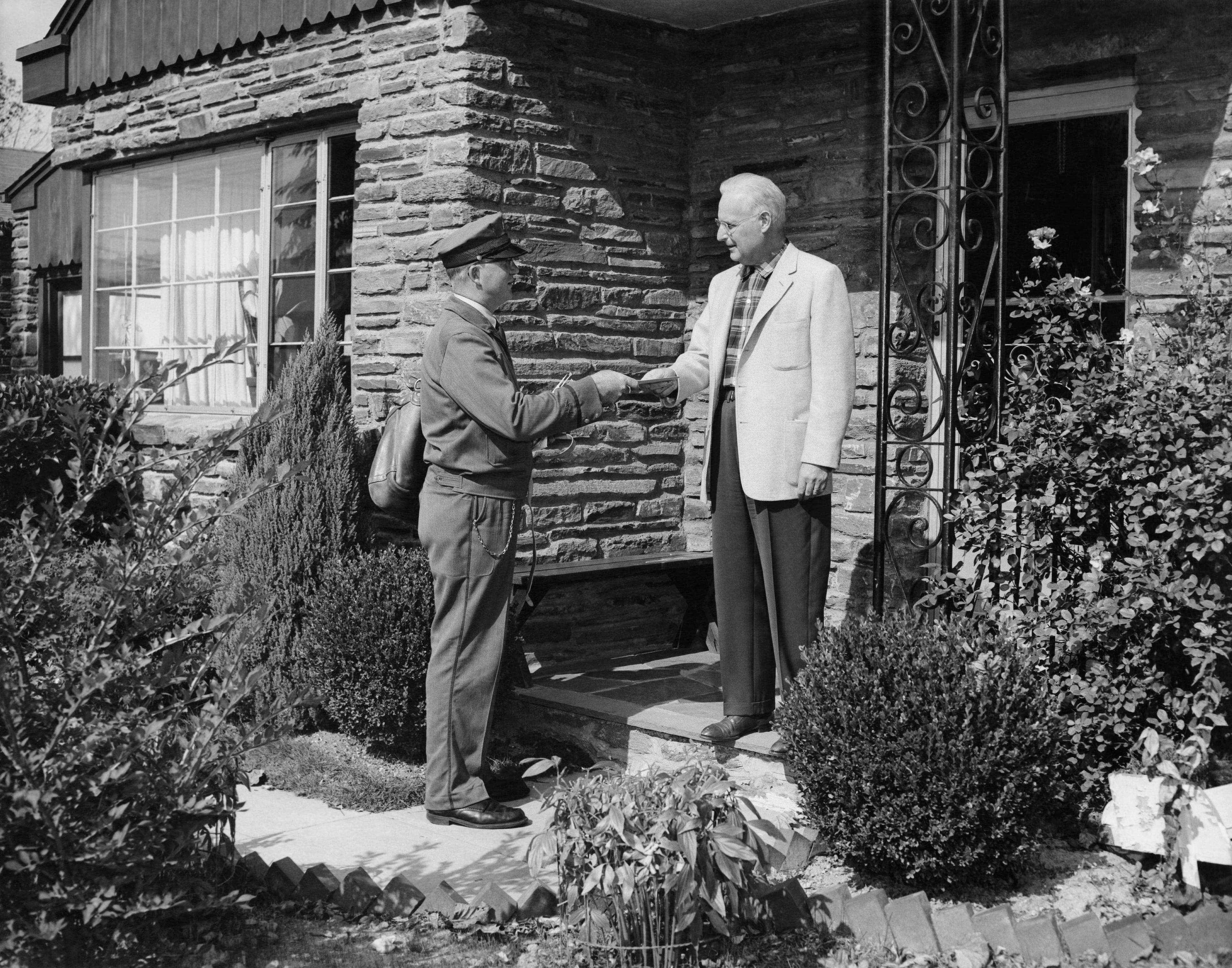
Fortunately, there is already a service that visits homes in the country—on weekdays, free of charge, rain or shine. That service is Canada Post. During the height of the pandemic in 2021, I and my peers at the NIA explored whether we could leverage the postal service to check in on older adults. We discovered that this wasn’t a new idea. Japan has one of the world’s oldest populations, and its national postal service offers what they call a Watch Over program. It’s a two-tiered service where families, or the older people themselves, pay a fee for postal workers to do wellness checks. One tier comes with monthly face-to-face conversations and questionnaires about prescriptions and health status for about $26 per month. The other tier includes daily automated virtual check-ins, the results of which are sent directly to a trusted person, for about $11 per month. Since launching in 2013, Watch Over has expanded nationwide and received new investment from the Japanese government. In 2022, the Japanese Ministry of Health proposed a combined budget for Watch Over services of approximately $2.75 billion. And as a bonus, studies showed that the service reduced feelings of social isolation among its users.
In 2017, the French postal service officially launched a similar program called Veiller Sur Mes Parents, which translates to “Watch Over My Parents.” The idea originated in 2013, when local post offices were engaged to conduct check-ins on vulnerable and older residents during a major heat wave. By 2019, there were 7,500 elderly people paying for the service. It has various tiers, some of which have expanded to incorporate grocery delivery, housekeeping and even gardening.
Related Posts

The Case for Lifelong Renting

International Student Caps Are Decimating Canadian Colleges
Bringing this service to Canada also has the potential to help another rapidly aging body in this country—the postal service itself. It’s no secret that Canada Post has been in dire straits for some time now. The volume of daily letter mail has dropped dramatically, and it’s being kept afloat by federal loans, including two billion-dollar cash injections since January of 2025 and a recent $673-million top-up. A whopping $1.57 billion in losses last year pushed the government to do away with door-to-door delivery altogether. To phase out the service, Canada Post will be converting about four million more households to community mailboxes in the next five years.
CUPW—the union representing some 55,000 postal workers—is understandably upset by this development. While Canada Post’s CEO has suggested that no employees will be laid off, the door-to-door phase-out will likely eliminate many jobs for good. But a check-in service could breathe new life into the system. Even with the mandated end to door-to-door delivery, Canada Post will still offer weekly direct delivery to those with accessibility needs through its special accommodation program. The Canadians who would use a check-in service could very well be enrolled in this program already. The corporation has also confirmed door-to-door won’t be going away for rural residents, who could benefit from a check-in service more than most. CUPW has publicly supported this idea since 2016.
Implementing a service like this may have costs, but it’s small potatoes compared to the financial burden of preventable 911 calls, ambulance trips, ED and hospital visits that taxpayers are already subsidizing. This is why Jersey, an island in the English Channel, pays for its postal workers to offer free twice-weekly wellness checks, based on the financial savings they achieved for their health system in doing so. Learning from international examples, Canadian jurisdictions could implement a combination of both paid and free tiers. Paid for those who can afford it, and free for those who can’t, with savings realized by health-care and emergency-response systems. In our research, we found that 85 per cent of older Canadians say they would be supportive of Canada Post offering a service like this. At the very least, this could operate as a subscription service for those who already qualify for Canada Post’s accommodation program.
To a certain extent, a service like this is simply formalizing a provision that already exists. It’s common courtesy for postal workers to alert authorities if they see a resident hasn’t been checking their mail. Canadians already trust postal workers, too. Though union conflicts have somewhat eroded the corporation’s reputation in recent years, a 2015 poll found that 87 per cent of Canadians trust their mail carriers.
This wouldn’t be the first time a service like this has been launched in Canada, either. In the 1980s, postal workers across Canada established what they called Letter Carrier Alert programs through the Letter Carriers Union of Canada, a precursor to CUPW. It allowed postal workers to alert volunteers or community groups to concerns they have about residents on their route. The program in Prince Edward County, Ontario, still operates to this day, entirely on the goodwill of its local postal workers, who receive no extra pay for it. This year, Canada will become a superaged nation, meaning one in five of us are over the age of 65. We need to think big about how to care for the many of us who want to stay at home for as long as possible. This solution is already on our doorstep.
Samir Sinha is a geriatrician at University Health Network and Sinai Health System in Toronto. He is also a professor of medicine at the University of Toronto.
What did you think of this story? Send a comment for publication to letters@macleans.ca, and supply your name and address. Comments should be fewer than 200 words, and may be edited for length and clarity.
Related Posts

Canada Can Be a Refuge for America’s Grad Students

How to Stop the Gen Z Slowdown

Can Canada Survive Trump’s Attack on Science?

Canada’s Aging Infrastructure Is a Ticking Time-Bomb
Get the Best of Maclean’s straight to your inbox.
Sign up for news, commentary and analysis. Join 60,000+ Canadian readers.