Let the Kids Play This Summer
As a child, I pretended to be Anne Shirley from Anne of Green Gables. I was obsessed with the story of an orphaned girl who ached desperately for a family and roamed my neighbourhood in rag dresses and bare feet. In the woods near my house, I created a home out of sticks and branches. I ate pine gum off trees, imagining it was my only food.
When I got older, I learned that pretending to be an orphan is a common theme of childhood play around the world. Unlike many other mammals, human children cannot survive without adults’ care. So they subconsciously fear the loss of that protection and are drawn to stories that help them process that fear. Children’s authors know this. Want a bestseller? Kill off the parents and watch the orphaned character not only survive but thrive—like Harry Potter, who becomes a wizard, or Superman, who can fly and rescue others.
For over 25 years, I’ve dedicated my career to understanding the power of play in child development. I started out developing and facilitating play-based programming for children, then later became a public speaker and workshop presenter in the 2010s. A few years ago, I started to notice a disturbing pattern: across the country, teachers were reporting a rise in anxiety and aggression in their classrooms.
I spoke to one kindergarten teacher whose classes were increasingly filled with aggressive, explosive students. Kids were throwing chairs. Sometimes, if they lost a game or weren’t first in line, they had meltdowns. A parent told me that her nine-year-old constantly fluctuated between clinging and whining to yelling and screaming. He was filled with worries and couldn’t fall asleep at night.
I sought out research to explain what I was hearing and found a connection: a decline in free play is coinciding with this surge in childhood anxiety. Researchers argue that this is not just a correlation. Experimental and theoretical work suggests that a lack of play directly contributes to anxiety and poor emotional regulation.
Related Posts
The Case for Lifelong Renting
International Student Caps Are Decimating Canadian Colleges
Today’s children are often deprived of outdoor free play. That trend has been building for a while—back in 2004, researchers found that children spent less time playing outdoors than their mothers had. By 2022, according to one U.K. survey, only 27 per cent of children regularly played outside their homes, compared to 71 per cent for the Baby boomer generation.
Growing screen time is one of the main drivers of that change, but it’s not the only one. Canadian society values achievement, so many parents strive to get their kids ahead; structured activities like extracurriculars now dominate children’s days. Kids spend what little free time remains indoors—on their phones and iPads. One study, which examined how school-aged children used their time between 1975 and 2015, found exactly that: an uptick in time spent on homework and screens over time, coupled with a decline in free play.
Children didn’t always live like this. Instead, they were forced to sit with a lack of stimulation. The Vancouver-based developmental psychologist Gordon Neufeld calls these empty, structureless times “void moments” and believes they’re critically important to a child’s development. That’s because, in those voids, a child is more likely to fall into free play.
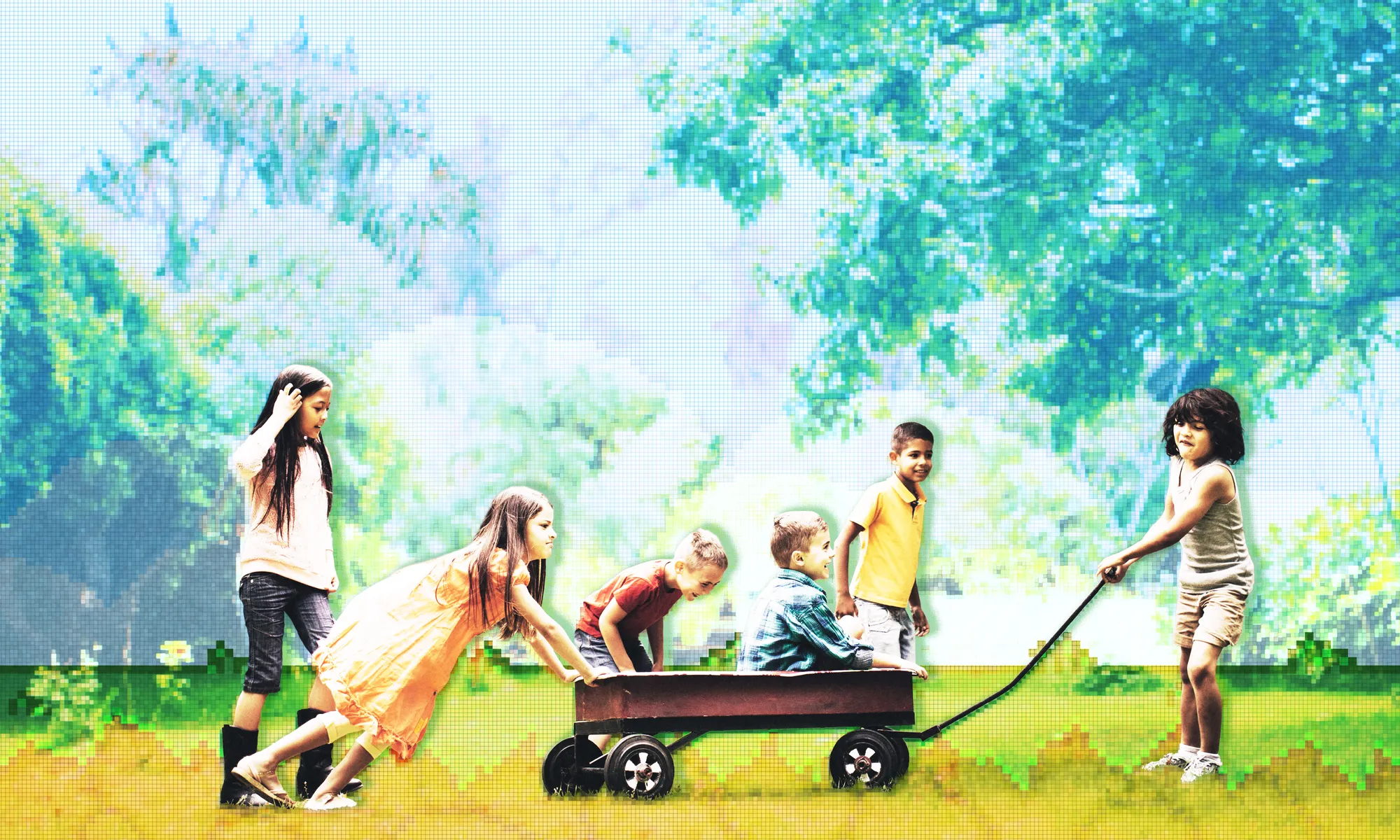
Free play is like life’s rehearsal ground, where children experiment with roles: the courageous hero, the caring doctor or the bad guy. As kids ride bikes, climb trees and explore the neighbourhood, they get repeated, low-stakes exposure to uncertainty, which builds confidence and teaches them how to cope with risk. They develop the courage to overcome and the creativity to imagine new possibilities. As they invent games and interact with others, they’re able to work on empathy, develop friendships and build self-esteem.
Ultimately, their cognitive skills improve—things like attention, concentration, and memory. So do self-regulation and emotional control, which help kids manage distractions and engage in positive social interactions, respectively. And when it comes to behaviour in class, children stay on task and control their inhibitions better after play sessions, especially outdoor ones.
What can we do to address all of this? The answer lies in creating environments that prioritize play. This means carving out dedicated time for unstructured play, limiting screen time and encouraging outdoor exploration.
The good news is that, in my work with hundreds of schools across Canada, I’m seeing an extraordinary shift as parents and teachers step up together. In the past, when I visited a school board, I typically offered professional development to staff alone. These days, families often attend a similar session in the evenings.
Several years ago, alongside registered clinical counsellor Tamara Neufeld-Strijack, I released a book called Reclaiming Our Students to help teachers understand how relationships and play help children’s potential unfold. Some schools have organized book clubs around it, and many are also offering parent book clubs based on psychologist Jonathan Haidt’s book The Anxious Generation. Meanwhile, I offer workshops to help parents navigate the role of devices in their children’s lives. They come in droves. These schools and families know that they can’t fix the culture at large, but they’re striving toward change in their own little pockets—in their schools, their families, their cul de sacs.
It’s working. After collaborating with me, the Ottawa Catholic School Board filled its schoolyards with “loose parts”—logs, sticks, pool noodles, tarps and more—to allow kids to build and create together. The project is still in its early days, but anecdotally, I’m hearing that there are fewer playground arguments. When children return to class, they’re calmer and more attentive. I’m hearing similar things elsewhere.
Schools are increasingly initiating “away for the day” policies, too. That means that cellphones are not permitted during any school breaks, including lunch. In Nanaimo, B.C., Aspengrove School now requires that all students—from kindergarten to Grade 12—keep their phones in their lockers during school hours. Staff have seen a transformation. Children of all ages now have the time and space to meaningfully connect. They’re talking with one another and playing together, and conflict is declining.
Schools didn’t always need to organize freedom for children. But until we revitalize childhood, they will need to. Parents, too, can do practical things to help. For one thing, they can schedule “void moments.” If a child complains of boredom, parents can remember that what a child needs may not necessarily be what they want, and remind them that they’ve got this. If they listen closely, their body will eventually send them a message that will tell them what they want to do. In the meantime, being bored is just fine.
Parents can also encourage outdoor play, and if they can get their neighbours involved, that’ll give children a community to play alongside. Community is important—it’s hard to do this alone. Connecting with other parents to establish common practices, such as device-free times, can keep children from feeling that they’re the only ones not on devices. Finally, parents can model healthy technology use. Children learn by watching their adults. Putting away our own devices will help children do so as well.
We have a lot at stake here. Will kids survive if they don’t engage in free play? Sure, they’ll survive. But they might never discover their best selves. We may end up with a generation of adults that are burnt out, disregulated and anxious.
We will rely on our children to one day invent new technologies, to keep peace, to lead with grace and to build a better world—and for that, they will need to be able to work hard, include others, know themselves and have the resilience to overcome obstacles. Free play is the key to that future.
Hannah Beach is the co-author of Reclaiming Our Students: Why Children Are More Anxious, Aggressive, and Shut-Down than Ever—and What We Can Do About It.
Related Posts

How to Stop the Gen Z Slowdown

Canada’s Aging Infrastructure Is a Ticking Time-Bomb

Can Canada Survive Trump’s Attack on Science?
Canada Can Be a Refuge for America’s Grad Students
Get the Best of Maclean’s straight to your inbox.
Sign up for news, commentary and analysis. Join 60,000+ Canadian readers.