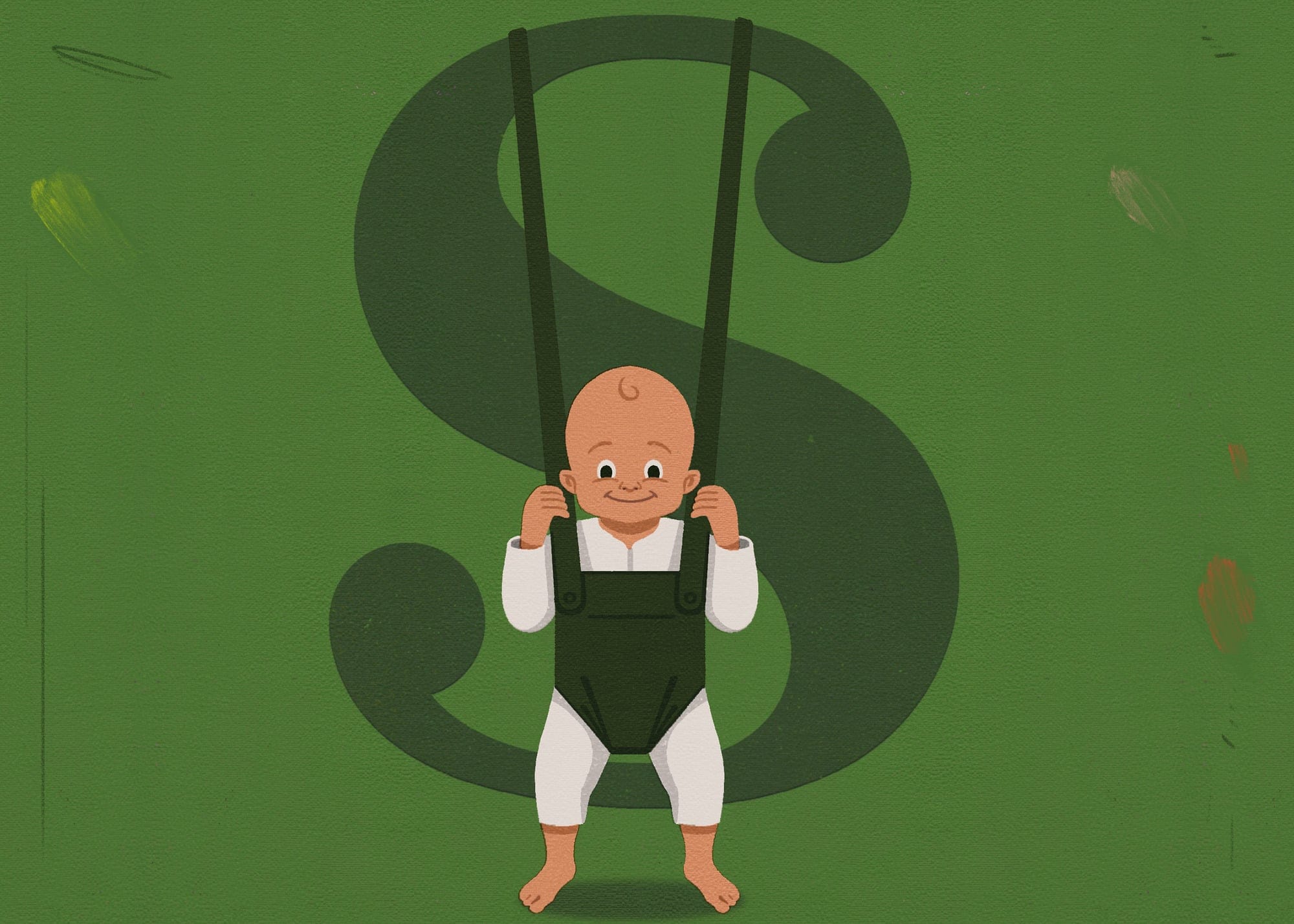
Give Canadian Kids $10,000 at Birth
Throughout my three-decade career, my north star has been creating wealth for Canadian families. One example of this is the children’s investing program I built in the ’90s, when I was president of the asset-management startup GT Global Canada. I often thought about grandparents who gifted shares in Disney, Apple and McDonalds and the disappointed expressions they’d get from their grandkids, who were expecting Air Jordans or the newest Barbie for their birthdays. I wanted to make investing fun for those kids, so for the under-10 set, GT rolled out gift boxes that contained a frameable stock certificate, a stuffed toy and a storybook starring Henry the Hedgehog, who discussed money with his animal friends. For tweens and teens, there was an Archie-style comic book. The program became a big success, selling thousands and thousands of boxes. I knew the way to strengthen a nation was to raise financially confident and savvy adults. To do that, you have to start young.
Even if Canadian kids reach adulthood knowing how to create an investment portfolio, manage the risks of credit cards and “pay themselves first,” as the Wealthy Barber says, it can be harder to build wealth than it used to be. About half of the country’s undergraduate students leave school with student-loan debt—the average is close to $30,000. (In terms of consumer debt, millennials now hold the highest share of any generation.) Over the past two decades, home prices have risen by 375 per cent, while incomes have grown only 93 per cent. And in a recent Statistics Canada study, nearly 40 per cent of adults aged 20 to 29 said they doubt they’ll be able to afford to have kids within three years, let alone a house to raise them in.
To level the generational playing field, I’ve been advocating for the creation of a universal wealth-building fund for all Canadian children—something I call the “head-start fund.” As soon as a child is born, the Canadian government would deposit $10,000 in a federal savings account, with annual birthday contributions of $1,000 from ages two to six and $500 between seven and 17. The only eligibility requirement is that the child is born in Canada.
Around the ages of 12 to 14, kids would have the option to invest up to 10 per cent of the money outside of their fund—giving them the chance to learn the ins and outs of investing with real capital, but not so much that they could blow everything up. Based on a compounding interest growth rate of eight per cent—similar to CPP investment returns—each fund could accumulate between $50,000 and $60,000 by the time the child turns 18, at which point they would be able to withdraw up to a quarter of the money. Additional withdrawals of 25 per cent would be allowed at the ages of 21, 25 and 28. Any remaining funds could stay invested tax-free. Left untouched, the funds could be worth $2.2 million by the time these kids retire.
So where would the money come from? With its highest marginal tax rate nearing 55 per cent (compared to 33 per cent in some American states), Canada generates tons of tax revenue, some of which could go toward these head-start funds. Primarily, though, the money would come from modest reforms to Canada’s Old Age Security program. This isn’t about picking on old people: when the OAS program kicked off in 1952, the average life expectancy for Canadians was 69; today, it’s 83. I’d propose gradually increasing the eligibility from 65 to 67. This could bank roughly $12 billion annually by 2030 as well as give seniors more time to work and save for retirement. Slightly reducing benefits for seniors at high incomes could result in extra savings of $4 to $6 billion that could be redirected to legacy funds for the next generation.
Related Posts
Tariff Fatigue Is Real

Why Canada Needs the Gordie Howe Bridge
What each child ultimately does with their money is up to them. Maybe it’s buying their first car or making a down payment. If they need seed capital to start a business, they’ll have it. If they want to go to university but their parents don’t have the money to send them—as was the case for me—they’ll have the money, and withdrawals wouldn’t count against any of their existing government loans, like OSAP, for example. For young parents worried about their kid’s prospects, the head-start fund would give their children some financial security when they eventually head out into the world. (With that extra buffer, those parents may well decide to have more kids themselves.) Broadly speaking, these head-start investments will have a multiplier effect on the country’s economy: much of that money would inevitably cycle back through the marketplace as investments in stocks, bonds and real estate. Backed by seed money, a huge new wave of Canadian entrepreneurs would hit the market, too.
Here’s an important stipulation: every child in Canada would receive the same amount of money in their head-start fund, whether they’re from downtown Toronto, Salt Spring Island or a remote Indigenous community in the North. Some might think the payments should vary by family income, but you can’t account for parenting. Many wealthy moms and dads maintain a philosophy of “my money, not yours” and never give their children a penny—I’ve seen this a lot. Others may not teach their kids financial basics, like how to balance a bank account. With an equal-opportunity fund, each kid would have a measure of financial autonomy from the beginning.
Initially, the head-start funds could be overseen in a similar fashion as the Canada Pension Plan or OMERS, which have dedicated boards experienced in managing billion-dollar investments. I imagine the program rolling out in phases over a period of four years: in year one, we’d build out the investment infrastructure and start enrollment for newborns and kids under five. This process would continue for three more years—with tweaks, as needed—and, at the end, the first cohort of 18-year-olds could access their money. I’d love to eventually tack on a matching initiative, where the feds kicks in money if relatives make donations to a kid’s fund for Christmas or Hanukkah—or for every $100 a kid plows into their own fund from their summer-job wages. This program would raise investors, and potentially more post-secondary grads, so by matching that money, the government would be incentivizing the economic outcomes it wants to see.
If the success of similar international initiatives is anything to go on, the future looks bright. In the case of Singapore’s Child Development Account, the government matches donations made by parents; as a result, the country has one of the highest household-savings rates around the globe. In New Zealand’s KiwiSaver program (NZ$1,000 at birth), participants save more on average for retirement than those who opt out. And following the U.K.’s Child Trust Fund pilot—which ran from 2005 to 2011, with an initial investment of £250—data revealed that participating families saved an additional £8 for every £1 provided by the government. These programs offer a hand-up, not a handout.
When I’ve explained the head-start funds to my colleagues, the response has been a mixture of “That’s awesome!” and “I can’t believe that doesn’t already exist.” There will be skeptics, of course. If I were to pitch the program to Prime Minister Carney, who’s in the middle of a national belt-tightening, here’s how I’d position it: this is a reallocation of capital, not an incremental expense. It would raise generations of financially empowered young people. It’s an investment in the country’s future.
Joe Canavan is a veteran asset-management expert, angel investor and former chairman and interim CEO of the Children’s Aid Foundation of Canada.
Related Posts

The World Cup Is an Economic Sinkhole
How to Save Canadian Agriculture

My Trucking Company May Not Survive the Iran War

Get the Best of Maclean’s straight to your inbox.
Sign up for news, commentary and analysis. Join 60,000+ Canadian readers.