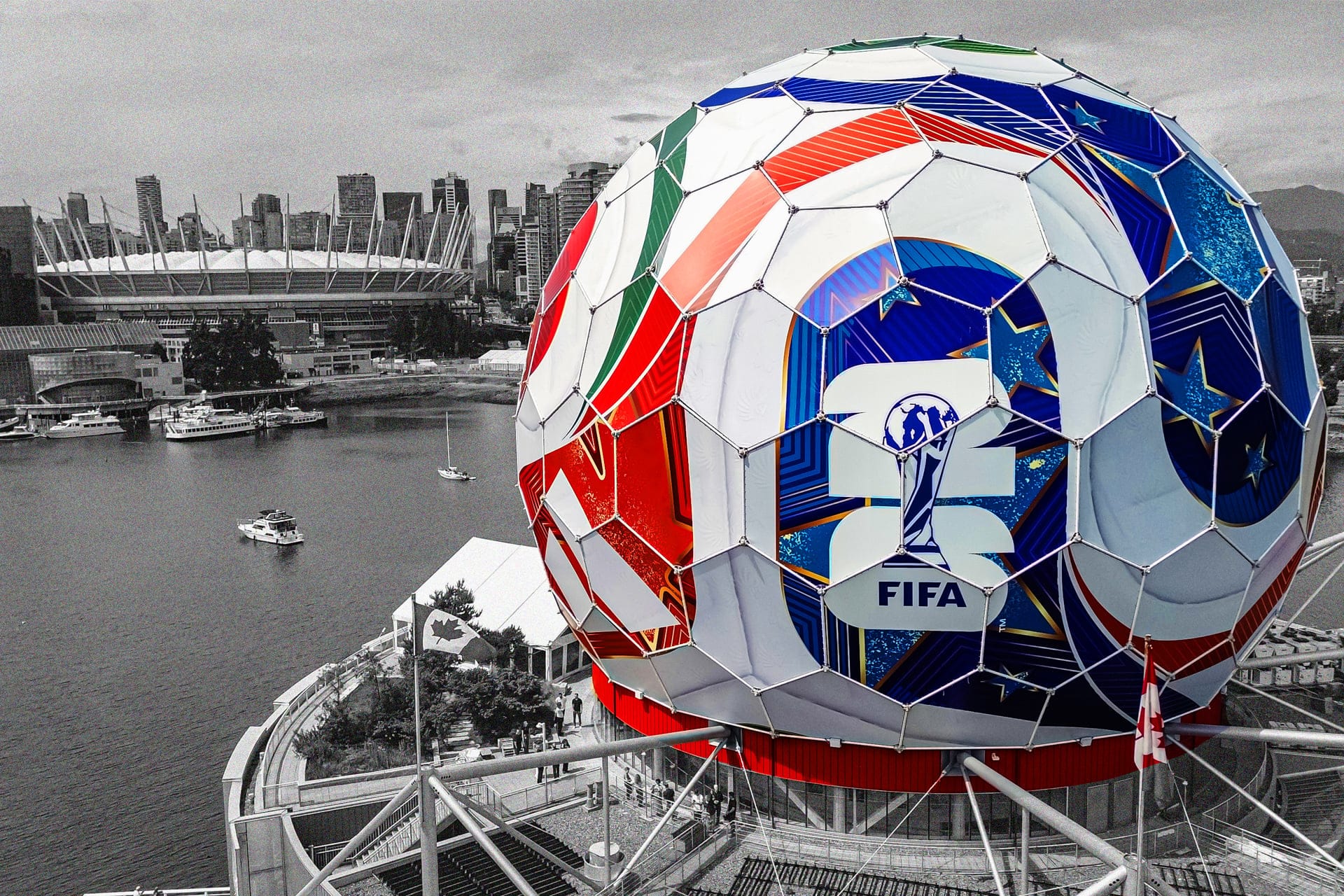
The World Cup Is an Economic Sinkhole
Forty Super Bowls. That’s how much economic activity Vancouver’s mayor says the FIFA World Cup could generate for the city over seven games. The tournament is set to cost Canada over $1 billion in total, but in exchange, the B.C. government projects its games alone will bring in $1 billion for the local economy. The investment, it argues, will pay off in the long run. But this is a fiction. Research and experience show that the promised economic gains for large-scale sporting events like the World Cup never seem to materialize.
The hypothetical tradeoff goes like this: someone halfway around the world will watch a match from Vancouver on TV, see how wonderful the city is and choose it as their next vacation destination. Or even better, soccer fans who visit for the World Cup will fall in love with Vancouver and return next summer—or every summer. The B.C. government projects a million additional travellers will come to the city between now and 2031, all inspired by the World Cup. (This amounts to less than a two per cent increase in tourists annually, but I digress.)
Based on this number, the government estimates how much money each new tourist will spend, then applies a multiplier effect: every dollar spent will generate new money for others to spend which, in turn, will generate yet more new money for others to spend. It’s an elaborate story that wildly overstates the positive impacts of these events.
Let’s assume those visitors do show up. Even in that case, the economic multiplier relies on the assumption that these dollars go to the local economy. This isn’t entirely true. Hotel prices may skyrocket, but that doesn’t translate to higher wages for hospitality workers. Lots of that money is going to Delta and Marriott’s shareholders. Some cash will land in residents’ pockets—say Airbnb landlords or hospitality workers earning tips—but that isn’t necessarily being spent locally, either. Canadians are in a lot of debt. It’s more likely those people will use their income bump to clean up their credit card debt or to pay off their student loans.
These projections also fail to account for tourist displacement: the regular tourists who aren’t visiting because of the World Cup. When politicians look at impact, they get tunnel vision, optimistically calculating incoming tourists alone. But an economist must also look at the outgoing tourist. Consider that neither Toronto or Vancouver has built new hotels for the World Cup, so actual capacity remains unchanged. These are already hugely popular summer tourism destinations, but regular summer tourists are displaced by sports tourists. The question then becomes: does the soccer fan spend more in the local economy? If so, it’s an incremental impact—not the spike it’s made out to be.
Related: World Cup Mania
Worst of all, we don’t know if even the incremental impact will bear out: hotels are sitting half-empty on match days, and Airbnb hosts are reporting far fewer bookings than anticipated. If we can’t even get people to show up for the event itself, why do we think it will attract visitors for years to come? One million additional tourists is a nice round number, but it’s not based on any robust economic analysis.
These numbers were invented to compensate for the massive price tag that comes with hosting 12 matches in Toronto and Vancouver. The cost to taxpayers is $82 million per game. Almost half of that is funded by the federal government, the rest from provincial and municipal governments. In the midst of a catastrophic affordability crisis, it becomes hard to justify—unless the games are sold with the grandiose narrative that they will somehow make up the money in the long term.
For one, security costs are staggering. The federal government pitched in $145 million for security operations. Sporting events, in all their fervour and activity, carry the risk of violence; just look at the Munich massacre at the 1972 Olympics, or the bombing at the 1996 Olympics in Atlanta. That’s a worst-case scenario—but we also don’t want fights breaking out between rival fans at the Eaton Centre or the Pacific Centre.
Beyond public safety, it costs a lot to ensure nothing embarrasses FIFA at its crown jewel event. The FIFA brand manages the image of World Cup games the same way Apple manages the iPhone, or McDonald’s the Big Mac. That means the grass has to be perfect; the signage in view of the stadium has to feature exclusively FIFA sponsors—including the name of the stadium itself, hence the BMO Field’s temporary renaming to Toronto Stadium. The associated costs fall on the city.
Related: The World Cup Will Relegate Canada to the Sidelines
There’s also the importance of optics for the host city. The world’s media descends on it: sports media, travel writers, journalists looking for human interest stories. The projected tourism dollars, fantastical as they are, require that Vancouver and Toronto present as safe, beautiful cities. This means an inflated budget to manage the unsightly—not just around the stadium but throughout the city. No one can decide the games are a good moment to protest Trump or Tehran. And no one wants the whole world to know we have a massive homelessness problem. If cities don’t have enough money to actually solve this, they can round up the unhoused population and move them somewhere journalists aren’t going to find them.
Many countries in Europe and South America are soccer mad. But Canada is not a soccer country, and our second-rate facilities reflect that. BMO Field originally didn’t even meet FIFA’s 45,000-person minimum seating requirement—it had to build new temporary stands—and BC Place is an aging multi-purpose facility. They’re not meant for world-class soccer. Infrastructure upgrades were one of our largest expenses: upgrades at BMO Field and BC Place cost $146 million and $196 million respectively.
Meanwhile, Canada has seven NHL arenas; we could pull off an international hockey tournament and actually make money doing it. In the U.S., they at least have NFL stadiums, which cost less to adapt for soccer. And their stadiums are privately owned, so they can tap the corporate owners for facilities upgrades. The upgrades benefit the owners long term, so they’re more willing to shell out. BMO has no such incentive. Our facilities are publicly owned, and the costs come from the public purse.
Cities are trying to recoup costs with policies like Toronto’s 2.5 per cent hotel tax increase. But these policies target fans. They smack of desperation rather than clear-headed business strategy. Instead, going forward, cities must have the conviction to say no to these events. Toronto should never host the Olympics. We should learn from Montreal, which declined to host any World Cup matches, citing cost concerns. That city understands the staggering costs of global sporting events: it carries the legacy of the catastrophic 1976 Summer Olympics, which almost bankrupted the city and province with cost overruns to the extent that, in 1977, nobody wanted to bid on hosting the 1984 Summer Olympics. Today, their Olympic Stadium stands empty and undergoing a $870-million roof restoration with no justifiable tenant. It’s a constant reminder that these events are toxic money sinkholes.
Related: Good Luck Getting World Cup Tickets
If the World Cup and Olympics are going to continue, cities need to host them more than once. That’s unlikely to happen; FIFA and the IOC would have to abandon the current bidding processes, which are designed to manufacture exclusivity and offload costs to local governments. But if we picked two host cities that alternated every four years, they could accrue institutional knowledge, invest in sustainable operations and build permanent infrastructure—and that long-term economic benefit might actually pan out.
In the current ecosystem, large-scale sporting events leave cities in the red. They’re vanity projects, alluring prospects for the egotistical politician: to sit in private stadium boxes among global leaders, their image broadcast into millions of homes around the world. It’s also an opportunity to earn political capital. Take Ralph Klein, who secured Calgary the 1988 Olympics when he was mayor. He resigned in ’89 and parlayed that into a larger political career as premier.
It’s time to divorce the love of the game from the math of the business model. A survey from the Angus Reid Institute showed that 72 per cent of Vancouverites said hosting was not worth the public cost. Our political leaders should’ve listened to them.
Moshe Lander is a sports economist and a senior lecturer in the department of economics at Concordia University.
What did you think of this story? Send a comment for publication to letters@macleans.ca, and supply your name and address. Comments should be fewer than 200 words, and may be edited for length and clarity.
Related Posts
The Case for Tourist Taxes

How Do We Keep Canada Insurable?
Canada is Funding its Own Economic Decline
American Carmakers Are Leaving. Bring on the Chinese EVs.
Get the Best of Maclean’s straight to your inbox.
Sign up for news, commentary and analysis. Join 60,000+ Canadian readers.