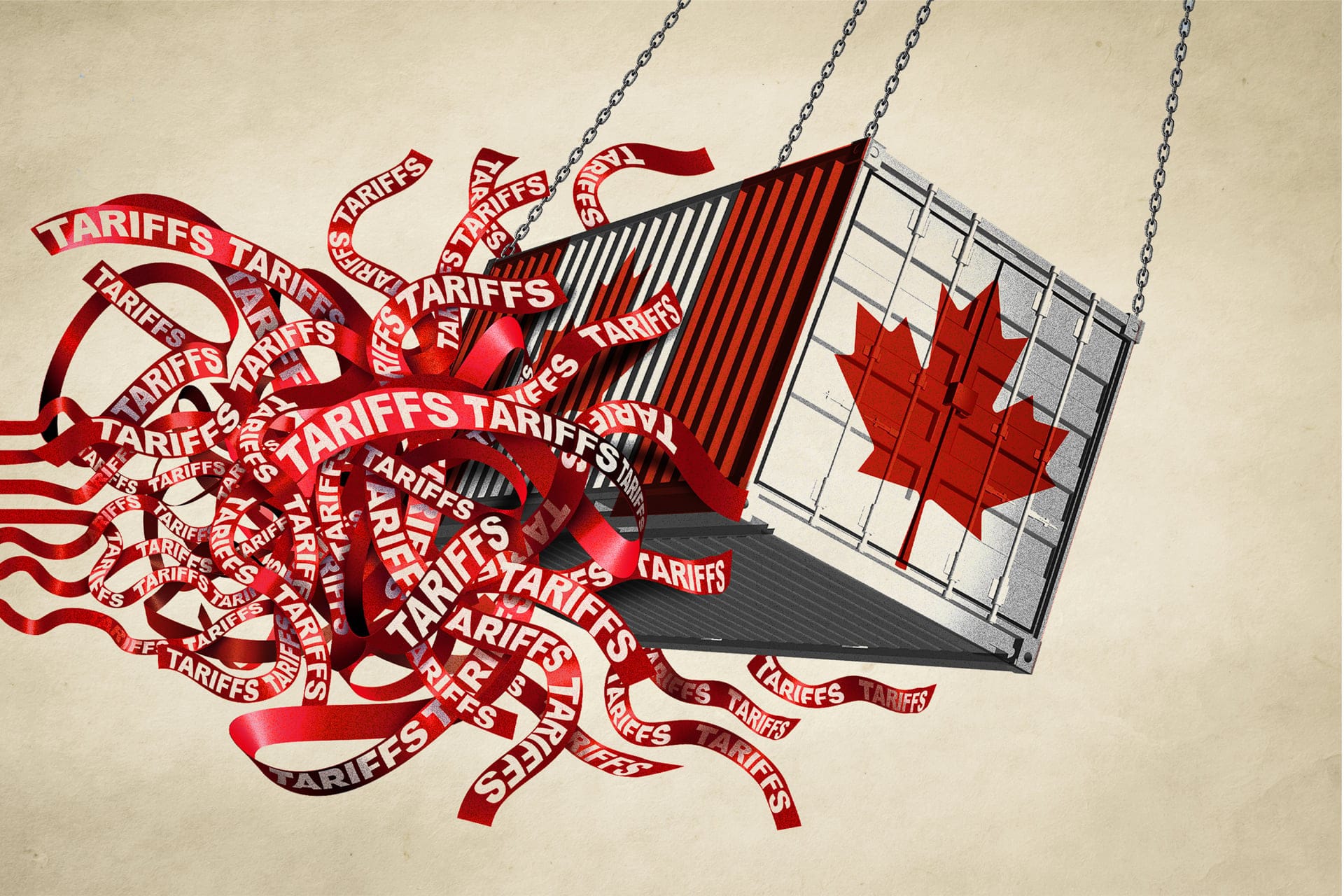
Tariff Fatigue Is Real
Every two weeks at Abacus Data, I poll Canadians on the same open-ended question: what issue or news story have you seen recently that’s most likely to keep you up at night? I don’t put an issue in front of them—they reply with whatever comes to mind. Fourteen months ago, tariffs accounted for roughly a quarter of all responses. Trump’s threats were relatively new, the possibility of a trade war felt immediate and Canadians were trying to work out how much damage he could inflict.
But last week, when I asked Canadians the same question, almost nobody said tariffs. In our latest poll, conducted with 1,502 Canadians, about 20 people mentioned tariffs or the trade war. That’s 1.3 per cent of the sample. The threat hasn’t shrunk—if anything, it’s escalated. This week, President Trump announced new 50 per cent tariffs on a range of Canadian goods, including products that were previously exempt under CUSMA. They’re supposed to take effect in 30 days. So why has our anxiety dissipated?
It’s partly because we’re used to it. For over a year, Canadians have lived through Trump’s threats, deadlines, insults, reversals and negotiations. Each announcement is a little less impactful and leaves us a little more numb. Psychologists call this habituation: as a stimulus becomes familiar, our response to it weakens.
And while the headlines dominate the news cycle, the consequences haven’t concretely manifested for the average Canadian. For one, Trump doesn’t follow through. His threats are so empty that we’ve coined a pejorative acronym to describe his wishy-washy economic strategy: TACO, or Trump always chickens out.
Even when threats do become policy, Canadians have now lived through a year of tariffs without much change to their day-to-day lives. The predicted collapse did not reach their households. Unemployment did not spike. It rose half a point, then returned to 6.5 per cent. The layoff rate didn’t move off its pre-pandemic average. Inflation for 2025 was 2.1 per cent, the lowest it’s been since 2020.
Related Posts

The Case for Tourist Taxes
Canada Doesn’t Need a New Pipeline
If you brace for something that never arrives, the reasonable response is to stop bracing. A large enough shock may rattle us again, but that would require real evidence that tariffs will touch our lives. An announcement from Washington—or post on Truth Social—isn’t enough.
The second explanation for the decline in tariff anxiety is that something else took its place: international conflict, specifically, the war in Iran. Fourteen months ago, war accounted for 11 per cent of Canadian worries. Today, that number has nearly doubled, with Iran alone at 13 per cent. War now occupies almost exactly the share of the Canadian psyche that tariffs did in May of 2025.
It’s not like we’ve stopped paying attention to tariffs—our latest polling on trade relations with the United States makes that clear. Almost three-quarters of Canadians say they’re still following the trade negotiations closely, while six in 10 Canadians believe reaching a new agreement is urgent. But 69 per cent want Canada to hold firm even if negotiations take longer. Only 20 per cent want compromises to get a deal sooner. And 55 per cent say Canada’s top trade priority over the next decade should be reducing our reliance on the United States. This is a public that has reached a conclusion: Canadians want an agreement, but in the meantime, we’re willing to live with uncertainty if the alternative is greater vulnerability to American coercion.
That uncertainty feels more tolerable under the guiding hand of Mark Carney. He’s become a kind of shock absorber, a foil to Trump’s mania. Half of our respondents have a positive impression of Carney, and among Canadians who identify Trump as a top concern, 63 per cent say the Liberals are best able to manage the issue, compared with only 15 per cent who choose the Conservatives. With Carney in charge, bedlam in Washington does not automatically translate to a crisis of confidence in Ottawa. In fact, it strengthens our faith in him. Carney’s political value is that he makes a volatile situation feel manageable.
But a thicker skin is not immunity. I think two things would have to happen for tariff anxiety to rise again. First, Trump has to follow through. The latest batch have been announced, but they’re not yet in effect. Canadians have watched deadlines move and threats become bargaining positions. Until a broad range of tariffs actually go into effect, many will treat the announcement as another stage in the negotiation.
Second, more Canadians have to feel the consequences. A 50 per cent tariff sounds enormous, but it remains abstract until it manifests in tangible, wide-scale effects. As long as tariffs are mainly understood as threats to Canada, Carney benefits from the perception that he’s the person best able to manage them. If tariffs cause mass layoffs or higher household costs, the issue could move onto less favourable ground for the government.
The Conservatives currently lead among voters who prioritize the economy and job security. Economic pain could stoke more anger with Trump and strengthen support for standing firm. But it could also test how much uncertainty Canadians are prepared to endure and how much they trust the current administration to protect them from the cost.
Fourteen months ago, Canadians were frightened by what Trump might do. Today, most have learned to live with the threat. If these new tariffs take effect, the question is not whether they’ll induce another round of sleepless nights. It’s whether Canadians will have to absorb lost jobs, cancelled hires and price hikes they can trace directly back to Washington.
David Coletto is the founder and CEO of polling firm Abacus Data.
What did you think of this story? Send a comment for publication to letters@macleans.ca, and supply your name and address. Comments should be fewer than 200 words, and may be edited for length and clarity.
Related Posts

Canada is Funding its Own Economic Decline
American Carmakers Are Leaving. Bring on the Chinese EVs.

How Do We Keep Canada Insurable?
Venezuela Can’t Deliver the Oil America Needs. Canada Can.
Get the Best of Maclean’s straight to your inbox.
Sign up for news, commentary and analysis. Join 60,000+ Canadian readers.