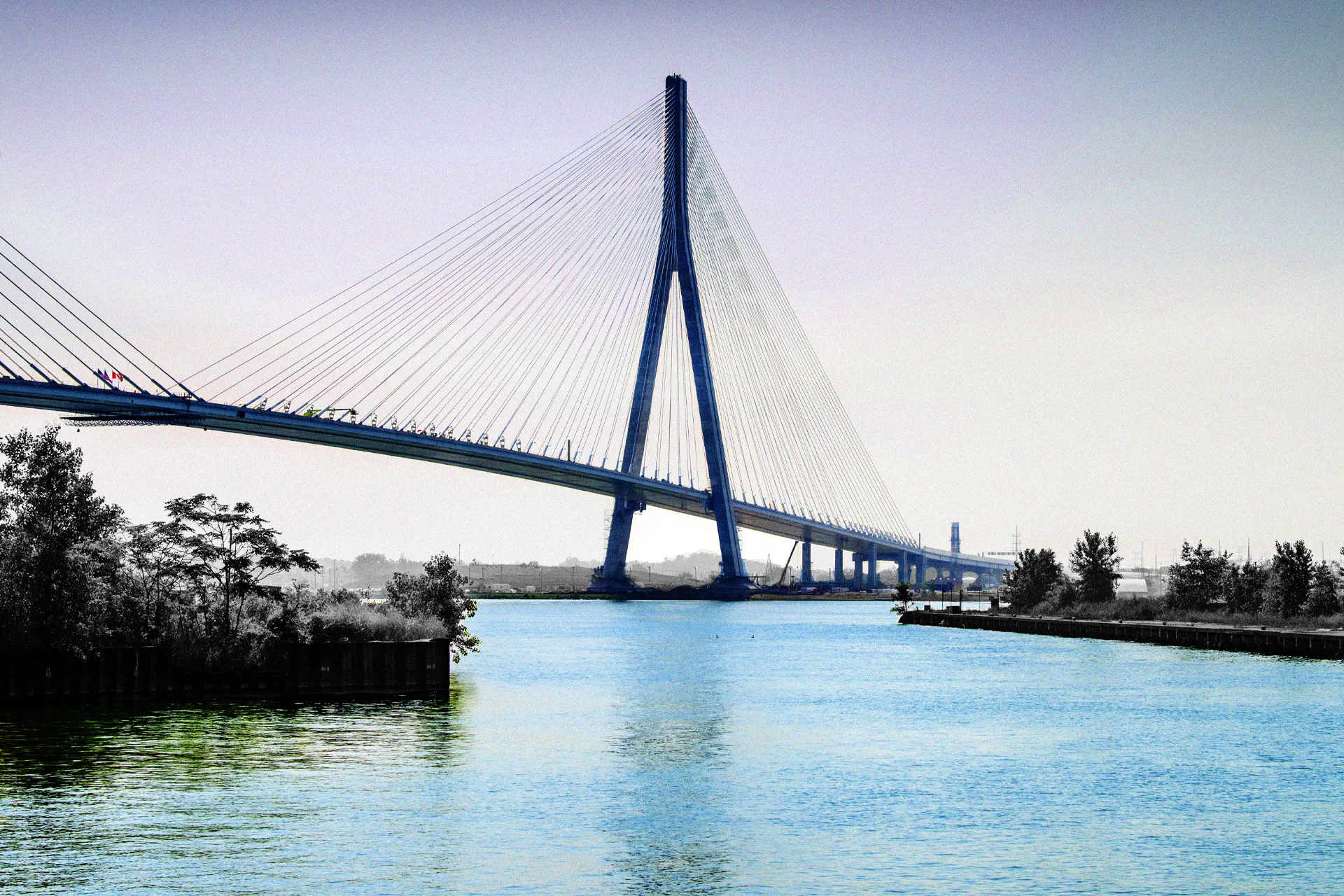
Why Canada Needs the Gordie Howe Bridge
The need for a new crossing on the Detroit River gained traction in the early 2000s. Back then, it seemed like cross-border manufacturing—and the free trade that facilitated it—were a given in an ever-globalizing world. The free flow of goods meant steel from Hamilton could build a car in Detroit, and an engine made in Dearborn could be installed in a Windsor-built minivan. Industries on each side of the border were free to do what they did best, collaborating on a wider variety of cheaper cars and more competitive products in the world market. In the middle of it all were a few million yearly truck trips in both directions across the Detroit River.
The new Gordie Howe International Bridge, which broke ground in 2018, was supposed to be the physical manifestation of that integrated trade relationship. It takes its name from Canadian hockey legend Gordie Howe, who led the Detroit Red Wings to four Stanley Cup championships. But now, in the shadow of Donald Trump’s second presidency and the tariffs on Canadian goods that came with it, that relationship is a lot less friendly. Commercial traffic at the crossing is way down, and the opening of the bridge has been delayed for an indeterminate amount of time—seemingly by Mr. Trump himself. But that’s all just short-term drama. Tariffs or not, the new bridge still stands to be transformational for Windsor and the rest of the country.
Today, around a third of Canada-U.S. trade travels across the Detroit River, and until the Gordie Howe Bridge opens, there’s really only one way to pass it: the beleaguered Ambassador Bridge. Built in 1929, the Ambassador is quickly approaching its 100th birthday—and it shows. Work was recently completed to replace 200 of the steel suspension cables that hold the bridge deck to maintain its structural integrity. As for the deck itself, chunks of concrete have quite literally fallen from its underside into the river—or worse, onto the streets of downtown Windsor.
Related: Fear and Loathing in Canada’s Most American City
Tolls on the Ambassador have also risen dramatically. Truck tolls—which are charged by the axle—have soared from $6.75 in 2015 to $27 today. For a five-axle big rig, that’s a $135 bill on a one-way trip. The cost is so high that many businesses have opted to send their shipments over Sarnia’s Blue Water Bridge, the next closest crossing, 108 kilometres north of Windsor. Per-axle tolls at the Blue Water are just $7. Earlier this year, the Blue Water Bridge overtook the Ambassador as Canada’s busiest commercial border crossing for this very reason.
But the biggest issue with the Ambassador might not be its age or tolls, but rather its owner: Michigan billionaire Matthew Moroun. Not only does Moroun own the only truck route across the river—the family bought it in 1979—but he and his late father, Manuel “Matty” Moroun, have fought tooth and nail to stop another bridge from being built. They’ve undertaken 22 legal challenges against the Gordie Howe Bridge and argued the construction of the Ambassador carried an implied right to be protected from a competing crossing. Nineteen of those challenges have been struck down, and three are still making their way through the courts. The family even attempted to build their own second crossing, buying dozens of homes and properties along the Canadian side of the river. Most recently, the younger Moroun has made efforts to curry favour with the president, donating a million dollars to a Trump-aligned super PAC.
Related Posts
Venezuela Can’t Deliver the Oil America Needs. Canada Can.

How Do We Keep Canada Insurable?
Related: My Trucking Company May Not Survive the Iran War
While the Morouns may be losing their golden goose, nearly everyone else involved stands to gain. Being a one-bridge town has hamstrung Windsor’s and Canada’s industries and Canada-U.S. trade. The auto sector, which is Canada’s largest manufacturing industry, runs on what’s called just-in-time logistics, a system where parts arrive at assembly plants right when they’re needed. This cuts down on storage costs and inventory management, making the process cheaper and faster, and those savings are passed on to consumers. But this means even the smallest delay can disrupt an entire assembly line. At a plant like Stellantis’s Windsor Assembly, where around 1,200 Chrysler minivans are built every day, these delays can represent tens, if not hundreds of thousands of dollars, lost by the minute.
Even amid a trade war, the expedited trade route at the Gordie Howe will alleviate this. The new bridge has six lanes and an automated system to change their direction if needed. The customs facilities on both sides are far larger than at the Ambassador Bridge and have state-of-the-art processing technology. Best of all, the new bridge connects Ontario’s Highway 401—the busiest highway on the continent—to America’s Interstate 75 without a single traffic light. The Ambassador, on the other hand, sends drivers into downtown Windsor and Detroit, places where most truckers have no business being.
Related: The Myth of the All-American Car
Regardless of how long Trump or the Morouns want to delay it, the demand for the Gordie Howe Bridge isn’t going away, and neither is the network of industries that need it. Trump may want auto production to move to the States, but the system is simply too complex for one president to dismantle. Market conditions have made auto manufacturing a cross-border affair for a reason: it’s just more efficient.
Take aluminium, for example: more than half of the aluminium used in American-made cars comes from Quebec because the U.S. simply doesn’t have the electricity to produce it as cheaply. Canada covered the $6.4-billion cost of the project because our government understood how badly it was needed. They built a damn good bridge, too. It’s projected to last the next 125 years. Hopefully, these isolationist trade policies will be ancient history by then.
Peter Frise is a professor of mechanical and automotive engineering at the University of Windsor.
What did you think of this story? Send a comment for publication to letters@macleans.ca, and supply your name and address. Comments should be fewer than 200 words, and may be edited for length and clarity.
Related Posts
American Carmakers Are Leaving. Bring on the Chinese EVs.
Canada Doesn’t Need a New Pipeline

Canada is Funding its Own Economic Decline
The Case for Tourist Taxes
Get the Best of Maclean’s straight to your inbox.
Sign up for news, commentary and analysis. Join 60,000+ Canadian readers.