Six Programs That Are Building A Stronger Canada
Mobile classrooms in First Nations communities that address local problems
School: Red River College Polytechnic
Location: Rural Manitoba
Credential: Certificate
First Nations youth, especially those living on reserves in rural and remote areas across the country, face significant financial and geographic barriers to education. In Manitoba, only 21 per cent of First Nations youth enrol in post-secondary education, one of the lowest rates in the country.
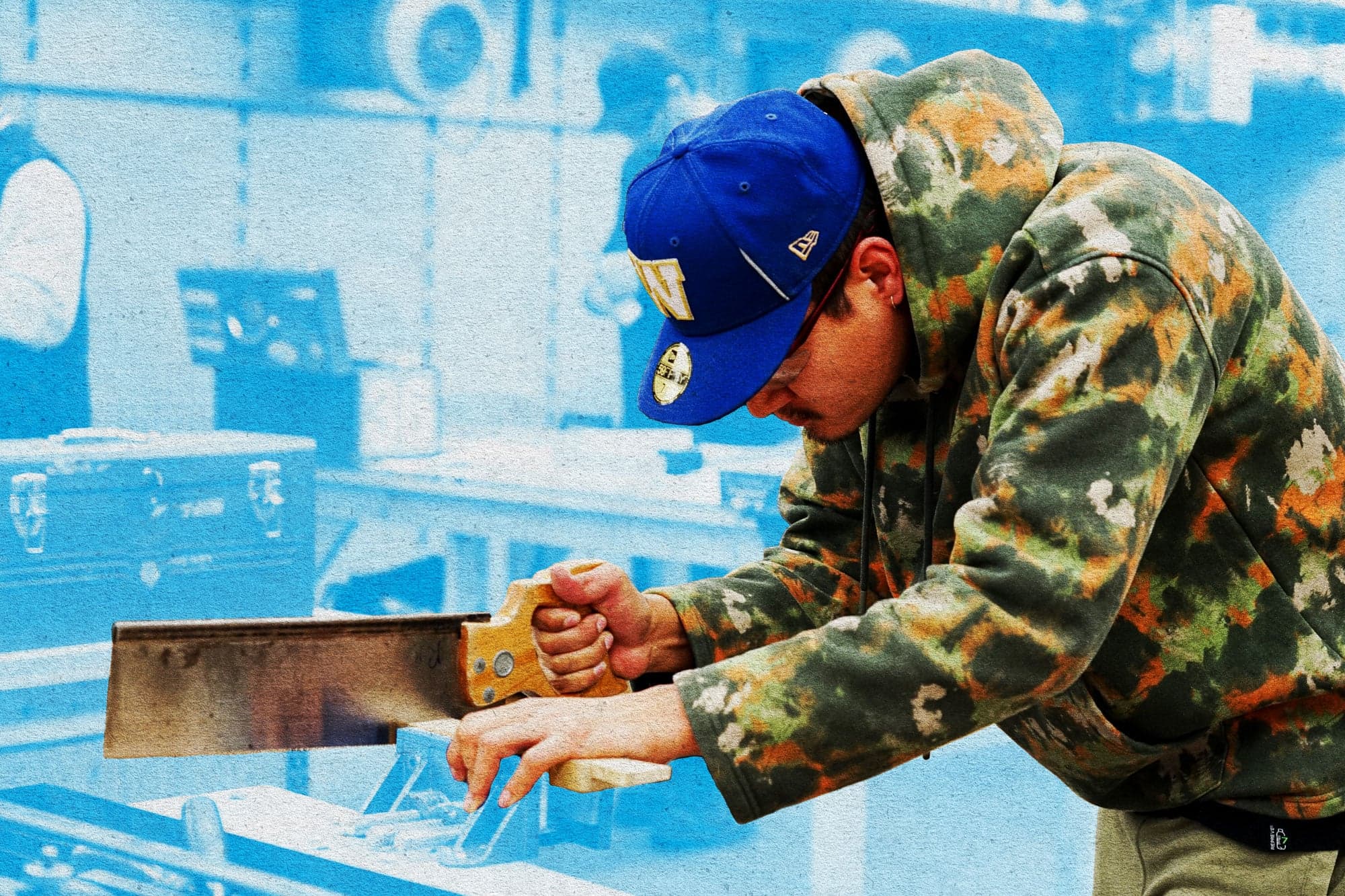
Red River College Polytechnic’s mobile-training labs help address this situation. Each lab is made up of two 53-foot trailers on wheels, with slide-out sides that can quickly open up into 1,000 square feet of training or storage space. The labs are big enough to train up to 12 students at a time but class sizes can be larger, as students rotate in and out of the lab as they work on projects.
Currently, Red River has two mobile training labs and is considering adding a third. To determine which academic programming and training would best serve the community’s needs, a regional campus manager from the school meets with an advisory committee made up of local leaders and residents of the community. Once the program is running, faculty maintain a connection with the community to ensure the training supports local needs and helps connect participants to jobs.
One of the labs moves back and forth between Peguis First Nation and Fisher River Cree Nation in the Interlake region of Manitoba. In early 2022, an intro to trades program was underway when major flooding occurred, forcing hundreds of community members out of their homes; many were unable to return due to mould, water damage and unstable foundations. Some students in the program took part in paid practicums during the summer to support community needs. Red River has since offered carpentry, plumbing and an electrical program to continue to help the community rebuild.
Related Posts

What’s the Difference Between College and University?

I Went Back to College at 37 and Found the Work I Was Meant to Do
The second lab moves around to other communities in rural Manitoba. Last summer, in Shoal Lake 40 First Nation, which straddles the border of Manitoba and Ontario, students were trained in construction labour, piping and framing to support a local highway project that required skilled workers. This fall, the mobile lab will be stationed in Roseau River Anishinabe First Nation, where students will train to become health-care aides.
A wildfire training and education centre to combat forest fires
School: Thompson Rivers University
Location: Kamloops, British Columbia
Credential: Certificate and diploma
British Columbia had its most devastating wildfire season on record in 2023: 2.8 million hectares burned, more than double that of the previous record-setting year. Across the country, wildfires have displaced hundreds of thousands of people through evacuations, destroyed homes and had a significant effect on the health-care system. In 2024, the fires caused more than $8 million in insured damages alone.
The research underpinning current wildfire practice is, in some cases, decades old and lacks relevance to Canadian contexts. Guidelines designed to keep communities safe were originally based on standards from the National Fire Protection Association in the United States. Although they’ve been adapted over the years, they still lack Indigenous knowledge and wildfire-management practices, which are imperative to understanding and fighting blazes in Canada. Having up-to-date local research is especially important as the climate crisis creates more unpredictable weather events each year.
To improve the ability to forecast, prevent and respond to wildfires, Thompson Rivers University and the B.C. Wildfire Service launched the Centre for Wildfire, Research and Education in 2024 at the Thompson Rivers Kamloops campus. The centre’s goal is twofold: to produce more skilled personnel for immediate wildfire response, and to provide an academic space for ongoing research.
This fall, the first cohort of students will start their studies in one of three certificate programs or a diploma program. Each program is designed to address specific knowledge gaps within contemporary wildfire management. The wildfire-science certificate trains future wildfire experts, policy analysts and forestry and environmental consultants with courses that cover wildfire dynamics and the impacts of these disasters. In the sociocultural dynamics of wildfire certificate, students learn about the impact of land use from colonization to current day, as well as the economic impacts of wildfire. The wildfire communications and media certificate, delivered online, is designed to provide people in the communications field with specialized wildfire and emergency management communication skills. The two-year diploma program provides students with a wider breadth of knowledge and skills, preparing grads to be leaders in wildfire mitigation, preparedness, response and recovery. The centre’s program roster is set to grow, with two new certificate programs launching next year.
Collaborative robots to ease the skilled trade shortage
School: British Columbia Institute of Technology
Location: Burnaby, British Columbia
Credential: Certificate and apprenticeship
Canada’s welding industry is facing a number of workforce challenges: many are aging and retiring and, right now, there aren’t enough welders-in-training to fill the gap. The work itself is also dangerous—welders risk skin and eye exposure to hot plasma from using welding arcs, and the repetitive nature of the work causes body strain.
One solution: automation. But a traditional industrial welding robot moves quickly and forcefully. They’re designed for large industrial applications, like an automotive assembly line, where a human won’t be near the machine while it’s in operation. These bots can also be cost-prohibitive for small companies and don’t allow flexibility for diverse or small-batch projects.
That’s where cobots come in. A collaborative robot, or cobot, is programmed to work with a human in a shared space. The welder can instruct and supervise the cobot while it performs the simpler, repetitive tasks, while the welder takes on more complicated tasks. Cobots have the potential to help close the labour gap by allowing tradespeople to work faster and more safely, without compromising quality or replacing the expertise of highly skilled welders.
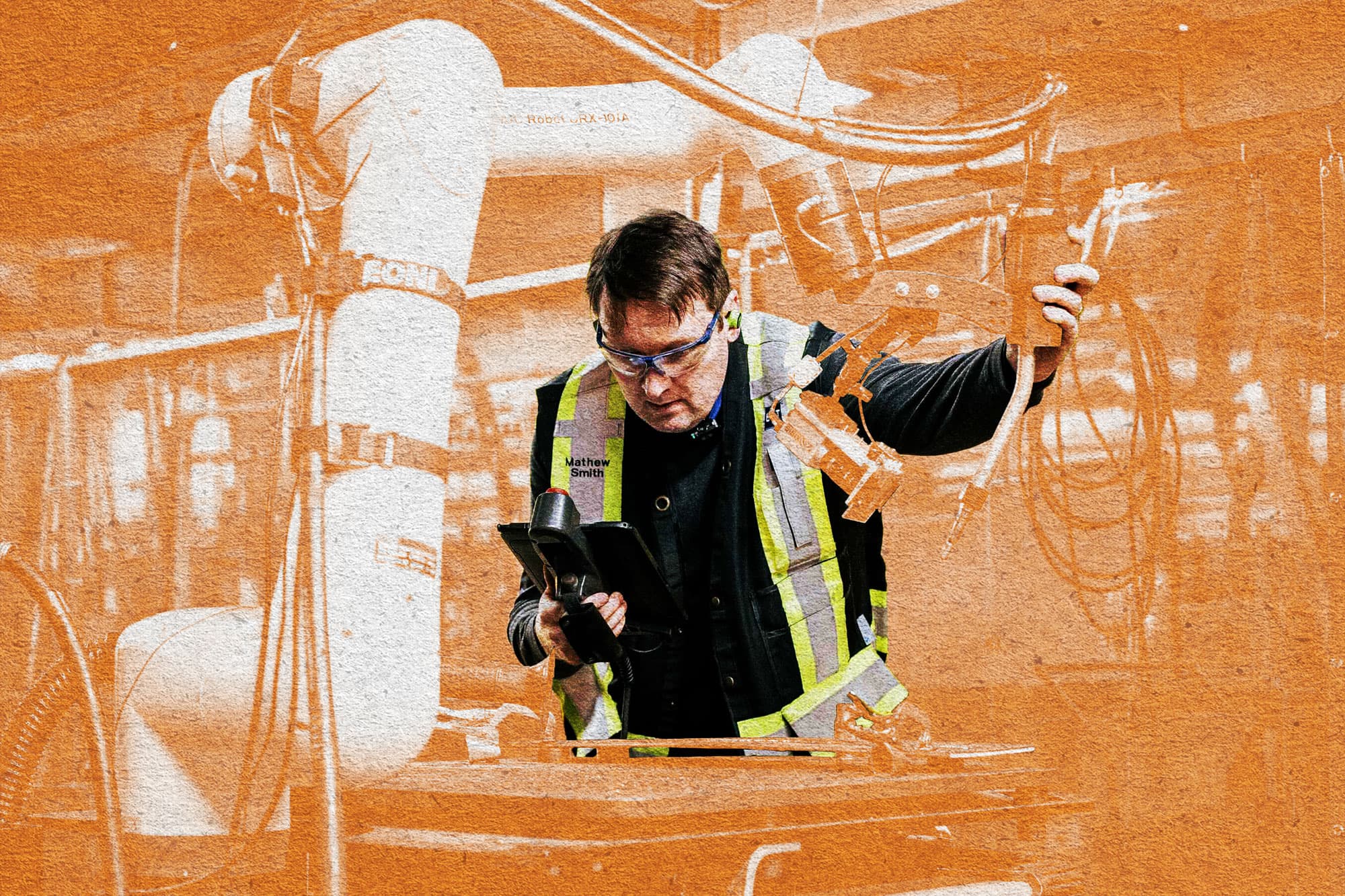
But as with all new technology, adaptation takes education. Under the direction of Mathew Smith, director of the Centre for Welding Technologies and Metallurgy Research at the British Columbia Institute of Technology, the school purchased a cobot last year to do just that. Smith is currently working with BCIT welding and metal fabrications instructors to incorporate the machine, which cost $100,000, into classes.
“Cobot,” as the students call it, has two white arms and five joints, or elbows, that can be manoeuvred to reach almost a metre and a half in any direction from where it’s mounted. The machine has a number of built-in sensors that shut it down if it runs into something or comes into contact with anything it shouldn’t, including a human—a feature lacking in traditional welding robots. And also unlike traditional robots, which require significant computer programming to operate, Smith says any welder can be taught how to use a cobot, which is as simple as providing it with instructions and pressing a button. Students in BCIT’s certificate and apprenticeship programs will continue to learn the manual skills required to become certified welders in B.C., but user-friendly cobots have the potential to massively increase productivity—and job satisfaction—especially as artificial intelligence is incorporated into its capabilities.
Carbon capture upskilling for energy sector workers
School: Southern Alberta Institute of Technology
Location: Online
Credential: Certificate and microcredential
Last year, the federal government set a goal of reducing Canada’s carbon emissions by 45 to 50 per cent below 2005 levels by 2035, as part of its larger goal of reaching net-zero emissions by 2050. But with the country still largely reliant on greenhouse gas–producing fossil fuels, Prime Minister Mark Carney has signalled his interest in scaling up carbon capture and storage, or CCS, initiatives as a way of reducing the climate impacts of extracting oil and gas.
Carbon capture technology is already in use all around the world, with over 570 facilities in development globally. There are seven large-scale carbon capture facilities in operation in Canada (about one seventh of the world’s total), and the Alberta government alone is assessing another 25 proposals. There are several capture methods: the most common method, called post-combustion capture, involves passing exhaust gases from industrial facilities, like power plants and cement factories, through a chemical or membrane system that captures CO₂. The captured CO₂ is then compressed into a dense, supercritical state for transport to storage sites. From there, it is piped deep underground into geological formations—often saline aquifers or depleted oil and gas fields—where it is securely stored.
The Canadian Climate Institute, which researches Canadian climate policy, predicts that CCS could be responsible for up to 29 per cent of Canada’s emissions reductions by 2050. But with the growing adoption of carbon capture technology, energy industry leaders and the Canadian government have identified an impending shortage of workers who are trained in the systems. The labour market will need people skilled in a wide range of tasks, including designing and building the storage and transportation infrastructure, overseeing the development of new plants and measuring and monitoring the carbon once it’s stored underground.
In anticipation of this need, the Southern Alberta Institute of Technology, or SAIT, worked with industry professionals to develop a carbon capture certificate and microcredential program in their school of continuing education. Students working on the carbon capture and storage certificate take one required microcredential course, Introduction to Carbon Capture and Storage, then choose one out of six elective microcredentials. The 15-hour intro course is designed to bring data technicians, civil engineers and others up to speed on how carbon capture technology works. The elective courses focus on technical aspects of carbon capture, including transportation; sequestering and storage; measuring, monitoring and verification; the design of carbon capture infrastructure and the design of carbon capture transportation infrastructure. The courses are taught by experts, often professionals currently working in the field. All courses are online and self-propelled, meaning students can complete them in their own time.
A wind turbine simulator to train technicians on the ground

School: George Brown College
Location: Online
Credential: Certificate
Wind energy is one of the fastest-growing energy sources in the world, and global wind power capacity is expected to more than double by 2030. While China, the United States and Germany are leading the wind-energy race, Canada is ninth, with more than 7,500 wind turbines. Several provinces are scaling up their renewable energy targets and—given our ample geography, open spaces and windy locations—we could easily house hundreds of thousands of wind turbines.
With more wind turbines churning out more clean energy, there will be demand for wind technicians to manage and maintain the structures, which range in height from 40 to 135 metres and are currently located from Newfoundland and Labrador to British Columbia. The new wind turbine technician program at Toronto’s George Brown College is an online program available to students across the country—and the world—that teaches future techs how to install, inspect, maintain, operate and repair these large electromechanical machines, all without ever climbing one.
More than 200 students enrolled in the college’s inaugural session in January of 2025, from Canada, Ireland and Germany. The program kicks off with a basic introductory course to get all students up to speed on windmill types and their systems and components. (Students don’t require knowledge of electricity or electronics, but coursework will come more easily to those with a basic understanding of these concepts.) Thirteen more modules cover topics like safety, wind energy theory, monitoring and communication, electrical code and blueprint reading, and maintenance and repair.
To offer the program digitally, the school developed a proprietary 3D wind turbine simulation software—the first and only of its kind—which lets students practise a wind turbine tech’s job without the inherent dangers of climbing up a real wind turbine. Enrolled students purchase a licensed copy of the software and retain access after the program is over, in order to perfect their skills.
Students considering the program should keep in mind that when a wind turbine stops working, a technician needs to get out—and up—there fast to solve the problem and get things working again. Wind turbine tech jobs involve on-call hours and travel (as necessary) to remote locations, sometimes in bad weather conditions. And while the training is done on a simulator, the actual work is high off the ground—likely disqualifying those with a fear of heights.
Vertical farming courses that use an at-home kit
School: Olds College
Location: Olds, Alberta; Online
Credential: Certificate
When Donald Trump threatened Canada’s sovereignty, many of us fought back with our most powerful weapon: our wallets. But shoppers looking for Canadian-made produce quickly learned that many of their go-tos, like lettuce and oranges, aren’t widely grown in Canada. A whopping 75 per cent of fruit and about 50 per cent of vegetables found on Canadian grocery shelves are imported. But with rapid advances in indoor-agriculture technology, that doesn’t need to be the case.
“The arrival of LED lighting transformed the indoor agriculture industry about 10 years ago,” says Rich Gibson, the course developer and instructor of the indoor agriculture program at Olds College in Alberta. There’s no longer any kind of limit on what we can grow here: bananas, pineapples, avocados, oranges and watermelons are all viable options, provided we have workers who know how to do it. Controlled environment agriculture, or CEA—also known as vertical farming—is also a solution in remote Canadian communities where fresh produce is scarce and exorbitantly expensive, like up North.
In January, a cohort of 28 students was the first to try Olds College’s new indoor agricultural certificate program. The curriculum—five 45-hour entirely online courses and an optional field placement—begins with the fundamentals (soil, fertilization, watering, temperature control, lighting) before branching into the business and economics of controlled environment agriculture, optimizing crop production, and the technology and systems involved in CEA.
Students hone their skills using an affordable indoor growing unit purchased on Amazon that grows hardy, leafy greens from seeds to harvest in just 30 days. For those closer to campus, a 4,000-square-foot controlled-environment green lab is available for field work, with carefully controlled humidity, air temperature and lighting, much like the kinds of large indoor farms where graduates may soon be working.
Though a math or science background is certainly helpful, students don’t need any previous experience or knowledge to enrol. Courses are self-guided and available to students around the globe.
This story appears in the 2026 edition of the Ultimate Guide to Canadian Colleges. You can buy the issue for $19.99 here or on newsstands.
Subscribe to Message Board, our weekly newsletter guide to planning your post-secondary journey
Whether you’re a student, parent or guidance counsellor, Message Board is a resource you won’t want to miss out on.
Related Posts
Learning to Weld Gave Me the Stability Bartending Never Could

Everything to Know About Applying and Getting Into College