For women of colour, there’s a gap within the pay gap
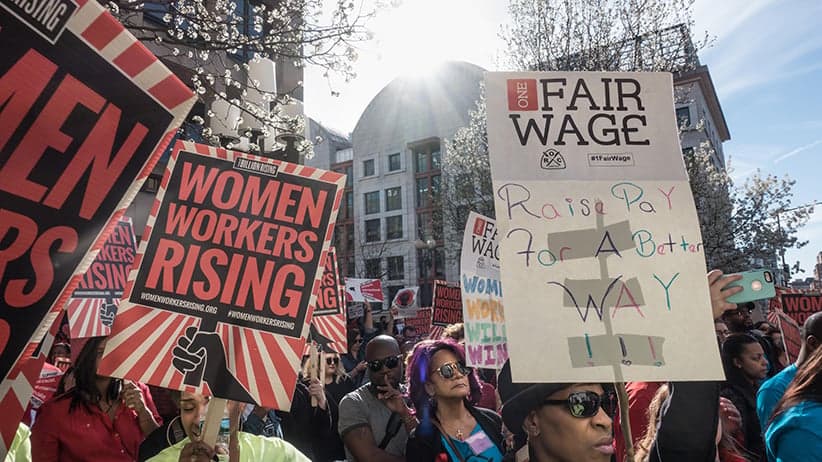
Melayna Williams holds a J.D., and is the director of the Rights Advocacy Coalition for Equality (R.A.C.E.). The gender wage gap remains a pertinent issue in Canada, despite how long women have been lending their labour to the workforce. And we often hear statistics that contrast two categories: men and women. On this, the numbers are stark. But that data doesn’t incorporate filters around identity and background of women, an omission that effectively erases the compounding discrimination faced by non-white women in Canada. A lens that compares only men and women sets up women’s rights as a replica of patriarchy, where one group is favoured over everyone else; in doing so it reinforces the rigid power structures that have brought us to this point. But including race in the analysis reveals a different kind of gender gap that’s perhaps even more alarming than the broader issue. In a 2011 Canadian Centre for Policy Alternatives report examining census data from 2006, Sheila Block and Grace-Edward Galabuzi found dire income disparities for racialized Canadians. They earn 81.4 cents for each dollar white Canadians make, and the jobs are typically less desirable: low wages, precarious, non-permanent. Add the filter of gender, though, and a much wider, more worrisome gulf appears: “Racialized women earned 55.6 cents for every dollar non-racialized men earned in 2005 . . . Racialized men made 77.9 cents for every dollar non-racialized men earned,” wrote Block and Galabuzi. “The gap narrows even further when comparing racialized and non-racialized women. Racialized women earned 88.2 cents for every dollar that non-racialized women earned.” Research has been done to identify the core issues and advance solutions around the position of Indigenous and Canadian women of colour in the work market. “Inequality, discrimination and a segmented labour market have left women of colour with earnings at just 64 per cent of men’s, and Aboriginal women’s earnings at just 46 per cent of men’s,” wrote Lisa Lambert in a 2010 paper titled “Gender wage gap even more pronounced for Aboriginal women.” For women of colour and Indigenous women in Canada, she writes, “the earnings situation is inexcusable.” How are we closer to gender parity in Canada when the gender gap we often think about ignores the unique struggles of women of colour and Indigenous women? If white men are still making more money than white women, can this be acknowledged while addressing the fact that women of colour fall far below both? If we actually believe in the principles of equality with which Canada so proudly associates itself, we must acknowledge both crises: the gap between men and women, and that between racialized women and everyone else.
WATCH: Hadiya Roderique on the gender pay gap from the law firm to academia
Related Posts
The curse of the convoy
How we chose the entries for our 2022 Power List
The Conservative Party’s identity crisis, post-O’Toole
How to really stop Russia: A million little carrots
Get the Best of Maclean’s straight to your inbox.
Sign up for news, commentary and analysis. Join 60,000+ Canadian readers.