
Canada Is Rebuilding Its Military. They’re Cashing In.
In April, the federal government announced that it was time for the armed forces to be properly armed again, and that Canadian companies would be at the heart of the effort. We’ve spoken to leaders at five companies jockeying for a place in that new Canadian defence firmament. Some are veterans in the industry; others are just breaking in. All are hopeful that a new era of defence spending will mean new opportunities for them—and all warn of the consequences if we don’t get this right.

Eliot Pence
The company: Dominion Dynamics
The product: A comprehensive Arctic sensing network
The money: Raised $26 million in private capital
“Growing up on Vancouver Island, I always considered myself a Canadian extremist. I love my country. But it wasn’t a hospitable place to be an entrepreneur. We were overregulated, favouring managerialism over innovation. And for decades, this same stagnation plagued our military. Defence procurement was in disarray. The government bought bulk foreign solutions for unique Canadian challenges, and companies contorted existing products to fit the bill. And that’s when we actually bought anything.
The U.S., meanwhile, had a far less centralized structure, allowing it to make decisions faster and distribute contracts among multiple smaller companies and foster competition. I spent 20 years building businesses in the States. But as the geopolitical environment hardened with the new U.S. administration, I began to see sovereignty differently. I watched with admiration as Canada’s leadership rose to the moment—yet I didn’t see that ambition from Canadian industry.
So last year, on June 6, the anniversary of D-Day, I founded Dominion Dynamics. Our mission is to build next-generation defence systems in Canada, for this country and our allies. I knew our starting point had to be the Arctic, which is core to our sovereignty. It’s the quickest way for our closest threats—Russia and China—to get a missile to us; Chinese buoys have already been found in the Northwest Passage. The Arctic is also the toughest operating environment on Earth; if we can prove ourselves there, everything else will seem easy.
One of our first products is AuraNet, a software platform that connects to a network of communication devices and autonomous sensors to create a common operating picture and keep users connected across vast distances. Soldiers use lightweight, handheld devices called Flints and satellite communication kits called Vaults that feed information into AuraNet. It displays locations, terrain, geospatial data and danger zones, as well as flight paths, weather reports, satellite imagery and more.
Related Posts

Alberta Treaty Law Could Decide the Arctic
Canada’s Defence Firms Are Ready to Boom
We started with AuraNet because of its value to the Canadian Rangers—the corps of roughly 5,000 people who patrol remote and coastal areas. We tested the product this year during Operation Nanook, a military exercise where the Rangers traversed the Northwest Passage on snowmobiles, crossing 5,200 kilometres across sea ice in frigid weather.
We’ve also developed a sub-ice acoustic sensor called Echo. One day down the road, it will burrow into sea ice after being dropped from a helicopter, listening for submarines and transmitting messages to and from our own subs. Another product is the Dominion Scout, an uncrewed aircraft that can handle high winds and electromagnetic storms. Finally, with Project Deep Crown, we’re building a digital fence across the Western Arctic—a sensing network designed to track vessels, submarines, buoys and other activity through northern waterways. Working with a consortium of Canadian companies, it can be deployable in months, not years.
The Carney government’s new investments have pushed Canada forward, but we still need to change how we procure things. Until recently, the same government agency responsible for buying pencils ran procurement for submarines. Technology evolves fast, and we have to prioritize speed over cost, create competition and ensure the best products win.
A nation is defined by how well it can protect its values, and some are trying to foist their value systems on others through military force. Canada has to face the reality: a country that doesn’t invest in defence risks its right to exist.”

Al Dillon
The company: Sapper Labs
The product: A sovereign Canadian intelligence platform
The money: Landed defence-related federal contracts worth approximately $25 million annually
“I’m a fifth-generation military man. I joined the Canadian Army Reserve at 16 and went on to work with the infantry and armoured corps. In 1993, while stationed in Newfoundland, I created my own internet service provider to connect the island’s communities to the early web. That turned into a business serving 19,000 clients. I sold the company to Bell in 1999, left the military and have worked in cybersecurity ever since.
In 2017, I was the Canadian lead for a cybersecurity company in Colorado called Root9B. It had developed technology to detect cyberattacks, identify culprits and respond, and it had contracts with the National Security Agency and U.S. Navy. Canada was at risk for attacks too, but we were behind on developing our own solutions—in the defence space, it’s not enough to borrow technology. We have to make our own.
I wanted to put my expertise to work doing that, but I needed people who were already embedded with the Canadian military. That’s how I discovered Sapper Labs, formed by a group of former RCMP white-collar-crime investigators to provide cybersecurity resources. They had more than 10 years of experience working with Canadian troops and integrating technology in combat zones. It was the perfect foundation to create a company that could give Canada control over its information systems.
I joined Sapper and, in 2019, we got an $11-million contract with the Department of National Defence to create an advanced cyberattribution system, which could identify online attackers. We built an automated system that could hunt adversaries on our networks—similar to Root9B’s tech, but Canadian.
In the years since, technology has advanced explosively, especially due to AI. Sapper Labs recently teamed up with an Alberta startup, Denvr, to build an open-source intelligence and cyberdefence system that’s uniquely Canadian. Denvr is an entirely sovereign Canadian AI company—it’s all in-country, right down to the fibre-optic cables transmitting the data. The system we’re building with them pulls data from all over the world to give decision-makers a full view of any situation: a storm, a wildfire or a war. Accurate information is crucial; these are life-and-death scenarios, and there’s no room for mistakes.
Of course, those same capabilities have found their ways to Canada’s enemies. Things that once required human expertise are now completed in seconds by AI-driven systems, which can replicate a person’s work a thousand-fold. IP theft, cognitive warfare, election interference: it’s all happening faster than ever before.
For example, there are government databases that keep track of where critical minerals have been discovered around Canada and which companies have applied to mine them. We’ve seen foreign actors infiltrate these systems to learn which Canadian companies are set to start digging. With that knowledge, they can invest in those companies through intermediaries.
This is digital warfare: confronting adversaries who sit within their own protected walls, who can touch us from across the planet. Digital attacks exist in a zone of impunity. We can’t go to war to stop them. Instead, we have to build systems that can defend us. And these can only be secure if they’re owned by us. We can use technologies built by Amazon or Microsoft, but we can’t rely solely on them; we’d always be at their mercy. And that’s simply unacceptable for national security.”

Cheryl Hacking
The company: IMT Group
The product: Artillery shells
The money: Received a $305-million government contract to produce munitions
“The origins of IMT Group date back to the early 1900s. During the world wars, our company’s factories employed the original “bomb girls,” women who built weapons while men were overseas fighting.
In 2004, my father purchased the company, and we expanded into the automotive, agriculture and aerospace industries. Today we operate seven divisions in Canada and the U.S., including IMT Precision, our defence arm, in Ingersoll, Ontario. If a component can be formed, machined, heat-treated or any combination of the above, we can manufacture it, and our products are used in helicopters, data centres, combines, tanks and trucks.
With so much uncertainty in the world, IMT’s focus has become munitions manufacturing. In 2023, we secured a U.S. army contract to support production of artillery rounds. Our highly automated and robotics-driven facilities in southwestern Ontario were brought online in just 18 months—the priority was speed. At the height of the war in Ukraine, we were called upon by the U.S. military to help meet an urgent demand. And we were relieved to see that, in countries like the U.S., procurement could move rapidly in times of crisis and conflict, cutting through much of the usual red tape.
That hasn’t been the case in Canada. What scares me is that we can’t blow the cobwebs off something that we haven’t used in any real fashion for decades, maybe since the Korean War, and expect it to work. IMT has been operating for more than 100 years, but not within a fully developed Canadian defence industry.
In Canada, in our sector, it’s been tough to get funding from financial institutions—it’s too taboo. IMT has had to get scrappy when it comes to financing, and we’ve invested heavily in our own manufacturing capacity. But now things are shifting. We’ve just been awarded a contract valued at over $300 million under the Canadian Defence Industry Resilience Program to build another munitions manufacturing facility, here at home, that will produce artillery for Canada. We’re replicating what we’ve done with the U.S., but this time for our own country.
Canada is finally making good on its promises. For years, we’ve failed to meet our NATO defence-spending commitments, leaving our own soldiers without the tools or the equipment to do their jobs properly. They fell behind our allies’ troops because they were under-resourced. Frankly, that’s embarrassing. We needed a wake-up call and, if nothing else, we have that now.
What IMT is offering—efficient and advanced munitions manufacturing—is not a nice-to-have or a luxury for our country. It’s a necessity in the world we live in. We’re happy to help secure that for Canada. It’s nice to be producing at a time when the government acknowledges how our country has been lacking in this area and is willing to support what we’re doing. All the talk is finally translating into policy, and into dollars.”
Chris Pogue
The company: Calian Group
The product: Defence-data platform Athora, among many others
The money: Received $1 billion in public and private defence-related contracts
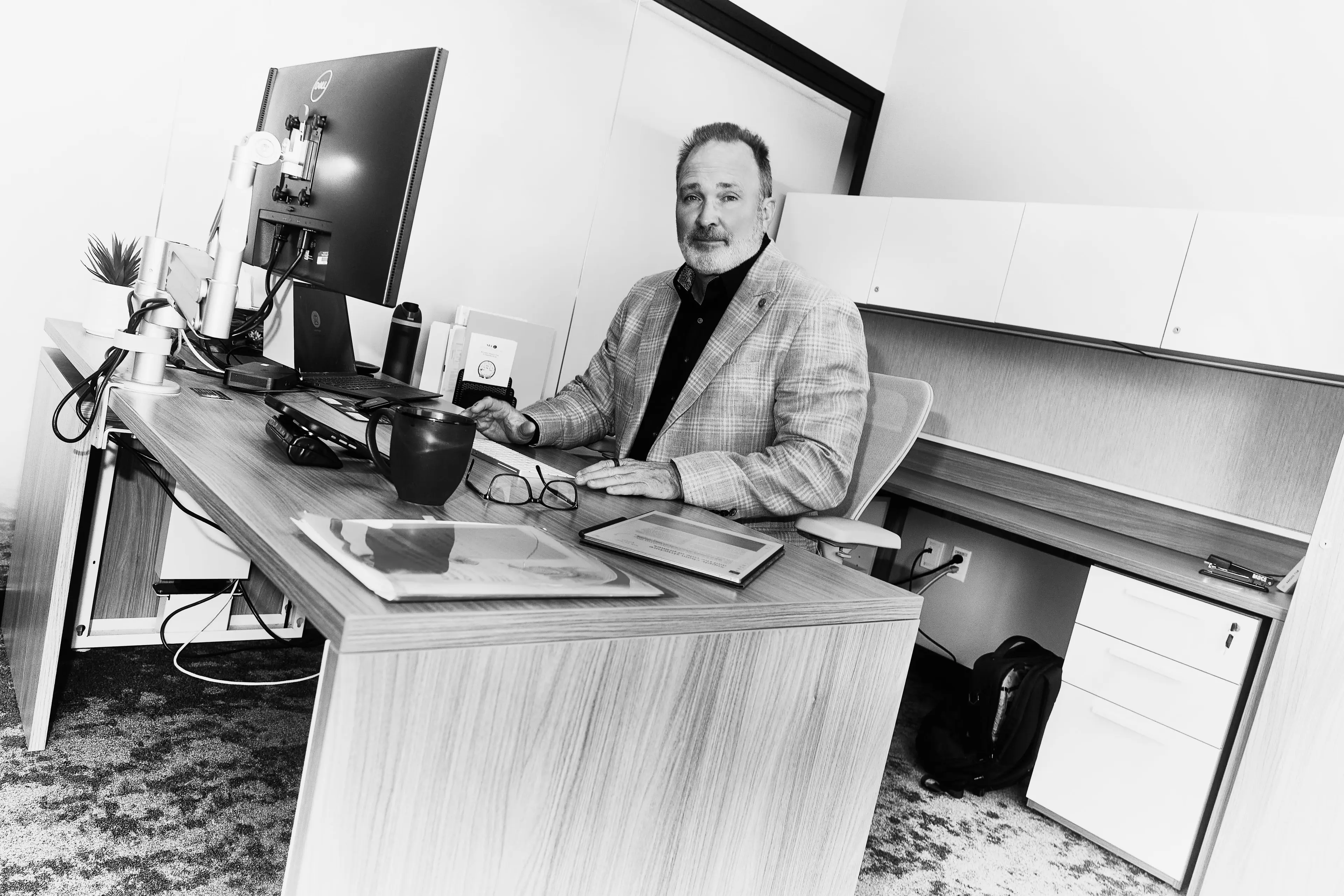
"I’ve devoted my entire career to Canadian defence, including 20 years in the Royal Canadian Air Force. I came to Calian a year ago as president of the defence and space division, where we’re developing a variety of technology and services—and securing new defence contracts—in support of Canadian sovereignty. In the second quarter of this year alone, Calian secured $200 million in contracts in areas like next-generation training, health services and cyber-resilience.
But we’ve zeroed in on the Arctic, a region as beautiful as it is vulnerable. There, you need myriad sensors, intelligence, surveillance and reconnaissance to cover vast distances. Some are in space, some on the ground, some in the sky and some underwater. Some will be human. No single component knows everything but, when you integrate them, you get a 24/7, all-weather, persistent awareness of what’s happening.
We’re accomplishing this with a platform called Athora: a system that gathers data from autonomous vehicles, space surveillance, on-the-ground information from soldiers and other sources to provide integrated informational superiority. It’ll be a game changer for Canadian forces, marshalling data from across the Arctic, in one place.
We’re also developing the technologies that feed into Athora, like anti-jam GNSS antennas. GNSS is similar to GPS, but it’s hypersensitive, precise to the millimetre. It’s engineered for Arctic environments, where GPS struggles due to the positioning of orbiting satellites. Our GNSS tech was recently deployed on an unmanned land vehicle during Operation Nanook, a recurring Arctic exercise to test military operations in the North—it was managed from a control centre 3,100 kilometres away. The tech was first developed by a small Canadian company, which Calian purchased several years ago. This was a big success for Canadian sovereignty. Otherwise, it would have sought American capital to grow. Instead, we acquired it, and the IP stayed in Canada.
This is crucial, because building sovereign defence capability means building domestic innovation, and that will have benefits for our entire industrial sector—roughly 85 per cent of defence companies in Canada are small businesses, after all. Last year, I spoke with a high-ranking member of the Ukrainian government who told me that their country now has 1,000 small businesses that didn’t exist before the Russian invasion. They emerged in conflict. And, just like their peers in Ukraine, Canada’s small defence businesses are focused on finding solutions to specific problems. That’s why Calian started Ventures, a new platform that provides small to mid-size enterprises with capital, support and customer access.
The world is changing in a way that can’t be ignored. New conflicts are arising, and the Arctic is becoming more vulnerable. A stronger Canada is a less reliant Canada. This doesn’t mean severing allegiances. If we build sovereign capabilities, we’re making Canada a better partner for other NATO nations. We must rise to the moment, to carve out our role in a more volatile world.”

Fady Mansour
The company: LeafStar Holdings LLC
The product: A small arms manufacturing plant
The money: Committed $100 million in private capital
“Historically, for every dollar Canada spent on defence, 70 cents has gone to the United States. But that’s changing fast. Canada will spend 3.5 per cent of its GDP on defence in the next 10 years and, for the first time, will award 70 per cent of new contracts to domestic firms. That presents opportunities—and challenges.
I’m a Canadian, and a partner at LeafStar Holdings, a U.S.-based company that’s establishing a Canadian-owned and -operated defence manufacturer. Today, only a handful of companies manufacture small arms domestically, leaving the country with limited sovereign production capacity.
LeafStar is planning to build a manufacturing facility in Canada, led by and employing Canadians. It will work through a ‘build-partner-buy’ model: it won’t make just one kind of product, but will fulfill contracts from other firms based on needs. This means other NATO countries could also fulfill contracts at our facility. We’re already executing this model at our Swedish sister facility, where companies come to us with diverse needs. This model could help make Canada a defence-manufacturing hub.
We’re in a great position for it. As one of the most mineral-rich countries in the world, we have the raw materials needed to produce weaponry and technology. We have a highly skilled workforce, and our geographic location places us far from threats of attack. If we play our cards right, when NATO countries think of defence manufacturing, they’ll think of Canada.
Canadians have long treated defence spending like a taboo. Today, public and government support for military expenditures has shot up, but we’ll have to come to terms with what this means: building new factories and defence facilities in our communities. Like power generation, pipelines, rail lines and other strategic infrastructure, these need to exist somewhere.
LeafStar is looking for what we call a willing host: a community with skilled workers, infrastructure and talent that will embrace the facility and welcome the roughly 300 jobs it would create. With the financial commitment in the federal budget, and increasing public acceptance, our facility likely won’t be the only one. For the sake of our sovereignty, it shouldn’t be. So far, I’m pleased to say the feedback has been positive, and we hope to be able to announce a location this summer. We’re looking to set up in Ontario, given the premier’s commitment to defence, but there’s no reason defence hubs, areas where many companies can locate, can’t pop up nationwide.
But industries aren’t built based on a single company. To scale up, Canada’s defence sector must attract a large network of companies to come together to form a larger supply chain. It’s vital that municipal partners embrace the industry and facilitate the creation of defence hubs. This takes coordination, incentives and collaboration across all levels of government. If Canada wants to stop relying on the U.S. for defence, we must consider how our communities and companies can support our sovereign security.”

This story appears in the July 2026 issue of Maclean’s. You can buy the issue here, subscribe to the magazine here or send a gift subscription here.
What did you think of this story? Send a comment for publication to letters@macleans.ca, and supply your name and address. Comments should be fewer than 200 words, and may be edited for length and clarity.
Related Posts

Carney Is the Crisis Manager Canada Needs

How to Win the Space Race

Carney’s Biggest National Project is Mythmaking

My Adventures in Greenland
Get the Best of Maclean’s straight to your inbox.
Sign up for news, commentary and analysis. Join 60,000+ Canadian readers.