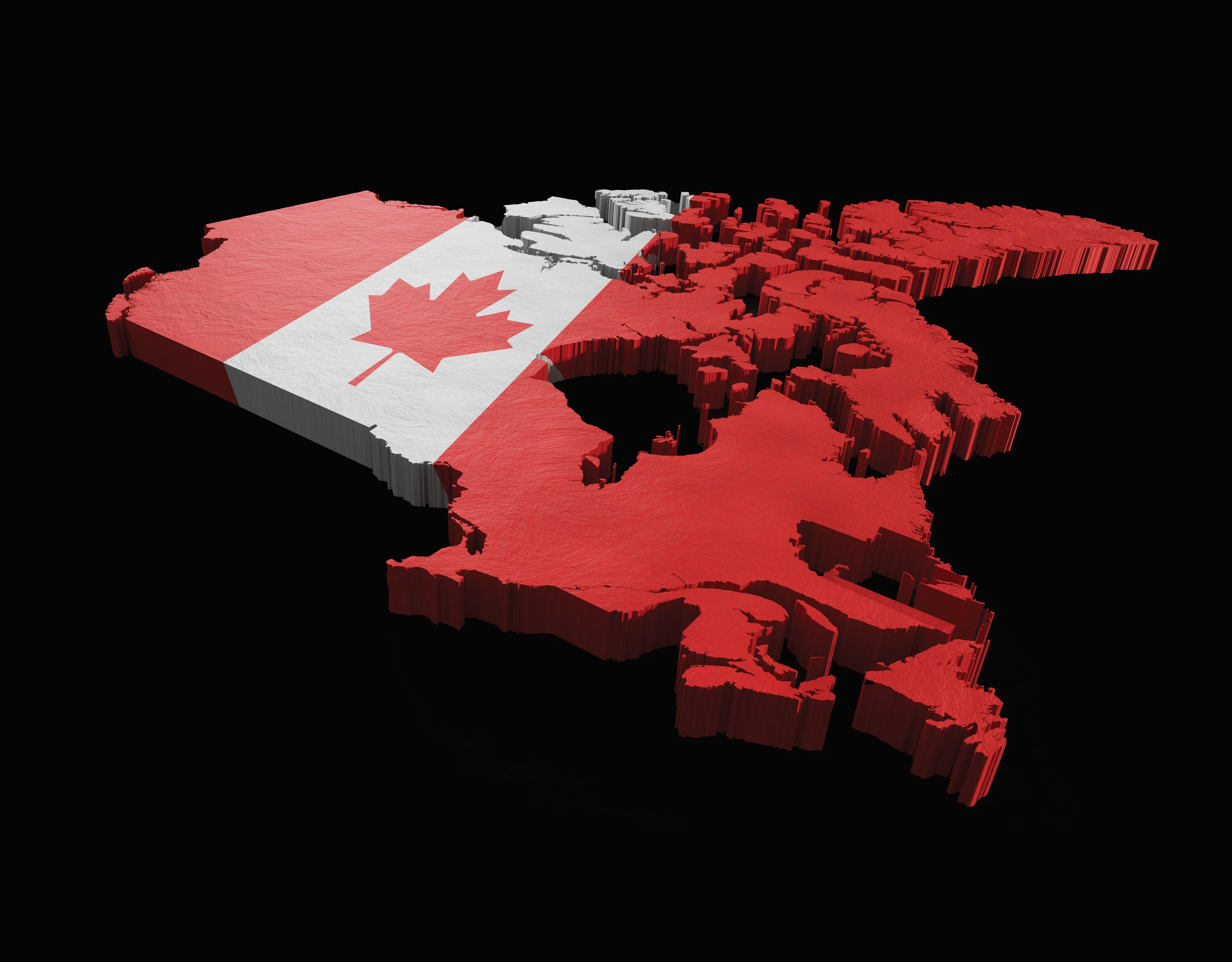
How to Build A Nation
The national mood is ugh. We count our lucky stars when Trump is distracted by anywhere but here. We cautiously relax our elbows—and we wait for the next presidential social media dump of bad news. In the meantime, steel and aluminum plants have fallen silent, contracts for new EV car plants are on pause and dairy farmers dread losing their cushy protected market. No one wants to buy your house. The long-tail tariff fallout, or AI, or both, could come for your job. Negotiations over CUSMA, our life-or-death trade agreement with the U.S. and Mexico, will clog our newsfeeds all summer and possibly for the rest of the year.
To cope, many of us have learned how to install a flagpole. No, really, it’s as easy as digging a three-foot-deep—er, make that a metre-deep—hole, cementing your pole in place so it stands strong and free and avoiding bourbon and other forbidden imports as you toast your proudly fluttering Maple Leaf.
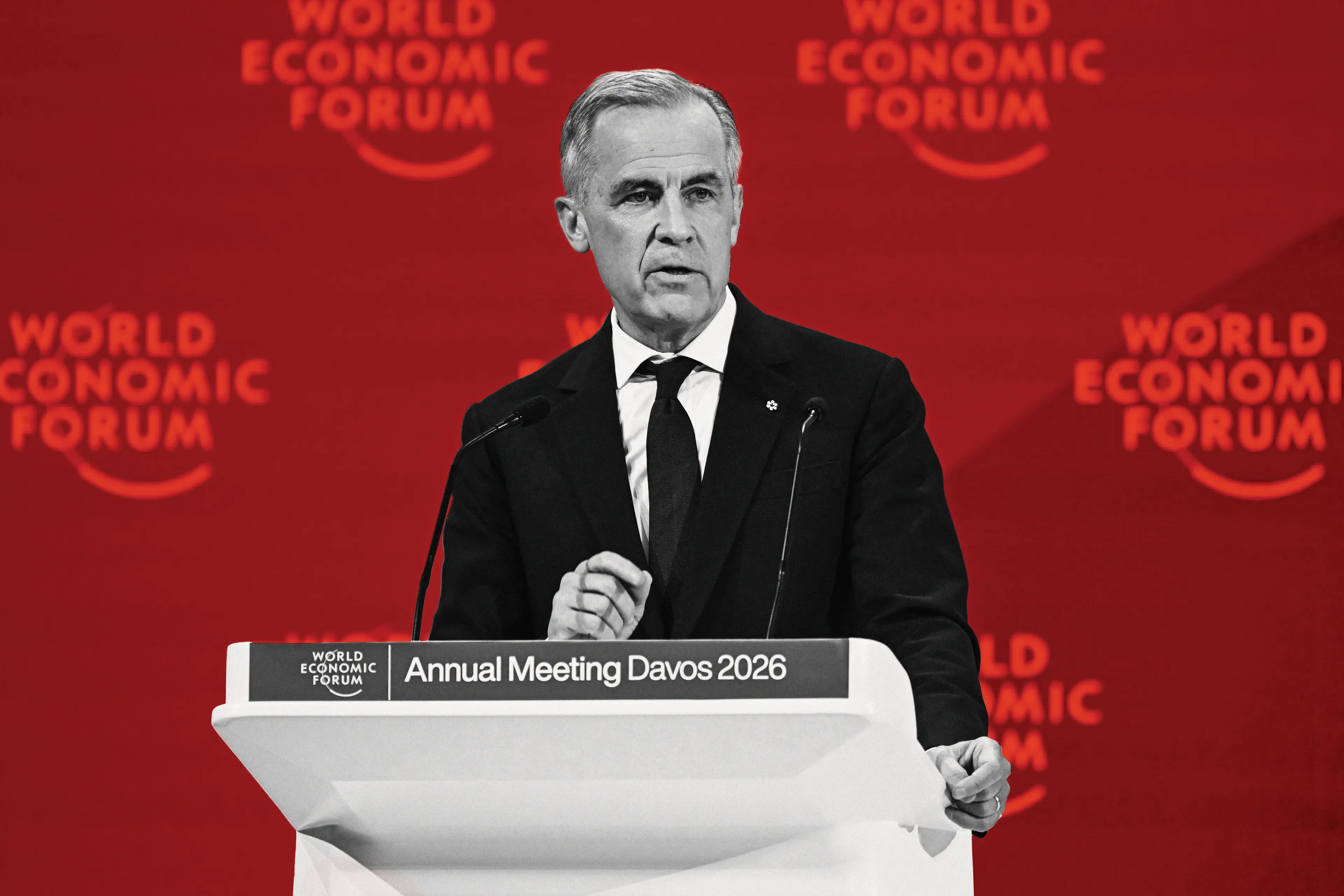
Bold displays of patriotism, once as rare as a roll-up-the-rim grand prize, are now the norm. And it doesn’t get more prosaically Canadian than a former bank governor, the stiffest shirt in any room, leading the charge. The year started with Mark Carney’s middle-powers Davos speech, a bird-flip to America couched in the gentlest technocratese. Pushing pragmatic international co-operation, he cautioned, “Middle powers must act together, because if we’re not at the table, we’re on the menu.” The Prime Minister knew he’d cause a stir, but his true motive was to define himself as the sober foil to Trump, which doesn’t take much. Carney had already been jetting around, signing deals and MOUs with the likes of India and China, and reminding anyone who’d listen that Canada is a friendly energy superpower and a rare-earth minerals wonderland. Bonus: we don’t back out of bilateral agreements in fits of pique. Can’t imagine Justin Trudeau and his collection of colourful socks being nearly as persuasive.
By spring, the PM was riding the momentum of five-and-counting MPs defecting to his party and three victorious by-elections. He finally had a majority that’d allow his nation-building schemes to speed through the Commons. Because there’s no time to save a nation like the present, or at least the near-to-present (this is still government, after all). At the Liberal party’s annual convention, the banker stepped onto the stage like Captain Canada, championing average citizens who’d resisted external threats by buying Okanagan wine and visiting Banff and the Canadian Canoe Museum instead of Disney World. “Small individual acts of solidarity,” he said. “But repeated millions of times. And together they make a statement: we are the masters of our destiny.” If Davos was Carney’s version of internationalist pragmatism, this was his sentimental side.
But no middle power, no matter how many other middle powers have its back, can protect itself from the crushing pressure of the giant next door strictly through plucky courage and good vibes. Trade deals take months to work out, and nation-building projects like a new Alberta pipeline, mineral exploration, high-speed trains and defence investments take many long years, even with sped-up reviews and approvals. In the urgent now, the economic forecast is sluggish-to-volatile. We can’t Buy Canadian our way out of this predicament.
Related Posts
How to Win the Space Race
Alberta Treaty Law Could Decide the Arctic
But this predicament, many politicians and business leaders are slowly admitting, isn’t entirely Trump’s doing. It was a shock when the president publicly taunted Trudeau as “governor,” complained we freeload on U.S. continental defence, called us “cheats” and lusted after hemispheric dominion. A shock, but not a surprise. He’d merely lifted the veil on the base reality of our relationship, which isn’t about friendship or the world’s longest undefended border, but giving and taking. It is, and has always been, strictly business. At some juncture, perhaps when Brian Mulroney and Ronald Reagan sang a duet of “When Irish Eyes Are Smiling” in tuxedoes, Canada grew sleepy. As long as the U.S. wanted to innovate and create wealth, we were satisfied to serve as a supplier of raw materials: softwood lumber, minerals and steel, and especially oil. As long as the U.S. needed our goods, life was good—or good enough.
Our uniquely Canadian complacency made us a uniquely easy target for an economic war waged through tariffs. We’d become so dependent on the U.S. economy that productivity, especially in the manufacturing hubs of Ontario and Quebec, instantly hit the skids. Last October, when U.S. commerce secretary Howard Lutnick told a room of Toronto suits that the U.S. is “taking back” the auto industry from Canada—that in the future we’d be allowed, at most, to supply parts—you could hear Doug Ford freaking out from B.C. The impact was immediate: automaker Stellantis shifted Jeep production from Ontario to Illinois, while Honda moved CR-V manufacturing to Ohio and scrapped a $15-billion Ontario EV investment. Watching those first rounds of tariffs kneecap a couple provinces, it was nauseating to imagine what’d happen if the Americans kill CUSMA and punish all Canadian goods.
The Canadian-born, U.S.-based political expert David Frum describes our economic situation as that of a lifelong protectorate: under the British flag, then under the U.S. flag. Our protectors set the agenda. Our job has been to keep quiet. To Trump, the logical endpoint for any protectorate, especially one that’s geographically strategic and rich with resources, is annexation. To his apparent surprise, we rejected his generous offer. Cue the middle-power flagpoles.
Now we’re having long-overdue, oddly thrilling Sunday dinner debates about why Canadian sovereignty is worth protecting. We’ve got new priorities: alongside Buying Canadian, we’re ready to Build Canadian and Innovate Canadian. Instead of waiting for the U.S. to return to business as usual, we’re exploiting our reputation as a reliable trading partner to expand into new markets. And we’re attracting attention from global investors who like what they see.
The convergence of these forces could—and frankly, finally, should—reshape the country’s economy and future. It’s the opposite of sleepy complacency. So there’s one thing to thank the U.S. president for: he kicked us awake.
Neuroscientists say our brains buzz with happy, healthy neurons when they’re challenged by new ideas, new skills, new newness. Similarly, entrepreneurs like Tobias Lütke, the CEO of Canadian tech unicorn Shopify, pin their success on what they call a growth mindset, a term coined by a Stanford psychologist who studied how people who believe their intellectual abilities can grow are more likely to take risks and succeed. A fixed mindset, like a brain that isn’t challenged by new ideas, may survive but it doesn’t thrive.
Shopify is a rare example of a Canadian company near the top of the TSX that isn’t a bank or a mining giant and wasn’t founded more than half a century ago. To grasp why there aren’t more, follow the money. Canadian investors, like Canadian banks, are famously not known for risk-taking, especially on new ventures. Lütke was lucky to get an early buy-in from his family and angel investors like Toronto wireless exec John Phillips, whose initial $250,000 stake in the company eventually made him and his wife billionaires. But Shopify is an outlier. Some of the greatest investment wealth in the country—$2.4 trillion in assets—is controlled by the Maple Eight, the Canadian pension funds. Despite the national swell of support for Buy Canadian, most of that money is invested outside Canada. The Canada Pension Plan, the biggest of the eight, has $366 billion invested in the U.S. and only $98 billion here.
That’s a symptom of Canada’s sleep paralysis: an aversion to investing in ourselves. A recent RBC report proposes that our country needs to make massive investments in six critical sectors: oil and gas, agriculture, metals and minerals, space, defence and electricity. A country, like a business, can’t make money if it doesn’t spend it. Much of our electrical grid was built 50 years ago and requires a massive upgrade to meet the demands of EV adoption and AI data centres. New mining operations are needed if we’re to keep up with demand for our critical minerals. New agricultural technologies and processing equipment is necessary to make our farmers and fishing industry more competitive—at home and in hungry markets like China. And we need to resolve regulatory delays, and disagreements between levels of government and Indigenous stakeholders, to build new oil pipelines and liquid natural gas projects. Although Canada has the fifth-largest supply of LNG, we’ve fallen far behind in sending it to market.
High-growth startup founders swear that innovation only happens when you “move fast and break things.” Carney’s government has taken that to heart. He has an efficiency fixation, imported into government from his time as a Brookfield exec and fuelled by constant announcements of new initiatives out of his Major Projects Office. The things getting broken are our traditional ways of doing business (the slow, multiple-levels-of-government approvals processes) and who we’re doing it with (i.e., the U.S.).
The PM’s MO, he says, is to “diversify to hedge against uncertainty.” In practice, this means flirting with joining the EU trade bloc, sending a trade mission to Mexico that resulted in new commercial partnerships and, most notably, smoothing over diplomatic tensions with China and India. Where Trump approaches trade with threats and smears, Carney targets diplomatic aims—like an agreement with India to co-operate in the policing of international criminal gangs—through the realpolitik of business exchanges. In March, Carney and Indian PM Narendra Modi agreed to improve trade on clean energy tech and critical minerals and signed a deal where Saskatoon’s Cameco will sell $2.6 billion in uranium to India’s nuclear plants. After Carney’s recent trip to Beijing, it actually seemed possible that trade with China could, as promised, increase by half by 2030. The Chinese government scaled back punitive canola and beef tariffs and signalled it was open to buying Canadian LNG (once we get around to making it fully market-ready). Canada, in turn, promised to import up to 49,000 Chinese EVs next year. Our idle car factories might be retooled to assemble China’s Leapmotor EVs.
The Chinese trade deals sent Washington heads spinning. Pete Hoekstra—the U.S. ambassador to Canada already notorious for demanding a Canadian newspaper apologize for comments about the U.S. Olympic hockey team—decreed that Chinese cars would be banned from crossing the U.S. border. Lutnick pointed to Carney’s China meetings as a line crossed and warned it would make CUSMA negotiations that much more fraught, though from this side of the border it seems the U.S., like a jealous ex-boyfriend, resents any effort by our country to forge new relationships.
China and India were just a taste. This September, Carney, in a bid to drum up more foreign investment in Canada, is co-hosting, with two of the Maple Eight, 100 moneybags organizations like the Government Pension Fund of Norway and BlackRock, the world’s largest asset manager, at a Toronto summit. Together those leaders, from hedge funds, international banks and pension plans, will represent trillions of dollars in capital. The goal is to attract more investment in Canada, but also to play matchmaker, pairing global business leaders with Canadian counterparts looking to enhance their own investment schemes.
Last year, foreign direct investment in Canada hit a new high of $96.8 billion, driven largely by our country’s reputation for financial steadiness, but also because we finally have something valuable to offer. That Mexico trade mission resulted in a $770-million buyout by Mexican mining company Fresnillo of Toronto’s Probe Gold, which controls some 10 million ounces of gold. Canadian companies are, at the same time, expanding international operations. The Business Development Bank of Canada, which participated in the Mexican trade mission, has promised $4.1 million in funding to the Canadian renewable energy startup Solfium, which primarily sells residential and commercial solar equipment in Mexico, though its intellectual property and management team are mostly based here. The war in Iran, and the chaos it created throughout the region, made Canada seem extra attractive to investment from Middle Eastern countries. The U.A.E. pledged to invest up to $70 billion in lucrative Canadian sectors like AI, mining and energy, while the Qatar Investment Authority, after a visit from Carney (the first ever by a sitting Canadian PM), invested in Canadian infrastructure projects and bought a stake in Canada’s Ivanhoe Mines, a major copper producer.
The instability in the U.S. can also be an opportunity for Canadian companies to expand both here and abroad by selling themselves as reliable partners. In the past year, the Canadian AI powerhouse Cohere partly justified its whopping US$7-billion valuation by signing agreements to overhaul services provided by the Canadian and U.K. governments. Cohere insists that its tech will help both countries to enhance sovereignty, which sounds, to be sure, like a promise to keep data safe from U.S. tech firms and, by association, the American government.
The Canadian government, meanwhile, has dramatically increased its defence spending, surpassing $63 billion in 2025. That increase could have something to do with repeated complaints from the U.S. president that Canada, like many NATO member nations, falls short of its defence-spending commitments. More likely it’s due to a combination of timing (expensive aging equipment needs replacing) and a recognition that the warming Canadian Arctic, in particular, requires a bump in surveillance and defence if we’re to keep it on our maps.
Carney touts a defence spending spree as a way for Canada to invest in itself—with much of the spending directed, when possible, to Canadian defence industries. All the same, the initiative has attracted international attention, with South Korea and Germany jostling to sell us subs and Sweden’s Saab eager to persuade the government to reconsider its $19-billion commitment to buy 88 F-35 fighter jets from Texas’s Lockheed Martin. Saab, unlike Lockheed Martin, pledges to build its Gripen fighter jets here, creating hundreds of jobs. Another deal sweetener: a promise to house all Canadian Gripen flight data at a secure site in Montreal. Some military analysts warn how, in the event that we need to defend ourselves against a U.S. military invasion, Americans would be able to monitor every movement of our F-35 fleet, since all data gets routed through the U.S., and they could even disable jets with a “kill switch.”
Backing out of the Lockheed Martin jet deal seems extra unlikely with CUSMA currently under review. One sure way to piss off U.S. dealmakers is to shortchange their military-industrial complex. Brian Clow, who led CUSMA negotiations as Trudeau’s chief of staff, has said that the current round is cursed because Trump and his people “hate Canada.” Janice Charette, a career public servant and Carney’s pick to lead the latest CUSMA negotiations, said from the start that her job is to preserve the deal as is, to give up nothing. No wonder: under the agreement, 98 per cent of our exports enter the U.S. duty free.
Trump, a failed casino owner, likes to think of global negotiations in gambling terms, telling Ukraine president Volodymyr Zelenskyy during an Oval Office meeting that he had “no cards.” Canada has several cards to play at the CUSMA table, including the hydro power sent from Ontario and Quebec to the northeastern states, the cheap B.C. softwood lumber that subsidizes U.S. home construction and our untapped reserves of critical minerals. Our trump card, so to speak, is the oilsands: Alberta supplies roughly 60 per cent of the crude that fuels the U.S. economy. Trump, notably, exempted Canadian oil from any tariffs. He can rip up trade agreements and claim, in one of his patented wild untruths, that the U.S. doesn’t need what Canada has to sell, when they plainly do.
Canada should have diversified a long time ago. No country can survive, and feel sure of the future, with a sole trading partner. All the same, because of geography but also because of our shared history and, in better times, shared interests, Canada needs the U.S. as much as the U.S. needs Canada.
This month, days after we observe Canada Day with a two-four in the cooler and a polite display of fireworks at the lake, the U.S. will celebrate its 250th anniversary with pomp, pageantry and military parades fit for a despot. Canadians, while anxious about, well, everything, are more unified as a nation than we’ve possibly ever been. That we would rally together in the face of external threats should have been predictable to anyone who understood us and our unique history or, indeed, understood basic human nature.
On its big anniversary, America seems, by comparison, more frantic and fractured than ever. Its citizens are terrorized by masked military militias in the streets, fuming about the end of democracy, obsessed with uncovering connections between a dead sex offender and the powerful elite and fighting over the unholy scale of ballrooms. The more Americans mess in the affairs of other countries, the messier their lives become at home.
In a recent survey, Americans were asked to rank countries to which they’d like to move. Respondents said they prioritized quality of health care, safety and livability. The number one choice: Canada.
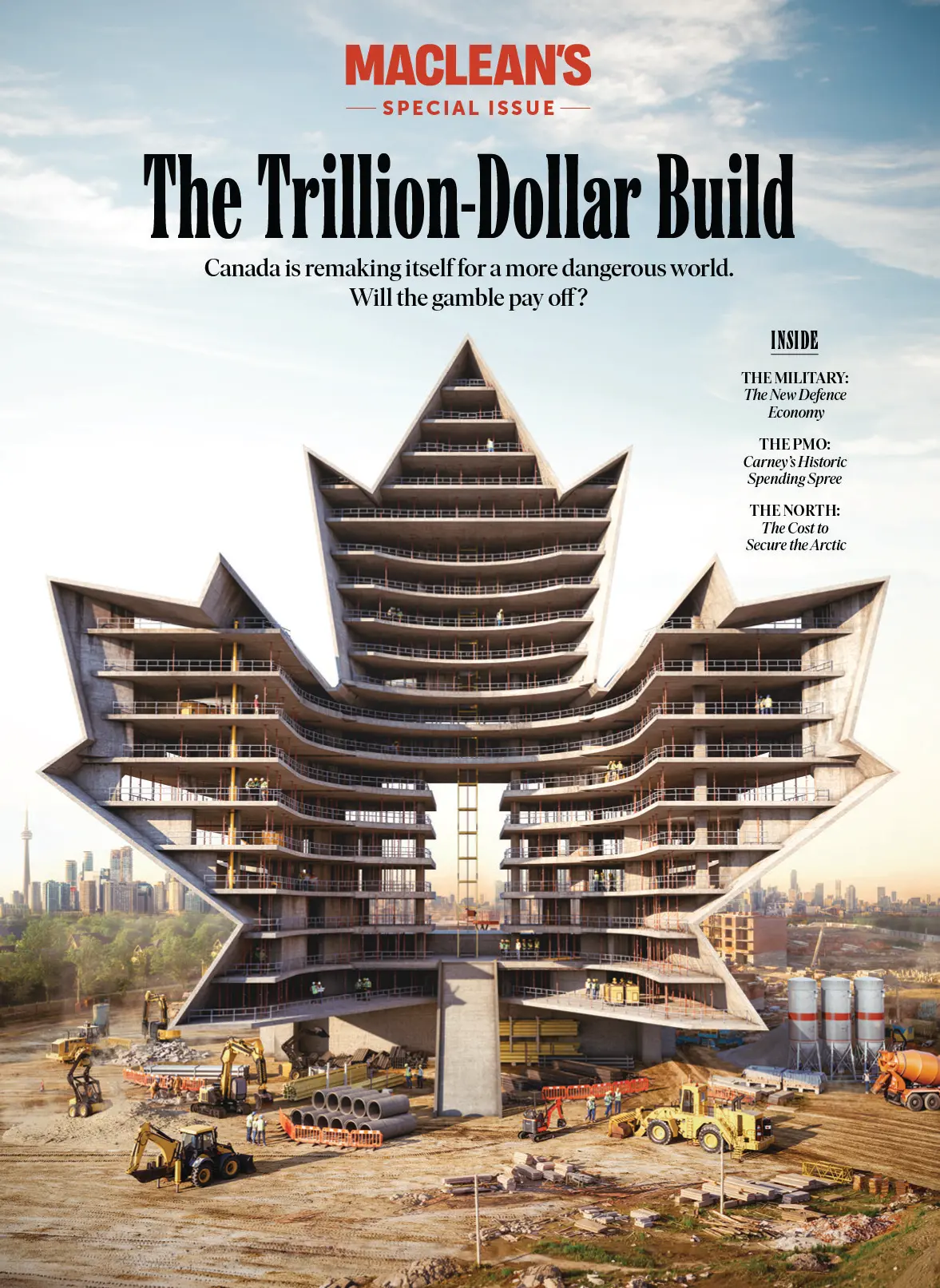
This story appears in the July 2026 issue of Maclean’s. You can subscribe to the magazine here or send a gift subscription here.
What did you think of this story? Send a comment for publication to letters@macleans.ca, and supply your name and address. Comments should be fewer than 200 words, and may be edited for length and clarity.
Related Posts

Carney’s Biggest National Project is Mythmaking
Canada’s Defence Firms Are Ready to Boom
Carney Is the Crisis Manager Canada Needs
My Adventures in Greenland
Get the Best of Maclean’s straight to your inbox.
Sign up for news, commentary and analysis. Join 60,000+ Canadian readers.