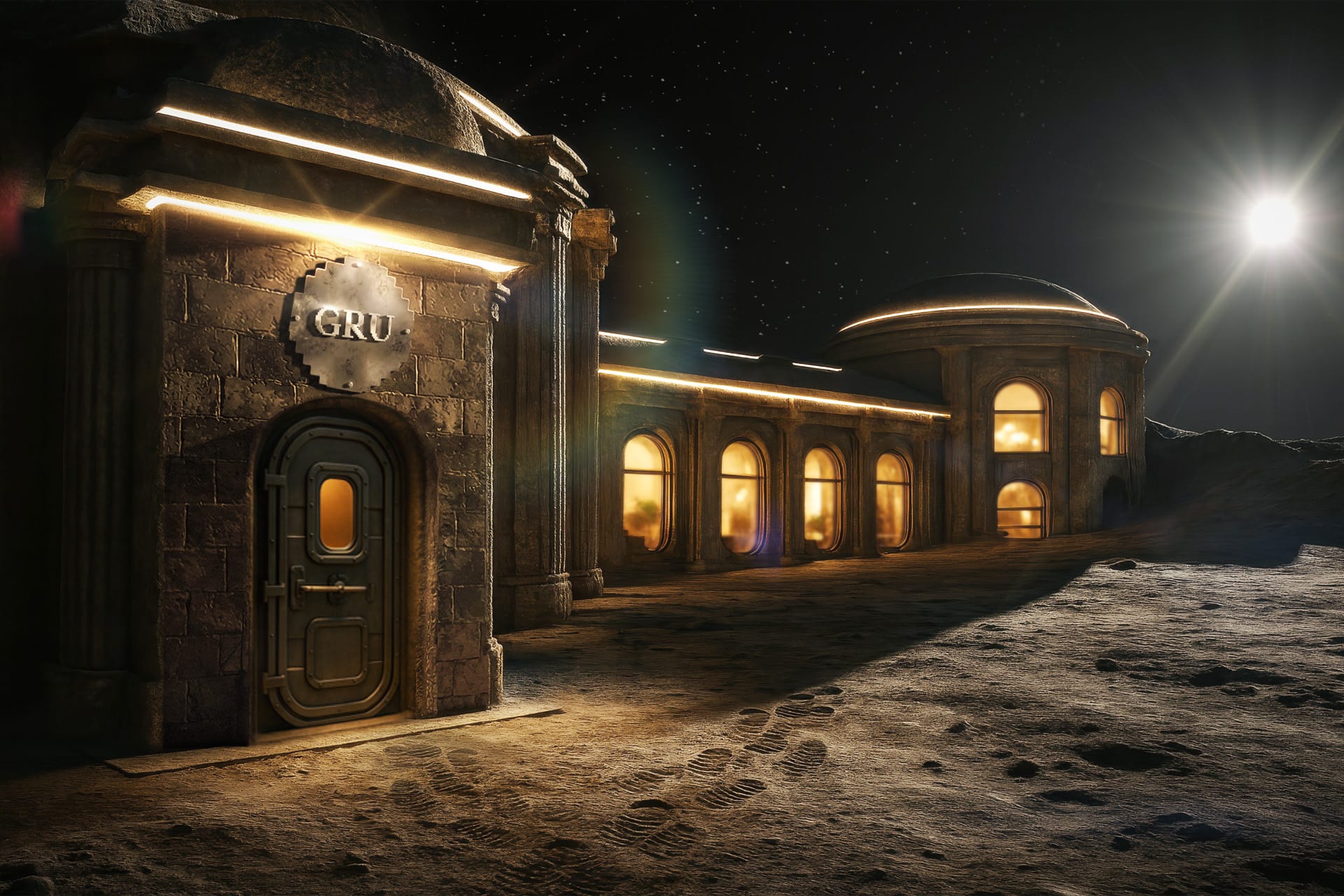
A Moon Hotel? Why Not?
I used to dream of becoming an astronaut. By 13, I’d taken concrete steps to achieve that goal: following Chris Hadfield’s lead, I joined the Air Cadets in Vancouver, where I lived, then earned a scholarship to fly gliders at the Comox Cadet Flying Training Centre three hours northwest of the city. But I soon realized I was more interested in figuring out how all of humanity could inhabit the moon and Mars than just visiting space myself. So, in 2022, I headed to the University of California, Berkeley, to pursue an electrical engineering and computer science degree. To create our off-Earth structures, we’d need the help of robots. I set my sights on building them.
At the end of my freshman year, I founded Mars Habitat at Berkeley, a club centred on engineering autonomous construction robots that could build the foundations for our future Martian homes. Shipping huge loads of steel, concrete and brick hundreds of thousands of kilometres into space would be insanely cumbersome and costly, so our members designed machines that could source materials found on the surface of Mars and the moon to build livable habitats, a technique known as “in-situ resource utilization.” By third year, we weren’t just the only Berkeley club tackling off-Earth habitation with self-driving robots—we were the only people in the space industry doing it.
Related: Jeremy Hansen’s Job Is Moon
Last May, seeing a market opportunity, I started my own company. Exploration ventures like NASA’s Artemis and billionaire-backed companies like SpaceX both focus on launch capability and are, to some extent, hemmed in by government bureaucracy. Space tourism, meanwhile, is a booming, wild-west sector. In 2024, the number of paying space travellers outnumbered astronauts 40 to 10. Last spring, Blue Origin launched Katy Perry and other celebrities into suborbital space aboard its passenger rocket New Shepard, and Virgin Galactic is selling seats on suborbital flights for up to US$600,000 a pop. Using Mars Habitat’s robot tech, I thought, we could push past the suborbital threshold and build a venue for tourists who wanted to extend their extraterrestrial stays—a moon hotel. I stopped studying for finals and started pitching the idea to startup incubators like Y Combinator (the one behind OpenAI and Airbnb). They offered me an interview the day before I graduated and accepted my proposal within hours.
That’s how Galactic Resource Utilization Space, or GRU Space, got off the ground, so to speak. The company goal is to have our moon hotel fully operational by 2032. But before any lunar vacations are possible, we have a few key missions to complete. By 2029, GRU Space plans to deliver a small payload to the moon’s surface on a commercial rocket. This payload has two parts: the first is an inflatable structure designed to withstand the temperature and pressure extremes on the moon. The second is GRU’s patent-pending mini-factory, responsible for making the first-ever lunar bricks. The mini-factory will mine lunar regolith (or soil) then bind it using a geopolymer-based process, creating the bricks directly on the moon’s surface instead of bringing them up intact from Earth. These early pilots will prove a moon hotel is practically possible to build.

Next, we’ll scale up. In 2031, GRU Space plans to deliver and stress-test a larger inflatable mock-hotel and ramp up brick production. The following year, we’ll construct the finalized hotel on Earth, then drop it onto the moon using a heavy lander like Starship. Our team’s current architectural inspiration is the Palace of Fine Arts in San Francisco; it’s my favourite building in the city, and I wanted the hotel to have a Greco-futuristic look—to be beautiful. After that, the first cohort of guests will arrive via commercial rockets, most likely operated by launch providers like Blue Origin or SpaceX.
The hotel entrances will, of course, be sealed to protect everyone from the vacuum of space. The internal environment will be regulated via a combination of carbon-dioxide removal and oxygen replacement, water reclamation and thermal control. We’re designing the structure to comfortably house four people for several days—with enough bedrooms and bathrooms for each. We’re still ironing out how outdoor excursions would work, but one day, we hope to offer hotel guests the opportunity to partake in moonwalks, ATV excursions and even moon-golf.
At first, this experience will only be accessible to folks who can cover the high costs of space travel. Using current public SpaceX prices for transport to the moon, we estimate that our internal cost per night is roughly US$416,000 for a trip to the first viable version of our hotel. GRU’s prediction is that lunar travel will be as accessible as plane rides in our lifetime. It used to be that only the wealthy could afford transatlantic flights. But the more early adopters that make these early hotel trips, the more easily we can fund the tech required to make lunar excursions easier and, thus, more affordable.
At this point, GRU Space has no competitors. According to the Outer Space Treaty of 1967, no one country can own the lunar surface. It’s essentially a real-estate free-for-all up there. Like a space-age Hudson’s Bay Company, we want to be the first business to capitalize on the resource feast that is the lunar frontier. If all goes to plan with the hotel, we’re well-positioned to build a more expansive moon base and eventually, roads, buildings and other infrastructure—and possibly move into resource extraction. With the revenue generated from the hotel, GRU Space could one day replicate such projects on Mars.
Beyond commercial profits, space exploration has historically resulted in a higher quality of life for humans back on Earth. Inventions like artificial limbs, wireless headsets, microwaves and memory foam were built off technologies first pioneered in space. To someone born 500, or even 100, years ago, a lunar sleepover would be an unimaginable concept. But today, we have the technology to enable off-world habitation, so why shouldn’t we? Humans have always pursued the next mountain worth scaling. Why climb Mount Everest? Because it’s there. The moon is next.
Skyler Chan is the founder of GRU Space.
Related Posts

Canada’s Aging Infrastructure Is a Ticking Time-Bomb

Canada Can Be a Refuge for America’s Grad Students

Can Canada Survive Trump’s Attack on Science?

How to Stop the Gen Z Slowdown
Get the Best of Maclean’s straight to your inbox.
Sign up for news, commentary and analysis. Join 60,000+ Canadian readers.