My University Students Cheat. I Don’t Blame Them.
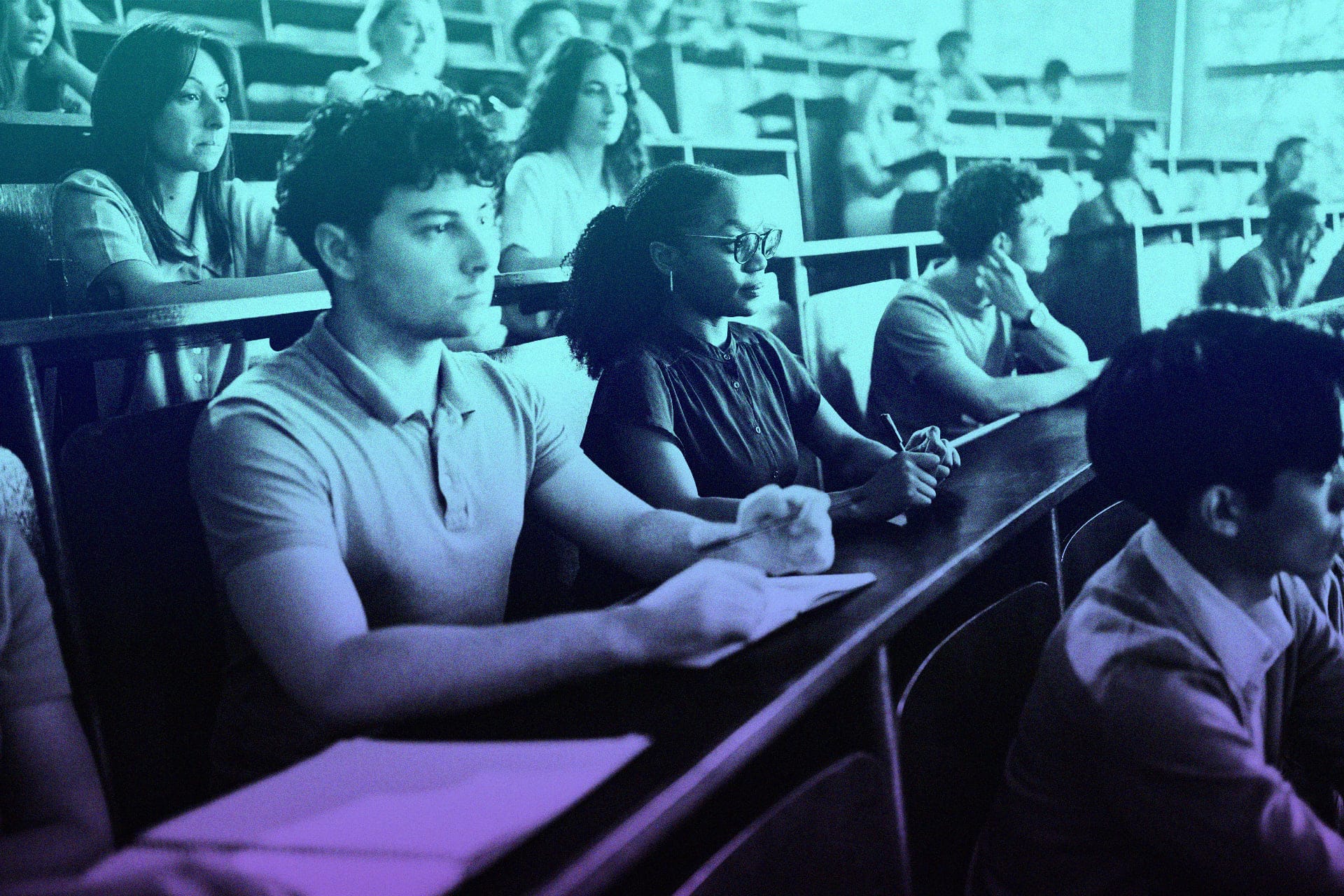
Last semester, on the final exam of the health-care law class I teach, my students scored the highest grades I’ve seen in 20 years as an instructor. It was an at-home, closed-book exam. Eight per cent of the class scored perfect on the multiple-choice section, and over half scored over 90. In the long-answer section, the responses were formulaic, typo-free and detached from the course material; they lacked the telltale signs of rushed exam writing. It was clear my students were using AI to cheat.
After the exam, I gave the class an anonymous, informal poll: I asked how many of them were cheating. Of those who responded, eight per cent admitted to it. How many students did they think were cheating? Over a quarter of respondents indicated they knew other students had cheated on the exam, and 73 per cent indicated they knew of students cheating in other classes. And that doesn’t account for the response bias: just under half the class responded to the poll, and I suspect those who didn’t respond were more likely to have cheated. I decided to annul the exam results, not counting them toward final grades.
I’ve spent my whole life in academia, first in theology, then in law. I know cheating has always been around. But I’m deeply alarmed by the idea that students are cheating en masse. There’s a whole online ecosystem for cheating: forums to share advice on circumventing AI detectors and proctor technology; software for humanizing AI-generated writing; tips for using AI to reduce (or eliminate) workload. Cheating is becoming culturally normalized. Two thirds of the people who responded to my survey agreed that students widely perceive cheating as acceptable. I’m not surprised. Think about what this generation has witnessed: the mortgage crisis driven by corrupt bankers, an American president who cheats and lies and is still elected; lawyers using AI to write for them and lying about it, a sporting world full of doping scandals. Students are repeating what we’ve modelled for them.
In the past few years, the way young people value their education has shifted. Universities are increasingly corporatized. They function as businesses, oriented toward maximizing revenue: professors are rewarded for grants and publications rather than leadership or mentorship, and students are reduced to head counts and tuition dollars. In turn, students behave like customers. It’s a fee for service: they pay their tuition and expect good grades and a degree. Learning becomes superfluous.
When I was studying the humanities, my classmates and I were concerned with ideas and arguments. We were reading course material to understand it, not to get a mark. Now, grades have become the sole currency of academic life. Students frequently email me asking outright for a higher grade, sometimes literally seconds after they receive it. They all want a 90 or higher. Marks are inflated across the board. At Ontario high schools, there was a six per cent increase in grade averages for graduating students between 2011 and 2021. I’ve seen 100 per cent averages on scholarship applications. Some schools are implementing policies to try to curb the inflation—including Harvard, which just put a cap on the number of As assigned in each undergraduate course.
Related Posts

The Case for Lifelong Renting
Canada Can Be a Refuge for America’s Grad Students
Students know an undergraduate degree doesn’t automatically land a well-paying job—or any job, for that matter—so they’re vying for acceptance to highly competitive postgraduate programs. There’s an enormous financial imperative to succeed academically, and students tell me that if you don’t cheat, you’re at a disadvantage. I went to university on my own dollar; my parents couldn’t afford to support me. I only paid off my undergraduate student loans last year, at 45 years old. For students today, the debts are even worse. They’re pushed to maximize productivity and output, racking up accolades and resumé entries while maintaining previously unattainable averages.
At the same time, cheating has become more accessible than ever thanks to AI. I see students using generative AI in all aspects of their work: summarizing the readings, research, note-taking, essay writing. Not all AI usage is cheating by default, and in some ways, it’s even levelling the playing field by making the same shortcuts available to everyone. When I was in law school, you could purchase CANS—consolidated annotated notes—from previous years as study aids. But they were expensive. Resources like CANS and tutors were reserved for students who could afford them. For the rest of us, AI could have been a free alternative. The problems arise when students use AI despite instructions not to, as was the case with my exam.
My options as an educator are limited. I’m exploring different grading schemas, but all of them require more resources than are made available to me. I could have one in-person exam worth 100 per cent of the course grade and put all my TA hours toward grading it. I could rely on oral exams, which would take weeks out of the semester to schedule and administer. One professor I know tried to introduce a participation grade in a class with hundreds of students. Students could scan a QR code to register their attendance. They would show up, talk until they got the code, then walk out.
Ultimately, this reveals the failures of an antiquated grading system. Our standard modes of assessment primarily track recall and memorization, not engagement or progress. One semester, I had a student who had some challenges with her grammar and syntax. We worked on her writing together throughout the semester, and it was a successful learning experience. Another student that semester had a flair for well-crafted drivel. I couldn’t give the first student an A-plus—her end product couldn’t justify it. But who put more work in? Who learned the most? The people with the highest grades are not necessarily my best or hardest-working students. They may just have the most free time, money, educational support or family backing. Some schools are attuned to this tension and adapting accordingly. The U of T law school, for example, uses an honours-pass-fail grading system. If we reimagined grading to assess skills that can’t be replicated by ChatGPT, students wouldn’t use it. As it is, marks are a perverse incentive—they reward cheating over learning.
My colleagues and I feel completely unsupported by the school administration. Publishing requirements are going up, and class sizes are ballooning. We have less faculty doing more work with less support, meaning there’s less time to build relationships with students. When I annulled the exam results, I told the administration that I need substantive guidance on how to run a class this large because I can no longer reliably mark it. They didn’t have a useful policy in place to address my concerns. Instead, they overrode my decision. Against my recommendations, they included the multiple-choice portion of the exam in the final grade—despite knowing that I called out cheating in this section. Their decision sent a singular message: cheating is fine and faculty has to accept it. This is anathema to the goals of education.
I’ve been told I should just use anti-cheating technology, like online proctors or AI detectors. I don’t use either in my classes. For one, they can easily be circumvented. More importantly, you can’t police people into having integrity. Instead, I try to impart to my students the reasons why cheating is morally wrong. The first question on my exam was about the deontological duty not to cheat. It was something we’d discussed at length throughout the semester. Within this ethical framework, relationships give rise to duties—the health-care provider to the patient or the lawyer to the client—and the rightness of your actions depends on how they align with those duties. Students have a duty not to cheat. It should be that simple. Anti-cheating technology can’t teach them that, and we can’t expect that students who lack integrity in school will spontaneously develop it in order to meet their professional obligations after they graduate.
Academic integrity needs to be taught starting on day one at every level of education. Every university student should have to take an ethics course in their first year, no matter their major. And there needs to be accountability when there are breaches. Administrators need to support their faculty, not railroad them. Colleagues have shared with me that even when students have been caught cheating, no penalty was imposed. Cheating is a product of the society we’ve created. It’s learned behaviour—and that means, with enough work, it can be unlearned.
—As told to Jes Mason
Jacob Shelley is a law professor at Western University.
What did you think of this story? Send a comment for publication to letters@macleans.ca, and supply your name and address. Comments should be fewer than 200 words, and may be edited for length and clarity.
Related Posts

Canada’s Aging Infrastructure Is a Ticking Time-Bomb

How to Stop the Gen Z Slowdown

Can Canada Survive Trump’s Attack on Science?
International Student Caps Are Decimating Canadian Colleges
Get the Best of Maclean’s straight to your inbox.
Sign up for news, commentary and analysis. Join 60,000+ Canadian readers.