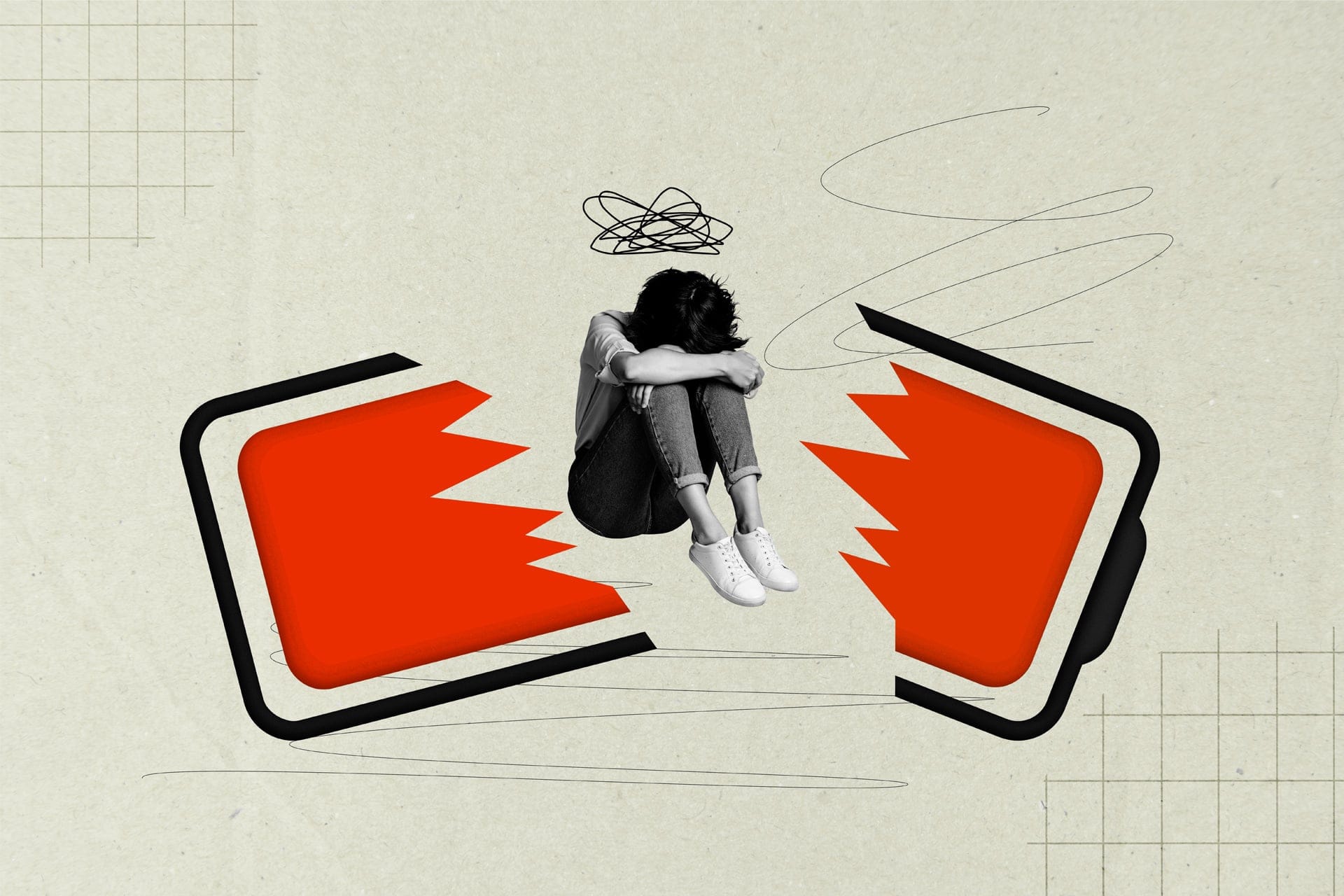
Non-Toxic Social Media Is Possible
For many years, I consulted on social-media campaigns in the film and television industry. I understand how social platforms capture our attention more than most. They help us share messaging, connect communities and shape how we see the world around us. So, back in 2018, when my daughter turned 12, I felt prepared for her to get her own accounts and benefit from their world-widening capabilities. Many of her friends were online already.
The bullying started soon after my daughter got her device. Her classmates made their own Instagram group chat and, very quickly, things got ugly. A few of them used YOLO and Tellonym, apps that integrate with Instagram and Snapchat, to send messages without revealing their identities. Some of those anonymous DMs were directed at my daughter, and many of them were vicious. Kids in their early teens are already incredibly vulnerable, but I didn’t realize how much these apps’ features could amplify that vulnerability—that is, until a year later, when my daughter was hospitalized.
As she recovered, I sat in the hospital room reading through her horrifying message history. I couldn’t believe kids her age were capable of writing such cruel things. I also couldn’t believe that tech companies would allow such abusive content to be circulated between young users—so I emailed them to ask how and why. In a response from a representative, Tellonym acknowledged the issue and explained that they were in the process of improving their language filters and reporting mechanisms. In other words, it was a technology problem.
I naively believed that, with more innovation, platforms would figure out how to address these harms. But then, in 2021, I read the Facebook Files, a Wall Street Journal investigation based on internal documents leaked by whistleblower Frances Haugen. One revelation stopped me cold: Facebook’s own research reportedly showed that children (girls in particular) were being fed self-harm content by its algorithms. (In a 2021 blog post, CEO Mark Zuckerberg responded to Haugen’s accusations, writing that it was “difficult to see coverage that misrepresents our work and our motives.")
The apps fed my daughter more disturbingly detailed, step-by-step suicide instructions, for example, precisely because they engaged her longer. They lacked safety measures like age verification, parental-consent tools and stronger moderation, all of which can lower the amount of time users spend on a platform. But that compromises ad revenue. It wasn’t that they couldn’t be implemented; it’s that, in many cases, doing so worked against the tech companies’ interests.
Related Posts

Why iPad Babies Have More Tantrums

Can AI Save Us From Misinformation?
Lately, courts and governments have begun to intervene where Big Tech hasn’t (or won’t). This past March, a Los Angeles jury awarded US$6 million in damages to an American woman after it found Meta and Google liable for psychological harms she incurred while using their platforms as a minor. That ruling has implications for hundreds of similar cases currently moving through courts across North America. On the regulation side, last year, in the wake of a series of youth suicides, Australia banned social media for anyone under the age of 16. Marc Miller, Canada’s Minister of Identity and Culture, introduced similar online-harms legislation, Bill C-63, in Parliament in early June. It would restrict social-media access for children under 16, with potential exemptions for platforms that implement safeguards to protect young users.
I understand the ban-it-all mentality. After my daughter’s hospitalization, my immediate reaction was to remove social media from her life entirely. I deleted my accounts too, as a show of support. What I didn’t anticipate was how isolating that decision would be. The majority of Gen Zers live their lives online. According to a 2025 survey from S&P Global, American Gen Zers spend more than five hours on social platforms each day, compared to the paltry three spent by millennials.
To my daughter, it felt like we were cutting her off from her network at the height of her exclusion. The bullying was gone, but so were the conversations about life, pop culture and piano, which she was learning how to play partly from Instagram reels. My teenage son, meanwhile, just started learning about healthy cooking from online creators and suddenly became interested in foods he never would have tried otherwise. Revoking all app access would be like outlawing television because there weren’t enough child-appropriate channels.
Another flaw in these bans is that kids can find ways around them. In Australia, many minors are simply lying about their age and learning other tricks to circumvent behavioural age-detection systems: they avoid using their real voices and limit visible clues that could identify them as underage, while continuing to access the same content. Bans can also push kids into more secretive—and potentially more dangerous—online spaces.
A better approach is to create safer social apps to supplant the bad ones. In 2023, I set out to make my own: I called it Tribela, a riff on the word "tribe." Beyond a rudimentary understanding of coding, I didn’t have the technical expertise to build the sophisticated platform I envisioned. So, that November, I enrolled at Oxford University’s Saïd Business School to connect with researchers who were studying AI ethics for children. At night, I took computer-science and venture-capital courses online through Harvard, along with a course on safe platform design through the Center for Humane Technology, a San Francisco–based nonprofit focused on creating a healthier digital ecosystem.
That course in particular explored how app design exploits natural human tendencies, such as our instinct to pay attention to conflict, danger and other emotionally charged content. In many ways, it’s the Instagram equivalent of slowing down to look at a car accident on the side of the road. For the first time in a long time, I felt hopeful: I learned that, despite what Big Tech was telling us, there were other design options for engagement that didn’t encourage compulsive use.
The following year, I joined Oxford University’s Innovation Startup Incubator and spent the next year and a half building out Tribela with a group of engineers and designers. The team’s key player, though, was my daughter. She wanted to stop other kids from experiencing the abuse she had gone through. While attending high school in Vancouver, she conducted more than 300 student surveys, asking her peers which platforms they used, how those platforms made them feel, what kinds of features kept them engaged and their motivations for being online in the first place.
Those survey results informed the creation of Tribela’s non-toxic features. Like most of the major apps, it was originally designed for users 13 and older. (Many jurisdictions don’t allow for data collection on kids younger than that.) In reality, however, more than 90 per cent of kids between nine and 12 are using them. Because we weren’t relying on harvested user data, we decided to adapt Tribela for the nine-to-12 set, rather than excluding them. Users under 16 are automatically given private accounts, while children under 13 require parental consent through built-in age-verification systems. The system performs a facial scan via smartphone cameras, then analyzes age-related facial markers to suss out whether the child’s estimated age matches the one they’ve entered.
We also rolled out a new kind of recommendation feed. On other platforms, my daughter told me she felt trapped by her feed. Even if she deleted the upsetting content, if enough time passed, it would reappear. In Tribela’s case, the users have more control. The app asks whether they want to prioritize text, photos or videos, and the feed should be chronological, rather than behaviour-driven. We don’t track what users linger on in order to manipulate recommendations. We also allow people to toggle between seeing content exclusively from close friends or opening up to the wider community. For kids under 16, messaging is only permitted between people who are actually connected to each other—never with strangers.
Tribela doesn’t have public “like” counts or comments, which can create psychologically consuming validation loops for users, especially children. Instead, my team created a “hand snap” feature (basically a celebratory finger-snap). Users receive notifications, but they disappear once they’re read. In real life, people acknowledge each other’s work, but they don’t then walk around holding a visible tally of how many times it’s happened. Hand snaps, as with IRL kudos, are just for you.
AI does play a role in our app—in a good way. It forms the basis of Tribela’s moderation system, which reviews every post, image and message before they appear in people’s feeds. Unlike the big social-media platforms, we don’t use user data to train our models, but rather our own data sets. Instead of creating different standards by age, we apply a single, family-friendly benchmark—based on the American Motion Picture Association’s guidelines for age-appropriate viewing—across the entire platform.
A major priority when we trained our AI was context awareness. We wanted it to be able to distinguish between discussions about sensitive topics and truly harmful behaviour. Users can chat about body image, nudity or feeling uncomfortable in their own bodies, for instance. What they can’t do is solicit or send nude photos, groom other users or engage in sexually explicit conversations. When content is flagged, the AI moderator generates a detailed explanation: it scans for categories such as violence, sexual content, hate speech, drug abuse and fraud, then assigns a probability score to each category.
That assessment is then reviewed by a human moderator, who responds directly to user complaints and reports of abuse. Our goal is to eventually make those reviews available in transparent reports so the users who posted flagged content can understand exactly why it was restricted. Major tech companies are vehement that this level of moderation isn’t possible, but look at what a small startup has done in under two years.
Tribela officially launched on Apple’s App Store this past March, and Android testing is now underway. In May, we asked university students across the U.S. to try out the app and provide detailed feedback: they loved the anti-performative hand snaps. They also liked the absence of autoplay. Whereas platforms like TikTok and Instagram allow us to scroll infinitely, we intentionally added extra space to establish clear breaks between posts. Many of the students said Tribela felt noticeably calmer for that reason.
Meanwhile, in the rest of the tech world, the prevailing mindset is still to scale aggressively, ignore safety concerns and deny culpability. Unsurprisingly, I’ve encountered a staggering amount of resistance to Tribela within the industry. At the many, many founder and investor gatherings I attended during the app’s development phase, people told me outright that nobody cares about kids’ safety online. In one instance, an entrepreneur yelled at me, saying I was stupidly going to lose all of my money because Tribela had none of social media’s most profitable features. For good measure, she told me she’d block me from joining a networking group she belonged to, presumably to protect those founders from falling into my money pit.
I disagree wholeheartedly with the idea that safer platforms can’t simultaneously be financially viable; Tribela is my real-world case study to prove it. As of early summer, we had 4,500 users across the platform, ranging from young children to seniors. All of that growth has happened through word of mouth, without any paid advertising. Some people clearly want more for themselves than manipulative algorithms, disturbing posts and zero guardrails.
With the onslaught of wearable devices—and even neural implants—the social platforms of the future have the potential to be much more invasive than they are now. But, then, there are counter-forces like my daughter. Now 20, she’s studying business at Western University and helping to lead Tribela’s youth-research wing to inform the design of new features, partly to protect other families from what ours went through. Social media may seem like everything to a kid, but, as she knows well, there’s more to life.
Natalie Boll is the founder of Tribela.
What did you think of this story? Send a comment for publication to letters@macleans.ca, and supply your name and address. Comments should be fewer than 200 words, and may be edited for length and clarity.
Related Posts
Drone Highways Are Coming to Canada’s Skies
Canada Needs Homegrown AI Infrastructure

In Defence of Screentime
Railway Tycoons Shaped Canada. Don’t Let AI Barons Do the Same.
Get the Best of Maclean’s straight to your inbox.
Sign up for news, commentary and analysis. Join 60,000+ Canadian readers.