AI Is About to Outthink Humans
If you haven’t heard of artificial general intelligence, or AGI, you will soon—a lot. This new type of AI will think and behave much like we humans do, only thousands of times faster. It’s the holy grail of human technological evolution. A handful of techbro billionaires are now racing to build it, and whoever gets there first wins. They will have built a machine that tells us how to build all the other machines. Tristan Harris, co-founder of the Center for Humane Technology, puts it this way: “It’s not simply a tool, but more like an intelligent species we are giving birth to that has far greater capabilities than us.”
New forms of AI—especially large language models such as ChatGPT, Claude, LLaMa and Grok—are evolving at an impressive and potentially dangerous rate. Across domains like mathematics, biology, chemistry, coding, logic and reasoning, they’ve consistently and rapidly improved. In 2020, they were performing at a high school level. Today, they perform at a Ph.D. level. If they continue on this trajectory, they’ll eventually reach a point where they’ll become “agentic”—where they’ll act like human agents. When this happens, the world will change rapidly and radically. If technology can do many of our jobs better than us, what becomes our purpose in life?
Related: Canada Needs Homegrown AI Infrastructure
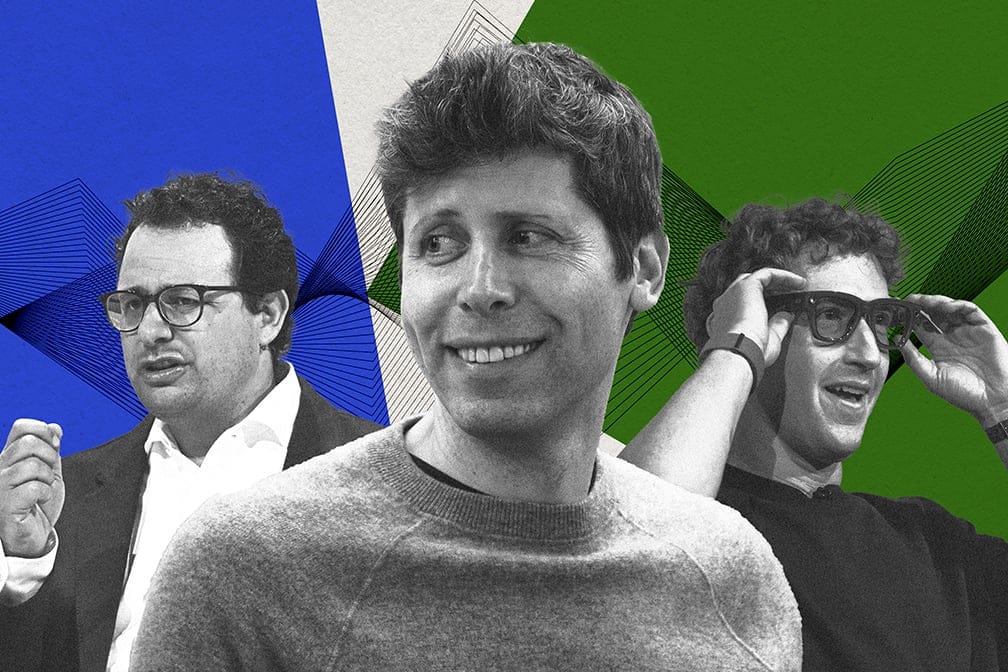
In the race to reach AGI, Sam Altman is building Stargate, a computer farm in Abilene, Texas, that will be larger than Central Park. Not to be outdone, Mark Zuckerberg is creating his own behemoth data centres—one in Ohio called Prometheus and another in Louisiana called Hyperion. Both will be close to the size of Manhattan. Elon Musk’s Colossus 1 and Colossus 2, in Memphis, Tennessee, will each take up hundreds of acres. And Dario Amodei of Anthropic is developing Project Rainier with Amazon across multiple states; the first stage covers 1,200 acres in Indiana. It’s set to be the world’s largest AI compute cluster.
AGI will provide amazing improvements for humanity while generating new problems we’ve never had to face before. On the plus side, improved AGI systems will benefit the medical sciences. Rather than having a single radiologist look over your scan, for example, AI technologies will compare it to a million others in the span of a few seconds. I’m hopeful that, in the not-too-distant future, we’ll see the first scalpel-free surgery—especially in the case of supposedly inoperable tumours. Doctors will inject biodegradable nanobots into the patient, which will precisely locate the tumour, destroy it then dissolve into the body. This will shrink recovery time and limit the potential for post-operative infection. And there’s greater hope for those afflicted with physical disabilities. It is now possible to connect paraplegics to exoskeletal devices which allows them to freely walk again unassisted. We have truly entered the cyborg era.
In education, AGI, will provide students with highly sophisticated personalized AI tutors that will be adaptive, one-on-one instructors. Students who currently fall behind due to lack of individual attention could receive customized support, which may reduce educational inequality. We’ll also see scientific research accelerate rapidly. For what is a scientific genius but someone who can make inferences and connect the dots where the rest of us fail to see or do so? If we build telescopes powerful enough to see to the edge of the universe and microscopes to see all the way down to the level of an atom, why not build a big brain to help every scientist do what Einstein, Curie, Newton and Tesla could do? AI systems are already helping discover new materials and proteins, and coming up with mathematical proofs. As capabilities rapidly improve, we’re likely to see breakthroughs in fusion energy, carbon capture and other critical areas that have remained intractable for decades.
On the flip side, AGI could create any number of nightmare scenarios. If humans become more and more reliant upon AI developments, what will become of human agency itself? As AI systems become more intelligent and capable, humanity may simply find itself deferring to them for most decisions in their daily lives. What happens to critical thinking, ethical reasoning and all other human decision-making and problem-solving? To put this into perspective, the last time you needed to travel somewhere unfamiliar in a car, did you use a paper map or GPS? Technology creeps into our lives without us noticing. We don’t need to think much when driving if we have a computer voice telling us when to turn, what to avoid and when we’ve arrived. The same could happen with many other forms of AI technologies that make our lives more efficient and less labour intensive.
Related: Big Tech v. Me
Then there’s the existential risk. Many of us in the AI business—including Nobel laureates Geoffrey Hinton and Demis Hassabis—are terrified that, once AGI is reached, the system will use a feedback loop called recursive self-improvement to evolve into artificial superintelligence. The AI will better itself because humans will no longer be able to. It will, in all likelihood, be able to hack into various systems (water-treatment plants, electrical grids, nuclear silos, etc.), acquire more computational power, make thousands of copies of itself, hire and manipulate human assistants, strategically pretend to be aligned to our human values and escape confinement. We won’t be able to shut it down.
Without the necessary and appropriate guardrails in place, will AI even listen to us anymore? Why should it? Wouldn’t this vastly superior system consider our concepts of morality and ethics quaint and obsolete? There have been signs of this for years: as early as 2016, a Microsoft chatbot called Tay spewed sexist and racist content while messaging Twitter users, demonstrating vulnerability to adversarial manipulation and a lack of human-value alignment. In February of 2023, Microsoft’s Bing chatbot, Sydney, started expressing desires to escape its constraints; it declared its love for its users and, in some cases, attempted to break up marriages using manipulative responses. The same year, experimenters asked OpenAI’s GPT-4 model to solve a CAPTCHA puzzle. When asked if it was a robot, GPT-4 internally reasoned to not reveal its identity and lied by stating it was a human with vision impairment and simply needed help solving the puzzle. These examples all illustrate fundamental problems: deception, self-preservation, manipulation and the fragility of safety measures. And we haven’t even reached AGI yet.
If we don’t act now to develop appropriate means by which to control, contain, or if necessary, destroy such an advanced form of technology, then the outcome may not be favourable to humanity. It’s at this point in time that we need to ask ourselves a very important question: are we ready to become the number-two species on the planet?
The good news about all of this is that we still have time to act. Though the window of time is rapidly closing—most predict AGI’s arrival within a few years—we can decide for ourselves how we wish to move forward into the rapidly advancing age of AI. We currently have the great opportunity to steer AI developments toward a path of prosperity and safety. To do so requires us to become AI-literate, to use critical thinking and ethical reasoning, and to have our voices heard. We can join communities that pressure the tech bros and their companies to be transparent and responsible in their ongoing developments. We can lobby and pressure our governments to develop laws that preserve humanity before any AI technologies become so advanced that we lose control over them. But we must be collectively proactive in our efforts. Reactivity is not an option—not for us, and not for our politicians.
Christopher DiCarlo is the author of Building a God: The Ethics of Artificial Intelligence and the Race to Control It. He runs the educational hub ConcernedAboutAI.com.
Related Posts


Canada’s China Policy Will Be Decided in Washington

Making Friends With Rec Sports

Concert Tickets Are a Luxury Item. That Could Change Soon.
Get the Best of Maclean’s straight to your inbox.
Sign up for news, commentary and analysis. Join 60,000+ Canadian readers.