Canada’s China Policy Will Be Decided in Washington
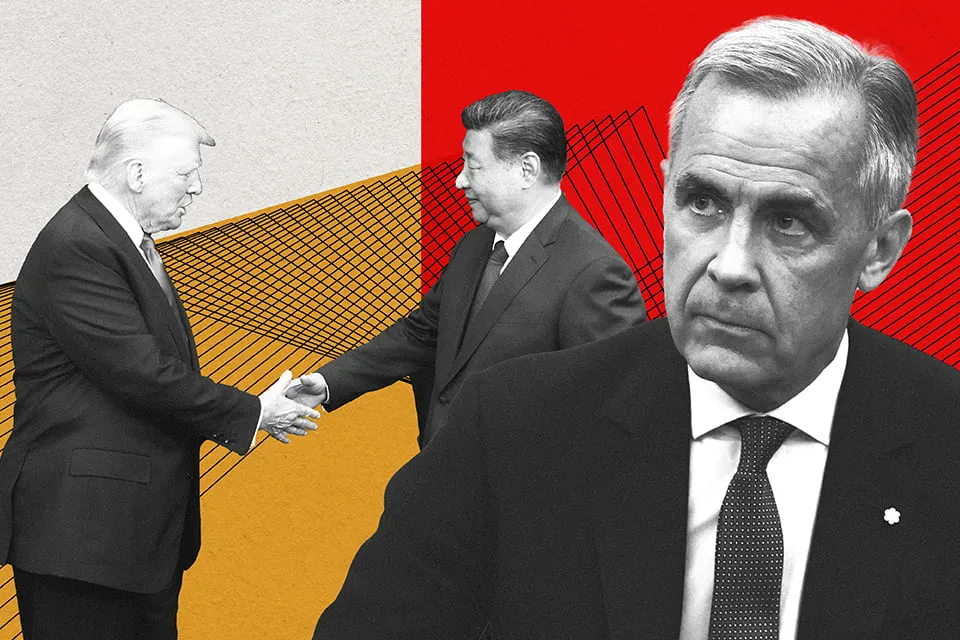
Mark Carney says Canada’s relationship with China is at a turning point. But it more accurately resembles a Rubik’s Cube, where each move to solve one problem scrambles the rest of the puzzle.
Sino-Canadian relations took a major hit beginning in 2018, when China detained the two Canadian Michaels 1,000 days. In the past year, tensions have worsened: Canada imposed a 100 per cent tariff on Chinese electric vehicles in October of 2024, with the goal of jumpstarting Canadian production. China levied 100 per cent canola oil tariffs in retribution.
Carney, of course, has been doing his level best to court Beijing as part of a broader effort to diversify Canada’s trade partnerships and reduce Canada’s economic dependence on the US. This past fall, he snagged a 40-minute meeting with Chinese President Xi Jinping on the sidelines of the APEC Summit in Gyeongju, South Korea—the first such encounter between the leaders of the two countries in eight years. No deals came out of the meeting, but Carney accepted President Xi’s invitation to visit China in 2026. So where do these shifting dynamics lead in the coming year?
In one scenario, there’s a major breakthrough between Canada and China, driven by the crisis in the U.S.. After trade talks with Trump collapse, Washington imposes sweeping new tariffs, and the Canadian economy goes into freefall. American automakers shut down assembly plants in Oshawa, Windsor and Oakville, and Japanese manufacturers follow suit, moving their production south of the border. As Trump’s tariff tsunami wreaks economic havoc, millions are thrown out of work, not just in the auto industry, but also in Canada’s lumber, agricultural and manufacturing sectors.
Carney will be forced to make a strategic calculation: if the U.S. won’t play ball, Canada must look elsewhere for an economic lifeline. He’ll move quickly to forge an ambitious, game-changing agreement with China that fundamentally recasts Sino-Canadian relations. The deal would be comprehensive and transformative. China would drop its punitive tariffs on Canadian canola exports. Canada, in turn, would slash its 100 per cent duties on Chinese-manufactured EVs. In this scenario, China also agrees to build EV-assembly plants in Ontario’s devastated economic corridors. China also launches massive investments in port expansion on Canada’s West Coast and in Churchill, Manitoba, to facilitate massive oil and LNG shipments.
Related Posts

Making Friends With Rec Sports

AI Is About to Outthink Humans
The most ambitious element would be an agreement with China to finance and rapidly construct a high-speed rail line linking Windsor, Toronto, Ottawa, Montreal and Quebec City. Drawing on China’s unmatched expertise, China would commit to completing the project within five years, a timeline that would be unthinkable under normal circumstances with Western contractors.
In a sharp departure from previous policy, Canada would lift its punitive curbs on Chinese investment—including state-linked investment—paving the way for high-impact capital and technology flows into telecommunications, artificial intelligence and advanced manufacturing. In this scenario, our universities agree to rapidly increase their intake of Chinese students. The major reset in bilateral relations catalyzes rapid economic growth and extensive people-to-people exchanges. As construction sites spring up across the entire country, Chinese engineers work alongside their Canadian counterparts to build gleaming, state-of-the-art airports, ports, rail lines and roads. Canada’s resource exports surge to China and the rest of Asia. Chalk it up to one big policy win.
But this scenario raises some profound questions. Would Canada simply be trading one dependent relationship for another? What are the security implications of such deep integration with an authoritarian state with global ambitions? And how would Washington under any administration—Republican or Democratic—now treat a northern neighbour locked into a deep relationship with its chief military and geostrategic rival? This scenario might be visionary and transformative, but it would also be a reckless gamble.
The opposite scenario in Sino-Canadian relations emerges not from a crisis with the United States but from success. After intensive, difficult negotiations, Washington and Ottawa hammer out a new, comprehensive trade agreement that resolves longstanding irritants and balances American security interests with Canadian economic ones. The Canada-U.S.-Mexico Free Trade Agreement is renegotiated, giving Canadian goods privileged access to U.S. markets.
But a major price of the deal is alignment with Washington on China. Although a temporary truce of sorts has emerged in the tariff war between Washington and Beijing following the meeting between Trump and Xi Jinping at the APEC Summit, it will likely be short-lived. Sino-U.S. relations will likely continue to deteriorate, driven by conflicts over Taiwan, territorial disputes in the South China Sea, technological competition and human rights concerns. As part of a new agreement, Washington could force Canada to levy new duties on Chinese goods and restrictions on Chinese investment. China takes retaliatory action, extending its punitive tariffs on Canadian canola and agriculture to energy and all other Canadian exports.
This scenario leaves Canada firmly embedded in America’s confrontation with China across the full spectrum of economic, technological and diplomatic relations. Carney’s desire to have a pragmatic and constructive relationship with China is dashed.
The stark contrast between these two scenarios reveals an uncomfortable truth: Canada’s China policy, whether it leads to deeper engagement or continued estrangement, is ultimately shaped less by our own volition and more by Washington. As Carney conducts high-stakes negotiations with Xi Jinping, he constantly risks being caught off guard by Washington’s punitive economic measures if we are viewed—rightly or wrongly—as out of sync with American policies and interests. A deal that looks attractive today could become a liability tomorrow if U.S.-China confrontation intensifies and Washington demands Canadian alignment.
Carney must therefore avoid the perils of committing to sweeping trade agreements that would fundamentally reorient Canada’s economic relationships. Instead, he should focus on targeted deals that unlock new markets—and not just in China—while defending Canadian interests and maintaining strategic flexibility. He must be mindful that any major agreement carries the risk of foreclosing options if continental relations stabilize or if geopolitical pressures demand different alignments.
The fundamental lesson is this: for a country of 41 million people sharing a continent with a 342-million-person superpower, genuine strategic autonomy will always be elusive. Geography, economics, and security imperatives constrain choices in ways that no amount of diplomatic creativity can entirely escape. Canada’s China policy, whether Carney likes it or not, will ultimately be determined as much by Washington as by Ottawa or Beijing.
Fen Osler Hampson is a professor of international affairs at Carleton University.
This story appears in the January/February 2026 issue of Maclean’s. You can buy the issue here, subscribe to the magazine here or send a gift subscription here.
Related Posts

Concert Tickets Are a Luxury Item. That Could Change Soon.

Buy Canadian Is Transforming Grocery Shelves


The Condo Crash is Spreading
Get the Best of Maclean’s straight to your inbox.
Sign up for news, commentary and analysis. Join 60,000+ Canadian readers.