
White-Collar Workers Are Not Okay
When Ben Gooch was a teenager in the mid-2010s, he was fascinated with filmmaking and prop design. But teachers and guidance counsellors warned him against chasing a career path in the arts. If he wanted a shot at stability, they said, he ought to pursue a more sensible field. So, in 2019, after graduating from high school in Alliston, an hour north of Toronto, he enrolled in the mechanical engineering program at McMaster University in Hamilton, Ontario. He figured it was a surefire way to kickstart a career in energy, aerospace or robotics: the university’s most recent data, from the class of 2020, touted a 97 per cent employment rate for engineering graduates.
For Gooch, university was difficult but often delightful. The 3D-printing classes scratched his creative itch, making engineering feel less like a tunnel of equations and more like a factory of possibilities. The degree felt solid and marketable. In June of 2023, he graduated and began firing off job applications.
And then nothing. Over the next few months, Gooch sent hundreds of applications to employers across the country. He landed a few interviews, but none of them went anywhere. He widened his scope beyond mechanical engineering to any field that seemed adjacent. He practised mock interviews with coaches and constantly tweaked his resumé. He listed awards he’d won, including a robot-design challenge where he’d topped a class of 500 students. Still, he couldn’t find work.
Related: The Battle for the Soul of the University
In early 2025, after a year and a half of job hunting, Gooch’s savings were growing thin. Moving back into his parents’ house wasn’t an option—he wanted to be independent, and his parents agreed it was time for him to stand on his own. But he became so desperate for income, and to pay his $1,100 monthly rent, that he applied to entry-level retail positions at PetSmart and Dollarama. He didn’t get those, either. Finally, he took the first job he was offered: a position at a garden centre, where he swept, moved heavy pots, repaired irrigation lines and unloaded trucks in the frost. He couldn’t believe he’d gone to school for four years only to end up doing unskilled labour. Of course Gooch couldn’t have known that when he entered the job market he was walking straight into a stiff headwind.
Until very recently, the post-pandemic economy was booming. The threat of AI loomed, but it was still mostly hypothetical. The worst we had to fear from an American president was Joe Biden having a senior moment. And with interest rates near zero, companies expanded rapidly; huge players like Amazon and Meta nearly doubled their workforces. In the spring of 2022, there were more than one million job vacancies in Canada. Landing and keeping a job had become so easy it spawned the “overemployed” movement, in which workers quietly held down two or three full-time roles at once, aided by the explosion of remote work. People could apply to jobs from bed, no hustling, networking or fruitless coffee chats required. For a moment, it seemed like anyone could find their dream job.
And then the boom fizzled—fast. By last November, the number of job vacancies had fallen to fewer than half a million, down 50 per cent from its 2022 peak. This contraction has been most severe in the professional and white-collar job markets, affecting both entry-level and more senior positions. In the finance and insurance industries, the job-vacancy rate has plunged from a high of 5.6 per cent in 2022 to just 2.3 per cent; in scientific and technical jobs from 6.4 to 3 per cent. Vacancies for management jobs have fallen from 7.7 per cent, in May of 2022, to 1.3 per cent.

Today, new grads once promised a foothold on the career ladder are launching cover letters into a void. Mid-career workers with impressive CVs are finding their momentum stalled. If they’ve lost a job, they’re finding it impossible to get back on the ladder. Mathematicians mop floors, software developers replace air filters in apartments, newly minted MBAs process returns at Costco and mechanical engineers pot plants. And that’s if they’re lucky. Viet Vu is a labour economist at The Dais, a public policy think tank at Toronto Metropolitan University. Just a few years ago, he says, the white-collar job market favoured employees. “Now it’s completely flipped the other way.”
There isn’t one reason for the sudden reversal, but a convergence of them: an overstuffed pipeline of new grads jockeying for the same jobs, a mismatch between credentials and the labour market, the uncertainty of Trumponomics and, of course, AI, which has gone from hypothetical to all too real.
The result is a growing disconnect between education, experience and employability. For this story, I spoke to frustrated job seekers who’ve been burned out by the experience of sending out dozens or hundreds of applications and hearing almost nothing back. They’re questioning the value of their education and career experience—and wondering if the sacrifices they’ve made have been worth it. As Ben Gooch told me about his years of all-nighters and the tens of thousands of dollars he spent on his degree, “It feels kind of pointless now.”
Oscar Cecena is another casualty of the job market’s stark and sudden transformation. He’s a 47-year-old computer engineer who moved from Mexico to Toronto in 2013, when job opportunities for workers like him were on the upswing. He was ambitious, highly skilled and backed by a decade of experience, as well as a degree from a prestigious institution in Mexico City. When he arrived in Canada, he easily found work, first as a project coordinator at a digital HR company and then a more senior role with a digital-banking startup, where he stayed for six years. But he had his sights set on the big tech companies and, in 2021, he joined LinkedIn’s Toronto team as a customer-success manager.
Then, in 2023, Microsoft launched Copilot, its AI assistant. Cecena says employees were pushed to use it to consolidate their workloads. Within months, roles in his department were removed, teams were dismantled and expectations shifted. Staff delegated administrative tasks to AI and took on heavier workloads. Cecena thinks that the logic was simple: if employees could be stretched further with AI, fewer employees would be needed. By June, he was part of a major layoff that affected more than 1,000 workers across the company.
Related: The New Rules of Workplace Etiquette
Unemployment hit Cecena hard after decades in the workforce. Ironically, he spent full days on LinkedIn: connecting, messaging, updating his resumé, rewriting cover letters. He applied for jobs all day, every day. He landed some promising interviews; once, he was so certain he was close to an offer that he did an interview during an anniversary trip to France with his partner, only to be rejected at the end.
Looking for a job became more demoralizing than losing one in the first place. The repetitiveness of sending applications and writing cover letters ravaged Cecena’s confidence. After months of applying to several positions a day, he was exhausted. The routine had taken over his life. “Maybe I won’t get a job this year,” says Cecena. He knows other people who’ve spent long periods unemployed. One friend, a former postdoc at both Harvard and the University of Toronto, applied to jobs for a full year before landing one. Those stories make him nervous.

Across Canada, AI has been transforming white-collar work, not with robot overlords or mass replacements but with a quiet creep: streamlining tasks, reshaping expectations and slowing hiring. In response, managers have subtly stretched job descriptions, demanding more from each AI-assisted employee.
Layoffs and job attrition are hard to pin specifically on AI. Companies don’t attribute layoffs to AI, even though it’s a growing factor in the hiring slowdown, especially in the tech sector. In April of 2025, Shopify adopted an AI-first hiring policy, forcing managers to prove AI couldn’t do a job before approving a new hire. IBM has replaced roughly 200 HR jobs with automation. Amazon has cut more than 41,000 workers since 2022, in part due to AI streamlining the work of employees. And in 2025, Microsoft poured billions into AI, even as it laid off 15,000 people.
But AI is also shouldering some undeserved blame for other labour-market contractions. By late 2022, people were returning to brick-and-mortar stores and offices. It was becoming clear that the digitization of the economy was progressing more slowly than anticipated. Shopify’s stock plunged 80 per cent in 10 months. Growth in the cloud didn’t only slow, it reversed. Tech leaders had overestimated how many new hires they would need, and soon the same companies that had expanded aggressively were cutting fast. What we’re experiencing now is a sort of corporate diet due to pandemic-era overhiring.
Emily Xiong is a 34-year-old Toronto software engineer who has experienced the negative effects of AI on her career and on the tech job market. Until last summer, she worked for a startup that built tools for other software developers. She says the company became keen to overshoot on AI projects to impress venture-capitalist investors, and Xiong was put on AI-related work she didn’t like and wasn’t knowledgeable about. When she expressed concern that she was getting in over her head, her manager told her to use AI tools to figure it out. The mentality was dotcom-esque: if everyone on the team hustled now, they would all be able to cash out in a few years.
By early 2025, Xiong was so dissatisfied with her role that she began job hunting pre-emptively. Then, in August, one of the senior managers let her and four others employees go during a quick one-on-one video call. At that point, Xiong felt so burnt out that she was relieved. “It was ‘ride this AI wave or die,’ ” said Xiong. “They were pushing me to work harder, micromanaging me; there was no work-life balance. Then it was over.”

But the job hunt was no less stressful. On search boards, she saw a suspicious number of AI-related roles. “Companies are rebranding themselves as AI companies, sometimes changing their entire business model, even if the product has nothing to do with AI,” she said. She also found herself competing with fresh University of Toronto and Waterloo graduates for a shrinking pool of roles.
It was a humbling shift for someone who once believed her U of T computer engineering degree was an all-access pass—especially because, for the first decade after she graduated in 2013, it largely had been.
Xiong’s experience, like Ben Gooch’s, illustrates the growing breakdown between education and the labour market. For decades, Canada’s university system has been a well-oiled degree-granting conveyor belt, producing an ever-growing stream of new graduates for the white-collar economy. Today, Canada has the best-educated workforce in the G7.
This is by design. For several generations, most young Canadians were promised that higher education would be a ticket to lucrative jobs and greater opportunities. But now there are more educated young job seekers than there are roles to fill. A report published last fall by the Labour Market Information Council—an Ottawa-based not-for-profit that collects data about Canada’s employment landscape—found that the reliable, reassuring correlation between education and employment is falling apart.
“Entry-level jobs that once welcomed bachelor’s degree holders appear to be vanishing,” it says. “The trends suggest not a temporary cooling, but a structural realignment of early-career work—one driven by automation, shifting employer preferences and an uncertain global economic climate.” It concludes bluntly: “The assumption that education equals opportunity is being tested.”
Numbers back this up. As of the 2021 census, nearly 6.5 million Canadians aged 25 to 64 held a bachelor’s degree or higher, up from under four million in 2006. Forty per cent of Canadians aged 25 to 34 have a bachelor’s degree, up from 29 per cent in 2006. Yet the number of jobs available to this rapidly growing pool of educated young people is shrinking. Between early 2024 and late 2025, the number of job vacancies in Canada requiring a bachelor’s degree dropped from 70,000 to fewer than 30,000.
Renze Nauta is a director at Cardus, a think tank in Hamilton, Ontario. He says this trend has been building for years. Recent shocks, like the economic turmoil emanating from Donald Trump’s White House and the explosion of AI, have accelerated things, but the long arc has been visible for some time. For much of the last half-century, expanding universities made the bachelor’s degree a shorthand for upward mobility. By comparison, college and trade school seemed like second-rate choices. But now Canada is funnelling young people into universities with no accompanying roadmap for where they should go next and no certainty that the opportunities available to them will continue to expand. Governments pour funding into post-secondary institutions, but less into apprenticeships and trades.
Ben Gooch was disillusioned about the value of his credentials the moment he graduated. Almost none of his friends found work in their fields. While applying for entry-level engineering jobs, Gooch was shocked at the level of expertise among other applicants. Some held master’s degrees, or even Ph.D.s. According to Nauta, more white-collar workers are overqualified for their jobs.
Gooch has considered graduate school, but that also feels like a gamble. “It would be so scary to get a master’s, come out of school and be two or three more years behind everyone else who is already in the workforce,” he says. “And will that even get me a job?”
In fact, it may do the opposite. A recent survey of Canadian hiring managers found that advanced degrees may thwart job seekers’ prospects. More than three-quarters of respondents said they worried that overqualified candidates would leave their jobs quickly, or could struggle with work they believe is beneath them. That’s a grim stat in an ostensibly meritocratic labour market.
A healthy job market requires pluralism: not everyone is suited to the same path. But students often choose their programs blindly. They enrol in engineering because it sounds sensible and then graduate into an oversaturated job market. And when almost everyone has a degree, two things can happen. First, credential inflation sets in. Employers begin demanding master’s degrees, or even Ph.D.s, for positions that once required only a bachelor’s. Then, paradoxically, certain employers abandon credentials altogether. Some job postings in white-collar sectors—including tech, media and human resources—no longer require a degree if the applicant has equivalent experience or can demonstrate proof of competence. A job seeker might be deemed underqualified for one role, and overqualified for an identical one.
Applying for jobs has never been easier, yet applicants have never struggled so much to stand out. Not long ago, applying to a position meant tailoring a cover letter and sometimes even mailing a physical portfolio. Candidates self-filtered. HR teams sifted through manageable piles. Today, a job seeker can blast out dozens of applications a day. They can use AI tools to draft mediocre but serviceable cover letters in seconds. Employers see a flood of resumés and respond with their own filters, screening bots and elaborate hiring pipelines. Candidates strike out on dozens, hundreds of jobs, often without interacting with a single human being. Slop goes in, slop comes out.
Niki Tisza is one of those candidates who seemed valuable on paper. She grew up in Hungary and became fluent in English after spending years in Ireland and New Zealand. She studied economics and social science before becoming an investment banker, then ultimately reinventing herself as a UX designer. She eventually founded her own company; one of her clients was the New Zealand government. She moved to Canada in 2022 with a job offer from a tech consulting company, but it was revoked two days before she arrived. She came anyway, hoping her resumé would function like a passport: proof of fluency across borders and industries, evidence that she could adapt anywhere. She figured she was exactly the kind of flexible, globally polished worker Canadian companies would value. But after months of job rejections, her eclectic CV made her feel less like a unicorn and more like a sore thumb.

She eventually landed at the Montreal-based digital payments company Lightspeed—but lost the job during a mass layoff in December of 2024. She dreaded wading back into the job hunt. “It makes you want to use AI to write the answers, when you know they’re using it to scan applications,” she said.
This time, Tisza kept track: of the 102 applications she sent in 2025, 48 employers ghosted her, 37 rejected her and 17 offered interviews. She turned down 10 of those interviews because the salaries were too low. “Large companies paid peanuts for a role at my level,” she says. The salaries were around $120,000 per year, but she says they were a significant drop from wages in New Zealand, and in many other countries, for comparable jobs.
She eventually made it to the final rounds of three separate hiring processes and, in December of 2025, accepted a role that suited her skills: a senior manager role for a global technology company. She’s still frustrated at how hard it was to find a proper fit. “In New Zealand, I would go to one interview for a job I’d want, I would get the job offer, and the salary made sense,” she said. “Here, it’s been such a challenge.”
In a contracting job market with a bottlenecked entryway and questionable security, some workers are turning away from white-collar life altogether. The long-documented pathologies of the office—burnout rates, corporate babble, the always-on culture—may once have felt like part of a reasonable Faustian pact for financial stability. But that no longer holds up. After Tisza lost her job in 2024, she briefly considered quitting the white-collar world entirely, perhaps for dog grooming or mushroom farming.
Related: How To Become A Skilled Tradesperson
Some workers are finding offramps, juggling multiple jobs and income streams. This even has a name: portfolio careers. Some of those pursuing this path are leveraging the skills they’ve picked up in university and in past jobs to create their own entrepreneurial ecosystem. Oscar Cecena recently launched his own consulting business. It means giving up the scale and certainty of a large organization, but it also offers a reprieve from the grinding cycle of applications, interviews and rejection. It’s not forever but, for now, it’s enough. “It feels like I can control my destiny,” he says, “even if it’s just for a short period of time.”
Still others are pursuing a path that has long been out of favour among educated, middle-class Canadians: the trades. I spoke to Lucie Levesque, a Quebecer who, after graduating from high school in her native Gaspésie in the mid-1990s, moved to Montreal to pursue a degree in mortuary sciences. She worked in the field for decades, and it was fascinating; she liaised with policymakers, worked in anatomical pathology departments and guided medical students through post-mortem assessments. She loved her job, but corporatization of the funeral industry, dwindling resources and scarcity of work opportunities eventually wore her down. Three years ago, looking for a change, she enrolled in college and started training to become an electrician.
It was surprisingly easy. As more working-age Canadians have sought out post-secondary credentials, fewer have gone into trades. In 2006, 2.15 million people between 25 and 64 had apprenticeship or trades training. The number had fallen to 1.8 million by 2021. The relative dearth of qualified tradespeople has created a situation that is the inverse of that facing white-collar workers: less precarity, more opportunity. This year, Levesque is reaching out to prospective employers. When asked whether she might ever return to her old career, she pauses. “Never say never,” she adds, “but I really don’t think I’ll go back.”
But trades and self-employment can’t absorb every over-educated and under-employed white-collar worker across the country. For most, things will get harder before they get easier. Faced with towering stacks of applications, employers are now turning to less democratic filters. There’s algorithmic AI screening, nepotism and vague notions of “fit”: networking, family, serendipity. A degree helps, but a phone call helps faster.
Last November, Ben Gooch took an entry-level role at his father’s business consulting firm in Mississauga. It isn’t engineering, but it’s something .“All my friends are in a similar boat,” he says. “They got jobs through family or people they know.” One friend, a mechanical engineer, ended up back at his family’s manufacturing business.
Gooch now helps American and international companies enter the Canadian market. It’s stable work in an unstable moment. But the tension lingers. “It feels terrible to have this degree that cost me so much money and to not be using it,” he says. Eventually, he’d like to do something more connected to engineering. But he’s realistic. Starting over at the bottom, for lower pay, while more and more young engineers flood the field feels impossible. “In 10 years, I’m most likely in the business world,” he says. “Maybe on the business side of an engineering company. But I don’t think I could ever see myself pivoting and becoming an entry-level engineer.”
Viet Vu believes that the white-collar labour market will loosen again. Companies will regain confidence, hiring freezes will thaw, jobs will return. But for young workers like Gooch, and mid-career professionals like Cecena and Tisza, the scars of today’s labour market will last as long as their careers do. They entered a workforce that had promised knowledge-economy abundance, only to find that credentials guarantee nothing, algorithms reshape job descriptions overnight and global politics can wipe out an entire hiring pipeline in a single press conference. But even in an uncertain time, some of the old and slightly tired principles of professional success remain unchanged: resilience, resourcefulness, networking and luck. And perhaps a bit of reinvention.
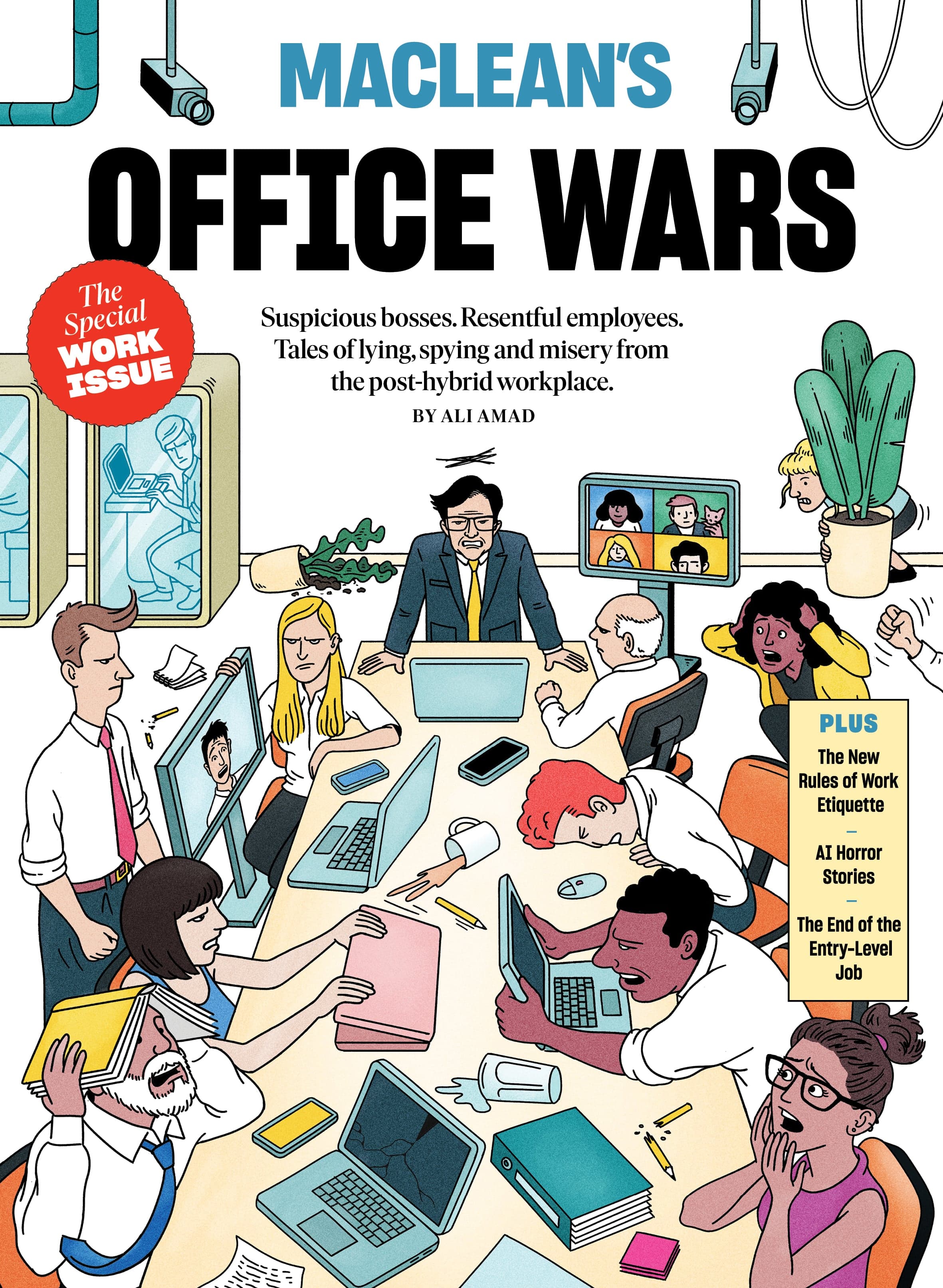
This story appears in the March 2026 special issue of Maclean’s. You can buy the issue here, subscribe to the magazine here or send a gift subscription here. Read the cover story here.

Alex Cyr is a freelance writer from Prince Edward Island, now living in Toronto. He is a contributing editor at Maclean’s since 2023, and writes regularly for The Globe and Mail and Toronto Life, focusing on health, culture, and fascinating people.
Related Posts

How Lindsay Somers takes the awkward out of on-screen nudity

Young, working Canadians face a dilemma: eat, or pay the bills?

The push to fill Canada’s critical PSW shortage

Inside Google’s super-sustainable new Montreal HQ
Get the Best of Maclean’s straight to your inbox.
Sign up for news, commentary and analysis. Join 60,000+ Canadian readers.