How Do We Keep Canada Insurable?
In the mid-1970s, in a bid to promote the city’s newly opened convention centre, the mayor of Winnipeg issued thousands of novelty soda cans filled with what was touted as “the world’s cleanest air.”
“Why settle for just a sample?” the can implored. “Come and enjoy all the air you can breathe.”
Skip ahead to the summer of 2025 and Winnipeg’s convention centre and hotels were filled not with conference delegates but with thousands of wildfire evacuees who had been displaced from their communities. The air in Winnipeg last July was not the “world’s cleanest” but among the most hazardous on the planet.
Related: Canada in the Year 2060
For weeks, the city’s skyline was heavy with rolling bands of smoke. My family considered ourselves lucky; many of our children’s summer activities were cancelled because of the toxic air, but at least we were able to remain at home.
The company I work for, Wawanesa Insurance, has its national headquarters immediately adjacent to the convention centre. Many of our employees volunteered to support the evacuees, a number of whom were our policyholders; or members as we call them, as a mutual company owned by the people we insure.
It was distressing to see so much hardship and so many people displaced, but the situation itself wasn’t unique. 2025 wasn’t even a standout year for insured losses caused by severe weather. In fact, despite exceeding $2.4 billion, it was a relatively “good” year from a traditional insurance perspective, at least compared to the $9.2 billion in insured losses from severe weather events that Canada sustained in 2024—a twelve-fold increase over the annual losses caused by severe weather a generation earlier.
What was once a year’s worth of severe weather losses can now occur in a single day. In Calgary, egg-sized hail with enough force to leave holes in vinyl siding caused $3 billion in damage in a matter of hours in August 2024. A few weeks before the Calgary storm, Toronto and other parts of southern Ontario were hammered with rain so intense it spurred a billion dollars in losses. In Quebec, our company recorded more losses in a single day in the province than in the previous five years combined due to flooding following Hurricane Debby.
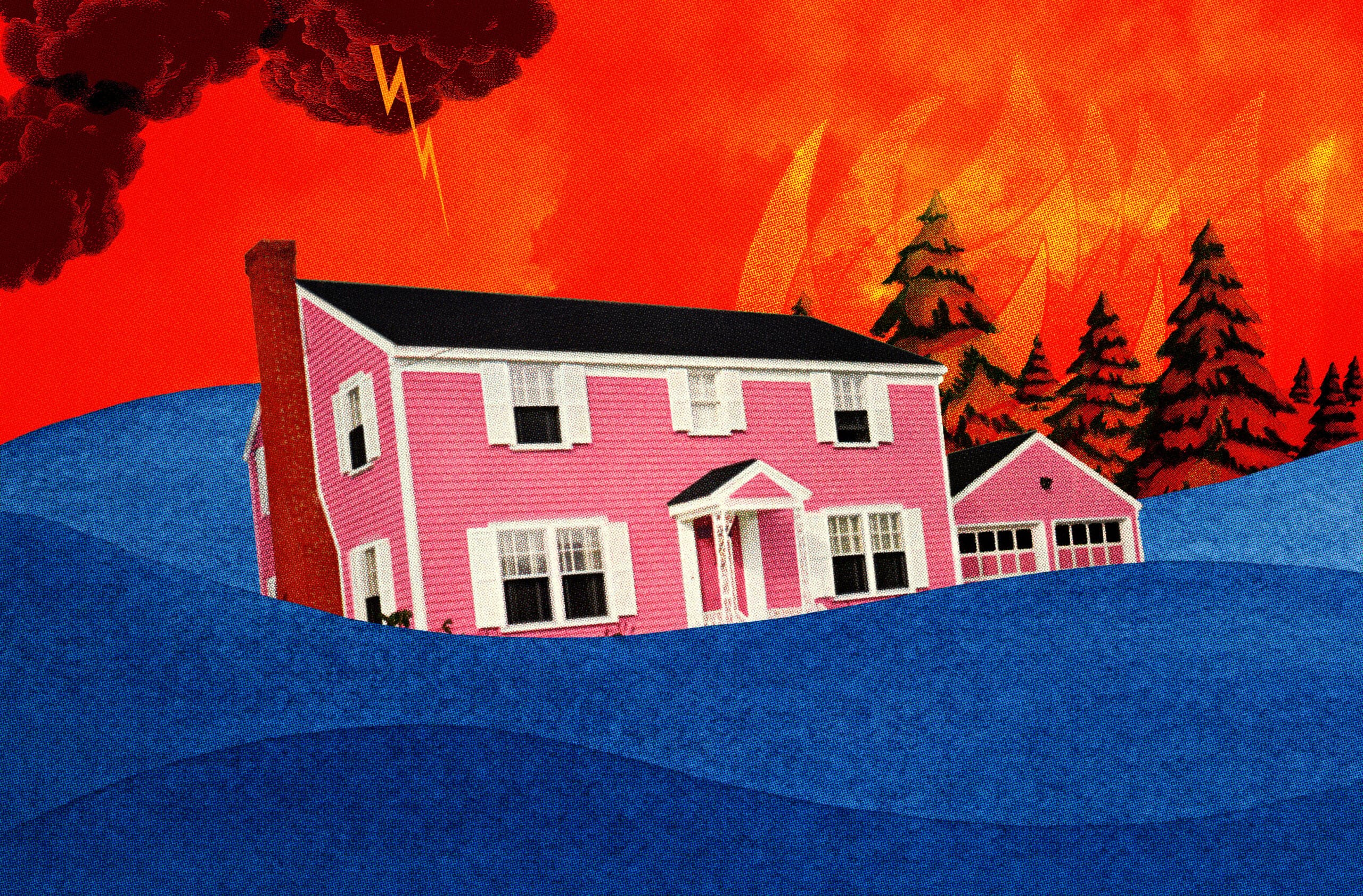
From British Columbia to Atlantic Canada, climate change is dismantling long-held assumptions about where and how Canadians can safely live. And because Canada’s infrastructure wasn’t built to absorb the destructive impacts of a changing climate, the longer-term affordability and accessibility of property insurance in Canada is increasingly at risk.
Related: The Fight For My Farming Future
Antiquated perceptions about profiteering insurers may persist, but Canada’s insurance companies actually lost money on property insurance in 2023 and 2024, driven by claims payouts related to climate losses. While Canada’s insurance industry remains well-capitalized and healthy overall, the current trendline isn’t sustainable. Insurers are having to raise premiums in areas of the country most acutely impacted by a changing climate. Property owners are seeing higher or peril-specific deductibles, reduced payouts for depreciated building components, and once-standard protections being reclassified as optional add-ons. These shifts are not arbitrary; they reflect the reality of providing coverage in parts of the country where climate change is already causing measurable loss, and are increasingly necessary for the industry to remain sustainable in the face of accelerating climate risk.
Canada now faces a choice. Will we become like parts of the U.S., where climate change has effectively made some regions uninsurable? Or will we accelerate efforts to improve the resiliency of Canadian communities, reducing the emotional, social and economic toll of increasingly frequent and severe weather?
It’s a stretch to expect Canadians to be seized with feelings of pride when they think about their insurance company, but most of Canada’s major insurers are now investing significant sums each year into climate and severe weather research, mitigation and adaptation. Granted, insurers have skin in the game when it comes to managing the soaring costs of severe weather, but much of this funding is oriented toward helping Canada fortify its resilience to climate change, not producing a direct financial return.
Related: I evacuated from Yellowknife this summer. Coming home was the hardest part.
At Wawanesa, we’ve given $5 million over the past three years to fund climate research and initiatives. But while Canada’s insurers are stepping up, the reality is that our contribution represents a small sliver of the funding needed to truly enhance Canada’s resilience to the growing impact of climate-driven severe weather. Climate change mitigation is vital, especially as our national emissions reduction progress has stalled, but the real money needs to go towards climate adaptation. That means protecting Canadians from the escalating hazards already causing real loss and harm.
Third-party research backs up what climate-impacted communities already understand: our country needs to dramatically scale up infrastructure investments, with billions in new annual spending to improve local resiliency and blunt the worst impacts of climate change. That means aggressively ramping up funded incentive programs that encourage property owners to retrofit buildings to higher resiliency standards, like installing hail-resistant roofing or fire-resistant siding. It also looks like more direct support for municipalities, which own and control most of the country’s under-resilient public infrastructure, better hazard mapping, and more stringent building code standards so that new residential and commercial infrastructures are built to withstand the hazards they already face.
This isn’t new thinking: Canada launched a National Adaptation Strategy in 2023, with 73 action areas centred on these very challenges. But progress remains startlingly slow. A 2025 report by Canada’s Auditor General concluded that federal departments “did not effectively design the National Adaptation Strategy” and that “the strategy did not prioritize Canada’s climate change risks.” The strategy’s accompanying action plan, the auditor general determined, “was neither systemic nor comprehensive.” The report also called out the pay-now-or-pay-later element of climate adaptation, saying, “Canadians will pay more to adapt the longer we delay action.”
Canada suffers an urgency gap when it comes to climate resilience. Public and government attention has been forcefully pulled elsewhere. When headlines are dominated by annexation threats, mercurial export tariffs, the uncertain future of the CUSMA trade agreement and the delicate matter of what Canada should do about all of it, climate resilience doesn’t command a lot of room in the nation’s headspace. But we need to solve for this, because things will only get worse in Canadian communities without intervention.
Related: Want to Flood-Proof a House? Make It Float.
The insurance sector has a role in amplifying this urgency, just as we have a responsibility to further the shift from a response-based posture to a preventative one, where we help property owners and communities reduce the likelihood of a climate-related claim in the first place. But most of the critical levers are beyond insurers’ direct control. We may have strong opinions about climate resiliency standards in building codes, intergovernmental wildfire response coordination, or not building new federally funded housing in known flood and wildfire zones, but these are ultimately public policy decisions. It’s why an appropriately resourced, coordinated and independently scrutinized national adaptation strategy remains essential.
If there’s an upside, it’s that there’s a generational opportunity here, and the business case isn’t particularly complex. As the federal government itself acknowledges, every dollar invested in climate adaptation avoids up to $15 in future disaster recovery, infrastructure damage or other costs. That’s an attractive return.
The call to accelerate climate adaptation is about more than safeguarding communities from weather-related perils; it’s an opportunity to create a blueprint for a renewed vision of nation building—one that holds long-term resiliency at its core. Canada’s future is already being reshaped by global uncertainty and instability. Our historical relationship with our largest trading partner and assumed protector is being rewritten in real time. Strengthening our own resilience—economically, socially and physically—has become essential.
Reassuringly, amidst the unfolding chaos, public appetite for initiatives that bolster the Canadian economy, drive stability and otherwise fortify the nation against a novel and evolving threat landscape has grown. The scale and depth of the threats Canada will face over the next decade are only beginning to be understood, but climate resiliency is an existential threat we can already understand, measure and, should we collectively choose, solve.
The auditor general’s recent assessment of the National Adaptation Strategy pointed out that Canada was one of the last OECD countries to develop a coordinated adaptation plan. The question now is whether we can together rise to the challenge of becoming the most resilient, where climate adaptation isn’t reduced to a policy debate, but becomes an expression of our shared purpose of building a stronger Canada.
David Leibl is the vice-president of sustainability and corporate affairs at Wawanesa Insurance.
Related Posts

Canada is Funding its Own Economic Decline
The Case for Tourist Taxes

American Carmakers Are Leaving. Bring on the Chinese EVs.
Venezuela Can’t Deliver the Oil America Needs. Canada Can.
Get the Best of Maclean’s straight to your inbox.
Sign up for news, commentary and analysis. Join 60,000+ Canadian readers.