The Arctic Needs Defending. Canada Isn’t Ready.
Canada’s Arctic defence infrastructure has shaped Jeannie Ehaloak’s life from the very start. After her father helped construct the Distant Early Warning Line—a chain of U.S.-built Arctic radar stations designed to detect incoming Soviet attacks—he took a job maintaining several DEW Line sites in Nunavut. It was here that Jeannie was born in 1963. At age four, she and her siblings were taken to residential school in Inuvik, 1,200 kilometres away from their family. When she returned home the following summer, she didn’t even recognize her parents.
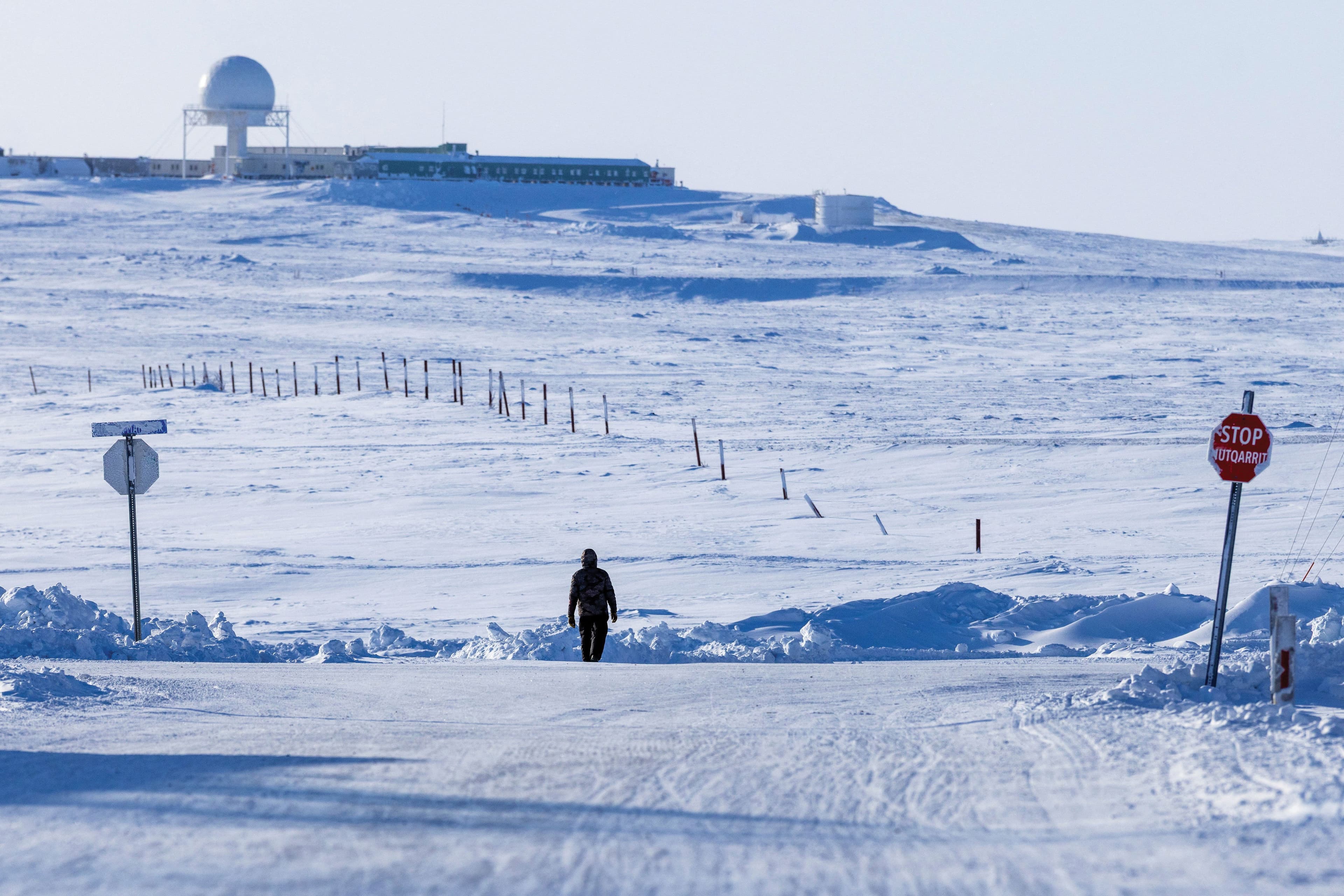
By the 1980s, the DEW Line had become technologically obsolete, with most sites decommissioned or upgraded to NORAD’s North Warning System, which monitors North American airspace today. But the defunct sites had left behind a time bomb of asbestos, heavy metals and petroleum byproducts leaching into the ground and water of Arctic communities. Eventually, Ehaloak became a mother, living in the hamlet of Cambridge Bay and working in the lands department at Nunavut Tunngavik Incorporated, the legal organization that represents Inuit in Nunavut. She oversaw some of the environmental remediation work on the DEW sites. Experience has taught her that the DEW Line, which had left such a toxic legacy, had served the interests of the south, not her community.
Ehaloak today is a petite, short-haired great-grandmother who works as director of strategic communications at Polar Knowledge Canada, the federal government’s polar-research agency. Her office is located in Cambridge Bay, at the Canadian High Arctic Research Station, founded in 2015—a legacy of Stephen Harper’s efforts to assert Arctic sovereignty. Before that, she served as the community’s mayor, from 2011 to 2017, and then as a Nunavut MLA until 2021. She spent most of her life, and her public-service career, within sight of those radar stations. But her years in office were marked less by concerns about national defence than by her constituents’ code-red crises: eye-watering food prices, overcrowded housing, unreliable water and sewage and the drag on economic prosperity and overall well-being that comes from being connected to the rest of the country by one short gravel runway.
Inuit communities like hers are once again on the frontlines of discussions about national sovereignty and defence. As the sea ice that once kept Arctic resources and shipping routes off the menu retreats, rivalries between Arctic countries—and self-declared near-Arctic ones, like China—are growing. Donald Trump’s 51st-state rhetoric, and his threats last winter to conquer Greenland, have made Canadians wary of our ostensible ally to the south as well. Eric Laporte, an executive director at Global Affairs Canada, has said that the government has gamed out how to respond if a U.S. warship were to transit Canada’s Arctic waters in an effort to undermine our claim to the Northwest Passage. This spring, Canada’s top general, Jennie Carignan, bluntly said that geography alone no longer guarantees the security of our northern flank. As a result, Canada is scrambling to reorient north-to-south as never before. Five of the 15 major efforts recently anointed by Mark Carney’s Major Projects Office are aimed at developing the North. After decades of underspending on what military experts call “domain awareness,” we are vulnerable to Russian and Chinese missiles, and upgrading NORAD will require nearly $39 billion alone, just to catch up.
But just like the DEW Line—which existed to protect communities in the south—much of the government’s new spending to fortify the North will do little for communities like Cambridge Bay, whose residents reside on Canada’s Arctic frontline. Much of the money will be spent on straightforward military needs: missile defence, drones and bases. Yet the most urgent threat facing the North is not a military incursion from a foreign power. Hostile states aren’t likely to come at the North with landing crafts and military strikes. Rather, the far greater risk is from grey-zone threats: covert schemes seeking to undercut Canada’s strategic interests and advance foreign political or economic ambitions. P. Whitney Lackenbauer is a Canada Research Chair specializing in the study of the North at Trent University and one of Canada’s leading experts on Arctic security. To him, the risks posed by foreign influence and interference are grave. “I’m not worried about an invasion of land forces on northern Ellesmere,” he told the Standing Committee on Foreign Affairs and International Development last October. His concern, instead, is “a whole bunch of interference activities” and “nefarious foreign actors” who may seek to undermine Canada’s own interests in the region.
Related Posts

The Doom Spenders

My Misadventures in Gentle Parenting
In fact, this has already happened. In 2022, Chinese bots fomented social media opposition to a Canadian company that owns a uranium mining project in northern Saskatchewan, as part of a larger campaign targeting potential competitors to China’s supply-chain dominance over rare-earth metals. The following year, Russian hackers launched cyberattacks on Hydro-Quebec and the ports of Montreal, Quebec City and Halifax. Assailants have also targeted northern institutions, including Nunavut’s energy supplier, Qulliq Energy, as well as researchers who work in the North. The culprits behind those breaches are unknown, for now.
The dire state of Arctic infrastructure and essential services—the kind of issues that preoccupied Jeannie Ehaloak during her time in office—amplifies that vulnerability. Canada is one of the most highly developed countries in the world, yet that narrative falls apart in the North. In Nunavut, one-third of Inuit live in homes in poor repair, compared to a national average of 7.4 per cent. Life expectancy among Inuit is 13 years shorter than among non-Indigenous Canadians. Rates of tuberculosis are 37 times higher than for the rest of the population. Infrastructure is deficient, with dramatic impacts on the region’s economy and quality of life. High-speed internet is a rarity—many of those who can afford it opt to get online via Elon Musk’s Starlink instead. In this era of geopolitical volatility and grey-zone tactics, a foreign influence campaign preying on Inuit inequality to undercut national solidarity poses a far more immediate threat to Canada’s sovereignty and security than the spectre of Russian missiles soaring over the pole.
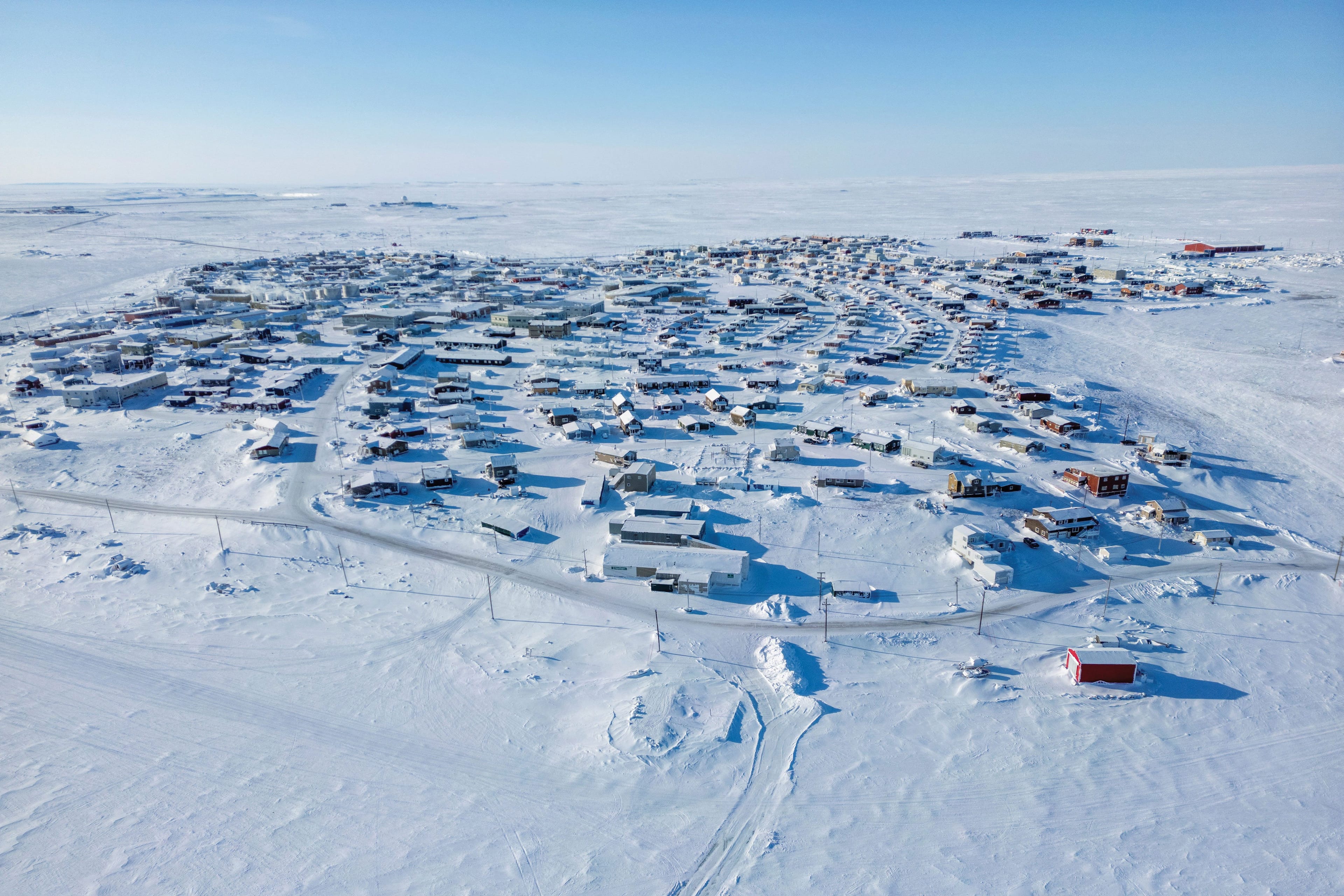
NORAD’s North Warning System site, huge and radiantly white on the outskirts of Cambridge Bay, has its eyes on the skies. But down on the ground, the community itself, whose presence asserts Canadian sovereignty in the Arctic, lives in what one young Inuk mother I met in Cambridge Bay called “survival mode.”
The same whole-of-society investments—into housing, transportation infrastructure and economic development—that can insulate the North against foreign interference can also leverage the region’s vast economic and strategic potential. Inuit Nunangat, the vast Inuit homeland stretching from the western Yukon to Labrador, comprises 40 per cent of Canada’s land mass. It makes up 70 per cent of its coastline. Its geology harbours 23 out of the 34 critical minerals found in Canada that modern economies need to move away from their reliance on fossil fuels (the same resources that China has strategically locked down to become the OPEC of critical minerals).
If Ottawa intends to build Canada into the great Arctic nation its geography dictates, it would do well to learn from the people and companies who have proven successful in the North, in large part by showing up as partners to those whose homelands span the region. Their success proves that if Canada can operate less on the terms of the south, and adapt to the ways of the North, it promises the world a model of a polar state unlike any other.
In some small ways, we are already on this path. Canada has an Inuit-Crown Partnership Committee, an arrangement unique among Arctic states, that ensures shared governance between the federal government and Indigenous leaders. CSIS is the only intelligence agency in the world that’s made commitments related to the United Nations Declaration on the Rights of Indigenous Peoples. The Department of National Defence’s Canadian Rangers program is a singular model of Indigenous defence collaboration, studied enviously by polar peers like Greenland, Alaska and the Sámi in Scandinavia.
But leaders like Natan Obed, president of Inuit Tapiriit Kanatami, the national organization that represents all Inuit in Canada, sees in the federal government a partner that holds itself back. “We still struggle with the inability for the federal government, and also provinces and territories in which Inuit reside, to imagine that we could have equity,” Obed says. “We’re still living with a limited imagination of what our communities could be.”
I arrived in Cambridge Bay at the end of last August, the start of the windy season. Three weeks earlier, the tundra had been carpeted in purple blooms of dwarf fireweed, but the colours of autumn greeted me on arrival: oranges and gold on the leaves of dwarf Arctic willow heralded the departing sun. Inuit have harvested and lived on this land for thousands of years, but the town’s precise location, on the southern shore of Victoria Island, was chosen as an RCMP and Hudson’s Bay Company outpost in the early 20th century; it grew further when the DEW Line site was built nearby.
Today the community is the hub of the Kitikmeot region, home to around 6,600 people, mostly Inuit, spread across nearly five per cent of Canada’s entire land mass. Fred Pedersen is the current MLA for Cambridge Bay, elected last October. Soft-spoken, with greying hair, he sports a closely shorn beard framing a button nose. When we met, he was serving as executive director of the Kitikmeot Inuit Association. “It’s grown,” he says of his community, “but in a sense, it’s also gone back in time.” He listed off recent regressions: worsening food insecurity, fewer and costlier sealifts from the south and a loss of jet service.
In 2023, the airline Canadian North retired the last jet that could land on the town’s short gravel runway. Now the community relies on smaller propeller planes, capable of carrying less cargo and fewer people. That’s driven up costs of tickets and air freight; the most basic round-trip flight between Cambridge Bay and Yellowknife currently goes for roughly $1,200, even when booked far in advance. Air travel is especially crucial in a community unconnected by road to the rest of the country. It’s necessary for medical purposes—flying specialists in, or flying patients, including expectant mothers, out. Cambridge Bay is also a regional hub where the Coast Guard and Navy cycle through crew changes. And when all of Yellowknife evacuated due to an advancing wildfire in 2023, the Western Arctic temporarily lost its largest hub for air travel. The best stand-in available was Cambridge Bay and its gravel airstrip.
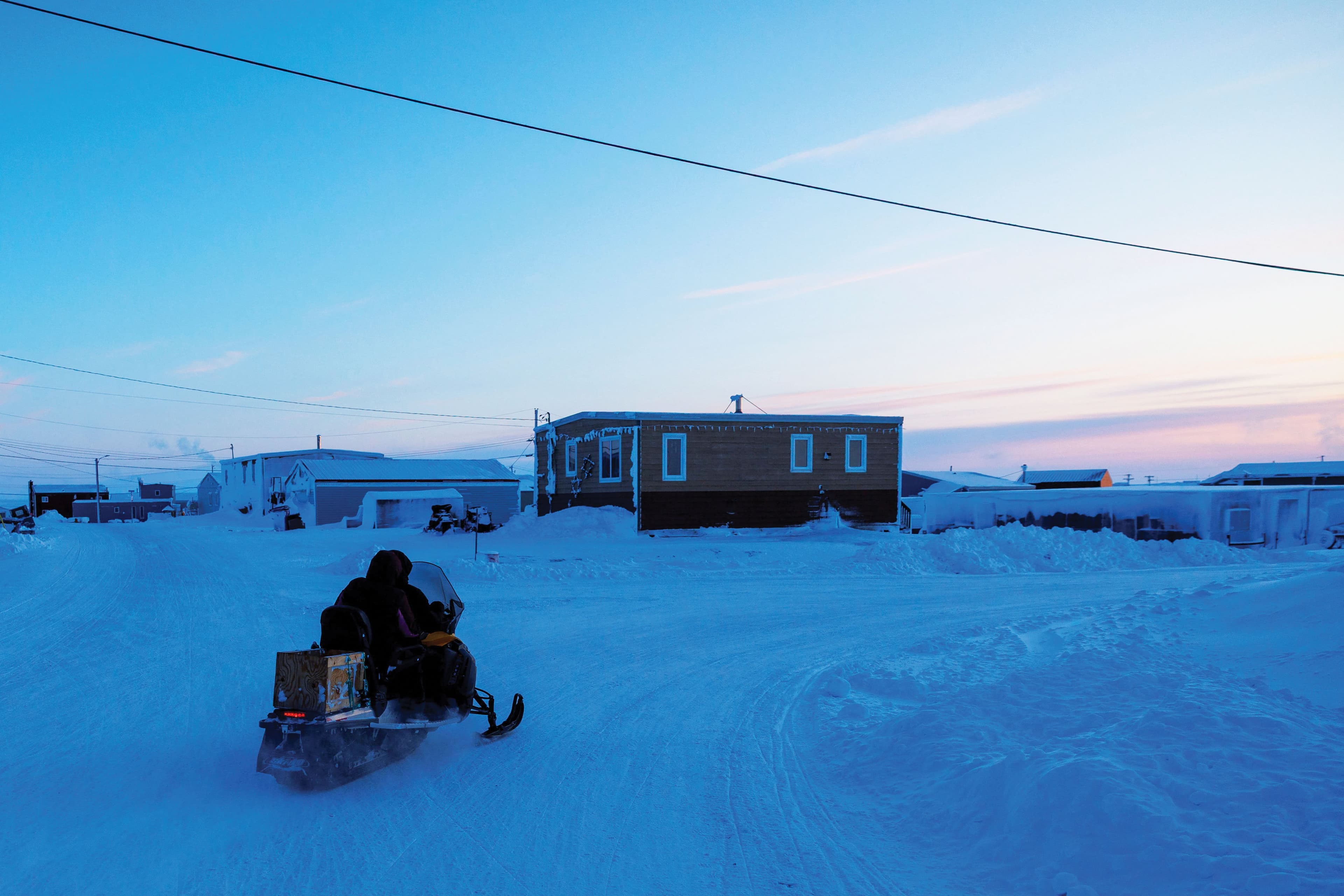
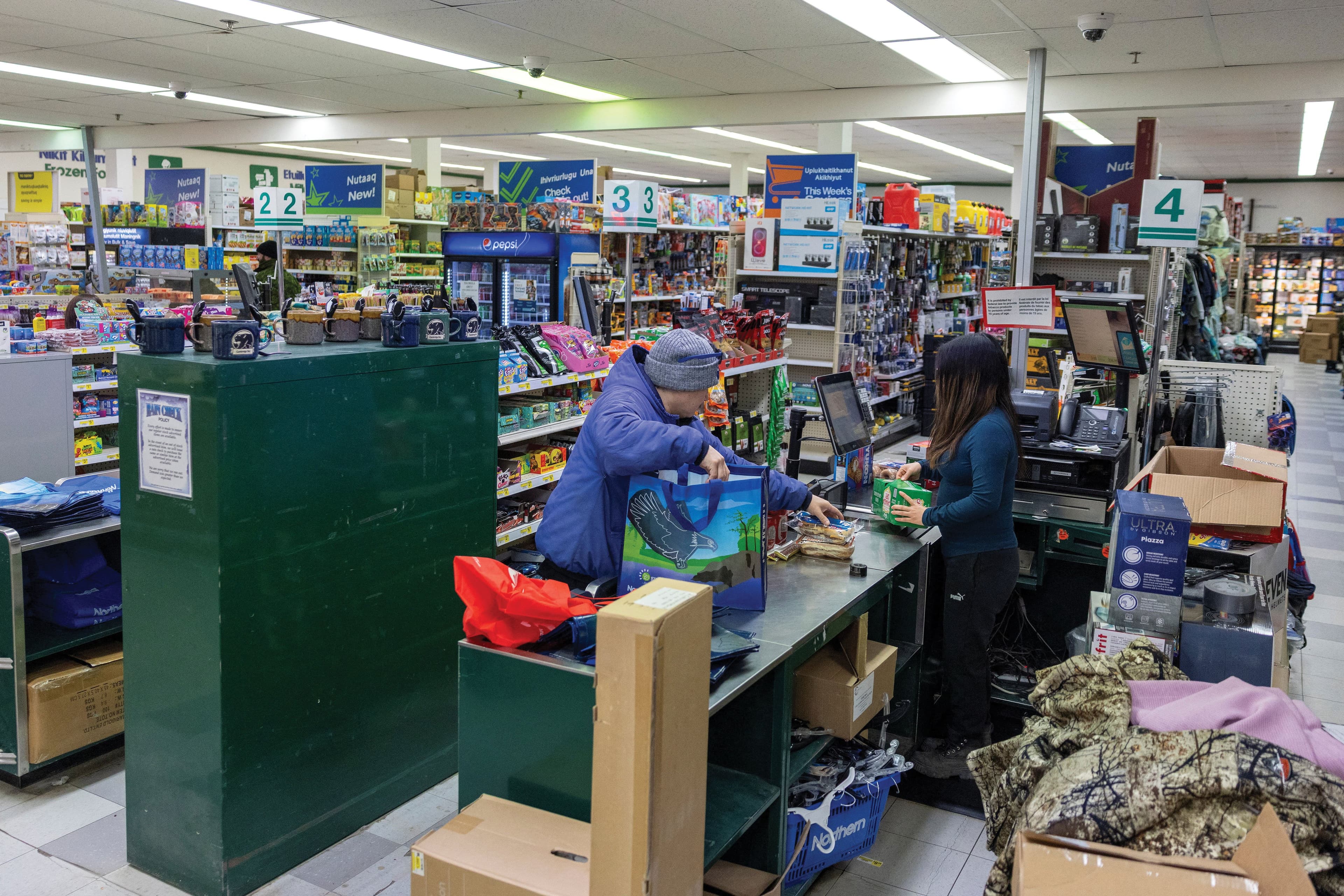
During my visit, the town was busy with the first of three sealifts for the year, arriving on cargo vessels from Montreal. These sealifts are a major event in town, when businesses and individuals receive all kinds of orders, including vehicles, fuel, groceries and consumer goods. The ship’s cranes unloaded shipping containers onto a barge, which brought them to the pebbly shore. From there, trucks hauled containers into town to resupply the two grocery stores’ warehouses. The sealift also included nine prefabricated homes for the Cambridge Bay Housing Association—in a hamlet of 570 households, there are 160 families on the waitlist for affordable housing, and it’s not uncommon for one residence to house three or four families. Outdoor homelessness is impossible given the climate, and ceaseless couch-surfing is a way of life for some. Others take turns sleeping on shared mattresses in shifts.
Mayor Wayne Gregory told me that infrastructure is often top of mind for him. Homes here aren’t on water and sewage lines, but rely on tanks that are serviced by trucks. In 2023, the community was slated to receive two new tank trucks to keep up with its growing population—but the supplier asked to redirect them to the Northwest Territories, to help battle wildfires. The ongoing delay has been a hardship for the residents, whose Facebook community page regularly featured requests for water and sewage service.
The importance of this kind of quotidian infrastructure to Arctic communities can hardly be overstated. When the main water line in Puvirnituq, Nunavik, froze and broke in March of last year, the impacts cascaded far beyond the stagnant water in people’s toilet bowls. Two homes were lost to a house fire, as limited water hampered firefighting—this in a community already facing a severe housing shortage. The two schools closed a full month early. And a doctor at the local hospital resigned after serving the community for five years. The final straw for her came when she admitted to the ER an extremely dehydrated child with gastroenteritis, whose home had been without water for weeks. Then, during the child’s stay, the hospital’s own water supply was cut off.
The high cost of living is another barrier to well-being. A weekly grocery shop in Cambridge Bay costs 50 per cent more than the same haul in Ottawa—I saw a box of Cheerios priced at $17.69. Until last year, the federal Liberals funded universal vouchers for Inuit families to feed and diaper their children, but that funding ended last year and was replaced with a more complicated needs-based application process that takes months for approval, if it comes at all.
By the time I visited Cambridge Bay late last summer, the local food bank had experienced an 80 per cent increase in use. The change left Mayor Wayne Gregory concerned not only for the well-being of his constituents, but for what the change communicated to locals about how Ottawa perceives them. “If you’re not helping us here with the basics, we don’t want to help you,” is how he sums up the local attitude.
Even as talk of Alberta separatism escalates, the potential for Inuit alienation is little appreciated—despite the potential inroads it creates for foreign powers seeking to take advantage of disenchantment toward a distant, seemingly indifferent federal government. Fomenting discontent, after all, is much easier among a population already disaffected for legitimate reasons. “I’m sure that CSIS sees all of this,” says Natan Obed, “and imagines the sovereignty threats for this country from external malicious actors trying to destabilize Canada through its own underinvestment in the Arctic.”
Canada’s intelligence agency has, in fact, explicitly described Inuit inequity as a national security threat. In 2021, CSIS cautioned Inuit leaders, including Obed, that foreign adversaries could attempt to gain a toehold in the Inuit homeland by making investments into infrastructure, scientific research and other private enterprises. In 2024, Northwest Territories Premier R.J. Simpson appeared on the Wonk podcast—hosted by former Globe and Mail editor Edward Greenspon—and described how Chinese interests had approached communities in that territory with offers to build infrastructure to get a foot in the door. Last year, Rob Russo, the Canada correspondent for The Economist, took part in a Q&A with Obed, during which Russo described a conversation he’d had with a former chief of defence staff. The former chief, he said, had suggested Canada’s military game out a scenario in which a Chinese destroyer anchors in a remote hamlet and beams free internet to everyone. And, this February, CSIS assistant director Paul Lynd warned Parliament of “predatory foreign investment” in the Arctic—particularly from China, which is keen to lock down supply chains and access to critical-mineral resources.
Months after I met with Cambridge Bay’s mayor, Wayne Gregory, he was in Iqaluit, attending the Nunavut Association of Municipalities’ annual general meeting. There, the chief liaison for CSIS in Nunavut addressed the gathering: “For the last two years, we’ve been making a point to say the infrastructure gap in Nunavut is creating national security risks,” he told the mayors.
The chess moves aren’t limited to straight-up capital investments. As recently as this February, CSIS confirmed to Parliament that the agency has tracked efforts by foreign countries to conduct social media disinformation campaigns to drive discontent with the federal government in the North. If anything, CSIS’s concerns seem to be more pronounced now, at least publicly. Cabin Radio, a news outlet in the Northwest Territories, reported on CSIS senior manager Jarrett Davis’s appearance at a cybersecurity panel during the Arctic Development Expo in Inuvik last year. Davis described how hostile states were engaged in “real-life targeting” of defence contractors, researchers and geopolitical experts. “Let me be very, very clear,” he said, “that from a national security threat space, the threat actors are already here.”
The irony is that many Inuit, in spite of a difficult history, exhibit a patient faith in Canada to do better by them. “There is an optimism in Canada as a nation state that is in some ways inexplicable,” says Obed. Former Nunavut premier P.J. Akeeagok has described how the Canadian government relocated his family in the 1950s, from northern Quebec to Grise Fiord—the northernmost community in Canada, created by the feds in 1953 for the express purpose of demonstrating sovereignty over the Arctic. Akeeagok’s family were, in his own words, “human flagpoles,” staked down in a harsh, unfamiliar environment. Yet last year, speaking at an event in Toronto, Akeeagok said, “I am probably one of the proudest Canadians you’ll ever see.” In part, he said, because he knows the sacrifice his people made for this country.
“Nunavummiut still want to be part of Canada, even though Canada doesn’t invest in them enough,” said Lori Idlout, Nunavut’s member of Parliament, who was in Cambridge Bay at the time of my visit. “I still see the pride that they have to witness Canada meet its actual potential as a great northern country.” But that good grace is not likely to be infinite.
The Hope Bay gold mine site lies 150 kilometres southwest of Cambridge Bay, on Bathurst Inlet, along the Northwest Passage. In 2020, it was owned by a company called TMAC Resources, which was in the process of being bought by Shandong Gold Mining, a majority Chinese state-owned enterprise. At the time, China was buying heavily into Arctic and northern mining operations and was seeking inroads into infrastructure plays in the region. Another Chinese state-owned firm had bid on construction contracts for three new airports in Greenland, and Chinese state-owned MMG Resources had bought lead, copper and zinc deposits in western Nunavut. But in December of 2020, the federal government blocked Hope Bay’s sale to TMAC, which would be Chinese-owned. This was the first time a Chinese investment in the mining sector was halted under the Investment Canada Act, which permits the government to review foreign investments for national-security concerns. That’s when Canadian mining company Agnico Eagle entered into negotiations to acquire the mine, its fourth in Nunavut. It paid $286 million.
When I visited, Agnico was undertaking exploratory work at the site. “This is the largest exploration under way in Nunavut right now,” Alex Buchan, Agnico’s director of Nunavut affairs, told me over the roar of helicopters slinging fresh rock samples. The geology here has undergone three bouts of continental collision and subduction, transforming 2.7-billion-year-old volcanic rock into the stone I glimpsed inside Agnico’s core shack, where rock cores are logged before they’re sent south for analysis of their gold content. This May, Agnico confirmed that it intended to move past the exploratory phase—so far, the measured and indicated resources at the mine come to 5.8 million ounces, which could yield US $1.9 billion worth of gold per year at today’s prices. The mine will be partially powered with wind turbines, bankrolled by the feds and operated by an Inuit-owned company. The mining giant will share its know-how of infrastructure delivery with the military.
Since Hope Bay is located on Inuit-owned land, Agnico is only a temporary visitor. Inuit in Nunavut have developed strong governance around mines like Agnico’s. The rewards for Kitikmeot Inuit from its development would be significant. B2Gold’s mine at Goose Lake, south of Cambridge Bay, for example, poured its first gold in June. It confers benefits on the Kitikmeot Inuit Association through a negotiated Impact Benefit Agreement, including royalties, minimum Inuit employment levels and preferential treatment for Inuit contractors. As lucrative as such mining operations can be, they are costly—Hope Bay’s capital expenditures run upwards of US$2 billion per year. The logistics of standing up an entire mine, including runways, generators, worker housing and everything else, are also incredibly challenging. Agnico’s operations at Hope Bay resemble a self-contained space colony.
But the company is well aware that it isn’t operating in a vacuum. There is, in fact, a collaborative, put-it-to-use mentality at the site that seems common to both individuals and enterprises who succeed in the North. When Agnico realized its unused sheet metal was the same type that Cambridge Bay needed to repair its dock, it arranged to deliver it. When Iqaluit’s water supply was contaminated in 2021, Agnico flew in 15,000 litres of bottled water. And last year, the company partnered with the Nunavut Housing Corporation to transport 20 modular homes on its northbound sealifts.
In 2023, when a wildfire struck Bathurst Inlet—where many Nunavut Inuit make seasonal camp—B2Gold lent one of its helicopters to the territorial government and hosted evacuees at its marine laydown area. That same year, when NORAD shot down an object out of the sky over the Yukon (initially thought to be a hostile spy balloon, but later attributed to a hobby club in Illinois), the regional airline Air North stepped in with de-icing equipment to support the Canadian Armed Forces.
These are all commendable examples of a whole-of-society ethic by private enterprises. It is also a reflection of Canada’s flimsy social contract with its Arctic citizens that the first and most effective responders to their security and safety needs are private corporations. It’s easy to understand, in this light, why the government nixed China’s chance to establish similar soft power in the region—and why, as recently as 2024, Chinese ambassador to Canada Wang Di visited Iqaluit. Speaking through a translator to Nunatsiaq News reporter Arty Sarkisian, the ambassador expressed sorrow that Shandong’s acquisition of Hope Bay didn’t proceed. But he added that China stands ready to enhance exchange and co-operation with Arctic Canada.
Early last September, the CCGS Sir Wilfrid Laurier was anchored in the bright, azure waters of Cambridge Bay, readying for a crew change and resupply. The 40-year-old icebreaker made headlines last summer when it journeyed from Japan to Alaska, apparently shadowing a Chinese polar research icebreaker, the Xue Long 2, which was voyaging into the Chukchi Sea, between Russia and Alaska. It turns out the parallel voyages were coincidental—though the Royal Canadian Air Force did dispatch a plane to babysit the Xue Long through the Bering Strait, for good reason: “A lot of what the Chinese are doing from a civilian scientific point of view has very clear, very obvious military implications,” says Adam Lajeunesse, a marine security expert at St. Francis Xavier University. China has been sending more and more vessels into the Arctic in recent years, ostensibly to conduct civilian scientific work. But data on water conductivity, temperature and depth is also handy for improving detection capabilities of submarine sonar, among other applications. In fact, China’s 2020 textbook The Science of Military Strategy is explicit about blurring those lines between the civilian and military realm. “Military-civilian mixing is the main way for great powers to achieve a polar military presence,” it states.
Though the rumours of a trans-Pacific cat-and-mouse chase turned out to be untrue, a comparison between the Sir Wilfrid Laurier and the Xue Long 2 is nonetheless instructive. On the face of it, the two icebreakers couldn’t be more different. The Sir Wilfrid Laurier, built in 1986, is vintage, having recently undergone life-extension work to keep it running. Its diesel-electric generators are brand new, but the worn-in brown pleather sectionals in the officers’ lounge and the gilt-framed nautical prints belie its 1980s roots. The Xue Long 2, by contrast, sailed from the Jiangnan Shipyard in Shanghai just seven years ago, the first made-in-China icebreaker, operated by the Polar Research Institute of China.
But there is one important similarity between them. Last fall, the Canadian Coast Guard was transferred from the Department of Fisheries and Oceans to National Defence. This allowed the government to get closer to its NATO defence-spending commitment, as well as make use of the Coast Guard’s icebreaking fleet to monitor and gather intelligence during routine work. And now, the federal government’s Bill C-2 proposes expanding the Coast Guard’s role to include intelligence gathering and security patrols (it has not yet passed). These changes mean that, like the Xue Long 2, the Sir Wilfrid Laurier will have both civilian and military utility.
Such considerations seemed far out of mind for the crew the day I visited; there was simply too much to do. The ship was hosting the Cambridge Bay Coast Guard Auxiliary, readying for a crew change and squeezing in maintenance, and GPS logging on the bright orange navigation aids that line the shores of Cambridge Bay and provide guidance to ships as they navigate its shallow entrance. In a season, the ship’s crew will maintain about 90 of these. It’s not glamorous work, but the marine lanes here are a lifeline in summer’s open water, making sealifts from points south possible. After lunch, the Laurier sent its helicopter back out to squeeze in more work. The five-person crew, from the Coast Guard, Transport Canada and the Canadian Hydrographic Service, repainted, greased, tightened and logged location data on the navigation aids. There was also seafloor-mapping work to digitize marine charts. The ship reminded me of a Swiss Army knife, with all its tools deployed at once.
I also saw, in how the Laurier’s crew worked together, an echo of ikajuqtigiinniq: the core Inuit value of working together, in service not of individual needs but of collective well-being. It turned out to be an echo of a deeper compatibility between the Coast Guard and the community on shore. Until 2018, Arctic waterways fell under the Coast Guard’s Ontario and Prairie region. That year, the Department of Fisheries and Oceans announced the creation of an Arctic administrative region—a joint priority of Canada and Inuit, first identified by the Inuit-Crown Partnership Committee. This was the first time that a federal department reorganized itself around the four regions of the Inuit homeland. Neil O’Rourke was the first assistant commissioner for the Arctic region. “We arrived with the understanding that we have to do things differently in the North, and that there is an opportunity to do that better in partnership with Inuit, First Nations and Métis,” he says. The end result is a branch of the federal government that spliced Inuit values into its own DNA. The charter of values that the Coast Guard’s staff developed for the Arctic region was based on the eight guiding principles of Inuit Qaujimajatuqangit—traditional Inuit knowledge and epistemology. It’s now part of the orientation for new employees.
The week after I visited the Sir Wilfrid Laurier, the ship helped a Dutch-flagged cargo vessel that had run aground in the Franklin Strait. It is possible that it had veered off the shipping channel into poorly charted waters to avoid sea ice and struck bottom. The incident underlined a growing hazard in the Northwest Passage: even though sea ice is melting, the route is becoming more dangerous, not less, as ice breaks up and finds its way into channels it hadn’t previously. And in the Western Arctic, the very navigation aids the Coast Guard is diligently maintaining are threatened as the frozen shoreline they stand on thaws and washes into the Beaufort Sea.
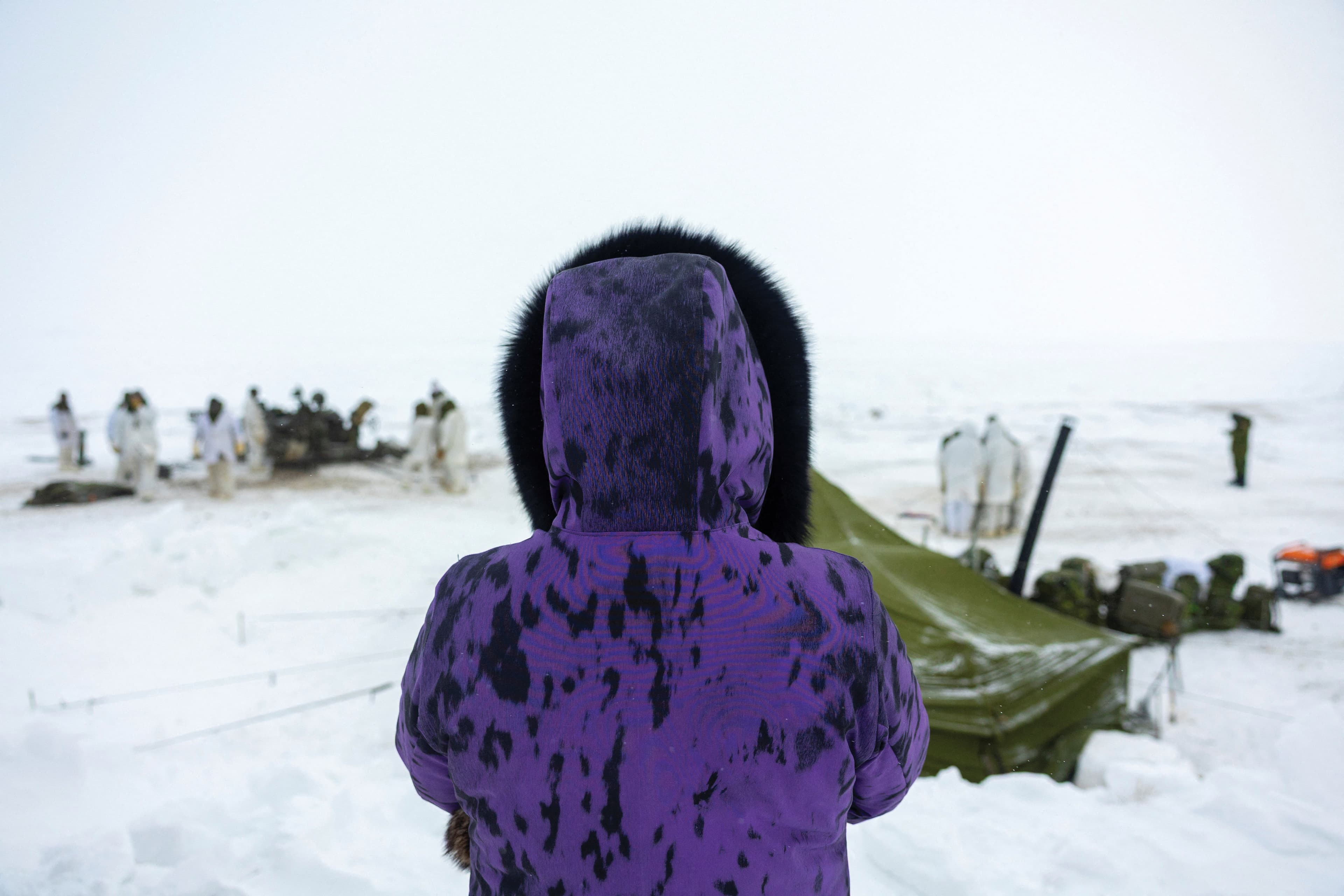
Seven months after my visit to Cambridge Bay, the hamlet was announced as one of the Canadian Armed Forces’ Northern Operational Support Nodes, to provide facilities and services for defence deployments. When I spoke to the mayor, Wayne Gregory, who had met with the defence department several times in fall and winter, it was clear that things were different than in the past: community needs were foregrounded, unlike in the Cold War era, when they were ignored.
“What was said and led with is that the infrastructure money is now going to be all dual-purpose, so the community and the Canadian Armed Forces both benefit,” Gregory says. “They didn’t give us a list of things that they wanted; they asked us what we wanted.” So Cambridge Bay might finally see its dusty gravel runway paved, after years of advocacy going back to Jeannie Ehaloak’s days as mayor.
It’s a much heavier lift to build the type of sustainable, long-term prosperity that ensures Canadian sovereignty in the Arctic. The military is now clearly demonstrating its ability to partner with communities and is putting its newly plentiful defence dollars to work building dual-use military-civilian infrastructure. Still, there’s only so much they can do to ensure the Arctic doesn’t have a giant “Welcome, Foreign Interference” sign.
During my time in Cambridge Bay, I saw firsthand the chasm between Ottawa’s rhetoric on Arctic sovereignty and the lived reality among those who make it Canadian territory—those citizens who are there for our country, but who have been habitually overlooked. The region’s greatest value, it seemed to me, was not in the gold underfoot but in its people, and their culture and values. During my stay, Nunavut News columnist Navalik Tologanak took me under her wing. One afternoon, she brought me to the town’s outskirts, where Arctic char were running upstream in abundance. Inuit flanked the riverbanks with rods out, water and fish scales sparkling, an embodiment of the Innuinnaqtun word for Cambridge Bay, Iqaluktuuttiaq, meaning “a good place to fish.” Another time, she pointed out the soft and expansive pastel-hued sky, reminding me that Nunavut means “our land.” In the time I spent in her company, I noticed that she and other Inuit women would greet each other not with “hello” or “hi” but a soft “you are beautiful” or “I love you.” It told me something of how Tologanak approaches the world and sees her people. It showed me how much this community treasures itself. As our nation struggles to chart its path as a middle power in a geopolitically volatile, rapidly warming world, the time has come to learn from those that predate us on this land.
It’s not as if the nation’s history isn’t rich with lore about what can happen if we don’t. In the mid–19th century, British polar explorer Sir John Franklin led two ships into the Northwest Passage to navigate the fabled Arctic sea route. Franklin and his crew made little effort to communicate with Inuit and stuck to their British naval ways. His expedition wound up trapped in ice, and all 129 of his crew perished. Half a century later, Norwegian explorer Roald Amundsen made another attempt at the passage. Using a nimbler ship and a smaller crew, he worked together with Inuit, who advised him on building igloos, using sledges and clothing his crew in furs. Amundsen listened, learned—and survived.

This story appears in the July 2026 issue of Maclean’s. You can buy the issue here, subscribe to the magazine here or send a gift subscription here.
What did you think of this story? Send a comment for publication to letters@macleans.ca, and supply your name and address. Comments should be fewer than 200 words, and may be edited for length and clarity.
Related Posts

The Battle for the Soul of the University

My Secret Addiction

The Rich List
Big Tech v. Me
Get the Best of Maclean’s straight to your inbox.
Sign up for news, commentary and analysis. Join 60,000+ Canadian readers.