Canada’s New Global Identity
Canada is at a crossroads, challenged on the outside by the bullying tactics of our American neighbour and on the inside by showboat provinces set on doing things their own way. One elbow is up and the other is still firmly taped to the hip. Prime Minister Mark Carney himself embodies this dual approach, cajoling with one hand and pushing away with the other. Part Mr. Nice Guy, part Mr. Hard-Nosed. Could this become Canada’s bold new image?
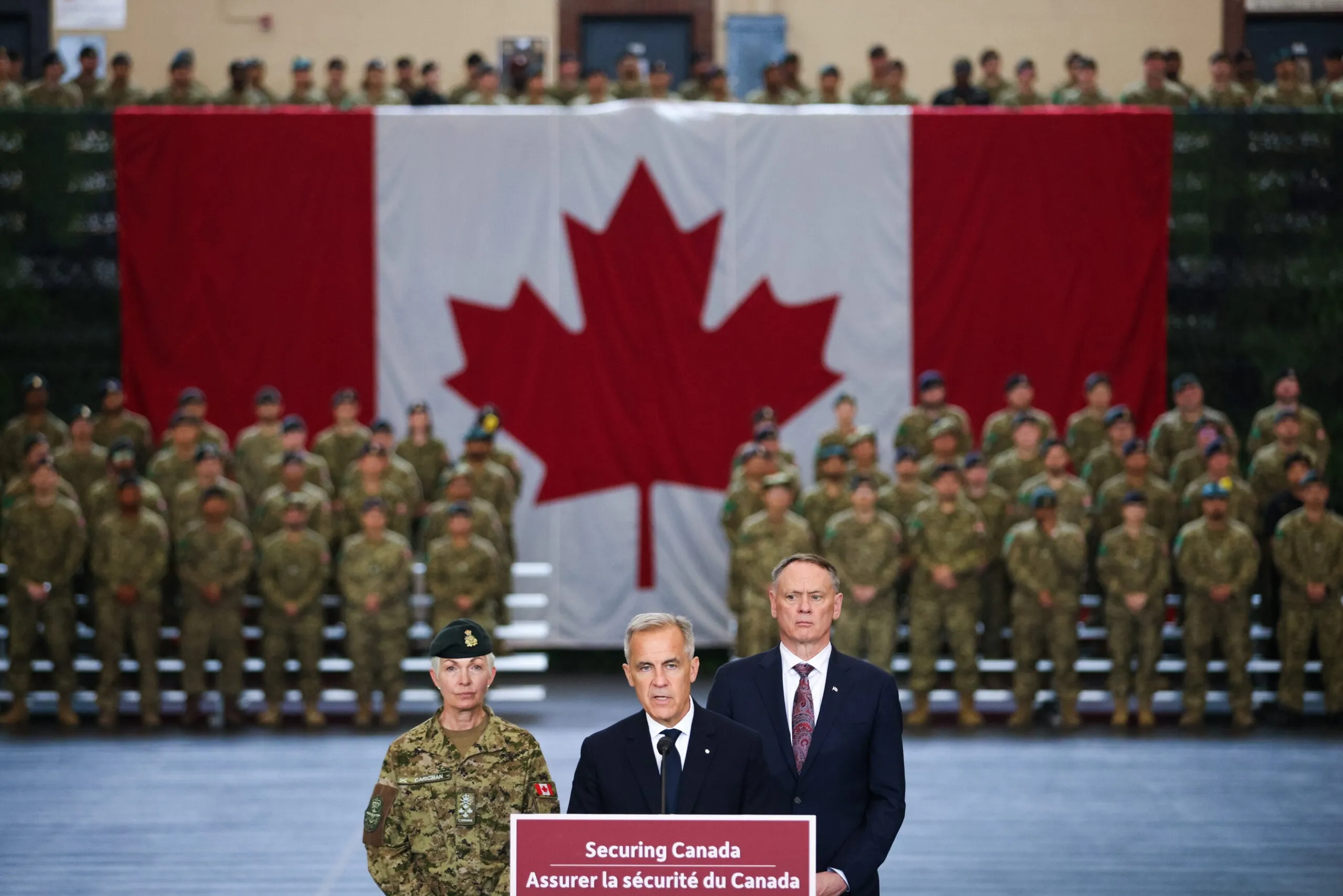
Canada must rethink itself. That much Carney has made clear. We can no longer count on the protection and goodwill of the United States nor on the stability of the world around us. Canada, by William Lyon Mackenzie King’s definition, has “too much geography and too little history.” It has long been a defensive nation, and it’s now being asked to morph into an offensive one. This transformation implies more military might, a fighting disposition, a new vision of the world and, at the end of the day, a different identity. Can the peaceable kingdom pull it off?
Related: How to Fight Back
For the last 250 years, Canada has been synonymous with impossible dreams, idealism rather than pragmatism, being high-minded and nice rather than bloody-minded and tough. In the wake of the Battle of the Plains of Abraham, for example, pragmatism would have dictated the assimilation of French settlers into the British fold. It’s what conquering nations do. But, faced with stiff resistance, British authorities allowed les Canadiens to keep their faith, civil law, seigneurial system and, later, their language, establishing the blueprint of a Byzantine nation for centuries to come.
Following Confederation, sheer practicality would have also required Canada, barely four years old and only four million strong, to forgo the task of building the world’s longest railway across a vast, unexplored territory. Composed of three distinct nations—English, French, Indigenous—it was said the newly minted country could never become a proper nation state. “When the experiment of the ‘Dominion’ shall have failed, as fail it must, a process of peaceful absorption will give Canada her proper place in the Great North American Republic,” wrote the New York Tribune at the time.
But the Dominion survived, and with it the idea of a divided but willful nation committed to peace, order and good government—committed to making the unreasonable work, despite the odds. Established in 1963, the Royal Commission on Bilingualism and Biculturalism was yet another example of this peculiar brand of Canadian idealism. The B&B Commission sought to define the country as an equal partnership between French and English but, ultimately, was unable to limit itself to a strict vision of a bicultural Canada, “if only because many Canadians of immigrant background do not recognize themselves in this understanding of the country,” wrote the commission’s co-chairs. While commendable, this high-mindedness essentially doomed the mission while revealing what would soon become English Canada’s distinguishing feature: multiculturalism.
And so evolved the notion of a kinder, gentler nation (despite the neglect and abuse towards First Nations, needless to say). A country more closely identified with universal health care than individual freedom. It’s this image of the nice Canadian, long in the making and more profound than meets the eye, that is being challenged today. There’s something to be said about a country that embraces long bumpy roads and the challenge of diversity over the more comfortable alternatives. The days of the benign Canadian, however, the guy happy to get stepped on, are over. If the polls are any indication, not to mention the thrilling spectacle of the Blue Jays during the World Series, Canadians feel the need to stand up and be counted.
Thanks to Donald Trump, there has been a surge in Canadian nationalism, though most people would be hard-pressed to describe what it consists of. Long dwarfed by American exceptionalism—the belief that, due to its history, ethics and political institutions, the United States is a superior nation with a special role to play—Canada has defined itself as the psychological opposite of its fearsome neighbours. Justin Trudeau’s famous description of Canada as the “first post-national state” epitomizes the Canadian predilection to say what we are not, rather than what we are.
Related: The Architect of Canada’s Anti-Americanism
Today, threatened by the very country we most count on, we see how dismally inadequate that definition is. Mark Carney has lost no time beefing up the country’s profile on the world stage. With new economic alliances, revamped foreign policies and increased military spending, the Prime Minister is sending the message that, “Yes, Canada can,” rather than reinforcing our Boy Scout image. It’s a more virile stance as well as a decidedly more conservative one. For the time being, at least, there is an overall sense of relief that the man at the top is reckoning with these fickle times. But tinkering with Canada’s international image, giving it more heft and drive, is the easy part. Much more difficult, and way overdue, is defining the country. What is Canada exactly? What should it strive to be?
Canada was built on the notion of dissonance. Like it or not, piecing together what is not supposed to fit is the backbone of this country, our main strength. The fact that we are a disjointed nation is never going to change. But we’ve often acted as if it should. The failure of the Meech Lake Accord in June 1990 is a case in point. Rather than welcoming our differences, being actively interested in them, we’ve simply paid lip service to them or, worse, begrudged their existence. That is the problem with idealism: it’s great in theory but not in practice. Both Quebec and First Nations have suffered from a general indifference to their unique predicaments.
Today, Canada’s basic fragmentation, French, English and Indigenous, is compounded by fragmentation within English-speaking Canada itself—Alberta, first and foremost. After being Quebec’s harshest critic, Alberta is now copying La Belle Province’s tactics, going so far as to threaten separation, but without a cultural leg to stand on. Being a conservative province in a mostly liberal country is not the same as being a French province in a mostly English country, or an Indigenous community in a predominantly white nation. There is no danger of Alberta ever disappearing. Yet, by agreeing to major fossil-fuel projects over the next 25 years, the Prime Minister has just handed Alberta the keys to the family car.
This astonishing move is in keeping with the PM’s dedication to improving our economic prospects. And, for now, weighed down by the affordability crisis and the frightful Trump himself, Canadians are nodding along. But for how long? If Canada needs rethinking, it can’t simply be on an economic level. The memorandum of understanding between Alberta and the federal government has already revived old grievances in Quebec and amongst First Nations. Drill-baby-drill will never be a unifying cry in a mostly progressive country with sharp cultural divides to boot. Mr. Carney needs to envision the country through a wider lens and focus on embracing Canada’s multitudes.
Beyond Trump’s tariffs and the necessity of carving out a new economic global order, the bigger worry—in the Western world, at least—concerns democracy. Trump’s theatrical coup in Caracas heightened these fears exponentially. “Any notions of international law, territorial integrity, the UN Charter, the interests and rights of other countries are now so much fluff,” wrote former UN ambassador Bob Rae. There are no rules, the gloating U.S. president said, that he needs to follow, save “his own sense of morality.” Can democracy survive a growing disregard for human rights and the rule of law? Crumbling institutions? Anti-elitism and populist uprisings? Disinformation and echo chambers? Egomaniacs and might-is-right authoritarians? Those are the more essential questions haunting us today, questions that Prime Minister Carney can no longer avoid in hopes of securing stronger economic alliances. Indeed, how Canadian principles and values square with a revamped economic relationship with China was the elephant in the room during the PM’s announcement of the recent trade deal. Increasingly, there is a growing unease that Carney might be carrying realpolitik a tad too far.
If Canada needs to take the world a little more as it is, then the Prime Minister himself must take Canada as it is. Try as we might, we will never be an economic powerhouse, but we do have a leg up in terms of upholding democracy. This country has so far resisted the white nationalism that has infected the United States and many European states and paved the way to authoritarian rule. Canada is a democratic nation in good standing and an expert on non-homogeneity. We are the “mosaic” to the U.S.’s “melting pot,” recognized on the international stage as a keen defender of pluralism and minority rights. We need to run with that ball, if only because it is the future of this planet, if there is to be one: finding common purpose in an increasingly diverse, complex world.
Related: Why Trump’s Tariffs Didn’t Break Canada
But first Canada needs to reinforce its domestic democratic pedigree. The challenge of finding our place in today’s fragmented world should start with embracing our own fragmentation. We must recognize our cultural divergences as a strength, not a weakness. By becoming more aware of how this country was built and what makes us tick, Canada needs to deepen its notion of itself. That means recognizing distinct requirements for distinct parts of the country, all the while selling such deals to the country as a whole. Tall order. To succeed, Canadians will have to be better acquainted with other parts of this country. Let’s face it: we are dismally ignorant of one another and have been for as long as Canada has held together. If we are to reimagine this country, then perhaps we should start there.
So, yes, part Mr. Nice Guy, part Mr. Hard-Nosed might just be Canada’s bold new face. One hand extended toward one another, one sharp elbow warding off exterior menaces.
Francine Pelletier is the author of Dream Interrupted: The Rise and Fall of Quebec Nationalism.
Related Posts
Carney’s Biggest National Project is Mythmaking
Carney Is the Crisis Manager Canada Needs
My Adventures in Greenland
Alberta Treaty Law Could Decide the Arctic
Get the Best of Maclean’s straight to your inbox.
Sign up for news, commentary and analysis. Join 60,000+ Canadian readers.