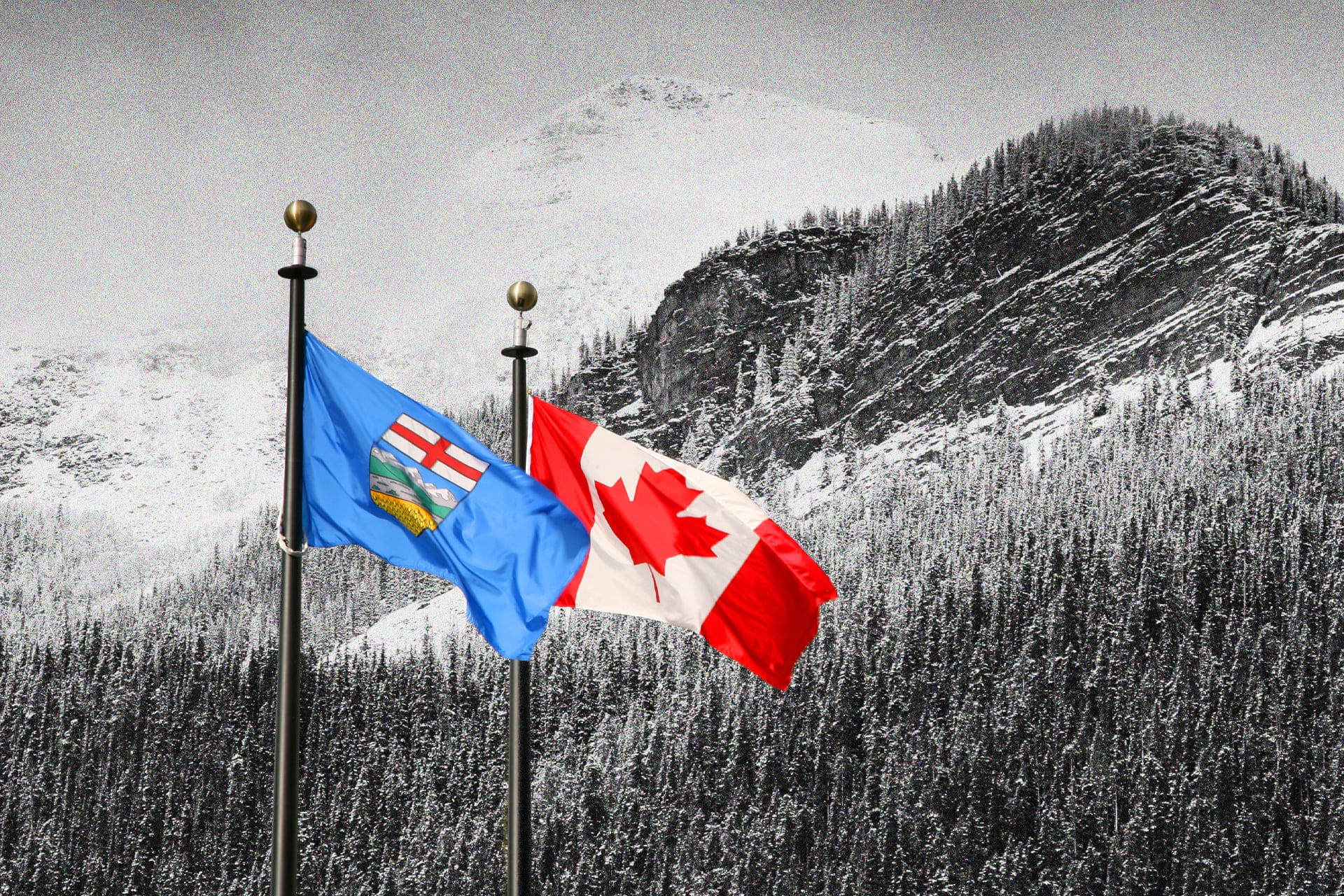
Why I’m Forever Canadian
To explain the roots of my patriotism, I have to tell you about my father, who immigrated from Sicily to Canada as a baby in 1930. He was obviously too young to enlist when the Second World War broke out, but he later joined the Royal Canadian Naval Reserve as a young adult. My siblings and I spent our childhood Saturday mornings paddling around the HMCS Chippawa swimming pool in Winnipeg, taking in all the nationalistic military paraphernalia—and what was then our brand-new Canadian flag. Back at home in nearby St. Boniface, a mostly Francophone community, friends and schoolmates referred to themselves as “French-Canadians.” When I asked my dad if we were Italian-Canadians, he stated with authority that, if we were born in Canada, we were just Canadians. If we had any other doubts about where our allegiance belonged, he’d again set us straight: country, not province. Question period closed.
The winds of separatism have long blown back and forth between Quebec and Alberta, where I moved in 2019. The latest flare-up in Wild Rose Country followed last year’s federal election. A Conservative win might have temporarily appeased the discontented; instead, a largely unexpected Liberal victory fuelled support for the Alberta Prosperity Project, or APP, a well-oiled, ably funded separatist group skilled at disseminating its message. They spouted the usual old grievances—namely, a distaste for equalization payments and the fact that, they said, Alberta’s interests are consistently underrepresented in Ottawa. But they also put forth a new, shiver-inducing vision that smacked of MAGA propaganda. It starts with, “For prosperity and the protection of individual freedoms and rights for all Albertans, codified by a new ‘Constitution of Alberta’ that recognizes the Supremacy of God as foundational to Civil Society and the Rule of Law…” Last summer, they backed “Stay Free Alberta,” a citizen-led petition to put provincial secession to a referendum vote.
Related: I Don’t Recognize Alberta Anymore
In the past, I’d blame Alberta’s erratic chinooks for my sleeplessness, but as of last year, the new culprits were midnight visions of separatists taking cleavers to our borders, removing us from Canada altogether. I had to do something. I soon came across a Facebook group that shared my sentiments on separatism. They called themselves Forever Canadian, and they were putting together another citizen-initiated petition, this one to request a referendum centred on a simple question: “Do you agree that Alberta should remain in Canada?”
The group coalesced under the leadership of Thomas Lukaszuk, a former deputy premier and well-known MLA whose family fled Poland for Canada more than 40 years ago. Forever Canadian was, in part, an expression of his gratitude for the open-armed welcome they received. After Elections Alberta approved their application for a petition last July, I signed up as a canvasser. It was something I could do from a lawn chair, while still rebuffing the gathering clouds of sedition.
A large number of Forever Canadian’s volunteers were retired Albertans who came from all walks of life. I canvassed alongside two former corrections officers and a former business owner, as well as farmers, teachers and nurses. Our squads propped up homemade signs, small, wobbly bistro tables and a few chairs on any public patch of grass, sidewalk or vacant lot we could find. Sometimes, we sat with our clipboards on curbs, risking that a disenchanted separatist might nick us with their truck bumper. (This only happened to me once.) Our local team captain barred us from canvassing alone due to the fraught political climate.
Related: A Sovereign Alberta Is a Treaty Violation
We could always count on at least one heckler making an appearance at our tables, usually parroting rehearsed talking points about their motivations for secession. “No more federal regulations or taxes” was an answer that really made us giggle. But our canvassing stations also became places where loyalists could come to vent. They’d express their anger at the separatists’ disruptions, their frustration with the failings of our premier, and their confusion as to why anyone would want to leave the greatest country in the world simply because they were disgruntled with the current federal cabinet. As canvassers, we weren’t allowed to share our own political views, so I sometimes had to pinch myself to keep quiet.
Many signatories shared that they were born outside of Alberta, but moved here from other provinces for better economic opportunities. Some were working-class young folks who took tourism jobs in the mountains; others were Manitobans who spent time in the oilpatch to save enough money to buy farmland back home. Their secession-related worst-case scenarios revolved around money—the businesses that might migrate out of Alberta, or the loss of their own health-care benefits. Elderly folks, in particular, worried about losing access to federal programs like Old Age Security and the Canada Pension Plan if Alberta seceded. A generalized terror of being taken over by the United States also lingered in the air. An independent Alberta would be appealingly vulnerable to a land-hungry America, they thought. I couldn’t help but agree.
I never had to ask people what they thought it meant to be Canadian. As they bent down to record their positions in ink, they told me stories of their immigrant parents and relatives who served in wars on our behalf. We’re a country of dependable, compassionate, deceptively tough folks, they said. We welcome and help those in need. Some only offered, “Universal health care,” which felt like a barely veiled dig at the quagmire down south.
Still, I wondered, What did it mean to be an Albertan? I decided to conduct a straw poll on my canvassing off-hours. My grandson snapped off his answer. “It means I can go skiing” wasn’t quite the response I had in mind. A friend who moved to Alberta in the ’70s for a job blurted out: “It’s about the money.” Many of my respondents focused on comfortable living, but some cited the beauty and ruggedness of the outdoors. One wise friend who grew up in a farming community unlocked a new understanding for me. A unique Albertan identity was a myth, he said, because all of us “come from away.”
Related: Alberta’s New Separatists
In just a few short months, the Forever Canadian petition morphed into a movement: we collected more than 400,000 signatures, and Elections Alberta certified it at the beginning of December. Whether or not it proceeds to a referendum this coming October is now in the hands of a committee appointed by Premier Smith—whose own UCP government recently passed legislation to lower the number of signatures needed to force a referendum by roughly two-thirds. Many Albertans saw it as the party practically paving the road to sovereignty.
Two polar-opposite petitions now hang in the balance: Forever Canadian and Stay Free Alberta, whose organizers claim to have surpassed the required 178,000-signature threshold well in advance of the fast-approaching May 2 cutoff. Earlier this month, an Alberta judge ruled in favour of two First Nations groups who challenged the Stay Free petition in court, granting a stay until the constitutionality of secession is ruled upon. In the meantime, Forever Canadian continues its work, fundraising and prepping an outreach campaign for the potential battle ahead. New polls show that, if the referendum were held today, roughly 70 per cent of Albertans would vote to remain in Canada. At night, when images of faceless separatists rattle me awake, I picture all the Forever Canadian patriots—and my dad, whom we buried in his Naval Reserve blazer—knowing I’m not alone in this fight.
What did you think of this story? Send a comment for publication to letters@macleans.ca, and supply your name and address. Comments should be fewer than 200 words, and may be edited for length and clarity.
Related Posts
Carney Is the Crisis Manager Canada Needs

Carney’s Biggest National Project is Mythmaking
My Adventures in Greenland
Alberta Treaty Law Could Decide the Arctic
Get the Best of Maclean’s straight to your inbox.
Sign up for news, commentary and analysis. Join 60,000+ Canadian readers.